PodParley PodParley

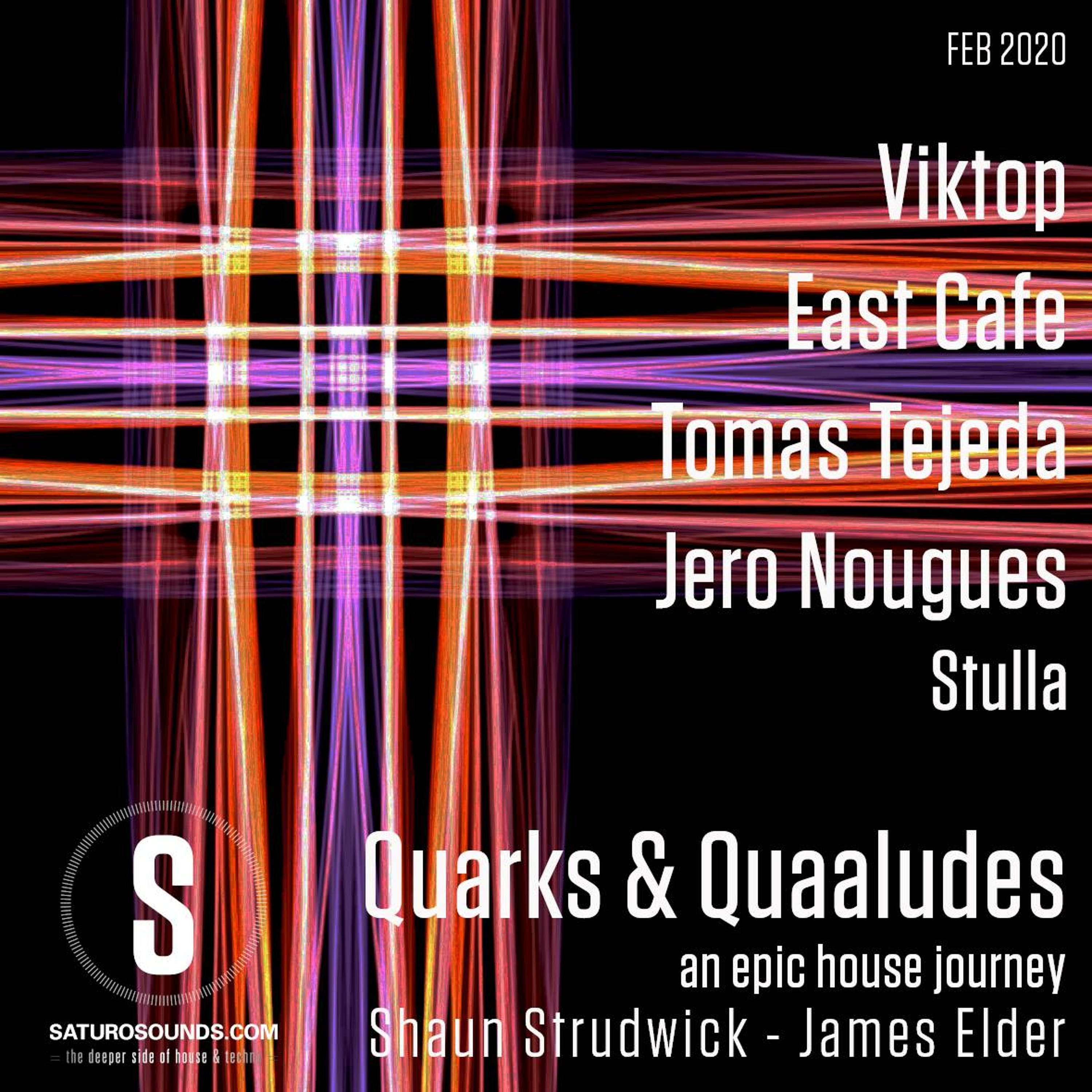
Q&Q Feb 2020 - James Elder

Q&Q resident DJ James Elder in the mix - sublime …

An episode of the Quarks & Quaaludes #EpicHouseJourney podcast, hosted by Quarks & Quaaludes @ Saturo Sounds Radio, titled "Q&Q Feb 2020 - James Elder" was published on February 23, 2020 and runs 66 minutes.

February 23, 2020 ·66m · Quarks & Quaaludes #EpicHouseJourney

0:00 / 0:00

Q&Q resident DJ James Elder in the mix - sublime track selection and transitions guaranteed 🔥

Q&Q resident DJ James Elder in the mix - sublime track selection and transitions guaranteed 🔥
Allein gegen den Wind

Apr 22, 2026 ·39m

Die Macht der Stimme

Nov 19, 2013 ·44m

Die Roboter kommen

Nov 12, 2013 ·43m

Leben mit Glasknochen

Nov 5, 2013 ·41m

24 Quarks Seconde Nicolas Petsilas, Marie-Louise Gariepy Passionné de cinéma de science-fiction? Découvrez 24 Quarks Seconde. Au menu: spleen dans l’espace-temps, opéra spatial rococo, uchronie nippone sanguinolente, péril dans les mondes virtuels, panoramas post apocalyptiques et autres délires futuristes! Suivez-nous aussi sur Facebook ou Twitter! Quarks Daily Quarks Deine Themen wissenschaftlich geprüft: Es gibt so viele Fragen, die auf eine Antwort warten, und so viele Entscheidungen, die zu treffen sind. Quarks hilft dir, dich gut zu orientieren. Auf Basis wissenschaftlicher Expertise und Studien. Und wir schauen nach guten Ideen für nachhaltige Lösungen. Quarks – gemacht mit Hirn, Herz und deinem Rundfunkbeitrag! Quarks – Mal angenommen Was wäre, wenn…? Was passiert, wenn wir als Gesellschaft etwas grundlegend ändern oder weitermachen wie geplant? Statt Horror-Szenarien und Traumschlösser erfährst Du hier faktenbasiert, wie Deine Zukunft aussehen könnte. Richard Taylor Richard Taylor shared the 1990 Nobel Prize in Physics with his colleague Jerome Friedman for a series of experiments proving demonstrating that protons, neutrons, and the other elementary particles of the atom are in turn composed of smaller entities, known as quarks. Born in the town of Medicine Hat, in Alberta, Canada, Taylor earned his bachelor's and master's degrees at the University of Alberta in Edmonton, and his Ph.D. at Stanford, where he joined the High Energy Physics Laboratory. From its inception, he was involved in the design and construction of the Stanford Linear Accelerator Center (SLAC). The experiments run at SLAC in the late 1960s and early '70s involved scattering high-energy beams of electrons from protons and deuterons and heavier nucleii. The results provided the first experimental evidence that the protons and neutrons were made up of point-like particles, later identified to be the up-and-down quarks that had previously been proposed on theoretical grounds. The
URL copied to clipboard!