
EPISODE · Feb 4, 2026 · 15 MIN
Quantum Fermentation: Exploring Sub-Atomic Interactions for Enhanced Yield
from Biomanufacturing & Fermentation Technology · host prasad ernala
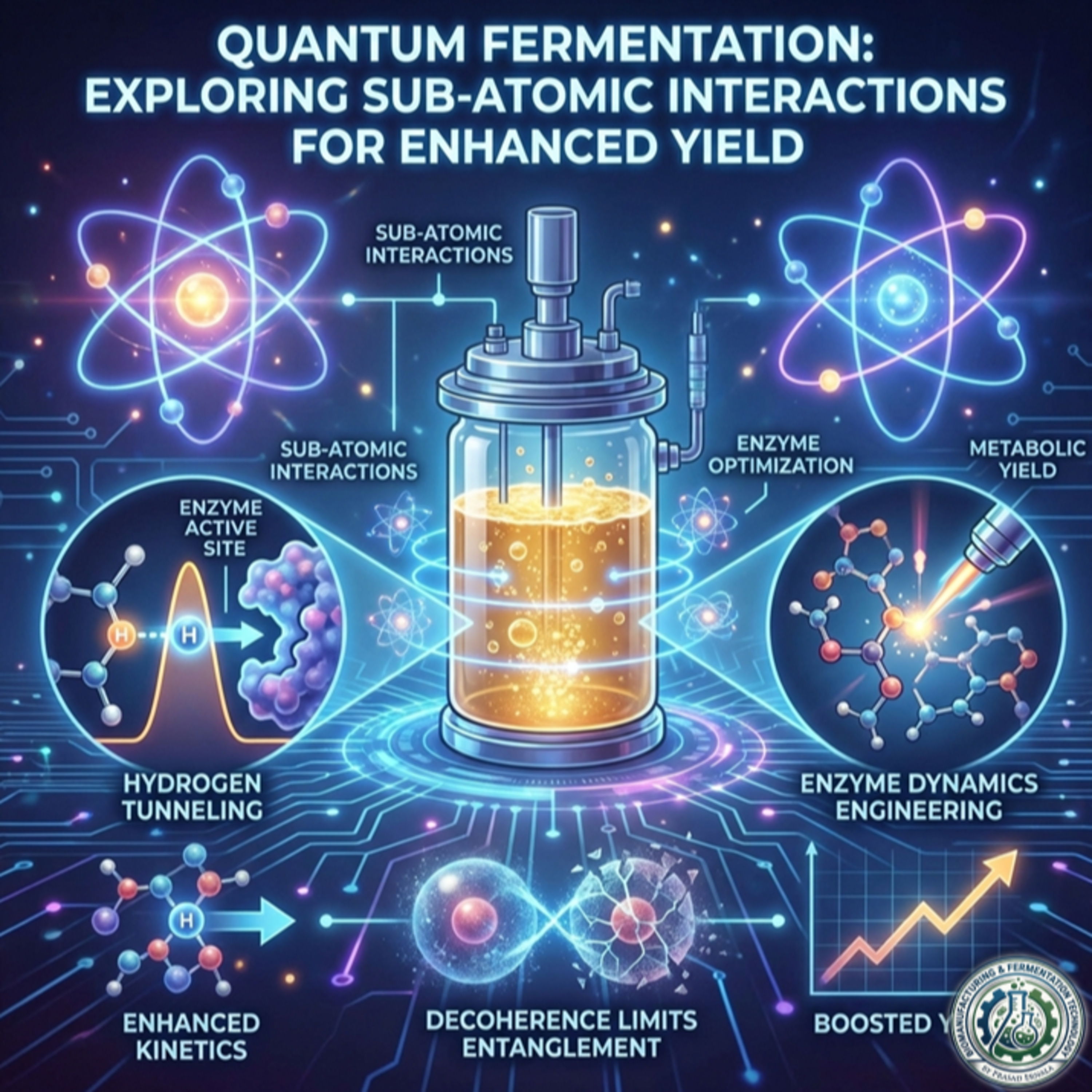
The most credible “quantum lever” in fermentation is not macroscopic entanglement across cells; it is the possibility that some rate‑limiting metabolic steps already rely partly on quantum tunneling of hydrogen, and that enzymes modulate tunneling through protein dynamics and active-site geometry. This implies a nontrivial proposition: for specific steps, improving yield may require engineering not only binding and classical transition-state stabilization, but also the barrier width and donor–acceptor distance distribution that controls tunneling probability. Reviews linking hydrogen tunneling to protein dynamics make precisely this point: a successful treatment of H‑tunneling requires multidimensional models that include environmental/protein motions, rather than a purely static barrier picture.The constraint is equally important:even if tunneling enhances a specific enzyme step, fermentation yield is a systems property, and local kinetic gains will translate into yield only when pathway control structure and cellular constraints permit that gain to propagate to net production.#Bioprocess #ScaleUp and #TechTransfer,#Industrial #Microbiology,#MetabolicEngineering and #SystemsBiology,#Bioprocessing,#MicrobialFermentation,#Bio-manufacturing,#Industrial #Biotechnology,#Fermentation Engineering,#ProcessDevelopment,#Microbiology,#Biochemistry,#Biochemical Engineering, #Applied #MicrobialPhysiology, #Microbial #ProcessEngineering, #Upstream #BioprocessDevelopment, #Downstream Processing and #Purification,#CellCulture and #MicrobialSystems Engineering, #Bioreaction #Enzymes, #Biocatalyst #scientific #Scientist #Research
What this episode covers
The most credible “quantum lever” in fermentation is not macroscopic entanglement across cells; it is the possibility that some rate‑limiting metabolic steps already rely partly on quantum tunneling of hydrogen, and that enzymes modulate tunneling through protein dynamics and active-site geometry. This implies a nontrivial proposition: for specific steps, improving yield may require engineering not only binding and classical transition-state stabilization, but also the barrier width and donor–acceptor distance distribution that controls tunneling probability. Reviews linking hydrogen tunneling to protein dynamics make precisely this point: a successful treatment of H‑tunneling requires multidimensional models that include environmental/protein motions, rather than a purely static barrier picture.The constraint is equally important:even if tunneling enhances a specific enzyme step, fermentation yield is a systems property, and local kinetic gains will translate into yield only when pathway control structure and cellular constraints permit that gain to propagate to net production.#Bioprocess #ScaleUp and #TechTransfer,#Industrial #Microbiology,#MetabolicEngineering and #SystemsBiology,#Bioprocessing,#MicrobialFermentation,#Bio-manufacturing,#Industrial #Biotechnology,#Fermentation Engineering,#ProcessDevelopment,#Microbiology,#Biochemistry,#Biochemical Engineering, #Applied #MicrobialPhysiology, #Microbial #ProcessEngineering, #Upstream #BioprocessDevelopment, #Downstream Processing and #Purification,#CellCulture and #MicrobialSystems Engineering, #Bioreaction #Enzymes, #Biocatalyst #scientific #Scientist #Research
NOW PLAYING
Quantum Fermentation: Exploring Sub-Atomic Interactions for Enhanced Yield
No transcript for this episode yet
Similar Episodes
Apr 21, 2026 ·13m
Apr 19, 2026 ·16m
Apr 17, 2026 ·13m
Apr 13, 2026 ·11m
Apr 11, 2026 ·16m