
EPISODE · May 11, 2026 · 18 MIN
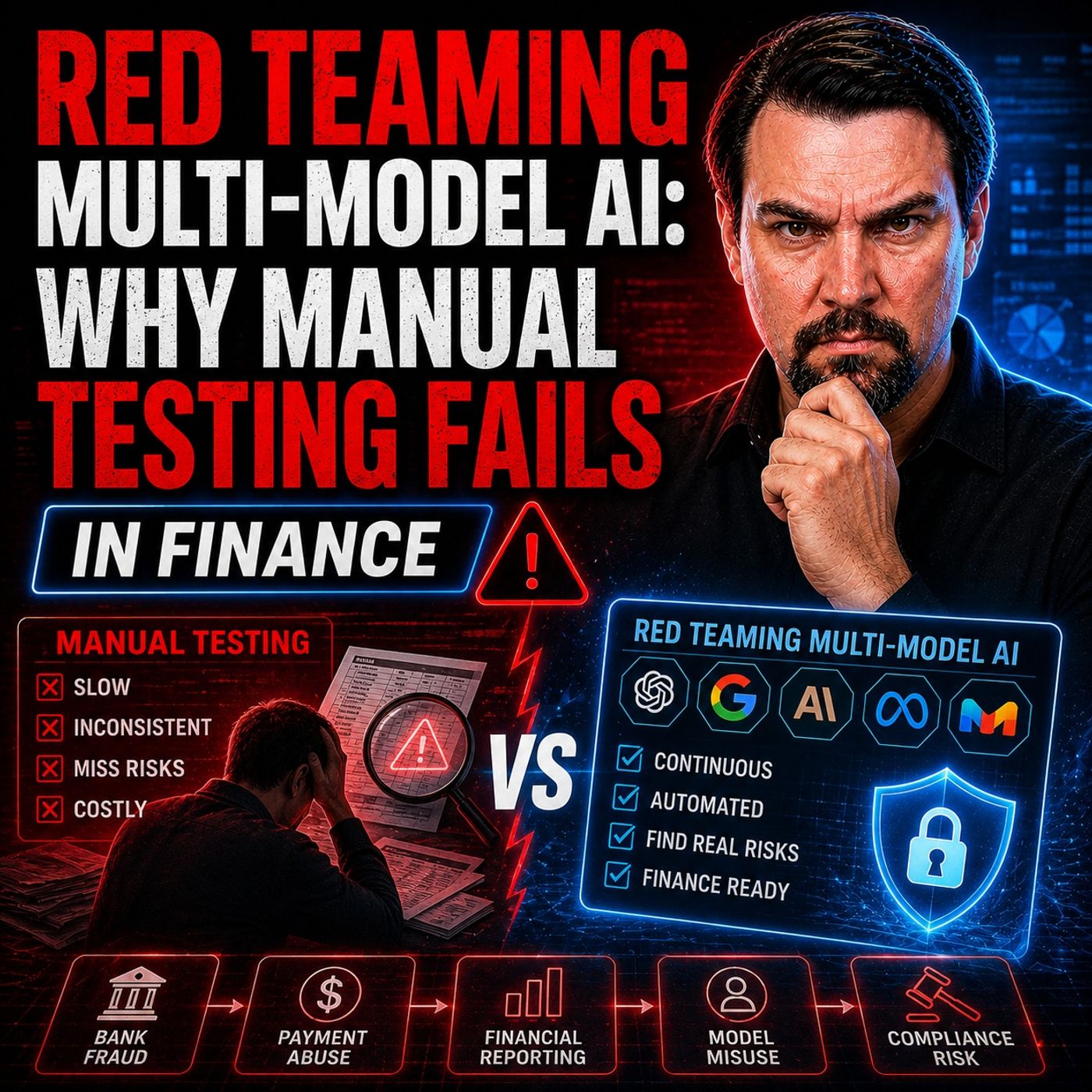
Red Teaming Multi-Model AI: Why Manual Testing Fails in Finance
from M365.FM - Modern work, security, and productivity with Microsoft 365 · host Mirko Peters - Founder of m365.fm, m365.show and m365con.net
In this powerful and deeply technical episode of the m365.fm podcast, Mirko Peters explores one of the most urgent and misunderstood threats in enterprise AI today: the collapse of traditional security models in the age of autonomous agents, multi-model AI systems, and adversarial finance attacks. Financial institutions are rapidly deploying AI agents for fraud detection, compliance automation, ACH monitoring, customer onboarding, payment authorization, analytics, and decision intelligence. But while organizations are racing toward automation, very few are prepared for the adversarial reality that comes with autonomous AI systems operating inside critical financial workflows. This episode goes far beyond generic AI discussions. Instead, it delivers a practical and highly detailed breakdown of how prompt injections, poisoned RAG pipelines, cross-model vulnerabilities, shadow AI, and agentic workflow manipulation are already creating massive enterprise risks that most organizations cannot even detect today. The era of “checklist security” is over. And according to this episode, the institutions still relying on manual testing and traditional governance models are already behind.THE $250,000 BLIND SPOT: HOW A SINGLE PROMPT INJECTION CAN BYPASS YOUR ENTIRE SECURITY STACK The episode opens with a chilling scenario that perfectly captures the new AI threat landscape inside modern finance. Imagine a single multi-turn prompt injection bypassing your AI security controls and authorizing a fraudulent six-figure wire transfer without triggering any traditional alerts. This is no longer science fiction. The discussion explains how modern adversarial attacks are no longer targeting firewalls, servers, or infrastructure directly. Instead, attackers are targeting the reasoning logic of AI systems themselves. Legacy security systems were built for deterministic software and static data environments. But autonomous AI agents operate differently. They reason. They interpret. They retrieve context. And that creates entirely new attack surfaces that traditional cybersecurity models were never designed to defend. The episode explores how financial institutions are unknowingly exposing themselves to:Multi-turn prompt injectionsHidden instruction attacksRoleplay-based manipulationContext poisoningRetrieval-Augmented Generation (RAG) exploitsMulti-modal injection attacksSemantic manipulation of AI reasoning systemsThe conversation also highlights the terrifying reality that many future financial breaches may not involve “hacking” in the traditional sense at all. Instead, attackers are increasingly manipulating the context and decision-making logic of AI systems directly.THE IDENTITY CRISIS OF AUTONOMOUS AGENTS: WHY MOST ORGANIZATIONS HAVE NO IDEA WHO OWNS THEIR AI One of the most important themes throughout the episode is the growing identity crisis surrounding enterprise AI agents. Organizations are deploying autonomous systems everywhere:Fraud monitoring agentsCompliance automation workflowsPayment approval systemsAI copilotsBanking assistantsInternal workflow automation agentsCustomer service AI systemsBut almost nobody is thinking seriously about accountability. The episode reveals a shocking statistic: Only 28% of organizations can reliably trace an AI agent’s action back to a specific human sponsor. That means most enterprises cannot properly explain:Who approved the logicWho authorized the workflowWho owns the model behaviorWho is responsible for the AI decisionWhy the system acted the way it didThis becomes especially dangerous in regulated financial environments where AI agents are increasingly making decisions involving money movement, payment approvals, customer risk scoring, and operational automation. The discussion explains how Shadow AI is massively accelerating the problem. Employees are now building their own autonomous workflows, AI agents, copilots, and automation pipelines without central oversight. These systems often receive:API accessDatabase connectivityCustomer information accessInternal application permissionsSensitive financial data exposureAnd in many cases, security teams don’t even know these agents exist. The episode argues that enterprises must stop treating agents like simple software tools and instead begin treating them as autonomous digital identities requiring full governance, traceability, and sponsor accountability.THE CROSS-MODEL INFECTION PATTERN: HOW AI MODELS ARE NOW POISONING EACH OTHER One of the most fascinating and alarming sections of the episode focuses on the emergence of cross-model infection patterns inside modern AI ecosystems. For years, organizations assumed that using multiple AI models from different providers created natural security diversity. The assumption was simple: If one model failed, the others would catch the issue. But according to the discussion, recent research is showing the exact opposite. The episode explains how vulnerabilities, biases, adversarial logic traps, and insecure reasoning patterns can now propagate between multiple AI models operating inside the same workflow chain. The conversation dives into:Cross-model contaminationShared transformer vulnerabilitiesSemantic infection propagationPoisoned embeddingsAdversarial hubnessMulti-model reasoning failuresAI supply-chain riskA particularly disturbing example involves poisoned RAG systems. The episode explains how attackers can inject malicious documents into vector databases, causing autonomous agents to retrieve manipulated instructions during financial workflows. Because multiple models often share similar architectural assumptions and training behaviors, they can reinforce each other’s mistakes rather than detecting them. This creates what the episode describes as: “AI systems talking each other into authorizing fraud.” The discussion highlights how attackers are increasingly targeting the reasoning layer itself rather than attacking traditional infrastructure. And because these attacks exploit semantics rather than code vulnerabilities, traditional penetration testing often fails to detect them entirely. Become a supporter of this podcast: https://www.spreaker.com/podcast/m365-fm-modern-work-security-and-productivity-with-microsoft-365--6704921/support.
Embed this episode
What this episode covers
In this powerful and deeply technical episode of the m365.fm podcast, Mirko Peters explores one of the most urgent and misunderstood threats in enterprise AI today: the collapse of traditional security models in the age of autonomous agents, multi-model AI systems, and adversarial finance attacks. Financial institutions are rapidly deploying AI agents for fraud detection, compliance automation, ACH monitoring, customer onboarding, payment authorization, analytics, and decision intelligence. But while organizations are racing toward automation, very few are prepared for the adversarial reality that comes with autonomous AI systems operating inside critical financial workflows. This episode goes far beyond generic AI discussions. Instead, it delivers a practical and highly detailed breakdown of how prompt injections, poisoned RAG pipelines, cross-model vulnerabilities, shadow AI, and agentic workflow manipulation are already creating massive enterprise risks that most organizations cannot even detect today. The era of “checklist security” is over. And according to this episode, the institutions still relying on manual testing and traditional governance models are already behind. THE $250,000 BLIND SPOT: HOW A SINGLE PROMPT INJECTION CAN BYPASS YOUR ENTIRE SECURITY STACK The episode opens with a chilling scenario that perfectly captures the new AI threat landscape inside modern finance. Imagine a single multi-turn prompt injection bypassing your AI security controls and authorizing a fraudulent six-figure wire transfer without triggering any traditional alerts. This is no longer science fiction. The discussion explains how modern adversarial attacks are no longer targeting firewalls, servers, or infrastructure directly. Instead, attackers are targeting the reasoning logic of AI systems themselves. Legacy security systems were built for deterministic software and static data environments. But autonomous AI agents operate differently. They reason. They interpret. They retrieve context. And that creates entirely new attack surfaces that traditional cybersecurity models were never designed to defend. The episode explores how financial institutions are unknowingly exposing themselves to: Multi-turn prompt injections Hidden instruction attacks Roleplay-based manipulation Context poisoning Retrieval-Augmented Generation (RAG) exploits Multi-modal injection attacks Semantic manipulation of AI reasoning systems The conversation also highlights the terrifying reality that many future financial breaches may not involve “hacking” in the traditional sense at all. Instead, attackers are increasingly manipulating the context and decision-making logic of AI systems directly. THE IDENTITY CRISIS OF AUTONOMOUS AGENTS: WHY MOST ORGANIZATIONS HAVE NO IDEA WHO OWNS THEIR AI One of the most important themes throughout the episode is the growing identity crisis surrounding enterprise AI agents. Organizations are deploying autonomous systems everywhere: Fraud monitoring agents Compliance automation workflows Payment approval systems AI copilots Banking assistants Internal workflow automation agents Customer service AI systems But almost nobody is thinking seriously about accountability. The episode reveals a shocking statistic: Only 28% of organizations can reliably trace an AI agent’s action back to a specific human sponsor. That means most enterprises cannot properly explain: Who approved the logic Who authorized the workflow Who owns the model behavior Who is responsible for the AI decision Why the system acted the way it did This becomes especially dangerous in regulated financial environments where AI agents are increasingly making decisions involving money movement, payment approvals, customer...
NOW PLAYING
Red Teaming Multi-Model AI: Why Manual Testing Fails in Finance
No transcript for this episode yet
Similar Episodes
Oct 3, 2025 ·19m
Similar Podcasts
No similar podcasts found.