
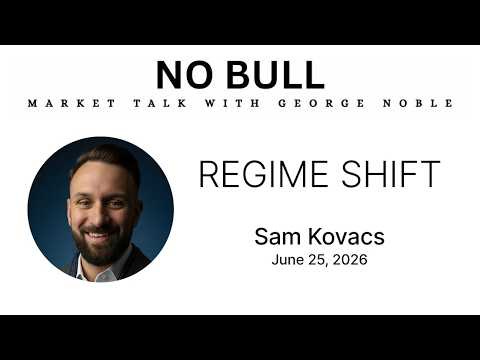
EPISODE · Jun 26, 2026 · 51 MIN
Regime Shift | Sam Kovacs
from The Noble Update Podcast · host George Noble
1. Strategic Actions and Decisions* Transitioning from tactical trades to a regime framework: Evaluate currency debasement as a long-term economic regime rather than a short-term trading event to protect 10- to 20-year portfolio values. [03:15]* Targeting supply-constrained assets: Focus asset allocation strategies on structural choke points with inelastic supply and long-term demand, such as U.S. utilities or memory production. [13:14]* Monitoring aviation supply chains: Identify investment positions in aerospace part manufacturers, such as TransDigm (TDG), to capitalize on multi-year aircraft delivery backlogs and aging commercial fleets. [21:55]* Locking in cyclical margin structures: Capture revenue stability during high-demand commodity phases by negotiating long-term take-or-pay contracts with structural price floors. [26:18]* Mitigating downstream tech bubble risks: Reduce exposure to early-stage generative AI infrastructure and model providers, scaling back holdings in highly valued hardware or chip firms. [41:44]2. Executive SummaryThis briefing examines the structural shift from a globalized market toward a fractured, multipolar financial regime defined by currency debasement and rising fiscal debt. Short-term volatility in gold and semiconductors highlights the necessity of shifting from speculative momentum trades to value-driven, supply-constrained assets. While secular technologies like artificial intelligence will achieve long-term economic returns, current corporate infrastructure spend mirrors past historical bubbles, risking near-term demand destruction. Leadership should prioritize capital allocation toward sectors controlling rigid, regulated, or physical choke points—such as aerospace maintenance and independent utilities—that command sustained pricing power through upcoming macro-economic volatility.3. Key Takeaways and Practical LessonsKey Takeaways and Practical Lessons* The Nature of Debasement: Currency debasement is a permanent structural regime driven by state fiscal deficits and slowing productivity, not a brief financial media narrative.* Transition defensive allocations away from nominal cash reserves and toward assets with verified physical or geological scarcity.* Identifying Structural Moats: True commercial moats exist at physical or regulatory choke points where immediate supply cannot scale to meet surging demand.* Screen capital investments for industries with severe entry barriers, such as a 2-to-3-year manufacturing lag time or rigid regulatory frameworks.* Exploiting Supply Chain Backlogs: Delays in primary equipment manufacturing shift high-margin demand toward maintenance, repair, and replacement components.* Allocate capital to downstream suppliers that provide mission-critical parts to captive consumers who face steep daily costs for operational downtime.* Navigating Cyclical Tech Cycles: Broad secular adoption of a new technology does not protect early infrastructure investors from severe overbuilding and subsequent valuation corrections.* Implement trailing stop-losses or technical moving-average rules to systematically harvest profits from vertical, narrative-driven momentum positions.* Evaluating Capital Returns: Early corporate IT and technology spend often fails to generate immediate yield when bolted onto legacy, human-centric workflows.* Audit corporate AI and technology deployments against a first-principles, AI-first operational architecture rather than treating software as a superficial add-on.Follow Sam on X: @SamKovXSam’s website: https://sam-kovacs.com/Watch on Youtube: This is a public episode. If you'd like to discuss this with other subscribers or get access to bonus episodes, visit georgenoble.substack.com/subscribe
Embed this episode
Ready to play
Regime Shift | Sam Kovacs
No transcript for this episode yet
Similar Episodes
No similar episodes found.
Similar Podcasts
No similar podcasts found.