
EPISODE · Mar 11, 2026 · 42 MIN
Rethinking Care for Older Adults With Jugdeep Dhesi
from Leadership & culture in healthcare · host Jugdeep Dhesi, Matthew winn
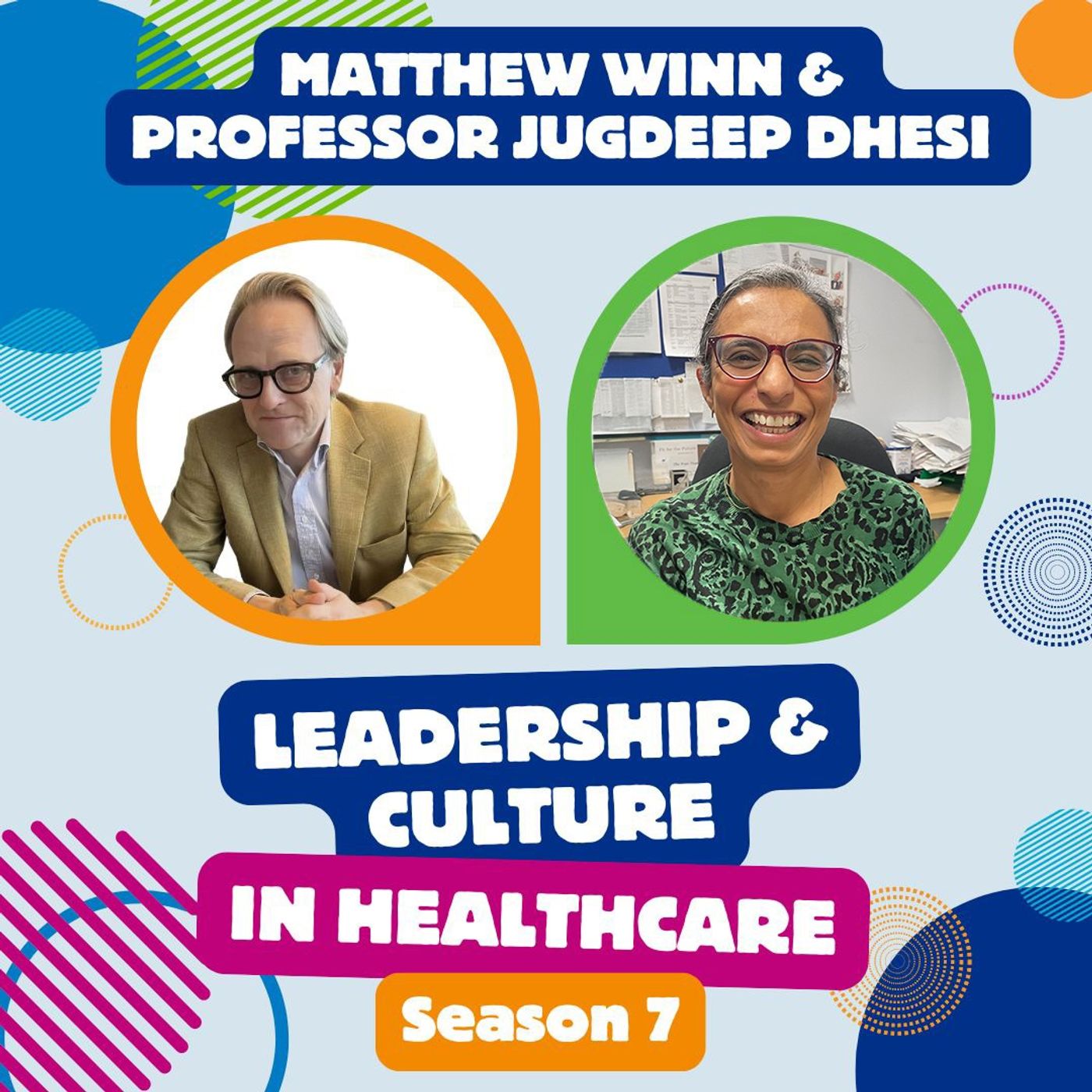
In this episode of series 7 of Leadership and Culture in Healthcare, Matthew Winn is joined by Professor Jugdeep Dhesi, Consultant Geriatrician at Guy’s and St Thomas’ NHS Foundation Trust, Professor of Geriatric Medicine at King’s College London, and President of the British Geriatrics Society (BGS). The conversation explores clinical leadership through the lens of geriatric medicine, examining how credible clinical voices can shape policy, influence system design, and advocate for better care for older people at a time of profound demographic and service pressure.Professor Dhesi begins by reflecting on her personal and professional journey into geriatric medicine. Raised in Essex by first-generation immigrant parents, she trained in Leicester before initially considering careers in neurology or endocrinology. A period of time away from training proved pivotal, allowing her to step back and reflect on what she valued most in medicine. This led to a clear realisation that her interests lay in whole-person care, multimorbidity, polypharmacy, and the interface between physical health, mental health, and social care—core principles of geriatric medicine. This insight prompted a move to London to train in a unit with strong clinical and academic pedigree, laying the foundation for her later leadership roles.The discussion then turns to Professor Dhesi’s role as President of the British Geriatrics Society. She describes the BGS as one of the UK’s largest medical specialty associations, with a multidisciplinary membership across the four nations, united by a single mission: improving healthcare for older people. As President, her role extends far beyond ceremonial responsibilities. It involves setting strategic direction, working closely with vice presidents responsible for policy, workforce, education, clinical quality, and research, and motivating clinicians who undertake national leadership roles on a voluntary basis alongside demanding clinical jobs. Central to her leadership is maintaining focus on the needs of older people amid an increasingly complex and pressured health and social care landscape.Professor Dhesi reflects on the long-recognised but insufficiently acted-upon challenge of population ageing. Despite decades of warnings, health systems remain largely organised around single organs or conditions, rather than around the needs of the population that uses healthcare most—older people living with frailty and multiple long-term conditions. She discusses how geriatric medicine has historically struggled to be heard at national policy tables, and how the COVID-19 pandemic acted as a catalyst for the specialty to step forward and assert its voice. Through sustained advocacy, evidence generation, and collaboration, she describes how the BGS has increasingly influenced national conversations about service design, workforce planning, and value-based care.A significant part of the episode focuses on Professor Dhesi’s work in perioperative care and the development of the POPS (Perioperative care for Older People undergoing Surgery) model. Drawing on her experience as a medical registrar witnessing preventable complications on surgical wards, she explains how better pre-operative assessment, optimisation, and shared decision-making can transform outcomes for older patients. She emphasises the importance of embedding research alongside clinical innovation, enabling services to demonstrate both clinical and cost effectiveness. Evidence from POPS programmes shows that when geriatricians, surgeons, and anaesthetists work together, a substantial proportion of patients choose not to proceed with surgery because it does not align with their goals or offer meaningful benefit—an outcome that reflects better, more personalised care.The conversation then turns to shared decision-making, realistic choice, and the ethical responsibility to support patients in choosing not to pursue interventions when the risks outweigh the benefits. Professor Dhesi highlights that “doing nothing” can sometimes be the most appropriate and compassionate option, particularly later in life. She argues that these conversations, while often described as difficult, are essential and require honesty, clarity, and strong clinical leadership.Looking to the future, Professor Dhesi expresses cautious optimism. She sees opportunity in the emerging long-term planning agenda for the NHS and in a renewed willingness to rethink how care is delivered. She stresses the importance of clinical leaders who retain credibility through ongoing practice, bringing frontline experience into national decision-making. She also speaks passionately about diversity, inclusion, and the need to support leadership development for people from different socio-economic, cultural, and geographical backgrounds, ensuring that national leadership does not become London-centric.The episode concludes with a powerful call to action around public awareness and advocacy for older people. Professor Dhesi challenges the accepted norm that older people often lack a dedicated specialist overseeing their care, arguing that just as children expect paediatric leadership, older people deserve coordinated, specialist-led care—delivered by the most appropriate professional within a multidisciplinary team. As she approaches the end of her tenure as President of the BGS, she reflects on the Society’s growing visibility, influence, and membership, and her confidence that geriatric medicine will continue to play a central role in shaping a more person-centred, integrated, and sustainable healthcare system.Quotes from the episode:Clinical Leadership & Influence • “It’s very much giving direction for the overall team, ensuring that we are delivering against our vision and our strategy, but also trying to inspire and motivate people during very challenging times.” • “You have to have credibility as a clinician back at your home base—it gives you the platform to speak with authority when influencing change nationally.” • “Clinical leaders need to bring shop floor experience into decision-making; that’s how we make policy meaningful and effective.”Journey into Geriatric Medicine • “I realised I liked looking at the whole person, managing multiple long-term conditions, polypharmacy, and the interface between physical and mental health—not just a single condition. That led me to geriatric medicine.” • “Having a bit of distance from training gave me the opportunity to reflect on what I really enjoyed about medicine—it was a real epiphany.”Advocacy for Older People • “We often organise healthcare around organs or conditions, not around the needs of the biggest users of healthcare—older people. That has to change.” • “Just as we expect children to have a paediatrician overseeing their care, older people deserve coordinated, specialist-led care. That’s what we’re championing.” • “Part of my role is making sure the issues facing older people are heard and informing how services and the workforce develop for the future.”Shared Decision-Making & Patient Choice • “Sometimes ‘doing nothing’ is the right thing. Supporting patients to make realistic choices about their care is essential, especially later in life.” • “One in four patients on the POPS model decide not to go ahead with surgery because it won’t deliver what matters to them. That’s not failure—that’s better, personalised care.” • “We need honest conversations about realistic choice versus patient choice. Not everything can be solved with intervention, and that’s okay.”Optimism & Future of Healthcare • “I’m generally an optimistic person. Despite challenges, we have opportunities with the 10-year plan and a resetting of the healthcare landscape.” • “We’re seeing people with imagination looking at new ways of doing things, not stuck in old patterns. That’s encouraging.” • “Diversity and inclusion in leadership is essential. People from different backgrounds and regions should have the chance to lead and shape care.” Matthew Winn, podcast host and an experienced leader in healthcare in the UK.
Embed this episode
What this episode covers
Professor Jugdeep Dhesi, President of the British Geriatrics Society, discusses the power of clinical leadership, the future of care for older people, and how evidence, shared decision-making, and compassionate innovation are transforming healthcare. From her journey into geriatric medicine to shaping national policy and driving integrated care, Professor Dhesi shares insights on leading change, challenging ageism, and putting patients at the heart of every decision.
Ready to play
Rethinking Care for Older Adults With Jugdeep Dhesi
No transcript for this episode yet
Similar Episodes
Similar Podcasts
No similar podcasts found.