
EPISODE · Feb 5, 2026 · 19 MIN
Risk Allocation in Industrial Microbial Biomass Separation
from Biomanufacturing & Fermentation Technology · host prasad ernala
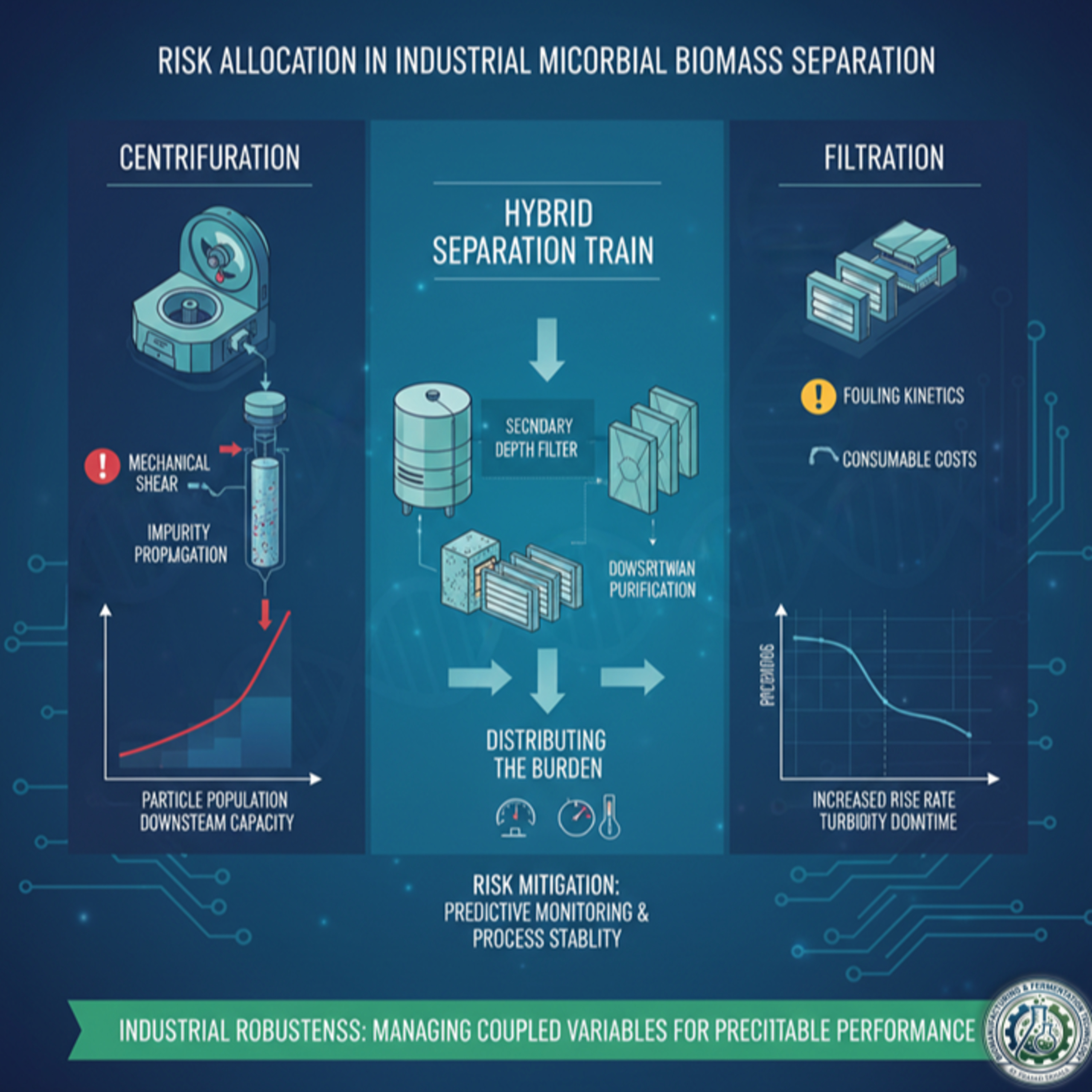
The primary focus of this episode is to explore a framework for managing biomass separation in industrial microbial manufacturing, framing it as a strategic exercise in risk allocation rather than simple efficiency maximization. It evaluates the physical and economic trade-offs between centrifugation, which carries risks related to mechanical shear and impurity propagation, and filtration, which is bounded by fouling kinetics and consumable costs. The discussion emphasize that industrial robustness is determined by coupled variables like particle population dynamics and hydrodynamics, where failures often manifest as reduced downstream capacity or increased downtime. To mitigate these risks, the text advocates for hybrid separation trains that distribute the burden of clarifying complex broths across multiple stages to ensure process stability. Ultimately, the documentation suggests using predictive monitoring, such as tracking pressure rise rates and turbidity slopes, to maintain predictable performance across large-scale production campaigns.#Bioprocess #ScaleUp and #TechTransfer,#Industrial #Microbiology,#MetabolicEngineering and #SystemsBiology,#Bioprocessing, #MicrobialFermentation, #Bio-manufacturing, #Industrial #Biotechnology, #Fermentation Engineering, #ProcessDevelopment,#Microbiology, #Biochemistry#Biochemical Engineering,#Applied #MicrobialPhysiology,#Microbial #ProcessEngineering,#Upstream #BioprocessDevelopment,#Downstream Processing and #Purification,#CellCulture and #MicrobialSystems Engineering,#Bioreaction #Enzymes #Biocatalyst #scientific#Scientist#Research
What this episode covers
The primary focus of this episode is to explore a framework for managing biomass separation in industrial microbial manufacturing, framing it as a strategic exercise in risk allocation rather than simple efficiency maximization. It evaluates the physical and economic trade-offs between centrifugation, which carries risks related to mechanical shear and impurity propagation, and filtration, which is bounded by fouling kinetics and consumable costs. The discussion emphasize that industrial robustness is determined by coupled variables like particle population dynamics and hydrodynamics, where failures often manifest as reduced downstream capacity or increased downtime. To mitigate these risks, the text advocates for hybrid separation trains that distribute the burden of clarifying complex broths across multiple stages to ensure process stability. Ultimately, the documentation suggests using predictive monitoring, such as tracking pressure rise rates and turbidity slopes, to maintain predictable performance across large-scale production campaigns.#Bioprocess #ScaleUp and #TechTransfer,#Industrial #Microbiology,#MetabolicEngineering and #SystemsBiology,#Bioprocessing, #MicrobialFermentation, #Bio-manufacturing, #Industrial #Biotechnology, #Fermentation Engineering, #ProcessDevelopment,#Microbiology, #Biochemistry#Biochemical Engineering,#Applied #MicrobialPhysiology,#Microbial #ProcessEngineering,#Upstream #BioprocessDevelopment,#Downstream Processing and #Purification,#CellCulture and #MicrobialSystems Engineering,#Bioreaction #Enzymes #Biocatalyst #scientific#Scientist#Research
NOW PLAYING
Risk Allocation in Industrial Microbial Biomass Separation
No transcript for this episode yet
Similar Episodes
Apr 21, 2026 ·13m
Apr 19, 2026 ·16m
Apr 17, 2026 ·13m
Apr 13, 2026 ·11m
Apr 11, 2026 ·16m