
EPISODE · Jun 12, 2026 · 42 MIN
S1 Ep 2: The Noble Profession, Part 1
from Classical Guitar Dispatch · host Classical Guitar Dispatch
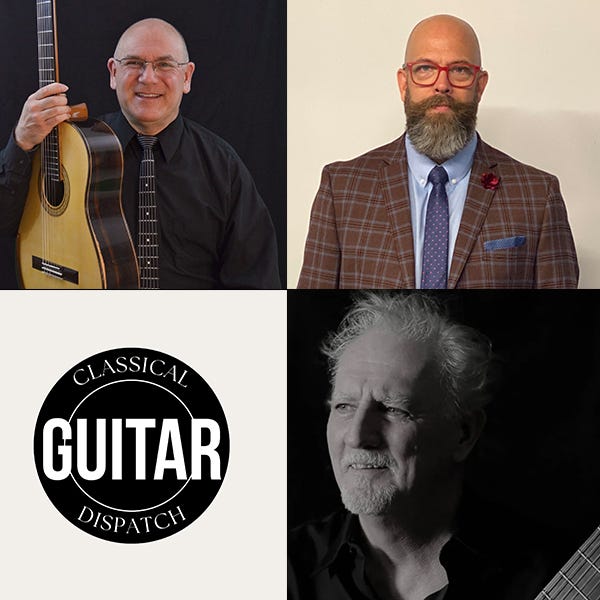
THEMEToday’s Dispatch comes from the teaching studio. I’ve occupied a number of them over a 25-year span, ranging in aesthetic appeal from a dingy backroom owned by a guy who won the lottery and spent his winnings mismanaging a guitar shop to the vestibule of a 17th-century cathedral.Most of the musical personalities I admire also occupied teaching studios, from Bach to Beethoven to Aaron Copland. A number of the direct influences on this podcast were also educators, such as Carl Sagan and Leonard Bernstein, and though they weren’t associated with any particular institution, I consider Anthony Bourdain and Julia Child to be among the great educators of the television age.The guitar’s history is rife with great teachers, such as the 19th-century icons Fernando Sor and Mauro Giuliani, and the 20th-century pioneers like Andres Segovia and Aaron Searer, whose efforts helped pave the way for the instrument’s inclusion in conservatories and universities.With all this vaunted pedagogical history, it’s tempting to see the teaching profession as providing the essential springboard for greatness in the lives and careers of the artists I mentioned. But a casual read-through of the historical materials left behind by various composers and performers provides a more nuanced view. Beethoven, in particular, had a thorny relationship with teaching. His letters indicate that he would clearly have preferred to spend his days creating, but teaching helped him pay the bills. And it seems he had a lot of bills.I frequently hear the phrase “teaching is a noble profession,” and my thoughts reflexively turn to a friend of mine whose student brought an incontinent goat to a lesson at a university campus. I wonder if my friend felt noble as he spread a layer of paper towels on the studio carpet and fogged the room with Febreze in an unsuccessful attempt to mitigate the remnants of that encounter. Considering I most often hear that phrase from those who left the classroom to climb the income ladder and become administrators, it seems to me a more accurate amendment to that phrase would be “teaching is a profession.”VARIATION I: KEVIN VIGILThe first stop on our educator tour brings us to one of the success stories in the contemporary teaching racket. If you’ve ever sat through a school board meeting, you’re aware that cost-cutting measures are a perennial topic. While middle and high school band and orchestra programs are generally expensive, savvy administrators figured out a while ago that guitar programs are comparably cheap to build and maintain. Buy a couple of dozen Yamaha C-40s, hire one of the many fresh-faced graduates from a reputable doctoral program, guide the new hire through a certification process, and in many cases, you find yourself with an if-you-build-it-they-will-come situation. Add a bit of can-do attitude and a sprinkling of advocacy to the mix, and you get…you know what? I’ll just let him introduce himself:“Well, uh, my name is Kevin Vigil. I have been teaching in the public school system for the last 21 years at Heritage High School in Loudoun County, Virginia. You know, I get paid to teach people how to play guitar.”To this day, many public high school music programs in the U.S. with a guitar component are taught by non-guitarists. The poor band or choir director gets assigned a guitar class and, of course, they try their best, but that Guitar Methods course from their undergrad was no match for a 15-year-old shredder who showed up with a Van Halen solo under their fingers. Loudoun County public schools happen to be just a stone’s throw away from several excellent conservatories. Those conservatories pump out guitarists with doctoral degrees at a much faster rate than colleges and universities produce the jobs those degrees are designed to fill. Loudoun County Public Schools saw a hiring opportunity, and for over 20 years, they’ve employed an impressive stable of guitar instructors, whose work, like Kevin’s, doesn’t stop at the classroom:“We do a lot of things outside of the building, right? So, we started the year playing for the Department of Education’s Board of Education. That was our first gig a week into the school year. We played for the State school board. We played for the Loudon County school board. We’ve played at Yale University many times; we just did Appalachian State’s festival this year. Reaching out like that, I think it’s kind of a form of advocacy, and I guess I’m just an advocate for the kids and for the programs.”That advocacy currently includes a turn as vice president of the Virginia Guitar Directors Association and chair of the National Association for Music Education’s Council for Guitar Education.“In terms of paying it forward, I just started seeing, year by year, seeing more and more what was going on. Not just in my district and other districts. And as I started working with organizations like the Virginia Music Educators Association, and NAfME, so many people that are teaching guitar that are not themselves guitarists. I found that there are so many needs that the profession needs. I just come into leadership roles that I found myself in. I said, OK well, if I’m in that spot, I might not know what to do, but I’m gonna do my best. I’m not afraid to be wrong about something. I need to learn from others. You need to learn from the band directors and the orchestra directors and the choral directors and all that stuff, right? You know, what’s going on well with them, and what can we bring to our system? I think everything that I’ve done is just been, it’s been inspired by trying to meet the needs of students at the end of the day.”In the process of meeting the needs of students, Kevin had to buy some polish for all those awards he’s been racking up. In 2014, he was named the Shenandoah University Teacher of the Year. He’s also the Joan C. Edwards Distinguished Professor in the Arts at Marshall University. The guy was even presented with a Sir Winston Churchill Commemorative Crown for music education, but good luck getting him to try it on:“When we do what we do, and we do it well, then it reflects and people recognize it. In the school culture, and in the school community, I don’t really like to talk about myself. I’d rather let my work speak for me, I guess would be a better way to put that. I don’t know if I’ve answered your question.”Sure you did, Dr. V.VARATION II: STANLEY YATESMoney and enrollment shape policy. Fortunately for this show, the higher education landscape is anything but monolithic. To account for their accounting, I’ve invited two people to share their varied experiences with institutions. We’ll start with the view from the mountaintop from a person who has, in his own way, aged out of the guitar-teaching industrial complex“Hey Matthew, Stanley Yates here. Thanks for your email and for thinking of me for your new podcast. Feel free to call me back at this number. I’m around all the time now, because I just retired. Uh…this week. Okay, bye.”Stanley Yates celebrated his final commencement just before we sat down for this chat. At that time, he had completed nearly all of his institutional obligations:“I got my full-time college position when I was in my mid-thirties here at Austin Peay State University, which was in 1994. I’m extremely grateful and fortunate to have gotten a position like this, and it’s been a 32-year tenure, which, once I turn my keys in on Wednesday, will be the end of my college institutional teaching life…and that’s about what I have to say about myself.”(laughs) Let’s hope that’s not entirely true. Before we hear more from Stanley, let’s take a beat to explore what he said about gratitude. Full-time academic jobs in Classical Guitar Performance are indeed extremely rare. Though things have picked up a bit since Baby Boomers started retiring, there are maybe two open position announcements per academic year, and that’s in an active hiring cycle. Austin Peay State University and its many competitors pump out guitar students with terminal degrees every year. When those newly minted guitar doctors start looking for work, they face stiff competition and, due to the slow-to-die tenure system, they also face a so-called “labor squeeze,” which is economist-speak for a low-hire, low-fire job market.VARIATION III. CHUCK HULIHAN“We’re rocking audio only, so I can look as stupid as I want. I can make funny faces and all, right, we’re good?” (laughs)Feel free to make as many faces as you want, Chuck. But we should probably make some introductions first:“My name is Chuck Hulihan, and I am currently in the greater Phoenix, Arizona area. I live in Peoria. I’ve taught since 1999 at one of our 10 Maricopa Community Colleges. Specifically, my campus is Glendale Community College, and I’ve served in various roles with the Guitar Foundation of America for the last decade. I currently serve as the Ensemble’s and Engagement Director, and if I had to label myself or sort of self-describe, I’m the Ensemble Guy.”Yup. Chuck is the Ensemble Guy. A fixture in the American guitar festival circuit who can swing a conductor’s baton while keeping a group of middle and high-schoolers on summer break focused, has premiered ensemble works by the who’s who of guitar composers, and does it all with a sartorial flair that somehow comes across through radio. But it didn’t happen by accident:“I believe a lot in manifestation and projection, and that’s something that’s always been really important to me: my imagination and thinking about intentional actions to move me closer to a reality that only currently existed in my mind. Pretty much everything I’ve ever done professionally has been very strategic and intentional, and it always has something to do with a foreseeable outcome that I’m either at the subconscious or very much at the conscious level attached to.”“It was only then that I realized you guys don’t all conduct. Like everyone here is, it’s like you’re not all in the guitar ensemble. No, it was just the normal studio of soloists who occasionally played in a duet or did some chamber music, but nobody conducted. Everyone found it odd, and that was probably my first light that really went off.This one room over here to the left is really busy. This room over here to the right looks wide open. The lights are on and the AC’s blowing, and I think I’m just going to go step over here.”So Chuck chose the room with air conditioning, which came in handy during summers in the greater Phoenix area. Chuck’s interest in guitar ensembles also came in handy when the high school guitar program phenomenon came to Arizona via a charter school mandate in 1996:“It was 1997 and that second year that I was offered a job at the Arizona School for the Arts, which was a performing arts charter school for arts and academics but their angle was they were hiring all professional musicians.”Great, so you get a job teaching guitar ensembles. You’re in the pink, right?“For me it became obvious that I needed to have materials that were high quality and that embraced a multitude of levels. I’m in 1997 so there’s not a lot of resources. We are before, like, way before all the great stuff that we have now in terms of ensemble methods, in terms of all these wonderful organizations. We are a century later in just a few decades, in my opinion.There were definitely other people out there doing it but I, sort of in Phoenix, felt a little bit like a one-man island.”Eventually, Chuck found people like Kevin Vigil who were working through some of the same issues. They fixed the repertoire problem by making arrangements, commissioning original pieces, and getting the stuff to print. They organized. They shared information. And when Chuck was hired at Glendale Community College, he took all that organization and repertoire, and applied it to his studio there. But, like Stanley Yates, Chuck recognizes that graduates of a guitar program need to understand the market they’re walking into:“There are far more opportunities in K-12 education at the moment than there are in college opportunities and that’s just being honest. If you need a job and you’ve got to keep a roof over your head and you’ve got to provide for a family, someone’s got to talk reality to you. The college jobs are really hard to come by, extremely competitive. You’re going to be able to teach all your heroes and they don’t all pay so well and most of them don’t have any long-term sustainability.I don’t even think intentionally but we are all just indoctrinated into thinking that is the only clear goal. If I’m going to teach I want it to be, I want it to be at Juilliard. That’s the only place to teach. Opportunities are far, far, far more wide open in K-12. That’s one thing I just have to say. Yes that’s not for everyone; doesn’t mean everyone shouldn’t even teach in the first place, never mind where you’re teaching. This is not for everyone. Period. End of story.”“It’s not for everyone” could have been the title of this episode. And I know I promised not to get too sentimental about the whole education grind, but I do this work too, and I know it’s hard. So I asked Chuck what he wished people understood about the work that he, Stanley, and Kevin already know about their profession:“Probably that the word “play”, like teaching people to play the guitar or the act of playing the guitar, is flipping hard work. Though it might look like we’re just hanging out and playing the instruments, really, really, really, flipping hard, particularly at the beginning stages, like really, really hard. All instruments present this paradigm that as you get better you realize it’s even harder and then as you get better and better you realize you are way worse than you thought. This is this cruel inverse.I guess what I would want people to know, being a musician or a career as a musician or just learning an instrument or teaching someone else an instrument, is that it’s hard and it might take a long time. You might not have instant success. There are going to be struggles. You’re going to want to throw in the towel. It’s far easier to quit. It’s far easier to not do that thing you said you were gonna do, but if you keep at it, if you grind and you keep working, you’ve got a chance.”Yeah. But you’re not gonna find that on a syllabus. Get full access to Classical Guitar Dispatch at classicalguitardispatch.substack.com/subscribe
NOW PLAYING
S1 Ep 2: The Noble Profession, Part 1
No transcript for this episode yet
Similar Episodes
Jun 19, 2026 ·81m
Jun 18, 2026 ·66m
Jun 15, 2026 ·60m
Jun 15, 2026 ·44m
Jun 14, 2026 ·52m