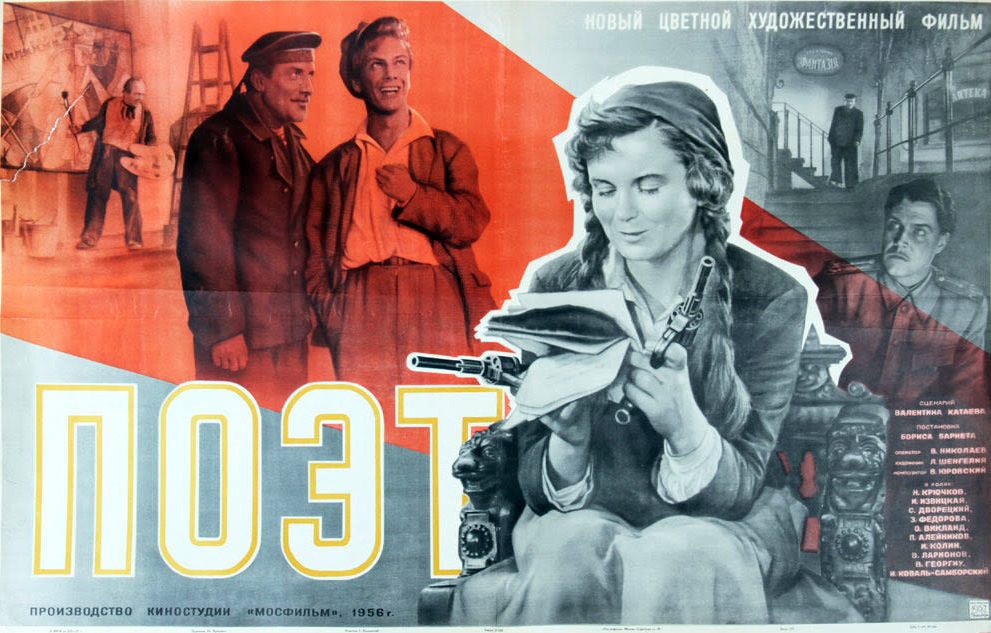
S2 Ep. 7: Poet (1956, Boris Barnet) episode artwork

EPISODE · Oct 27, 2025 · 1H 22M

S2 Ep. 7: Poet (1956, Boris Barnet)

from Cold War Cinema

This week on Cold War Cinema, we look at Boris Barnet's Poet (sometimes refered to as The Poet), a 1956 feature about the role of art and literature in war and revolution.  Join hosts Jason Christian, Tony Ballas, and Paul T. Klein for a broad-ranging conversation about the film and the politics of form and style. Throughout, we consider: The challenges of context-dependent domestic filmmaking and international spectatorship How film narrative and aesthetic modes like Socialist Realism participate in the construction of national myths, imaginaries, and ideologies Barnet's dynamic use of framing, blocking, color, and light to advance Poet's plot and politics _____________________ We love to give book or film recommendations on the podcast, so here are ours for this episode:  Paul recommends A History of Russian Cinema by Birgit Beumers. Tony recommends, The Common Wind: Afro-American Currents in the Age of Haitian Revolution by Julius S. Scott. Tony emphatically does not recommend Literature and Revolution by Leon Trotsky.  Jason recommends Miklós Janscó's 1967 Hungarian war film, The Red and the White.  _____________________ Like and subscribe to Cold War Cinema, and don't forget to leave us a review! Want to continue the conversation? Drop us a line at any time at [email protected]. To stay up to date on Cold War Cinema, follow along at coldwarcinema.com, or find us online on Bluesky @coldwarcinema.com or on X at @Cold_War_Cinema.  For more from your hosts: Follow Jason on Bluesky at @JasonChristian.bsky.social, on X at @JasonAChristian, or on Letterboxed at @exilemagic.  Follow Anthony on Bluesky at @tonyjballas.bsky.social, on X at @tonyjballas. Follow Paul on Bluesky at @ptklein.com, or on Letterboxed at @ptklein. Paul also writes about movies at www.howotreadmovies.com  _____________________ Logo by Jason Christian  Theme music by DYAD (Charles Ballas and Jeremy Averitt).  Happy listening!

NOW PLAYING

S2 Ep. 7: Poet (1956, Boris Barnet)

0:00 1:22:27

No transcript for this episode yet

We transcribe on demand. Request one and we'll notify you when it's ready — usually under 10 minutes.

Song Against Songs, The by G. K. Chesterton (1874 - 1936) LibriVox LibriVox volunteers bring you 9 recordings of The Song Against Songs by G. K. Chesterton. This was the Fortnightly Poetry project for October 16, 2011.Chesterton was a large man, standing 6 feet 4 inches (1.93 m) and weighing around 21 stone (130 kg; 290 lb). His girth gave rise to a famous anecdote. During World War I a lady in London asked why he was not 'out at the Front'; he replied, 'If you go round to the side, you will see that I am.' On another occasion he remarked to his friend George Bernard Shaw: "To look at you, anyone would think a famine had struck England". Shaw retorted, "To look at you, anyone would think you have caused it". P. G. Wodehouse once described a very loud crash as "a sound like Chesterton falling onto a sheet of tin."( Summary from Wikipedia ) Nightline: War with Iran ABC News Late-night television's award-winning news program featuring anchors Juju Chang and Byron Pitts. For in-depth reporting on today's major news stories, to features, profiles, Nightline has the last word in live network news. The David Burnell Podcast Life, leadership, and truth forged in real experience. Reflections on service, leadership, faith, and the lessons forged through a life spent in war zones, rescue missions, and humanitarian work. davidburnell.substack.com WW2 - the Key Questions, answered by Laurence Rees. Laurence Rees A former Head of BBC TV History programmes, Laurence has specialized in writing books and making television documentaries about World War Two, the Nazis and Stalinism for thirty years. He won a BAFTA and a Peabody for his TV series 'The Nazis: A Warning from History' and a British Book Award for his book on Auschwitz, which is also the world's best selling book on this notorious camp. His book 'the Holocaust: A New History' was described by the Times as 'exemplary' and by the Daily Telegraph as 'the best single volume account of the atrocity ever written'. Educated at Oxford University, for several years he was a visiting senior fellow at the London School of Economics, London University. He holds honorary doctorates from the University of Sheffield and the Open University. Professor Robert Service, of Oxford University, described Rees as 'one of the world's experts on the Second World War'. Sir Max Hastings wrote in the Sunday Times, in a review of Laurence Rees' 'World War Two: Behi

Frequently Asked Questions

How long is this episode of Cold War Cinema?

This episode is 1 hour and 22 minutes long.

When was this Cold War Cinema episode published?

This episode was published on October 27, 2025.

What is this episode about?

This week on Cold War Cinema, we look at Boris Barnet's Poet (sometimes refered to as The Poet), a 1956 feature about the role of art and literature in war and revolution.  Join hosts Jason Christian, Tony Ballas, and Paul T. Klein for a...

Can I download this Cold War Cinema episode?

Yes, you can download this episode by clicking the download button on the episode player, or subscribe to the podcast in your preferred podcast app for automatic downloads.
URL copied to clipboard!