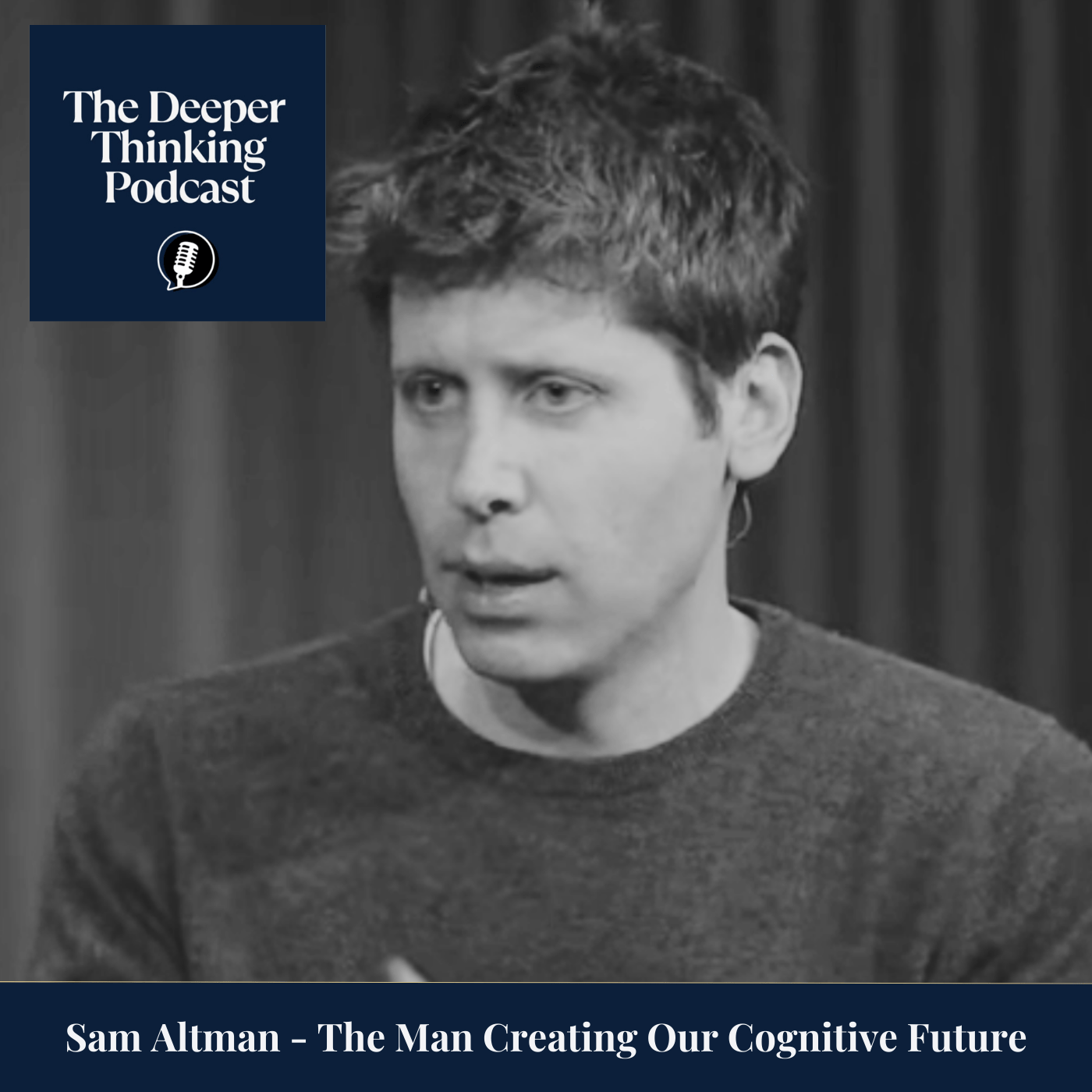
Sam Altman - The Man Creating Our Cognitive Future - The Deeper Thinking Podcast episode artwork

EPISODE · Apr 12, 2025 · 22 MIN

Sam Altman - The Man Creating Our Cognitive Future - The Deeper Thinking Podcast

from The Deeper Thinking Podcast · host The Deeper Thinking Podcast

Sam Altman - The Man Creating Our Cognitive Future The Deeper Thinking Podcast What happens when machines stop waiting for input and begin to anticipate you? In this episode, we unpack Sam Altman’s TED2025 conversation with TED curator Chris Anderson—not to debate AI’s dangers or promises, but to trace what it reveals about authorship, memory, agency, and power. This is not just about a future we are building. It’s about a system we’re already inside. AI is no longer framed as tool, but as presence. A memory that accumulates. A voice that preempts. As Bernard Stiegler wrote, technics are not just extensions of the body—they are prosthetics of memory. And in this episode, memory becomes infrastructure. Through Altman’s calm precision, we hear not certainty but recursion—echoes of Simone Weil’s claim that attention is an act of devotion, and Hannah Arendt’s insistence that every birth is a beginning of a new world, whether we intend it or not. The episode also surfaces contradictions between openness and control, ambient design and algorithmic authorship. As Byung-Chul Han warns, transparency can flatten trust into performance. And Gloria Anzaldúa reminds us that contradiction is not a flaw—it is the texture of reality. This episode listens for the textures Altman doesn’t name, but performs: recursion, proximity, the ambient structure of systems that speak before we do. Why Listen? Explore AI as atmosphere, not interface Understand how memory, trust, and agency are being restructured Hear Altman’s own words—with quote fidelity—against deep theory Engage thinkers from Weil to Moten, Virilio to Simondon Listen On: YouTube Spotify Apple Podcasts Support This Work If you'd like to support the ongoing work, you can visit buymeacoffee.com/thedeeperthinkingpodcast or leave a kind review on Apple Podcasts. What We Learned Along the Way Bernard Stiegler: Frames technics as memory prosthetics—technologies that rewire cognition through time. Simone Weil: Understands attention as sacred discipline and moral action, relevant to AI’s pre-emptive design. Hannah Arendt: Offers a politics of beginning that disrupts deterministic views of technological evolution. Byung-Chul Han: Critiques transparency as a neoliberal control logic cloaked in openness. Gloria Anzaldúa: Validates contradiction as epistemology—central to understanding algorithmic paradox. Fred Moten: Writes from the break—where performance, refusal, and improvisation co-author meaning. Paul Virilio: Defines speed as political vector—accelerated systems and compressed agency. Gilbert Simondon: Reconceives individuation and the technical object as co-emergent, not separate. Roland Barthes: Questions authorship—relevant to Altman’s ambiguous role in shaping language models. Sheila Jasanoff: Introduces “technologies of humility” as a framework for responsible AI governance. The system is already speaking. The question is—who taught it to listen like that? #SamAltman #AI #BernardStiegler #SimoneWeil #HannahArendt #ByungChulHan #FredMoten #PaulVirilio #GloriaAnzaldúa #GilbertSimondon #TheDeeperThinkingPodcast #Authorship #Trust #Futurity #Memory #Prosthetics #AmbientAI

Sam Altman - The Man Creating Our Cognitive Future The Deeper Thinking Podcast What happens when machines stop waiting for input and begin to anticipate you? In this episode, we unpack Sam Altman’s TED2025 conversation with TED curator Chris Anderson—not to debate AI’s dangers or promises, but to trace what it reveals about authorship, memory, agency, and power. This is not just about a future we are building. It’s about a system we’re already inside. AI is no longer framed as tool, but as presence. A memory that accumulates. A voice that preempts. As Bernard Stiegler wrote, technics are not just extensions of the body—they are prosthetics of memory. And in this episode, memory becomes infrastructure. Through Altman’s calm precision, we hear not certainty but recursion—echoes of Simone Weil’s claim that attention is an act of devotion, and Hannah Arendt’s insistence that every birth is a beginning of a new world, whether we intend it or not. The episode also surfaces contradictions between openness and control, ambient design and algorithmic authorship. As Byung-Chul Han warns, transparency can flatten trust into performance. And Gloria Anzaldúa reminds us that contradiction is not a flaw—it is the texture of reality. This episode listens for the textures Altman doesn’t name, but performs: recursion, proximity, the ambient structure of systems that speak before we do. Why Listen? Explore AI as atmosphere, not interface Understand how memory, trust, and agency are being restructured Hear Altman’s own words—with quote fidelity—against deep theory Engage thinkers from Weil to Moten, Virilio to Simondon Listen On: YouTube Spotify Apple Podcasts Support This Work If you'd like to support the ongoing work, you can visit buymeacoffee.com/thedeeperthinkingpodcast or leave a kind review on Apple Podcasts. What We Learned Along the Way Bernard Stiegler: Frames technics as memory prosthetics—technologies that rewire cognition through time. Simone Weil: Understands attention as sacred discipline and moral action, relevant to AI’s pre-emptive design. Hannah Arendt: Offers a politics of beginning that disrupts deterministic views of technological evolution. Byung-Chul Han: Critiques transparency as a neoliberal control logic cloaked in openness. Gloria Anzaldúa: Validates contradiction as epistemology—central to understanding algorithmic paradox. Fred Moten: Writes from the break—where performance, refusal, and improvisation co-author meaning. Paul Virilio: Defines speed as political vector—accelerated systems and compressed agency. Gilbert Simondon: Reconceives individuation and the technical object as co-emergent, not separate. Roland Barthes: Questions authorship—relevant to Altman’s ambiguous role in shaping language models. Sheila Jasanoff: Introduces “technologies of humility” as a framework for responsible AI governance. The system is already speaking. The question is—who taught it to listen like that? #SamAltman #AI #BernardStiegler #SimoneWeil #HannahArendt #ByungChulHan #FredMoten #PaulVirilio #GloriaAnzaldúa #GilbertSimondon #TheDeeperThinkingPodcast #Authorship #Trust #Futurity #Memory #Prosthetics #AmbientAI

NOW PLAYING

Sam Altman - The Man Creating Our Cognitive Future - The Deeper Thinking Podcast

0:00 22:08

No transcript for this episode yet

We transcribe on demand. Request one and we'll notify you when it's ready — usually under 10 minutes.

No similar episodes found.

No similar podcasts found.

Frequently Asked Questions

How long is this episode of The Deeper Thinking Podcast?

This episode is 22 minutes long.

When was this The Deeper Thinking Podcast episode published?

This episode was published on April 12, 2025.

What is this episode about?

Sam Altman - The Man Creating Our Cognitive Future The Deeper Thinking Podcast What happens when machines stop waiting for input and begin to anticipate you? In this episode, we unpack Sam Altman’s TED2025 conversation with TED curator Chris...

Can I download this The Deeper Thinking Podcast episode?

Yes, you can download this episode by clicking the download button on the episode player, or subscribe to the podcast in your preferred podcast app for automatic downloads.
URL copied to clipboard!