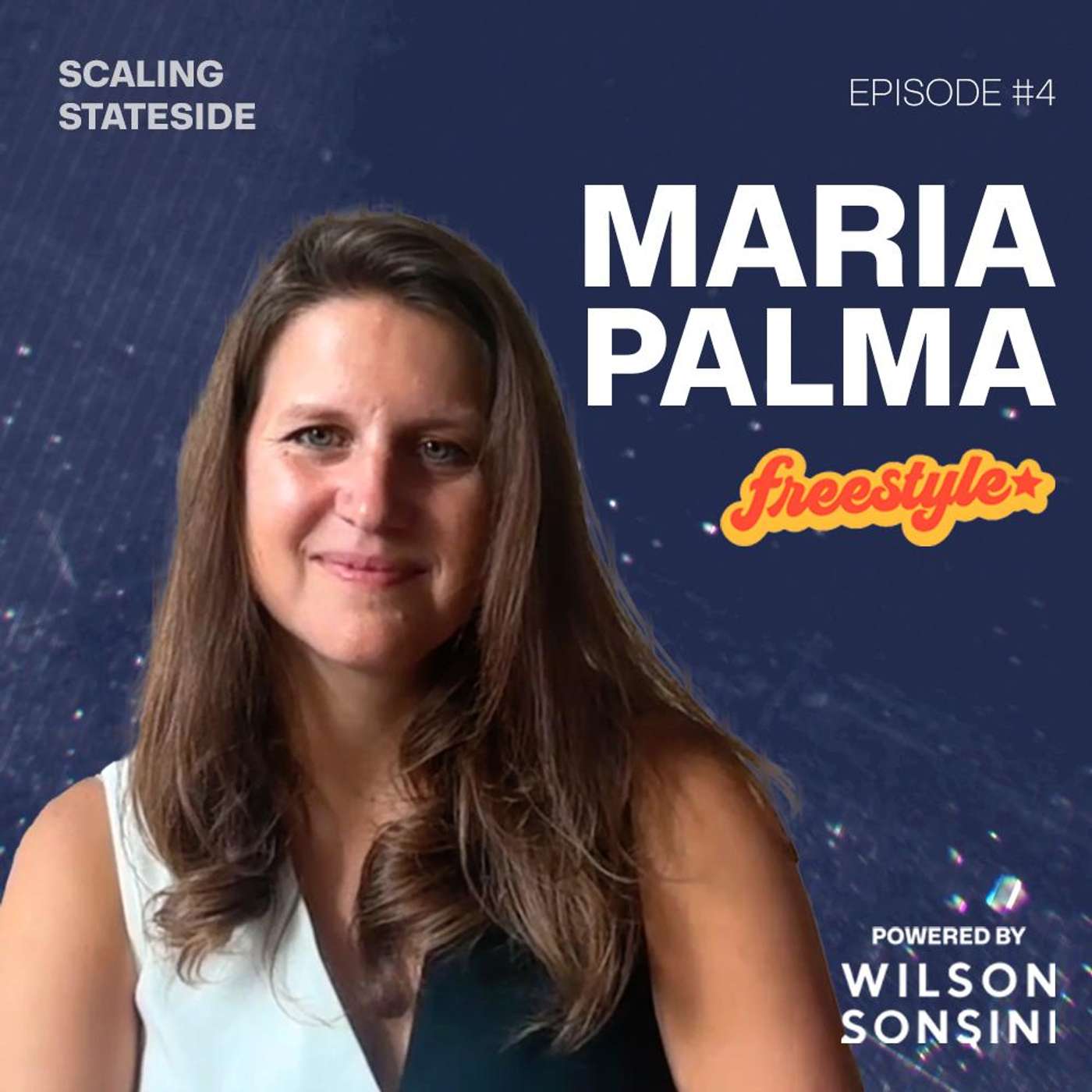
Scaling Stateside Podcast Episode #4 with Maria Palma, General Partner at Freestyle Capital episode artwork

EPISODE · Nov 18, 2025 · 43 MIN

Scaling Stateside Podcast Episode #4 with Maria Palma, General Partner at Freestyle Capital

from Scaling Stateside · host USXP

In this episode, hosts David Rose and Matt Oxley sit down with Maria Palma, General Partner at Freestyle Capital, to discuss the US venture capital landscape from a unique perspective. Maria brings invaluable insights from her decade in venture capital, having worked across three major ecosystems: five years in New York, three years in London, and nearly two years in San Francisco.Maria shares her unconventional journey from corporate America at GE Healthcare to the venture capital world, offering candid advice for European founders considering US expansion and fundraising. The conversation demystifies the VC landscape, explores the key differences between US and European startup ecosystems, and provides practical guidance on when and how European companies should make the leap to the US market.Guest BackgroundMaria Palma is a General Partner at Freestyle Capital based in San Francisco. Originally from Wisconsin, Maria started her career in corporate America at GE Healthcare before transitioning through various startup experiences in India, Brazil, and New York. She earned her MBA from Harvard Business School and has been in venture capital for a decade, uniquely positioned to understand the dynamics of the New York, London, and San Francisco startup ecosystems.Before venture, Maria scaled a New York ad tech startup to $40 million in revenue and worked extensively with underrepresented founders. She also served on the board of a nonprofit supporting refugee founders in Africa.Key Topics DiscussedThe Journey from Corporate to Venture Maria discusses her transition from managing manufacturing operations at GE Healthcare to discovering her passion for "zero to one" problem-solving. She shares how a friend's observation that she loved helping founders led her to venture capital, despite initial misconceptions about what the job actually entailed.Demystifying the US VC Landscape Maria emphasizes the importance of understanding "inside baseball" in the US startup ecosystem. She notes that European founders often consume US content without the context that local founders have, leading to unnecessary imposter syndrome. Her key message: if building a company feels hard, that's normal—it's always hard for everyone.Information Asymmetry Between US and European Founders The conversation explores how US founders benefit from ecosystem density and informal networks that provide real-time intelligence about what's actually working versus what's just marketing. European founders often lack this context due to geographic dispersion across multiple cities and ecosystems.When Should European Companies Expand to the US? Maria provides a nuanced framework for deciding on US expansion:If your customers are primarily in the US (especially for SaaS selling to US enterprises), you should expand to the USIf your business is geography-specific (like Polish banking rails), US expansion may not be necessaryThe universal advice: if you believe the US is your primary market, don't wait too long—every company she's seen says they should have expanded two years earlierUS vs. European Fundraising Dynamics Maria discusses the evolution she's witnessed in European markets, particularly Paris, where US funds are now actively investing. She notes that having US investors on your cap table provides legitimacy that helps with US talent recruitment and customer acquisition, as sophisticated US hires will recognize and value US fund backing.Getting to Know US Investors The best time to build relationships with US VCs is when you're not actively raising. Maria encourages European founders to reach out, understand what metrics US investors care about (especially for Series A), and build relationships early.Maria's Investment Philosophy at Freestyle Capital Maria emphasizes that Freestyle is thesis-driven and focuses heavily on the people side of investing. She looks for founders who can articulate their leadership journey and personal transformation. Her contact process reflects this: she requires founders to share not just their deck, but also how they've changed as leaders.Advice for European Founders Maria's core message: don't worry too much about what VCs think. If you build a great product that customers love and find a way to grow it, you'll find funding—whether through traditional venture or alternative routes. She encourages European founders to adopt more American optimism and just build what they believe in.The Future of European Tech Maria is bullish on European tech ecosystems because the best talent is increasingly choosing startups over traditional career paths. She notes that startups offer unparalleled career growth opportunities compared to rigid corporate structures in many European countries, particularly Germany.Key TakeawaysInside Baseball Matters: US founders benefit from ecosystem density that provides context European founders often lack. Don't assume everything you read about US startups is the whole truth.Timing is Critical: If the US is your primary market, don't delay expansion. Every successful company wishes they had moved two years earlier.US Investor Signal Value: Having US VCs on your cap table provides legitimacy for hiring US talent and acquiring US customers.Build Relationships Early: Connect with US investors before you need to raise, understand their metrics, and get to know them when there's no pressure.Product Trumps Everything: If you build something customers love and find a way to grow it, funding will follow. Don't let VC concerns override your conviction.Adopt American Optimism: European founders should embrace more of the American "can-do" attitude while building their companies.Talent Flow is Changing: The best talent in Europe is increasingly choosing startups, which is fundamentally strengthening European tech ecosystems.Be Thoughtful About Contact: When reaching out to investors, follow instructions and demonstrate you've done your homework. Maria values founders who can articulate their leadership journey.Notable QuotesOn the VC landscape: "If it feels hard, it's not you. That is just what it always feels like."On US expansion timing: "Every company that I've seen come from the US to Europe...that ultimately knew their market was in the US, every single one has told me we should have done that two years earlier."On fundraising philosophy: "If you build a great product that your customers love and you find a way to grow it, you will find a way to get money. Traditional venture, not traditional venture or whatever."On European tech's future: "I think the most important thing for European tech no one's even talking about, which is that all the best talent is falling into tech...there is no better career path for anyone in Europe than a startup."On founder mindset: "Don't listen too much to what VCs say. And if you really believe in building this, like this is where I'll bring some optimism. Just build it. You'll be fine. You'll figure it out."Connect with Maria PalmaVisit the Freestyle Capital website...

In this episode, hosts David Rose and Matt Oxley sit down with Maria Palma, General Partner at Freestyle Capital, to discuss the US venture capital landscape from a unique perspective. Maria brings invaluable insights from her decade in venture capital, having worked across three major ecosystems: five years in New York, three years in London, and nearly two years in San Francisco.Maria shares her unconventional journey from corporate America at GE Healthcare to the venture capital world, offering candid advice for European founders considering US expansion and fundraising. The conversation demystifies the VC landscape, explores the key differences between US and European startup ecosystems, and provides practical guidance on when and how European companies should make the leap to the US market.Guest BackgroundMaria Palma is a General Partner at Freestyle Capital based in San Francisco. Originally from Wisconsin, Maria started her career in corporate America at GE Healthcare before transitioning through various startup experiences in India, Brazil, and New York. She earned her MBA from Harvard Business School and has been in venture capital for a decade, uniquely positioned to understand the dynamics of the New York, London, and San Francisco startup ecosystems.Before venture, Maria scaled a New York ad tech startup to $40 million in revenue and worked extensively with underrepresented founders. She also served on the board of a nonprofit supporting refugee founders in Africa.Key Topics DiscussedThe Journey from Corporate to Venture Maria discusses her transition from managing manufacturing operations at GE Healthcare to discovering her passion for "zero to one" problem-solving. She shares how a friend's observation that she loved helping founders led her to venture capital, despite initial misconceptions about what the job actually entailed.Demystifying the US VC Landscape Maria emphasizes the importance of understanding "inside baseball" in the US startup ecosystem. She notes that European founders often consume US content without the context that local founders have, leading to unnecessary imposter syndrome. Her key message: if building a company feels hard, that's normal—it's always hard for everyone.Information Asymmetry Between US and European Founders The conversation explores how US founders benefit from ecosystem density and informal networks that provide real-time intelligence about what's actually working versus what's just marketing. European founders often lack this context due to geographic dispersion across multiple cities and ecosystems.When Should European Companies Expand to the US? Maria provides a nuanced framework for deciding on US expansion:If your customers are primarily in the US (especially for SaaS selling to US enterprises), you should expand to the USIf your business is geography-specific (like Polish banking rails), US expansion may not be necessaryThe universal advice: if you believe the US is your primary market, don't wait too long—every company she's seen says they should have expanded two years earlierUS vs. European Fundraising Dynamics Maria discusses the evolution she's witnessed in European markets, particularly Paris, where US funds are now actively investing. She notes that having US investors on your cap table provides legitimacy that helps with US talent recruitment and customer acquisition, as sophisticated US hires will recognize and value US fund backing.Getting to Know US Investors The best time to build relationships with US VCs is when you're not actively raising. Maria encourages European founders to reach out, understand what metrics US investors care about (especially for Series A), and build relationships early.Maria's Investment Philosophy at Freestyle Capital Maria emphasizes that Freestyle is thesis-driven and focuses heavily on the people side of investing. She looks for founders who can articulate their leadership journey and personal transformation. Her contact process reflects this: she requires founders to share not just their deck, but also how they've changed as leaders.Advice for European Founders Maria's core message: don't worry too much about what VCs think. If you build a great product that customers love and find a way to grow it, you'll find funding—whether through traditional venture or alternative routes. She encourages European founders to adopt more American optimism and just build what they believe in.The Future of European Tech Maria is bullish on European tech ecosystems because the best talent is increasingly choosing startups over traditional career paths. She notes that startups offer unparalleled career growth opportunities compared to rigid corporate structures in many European countries, particularly Germany.Key TakeawaysInside Baseball Matters: US founders benefit from ecosystem density that provides context European founders often lack. Don't assume everything you read about US startups is the whole truth.Timing is Critical: If the US is your primary market, don't delay expansion. Every successful company wishes they had moved two years earlier.US Investor Signal Value: Having US VCs on your cap table provides legitimacy for hiring US talent and acquiring US customers.Build Relationships Early: Connect with US investors before you need to raise, understand their metrics, and get to know them when there's no pressure.Product Trumps Everything: If you build something customers love and find a way to grow it, funding will follow. Don't let VC concerns override your conviction.Adopt American Optimism: European founders should embrace more of the American "can-do" attitude while building their companies.Talent Flow is Changing: The best talent in Europe is increasingly choosing startups, which is fundamentally strengthening European tech ecosystems.Be Thoughtful About Contact: When reaching out to investors, follow instructions and demonstrate you've done your homework. Maria values founders who can articulate their leadership journey.Notable QuotesOn the VC landscape: "If it feels hard, it's not you. That is just what it always feels like."On US expansion timing: "Every company that I've seen come from the US to Europe...that ultimately knew their market was in the US, every single one has told me we should have done that two years earlier."On fundraising philosophy: "If you build a great product that your customers love and you find a way to grow it, you will find a way to get money. Traditional venture, not traditional venture or whatever."On European tech's future: "I think the most important thing for European tech no one's even talking about, which is that all the best talent is falling into tech...there is no better career path for anyone in Europe than a startup."On founder mindset: "Don't listen too much to what VCs say. And if you really believe in building this, like this is where I'll bring some optimism. Just build it. You'll be fine. You'll figure it out."Connect with Maria PalmaVisit the Freestyle Capital website...

NOW PLAYING

Scaling Stateside Podcast Episode #4 with Maria Palma, General Partner at Freestyle Capital

0:00 43:14

No transcript for this episode yet

We transcribe on demand. Request one and we'll notify you when it's ready — usually under 10 minutes.

The Brendan Ecker Influence Brendan Scott Ecker The Brendan Ecker Influence is hosted by Brendan Scott Ecker — a 27-year-old American entrepreneur, Michigan real estate agent, CEO of Gold Shark Media Ai, founder of PassRE USA, investor, law enforcement officer, former NCAA two-sport athlete, and author of Beyond the Beat and How I Made My Dorm My Office.Ecker went from a middle-class “Matrix” upbringing to building a fast-growing digital brand, scaling multiple businesses, and growing a YouTube channel with over 27,000 subscribers. With a background in Criminology, law enforcement, and competitive athletics, he blends discipline, strategy, and mindset into everything he teaches.On this podcast, Brendan breaks down the real frameworks behind wealth, business, real estate, marketing, AI, geopolitics, mindset, and personal growth. He discusses the journey in growing his businesses, documenting the wins, failures, and the tactical steps that helped him escape Profit Powerhouse Glenn Poulos Glenn Poulos is the co-founder, Vice President, and General Manager of Gap Wireless Inc., a leading product and service distributor for the mobile broadband and wireless markets. With over three decades of experience in sales, he has spent thousands of hours in the field or on the phone with customers and working with salespeople to help create several very successful companies. He is now also the host of this podcast, Profit Powerhouse!Our 20 to 30-min podcast shares amazing founder stories who reveal the smartest strategies for scaling TODAY. 595Social John Wheeler Host John Wheeler talks about all things business. We talk about growing your business, how to craft your ads, marketing, scaling, entrepreneurship and much much more. If you want to learn how you can grow and scale your business, then listen up! All Systems Go! Marketing Automation and Systems Building with Chris L. Davis Chris L. Davis: Marketing Automation Expert Looking to go deeper with marketing automation? Join Chris L. Davis from Automation Bridge reveals strategies how to properly implement marketing automation to scale your business without exhausting yourself. Listen and learn proven principles, discovered by working in fast scaling marketing and technology startup environments, that will save you from making common mistakes and traps many entrepreneurs fall into. Since 2012, Chris has coached hundreds of small businesses and consulted with some of the most prominent tech startups affording him a comprehensive understanding of what automation looks like for all types of business models. That experience, coupled with his unique way of creating clarity out of complexity will make the listening experience enjoyable and topics easily consumable. You'll laugh, you'll learn, and when put to practice, your business will grow...automatically.

Frequently Asked Questions

How long is this episode of Scaling Stateside?

This episode is 43 minutes long.

When was this Scaling Stateside episode published?

This episode was published on November 18, 2025.

What is this episode about?

In this episode, hosts David Rose and Matt Oxley sit down with Maria Palma, General Partner at Freestyle Capital, to discuss the US venture capital landscape from a unique perspective. Maria brings invaluable insights from her decade in venture...

Can I download this Scaling Stateside episode?

Yes, you can download this episode by clicking the download button on the episode player, or subscribe to the podcast in your preferred podcast app for automatic downloads.
URL copied to clipboard!