
EPISODE · Mar 30, 2026 · 48 MIN
Season 1, Episode 11 – The Adventure Where Seeing is Believing, Part 9
from The Great Game Guide · host Sean J. Jordan
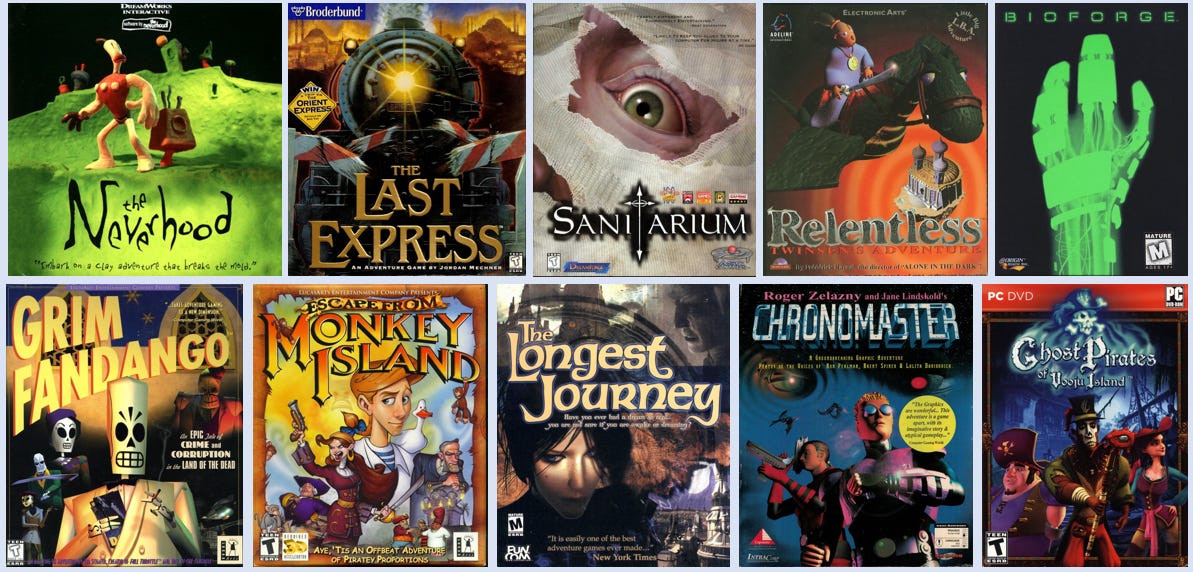
In this episode, we’re going to talk about 1990s adventure games using pre-rendered scenes and 3D, including The Longest Journey, Grim Fandango, Escape from Monkey Island, Chronomaster, Sanitarium, BioForge and more! Join us on this expedition through games you’ve may have loved, some you may have heard of and some you’ve probably never played with Sean Jordan, your Great Game Guide!-------------------------------------------------------------------Season 1, Episode 11: The Adventure Where Seeing is Believing, Part 9Enjoy the show? Please share it with a friend! And be sure to like it on your platform of choice or leave a glowing review.You can contact Sean via Substack or BlueSky (@greatestgames.substack.com)And if you enjoy this show, you should check out The Greatest Games You (Probably) Never Played at https://greatestgames.substack.com, Sean’s free newsletter featuring tons of great games that are obscure, overlooked, forgotten or otherwise unknown!-------------------------------------------------------------------Copyright 2026, Sean J. Jordan. Some Rights Reserved. Permission is granted for the noncommercial, free distribution and archival of this episode.Music “The Great Game Guide Theme” written by Sean J. Jordan using Online Sequencer (https://onlinesequencer.net/)Questions? Concerns? A burning desire to talk about obscure video games? Contact Sean via Substack or Bluesky. He’d love to hear from you!--------------------------------------------------SOURCES:https://web.archive.org/web/20050308133426/http://www.justadventure.com/Interviews/TLJ2/TLJ2.shtmhttps://www.gamedeveloper.com/design/the-last-express-revisiting-an-unsung-classichttps://insidethemagic.net/2012/02/interview-imagineer-jonathan-ackley-details-the-creation-of-sorcerers-of-the-magic-kingdom-at-walt-disney-world/https://mixnmojo.com/news/Jonathan-Ackley-ensures-my-future-children-get-lost-at-Disney-World-UPDATE-Ahern-shares-culpabilithttps://www.kickstarter.com/projects/venture-moon/duke-grabowski-mighty-swashbuckler-point-and-click/posts/1562717https://www.adventureclassicgaming.com/index.php/site/features/376/-------------------------------------------------EPISODE 11Coming up in this episode –We’re going to talk about adventure games from the 1990s that attempted to move the genre into three dimensions including The Longest Journey, Grim Fandango, Escape From Monkey Island, BioForge, Chronomaster and more! And we’ll also look at some of the odd offshoots of the genre like The Neverhood, The Last Express, Sanitarium and Twinsen’s Odyssey!I’m Sean Jordan, and I am your Great Game Guide. Get ready for a survey of many of the great adventure games you may have played, may have heard of … or may have missed! If you’ve been hanging in there with us week after week, you might have wondered why I haven’t delved into talking about LucasArts’s last few adventure games, which are generally considered some of their best. But don’t worry – I haven’t lost the thread. I was just waiting for the right time to bring them back up, because LucasArts found itself on a very interesting trajectory between 1995 and 2000 as it released four adventure games that gradually evolved away from the style the developer had become famous for and into the 3D style we’re going to talk about in detail in this episode.So let’s start off with Full Throttle, a point and click adventure game by Tim Schafer that came out in 1995 as a CD-ROM exclusive title. And this was actually a pretty big deal at the time because many adventure games to this point were still shipping on floppy disk editions with optional enhanced CD-ROM versions. Full Throttle certainly looked like a Day of the Tentacle or Sam & Max-style adventure at first blush, with hand-drawn sprites, painted backgrounds and an icon-driven point and click system.But seeing this game in action made it clear why the multimedia features were needed, from the awesome theme song by the hard rock band The Gone Jackals to the cool cinematic sequences featuring the game’s protagonist, Ben, riding his fat, noisy Corley Motors motorcycle down the road and getting into scraps with rival gangs. In fact, a significant part of the game involves arcade action fighting sequences that are sort of like a cartoon version of the game Road Rash where Ben has to knock other bikers off their rides. Full Throttle turned out to be one of the best point and click adventures ever made, and it also gave Tim Schafer enormous license to try something wildly different with his next game, 1998’s Grim Fandango.And wow, did Grim Fandango deliver, though it was a rather polarizing game among adventure game fans at the time because of the changes it made to the familiar formula of the genre. The game’s set in an afterlife based on Meso-American folklore and stars Manny Calavera as a grim reaper agent of death who helps guide departed souls to the appropriate place in the great hereafter. But when he meets a woman named Meredith who ought to be bound for eternal paradise aboard the number 9 train, but who’s somehow stuck in the lower levels with people who lived far less saintly lives, Manny realizes something’s up and that there are nasty souls who’ve decided to make themselves comfortable in the slums instead of trying to ascend to the heavenly realm. The game’s scope and imagination is, quite frankly, absolutely amazing, and it has a dio de los muertos vibe fused with a film noir art style that makes for an unforgettable story and experience.But there was a practical reason for this style of art as well. Tim Schafer was trying to figure out how to bring adventure gaming properly into 3D, and more abstract character designs and pre-rendered backgrounds were better-suited to the relatively low-polygon capabilities of computer systems of the day. Grim Fandango also was designed to ditch the mouse cursor and GUI common to most adventure games and instead allow players to move Manny around with arrow keys and recognize areas of the world he could interact with by tilting his head – an elegant solution to having to wave a mouse pointer all over the screen in search of objects or characters who were interactive.I really don’t want to go into much more detail about Grim Fandango because it’s such a brilliantly-made game that it’s held up over time and become regarded as a classic. But in the 1990s, it definitely wasn’t for everyone. Hardcore adventure game fans thought the gameplay was too linear and the puzzles were too easy, and navigating Manny around the backgrounds could be an awkward affair because of the odd shape of his body and the sometimes less-than-obvious pathways. The fixed camera angles were also awkward in the same way other 3D games like Alone in the Dark, Resident Evil and Final Fantasy VII struggled to fuse 3D characters and backgrounds.Gamers who weren’t adventure fans, on the other hand, just thought the game looked weird, and since it was only available on CD-ROM and really needed a beefy computer with a 3D graphics card to run optimally, it’s no surprise that it was a commercial failure despite receiving fairly strong critical reviews. Remember, Grim Fandango came out during a major year for games – Half-Life, StarCraft, Thief: The Dark Project, Baldur’s Gate, Unreal, Starsiege: Tribes and Fallout 2 all came out that year as well on PC – and given the pedigree of those games, you can see what stiff competition it was up against.Not that gamers were suffering from a lack of great games, because 1997 also happened to be an amazing year for computer gaming. And one of the titles that debuted was The Curse of Monkey Island, the last of the SCUMM engine games, but also by far the most sophisticated in terms of art design and multimedia features. With all of the original designers off doing their own thing, LucasArts turned to Larry Ahren and Jonathan Ackley to helm this sequel. Both had worked on other LucasArts adventures, and both eventually wound up working in theme park design, notably teaming up again in the early 2010s to work on the Sorcerers of the Magic Kingdom experience for Disney theme parks.This is an interesting note because one of their jobs in reviving the Monkey Island games was to deal with the twist ending of Monkey Island 2, which heavily hinted that LeChuck and Guybrush were actually children playing in an amusement park called Big Whoop and the entire adventure had been make-believe, but that Chuckie was actually infused with some sort of demonic magic. How do you make a sequel to that?Ron Gilbert would claim over the decades he knew exactly what was going to happen next, but to the LucasArts team responsible for continuing the story, the best choice was to pretend most of that never happened and to return Guybrush to the Caribbean, floating his way into a siege on Plunder Island where LeChuck and his undead pirate minions were busy trying to forcibly capture Governor Elaine Marley the same way Bowser is constantly trying to snatch and grab Princess Peach.Honestly, this was a good choice. No offense to Ron Gilbert, who is a brilliant adventure game designer, but the Monkey Island 2 ending never sat right with me and risked undermining all the fun of a series that was part Pirates of the Caribbean theme park ride and part On Stranger Tides pirate shenanigans inspired by Tim Power’s crazy 1987 novel.And The Curse of Monkey Island added in a few nice new things that have stuck with the series since. The first is an all-star voice acting cast led by Dominic Armato, who nails the role of Guybrush so well he basically was the character we all heard in our heads all along, and he’s since voiced every Monkey Island game released, including the remasters of the originals.And the same is true for the other voice actors, at least mostly – Earl Boen is LeChuck, except in the final game, because he was retired from voice acting. Alexandra Boyd is Elaine Marley, except in the fourth game for some reason where she loses her English accent and sounds completely different. Leliani Jones is the Voodoo Lady, except in Tales of Monkey Island. Neil Ross is Wally B. Feed, a.k.a. Bloodnose the Pirate.And Denny Delk is Murray, the aggressively evil demonic talking skull, a brand new character introduced in this game who’s the second great addition. Every game since has included Murray, and he always steals the show.The third addition is the ability to play the game in an easy, story-driven mode or a more challenging puzzle mode, and what I particularly like about this feature is that the puzzle isn’t just more difficult, but holds back some of the game’s best jokes and moments to reward players to pick the tougher path. Since the interface adopts Full Throttle’s icon-driven commands, The Curse of Monkey Island is more focused on pointing and clicking on the environment than the previous games, and it also runs in full-screen since the action menu pops up as a doubloon with regions to click for different interactions. This allows players to not only enjoy the scenery, but to search it for areas allowing them to do something. It feels less like a pixel hunt and more like a multimedia cartoon.The game’s story, too, makes some smart choices as Elaine gets turned into a golden statue after Guybrush proposes to her with a cursed ring in the opening animated sequences and then sends him on a chase around Plunder Island, Blood Island and Monkey Island. The end of the game even attempts (rather confusingly) to retcon the whole Big Whoop issue by having LeChuck and Guybrush have a showdown on a roller coaster. The game puts all that stuff to rest, lets Guybrush triumph and rescue Elaine, and ends with them both getting married and, presumably, ready for a sequel.But Escape From Monkey Island didn’t make it out until 2000, this time led by LucasArts vets Sean Clark and Mike Stemmle, who’d worked together before as the designers behind Sam & Max Hit the Road. This time, the series utilized the Grim Fandango game engine and eschewed the cel-animated style of the previous game for 3D characters. I don’t think I’m out of step with most series fans in saying Escape From Monkey Island is the weakest game in the entire series, and while it’s good by adventure game standards, it feels like a downgrade after the great leap forward The Curse of Monkey Island offered.The plot feels like a “where do we go from here?” sort of contrivance and focuses on LeChuck pretending to be a gubernatorial candidate named Charles L. Charles trying to unseat Elaine Marley and acquire her family’s voodoo talisman that will unleash the Ultimate Insult. There’s a bad guy named Ozzie Mandrill who is constantly criticized for being an “Australian developer buying up everything,” which is a very dated reference to Rupert Murdoch. There’s also a parodic restaurant called “Planet Threepwood”, filled with references to the previous games in a manner that’s clearly making fun of the ill-fated Planet Hollywood restaurants and their penchant for displaying minor film props as major treasures.And the second half of the game is bogged down by an enormously unfun sequence called “Monkey Kombat” where Guybrush battles the island’s simians with insulting monkey noises and eventually pilots a monkey mecha suit to defeat a giant statue of LeChuck.It sounds a lot more exciting than it actually is. And despite some amusing moments and some great character interactions, there’s also a lot of silly stuff. Did we really need to know the origin story of Herman Toothrot or the lineage of the three-headed monkey?After LucasArts stopped producing adventure games and a Sam & Max and Full Throttle sequel were both canceled, Mike Stemmle wound up moving over to Telltale Games and was involved in several of their adventures, including Tales of Monkey Island, for which he was a co-director, designer and writer.This five-part series is actually pretty good in terms of its story and humor, preserving the art style of Escape From Monkey Island but also offering different gameplay experience, returning to a point and click interface that has Guybrush move around 3D environments and investigate interactive objects. I’d argue that the Telltale series is best for long-time fans, but it’s fairly standalone in terms of its continuity and I really enjoy some of the new characters, particularly Morgan LeFlay, a Guybrush fangirl and bounty hunter who becomes sorry to meet her hero, and who plays a significant role in this story.As I mentioned, Ron Gilbert started teasing on social media that he’d always wished he could finish the Monkey Island trilogy with his planned third game because he had an amazing idea of where to take things from the ending he’d concocted for Monkey Island 2. Once Disney acquired LucasFilm, that seemed like it would never happen since Disney was even less interested than LucasArts in producing new games and LucasArts itself had been turned into a licensing arm. But then Ron Gilbert made the surprise announcement in 2022 that he was finishing up Return to Monkey Island for release later in the year along with several LucasArts veterans like Dave Grossman and David Fox at his current development studio, Terrible Toybox. While the game introduced yet another art style – this time sort of like paper dolls atop more stylized backgrounds – it initially underwhelmed some fans when it was shown off. And when it debuted that September, it finally brought a close to not only Ron Gilbert’s big idea, but also, surprisingly, the series itself.Whether or not Return to Monkey Island effectively pulls off the idea Ron Gilbert was so excited about is a matter of taste. But is the game funny? Absolutely. Are the puzzles worthwhile? Mostly. Does the ultimate storyline pay off by finally revealing the Secret of Monkey Island? Pretty effectively, in my opinion, while still incorporating all of the continuity of the games Gilbert wasn’t involved in and showing respect for the contributions of the other creators. Ron Gilbert and Dave Grossman even include a letter to series fans dated June 18, 2020 to talk about their perspective on the series at the very end. That’s about as nice of an ending as you could hope for, and I’d glad we finally got it.But I want to point out that the Monkey Island series is a microcosm of many of the changes that the adventure gaming genre went through. It started off solving the problems inherent to the adventure game genre by removing pointless deaths and focusing players on actions they could do instead of the ones they couldn’t, then it evolved into one of the great multimedia adventure games, and then tried to move into a more console-friendly 3D style. As the genre returned to the flatter point and click 2D style, so did the final entry, and it de-emphasizes tough puzzles while adding in clues, comfort systems and lots and lots of self-awareness.But before we move on to talking about other games that, like Grim Fandango and Escape From Monkey Island, took the adventure game genre into 3D, let’s briefly mention two games that took direct inspiration from Monkey Island to deliver pirate adventures worth playing. The first is called Voodoo Kid, and it’s a 1997 point and click adventure from Infogrames that uses digitized character renders and pre-rendered environments to depict a haunted pirate ship with a literal skeleton crew. The premise is that you fall asleep reading the story of Baron Saturday, who turned his crew into zombies and is heading for the Island of Lost Souls. In your dream, you awaken on the ship and have to find a way to divert the ship from its course. It’s a fairly short and easy adventure, definitely targeted at kids, but it at least allows you to pick if you’d rather play as a boy or girl and it’s fully voice-acted and well animated, with lots of fun little moments. The only downside is the puzzles, which tend to be along the lines of The 7th Guest’s arbitrary brainteasers.Another interesting game is Ghost Pirates of Vooju Island, a 2009 game from Autumn Moon Entertainment first released in Germany that made it to the English-speaking world in 2010. Its biggest claim to fame is the involvement of studio co-founder Bill Tiller, a former LucasArts designer and artist who worked on The Dig and The Curse of Monkey Island.Autumn Moon’s 2008 point and click adventure game A Vampyre Story was a reasonably good time, and I do recommend it, particularly if you’d like to play as a busty French vampiress and pull items out of a coffin to try to cast a spell to allow you to escape from the cursed castle in which you’re imprisoned. It’s a gorgeous game bursting with personality and which has an incredible soundtrack.Autumn Moon’s follow-up game The Ghost Pirates of Vooju Island is a really interesting adventure because you play as a trio of ghosts named Papa Doc, Jane Starling and Blue Belly, all of whom are trying to get back into their bodies and who have to work together to solve their problem and then defeat the evil Queen Zimbi. While the characters are rendered in 3D, the backgrounds themselves are painted and multilayered, offering a strong sense of the artistry from The Curse of Monkey Island while also utilizing the fluid animation that 3D characters can provide.If you enjoy the Monkey Island games, you should definitely give Ghost Pirates of Vooju Island a try. It definitely has its own vibe and is often seen as being lesser-than the Monkey Island series, but I think it stands on its own pretty well. The puzzles are decent, the voice acting’s good and the artwork and animation are spectacular! The Day of the Tentacle-style teamwork adds some variety to the game, and the characters are varied enough that they don’t overstay their welcome if they start to annoy you.Unfortunately, Autumn Moon never got to make a true sequel to either of its adventure games, and the most we’ve gotten is episode one of Duke Grabowski: Mighty Swashbuckler! in 2016 after a successful Kickstarter campaign. It’s a great looking game very much in the piratey spirit of Ghost Pirates of Vooju Island, but after 10 years and some promises about four more episodes that have never manifested, it’s looking increasingly unlikely that we’ll ever see Duke’s adventures continue.I mentioned Alone in the Dark in our last segment, and now seems like a good time to explain why I did. In 1992, Infogrames released this interesting horror-themed adventure featuring two 3D characters – Edward Carnby and Emily Hartwood – exploring a haunted mansion in Louisiana called Decreto. While Alone in the Dark certainly looked odd for its time due to its use of low-polygon, slow-moving 3D character models atop pre-rendered environments and static cameras depicting each room, hallway or scene, the game was able to create a mood unlike anything that had come before it, and while games like Elvira, WaxWorks and Harvester were going for gore, the Alone in the Dark games were able to build a much more unsettling experience that became the template for the survival horror genre that Resident Evil would later popularize.It’s funny, though, because I don’t think many people consider Alone in the Dark an adventure game despite the fact that it’s not that different from The 7th Guest or Dark Seed in terms of structure and design. One reason why it is a bit different is because it involves limited combat with enemies who can definitely kill you, but you’re still exploring a mansion and trying to find ways to solve puzzles with items. I think the best way to categorize Alone in the Dark is as an action adventure game that had an enormous influence not just on horror games, but also the burgeoning field of 3D adventures.BioForge is definitely a game with a similar design philosophy. It’s a 1995 3D action adventure game from Origin Systems that still focuses on combat and horror, but which has a science fiction premise. After a cryptic introduction, you awaken as a cyborg in a derelict station aboard a moon somewhere in space. You not only have to fight your way through the robots and cyborgs left on the station – early in the game, you can literally beat one foe with his severed arm when he won’t stop attacking you! – but also get your bearings as you strive to understand what happened to everyone there.I actually feel like BioForge is a little bit closer to an adventure game than Alone in the Dark because so much of it is focused on puzzle-solving. Many of the solutions to the puzzles are found by reading logbooks or computer monitors – an idea that’s pretty common today, but which was a fairly novel and immersive way of sharing information with the player in the mid-1990s. The game also has an unfolding cinematic story brought to life by voice acting and in-game events rather than cutscenes or narration, which was again pretty exciting for the era. While the gameplay itself is a bit clunky due to tank controls and lousy combat, there are several places in the game where you need to outsmart your enemies rather than beat them down, and that helps BioForge overcome its weaknesses somewhat. I definitely recommend it if you can put up with its limitations as an awkward 90s action adventure game.Speaking of games set in futuristic settings, let’s take a look at Chronomaster, which came out the same year as BioForge, and which had the bona fides of being created by a famous Hugo and Nebula award-winning author.Roger Zelazny was a science fiction writer who was very popular in the 1960s, 70s and 80s, particularly for his novel Nine Princes in Amber, which was the basis of an illustrated text-based adventure game adaptation by Tellarium in the 1980s. Those novels are about a true world called Amber that casts shadows across the multiverse to create every other reality. Some shadows have different laws of nature and even allow for magic. Zelazny loved the idea of alternate worlds and used them to play around with what was possible without violating the accepted rules of hard science fiction. The canon in the Chronicles of Amber thus tends to focus on the characters themselves, not the inconsequential worlds they inhabit.Zelazny was also well-known for infusing mythology into his writing as well as a strong sense of action due to his prowess in fencing and various martial arts. If you’ve never had a chance to read some of Zelazny’s novels, you absolutely should; they’re often energetic and interesting, with fast-moving plots and cool characters and that overwrought, thoughtful, philosophical style of dialogue that’s so strongly associated with the wooden characters in science fiction magazines.Chronomaster is not a novel, but a multimedia adventure game from 1995 that Zelazny was working on with his partner and collaborator Jane Lindskold when he passed away of cancer. The game was developed by DreamForge Interntainment, a US-based studio mostly known for making Dungeons & Dragons games and other role-playing games like DarkSpyre and Veil of Darkness, which I’ll absolutely talk about another time when our discussion is centered on underrated 90s CRPGs. But Chronomaster is not like anything else DreamForge ever made, both before and after. It’s a 3D-style icon-driven point and click adventure game where you explore a pre-rendered game world as Rene Korda, a sort of godlike scientist who creates customized pocket universes for wealthy people with exacting tastes. He’s brought out of retirement to repair some universes that have entered a state of “temporal stasis” where everyone and everything is stuck in time.And when I say pocket universes, I mean that literally, because within some of these, Korda can visit multiple worlds. This sense of scale is both the game’s greatest asset and its biggest weakness. As an adventure game, Chronomaster is absolutely massive. But on the other hand, the game definitely weakens as it goes on because the more focused science fiction story of the initial sections gives way to a wild, anything goes approach later on where the game nearly turns into a parody of itself as Korba begins exploring universes that are built to some very strange specifications.One of the most notable aspects of Chronomaster is the voice acting, which is provided by Ron Perlman as Korba, Brent Spiner of Star Trek: The Next Generation as his eventual ally Milo and Lolita Davidovich as his chripy computer assistant Jester. They all do a good job, though Ron Perlman sounds half-awake in a lot of his narration. But there are dozens of other characters who’re voiced in this game as well by a fairly large cast of actors ranging from suitable for the roles to absolutely amateurish.The game also has a rather strange sense of art design. Korba is a goofy-looking character with spiky blond hair, opaque goggles and Halloween costume-level body armor, Milo sort of looks like an outer space Steven Seagal and Jester has the appearance of a Western comic book artist’s take on an anime girl. There’s also a later ally named Selene who’s wearing revealing spandex but who has a cybernetic eye and a crew cut so you’ll know she’s supposed to be tough. The ultimate bad guy looks like a reject from the Borg. All of this is rendered in that awkward mid-90s plastic uncanny valley style that looked dated the moment the game shipped.Even so, you’ve got to overlook this game’s rough edges because the story is unique and interesting and the gameplay is rewarding if you can stick with it. The puzzles are quite challenging, but there is some openness to the design, with multiple solutions to many of the problems you face, making every playthrough feel a bit different if you don’t stick to a walkthrough. There are also a few different endings, so the game responds somewhat to your playstyle. There’s even one way to finish the game midway through, though I’ll note this is not the good ending.Speaking of endings, DreamForge Intertainment inserts itself into the game’s ending newsreel, suggesting a pocket universe in which the company is still making wildly creative games today. Unfortunately, they’d wind up closing their doors while working on Myst IV a few years later, but before that happened, they created one of my favorite 3D-style adventure games of the 1990s – the very trippy and weird 1998 isometric adventure Sanitarium. At first blush, this game looks a lot like Fallout or Baldur’s Gate because you wander around pre-rendered environments viewing everything from a diagonal top-down angle. But the gameplay follows the mechanics of adventure games, putting you in the shoes of the fully bandaged coma patient Max, who awakens in a horrifying sanitarium and soon finds himself wandering around a village of mutant children who have been adopted by an evil alien they call “Mother.”And just when you think you have a handle on where this game is taking you, the game throws you an incredible curveball I won’t spoil. As I was playing it, I assumed that it was going to turn out to be one of those games where Max turns out to be the villain facing his worst crimes in the form of a coma-induced nightmare so he can seek redemption, but nope, that is not at all where this game’s story ultimately goes. It’s definitely a game I’d describe as “messed-up,” but it’s not quite the horror experience it appears to be, so if you’re more a fan of psychological horror and tension as opposed to jump scares, this one is definitely worth a playthrough.In the 1990s, video gaming got its first cover girl in the form of Lara Croft, Tomb Raider. Core Design and Eidos’s self-assured polygonal gun-toting adventurer came at the right time to represent console gamers who were starting to outgrow Mario and Sonic, who were getting bored with Street Fighter and Mortal Kombat and who were ready for a little bit of sex appeal. That Lara Croft was one of the first 3D characters who managed to pull off being attractive rather than hideous didn’t hurt, and Core Design was more than happy to generate pictures of her in swimsuits and provocative poses to ensure every magazine had ample reasons to cover her.PC gamers tended to be a little bit older in the 1990s than their console gaming counterparts, and so it’s not surprising that when April Ryan came around in the game The Longest Journey in late 2000 in the English-speaking world, most gaming magazines barely noticed it despite the fact that April spends the beginning of the game in skimpy pajamas and much of the rest of the game dressed in skin-tight clothes with a visible midriff like she’s headed to the club. But that also might be because April’s a stylish artist who’s not just tossed in the game for sex appeal, but part of a story where she can go and have lengthy conversations with her friends and neighbors and where she fits into the worlds she inhabits instead of plundering them. The Longest Journey was originally released in Scandanavia and Europe everywhere but the UK by a developer called Funcom, largely known at the time for making licensed console games. While the game was a big hit in its home country of Norway and sold well in its neighboring countries, the decision to wait on an English-language release was primarily due to the desire to get the game into the North American market, not an easy feat since a lot of publishers wanted nothing to do with adventure gaming. And you can tell that the excitement for this game was not high despite the glowing reviews it received once it shipped; Computer Gaming World and PC Gamer gave far more pre-release coverage to Escape From Monkey Island than The Longest Journey, often in the context of discussions about whether or not the adventure game genre was truly dead.The premise of the game is that there are two parallel worlds that have split off from the original Earth. One is called Stark, and we see it in the year 2209, with a similar history and culture to our own world, though it has a sort of steampunkish, science fictiony Blade Runner vibe and takes place within a fictional city on the US West Coast called Newport. It’s governed by science. The other world is called Arcadia, and it’s a lower-tech, fantasy-style place governed by magic.April has a dream in which she meets a white dragon who tells her she’s going to play a part in a future that may bring about a different world. But before April can get any clarity on what this means, a force of dark chaos rises up beside her and shatters her dream, sending her back to her regular life on Stark, where she’s worried about finishing off a piece for an upcoming art show.And yet April’s life keeps being interrupted by moments where strange things are happening, and there’s some subtext to suggest that maybe her dreams are being influenced by the things around her and she’s going crazy. But an odd man she encounters named Manny Cortez explains that she is special in some way. He eventually opens a portal to Arcadia and explains that once she steps inside, she will take the first step on the longest journey of her life.And as April emerges in the other world, she finds she cannot understand anyone there, though her ears gradually acclimate to allow her to understand the magical Alltongue. This opens her up to learning from a priest named Tobias Grensret, who walks her through the backstory and explains that April is a Shifter, a rare person who can travel between both worlds. Both worlds exist in a balance that’s maintained by a dragon-like alien race called the Draic Kin, twelve humans called the Sentinel and a quasi-divine individual known as the Guardian, but he’s gone missing and his replacement has not been found. April eventually discovers that a group called the Vanguard is trying to merge both worlds back together, which will plunge both worlds into chaos, and her quest is to restore a disc that will help allow the Guardian to return.I’m really oversimplifying things, because The Longest Journey has a very detailed storyline that is frequently dropped on April through lengthy conversations and info dumps. If you’re not into complex lore and detailed characters with complex motivations for doing things, this is definitely not the game for you. And if you assume that April is going to become the Guardian in the end, well, no, this game’s not that straightforward either. The entire experience is incredibly lengthy and this has often led gamers to joke that this game is aptly named – your first playthrough can easily last 15-20 hours if you sit through the conversations and work to solve the puzzles.But oh, what a fantastic journey The Longest Journey has to offer! The game’s built on vibes, and so many of its ideas feel like they were inserted because the development team took some inspiration from something and decided to jam it into their game. Normally, this is the mark of a bad game, but the dreamlike feel of the adventure actually handles this structure really well. April’s young and naïve, but she’s no dummy, and her cleverness and ability to persevere carry her through this game and make you feel really attached to her by the end. The game even seems to hint that she survives to be an old woman in Arcadia, telling stories about her young exploits.That’s why it was such a surprise that the sequel, 2006’s DreamFall: The Longest Journey, didn’t really continue April Ryan’s story so much as sideline her to introduce a new character named Zoe Castillio who’s living in the city of Casablanca in Stark in 2219, ten years after the first game. And from the start, you know that Zoe’s in a coma, telling you the story of how she got there. Zoe’s quest before the coma is to find and save April Ryan, who’s now living in Arcadia as a part of a resistance movement there, and Zoe begins receiving cryptic directions from a little girl named Faith whose consciousness exists in Stark’s global computer network, DreamNet. Zoe’s ultimate quest is to thwart a plot to infiltrate the dreams of people in both worlds and brainwash them, which sounds kind of stupid as I say it out loud, but I promise, it makes sense in the game.DreamFall is an action adventure game, eschewing most of the traditional adventure game conventions and focusing more on combat. Like The Longest Journey, it’s filled with dialogue and complex lore. There’s a whole backstory about an event called the Collapse that isn’t even really explained in the game and the rise of an Arcadian faction called the Azadi and a conspiracy in Stark involving a mysterious Japanese toy company. Oh, and the world is being plagued with static that keeps knocking technology out. Again, as I say this out loud… just trust me, it’s not as dumb as it sounds, and the dreamlike quality of the game glosses over the silliness of the story.Like The Longest Journey, DreamFall also draws obvious inspirations from all sorts of different things that were popular during its development – the films The Ring, AI: Artificial Intelligence and Lost in Translation are three of the most obvious influences just in the first few minutes of Zoe’s adventure, and many of the things that happen in Arcadia seem to be visually influenced by Peter Jackson’s The Lord of the Rings films this time around.My only real gripe about DreamFall is that it ends April’s story rather unceremoniously and, in my estimation, to the detriment of the continuation of the series. When Funcom continued the story in their five-part episodic adventure game DreamFall Chapters in 2014-2017, they had to retcon this with a rather silly contrivance designed to bring April back into the fold. I really only recommend DreamFall Chapters in its 2017 Final Cut edition, and even then, only if you’re really interested in seeing how the story ends.Let’s close out our look at 1990s adventure games with a few that don’t really fit neatly into any category. All of these games are absolutely excellent, and I hope you’ll check them all out. But the first is still not available commercially, and that’s a shame, because this 1996 adventure, The Neverhood is a really great game that was released by Dreamworks Interactive.But before we begin, let me go ahead and rip off the band-aid and talk about Doug TenNapel, the artist and co-designer of this game who’s largely responsible for its distinctive look. Doug TenNapel is a brilliant animator who’s responsible for some great stuff, including some wonderful graphic novels and kids’ books, some cool album art for the band Five Iron Frenzy, many television shows from the 1990s and early 2000s and, most famously, for creating the character of Earthworm Jim and even voicing him in the first two games.Dan Castellenata, the guy who voices Homer Simpson, played Jim in the cartoon show. But Doug TenNapel was responsible for that show, too, which is probably why it does such a good job of sticking to the game’s goofy premise.But here’s the thing. Doug TenNapel is a very problematic personality who’s allowed his very conservative Republican politics and support for figures like Andrew Breitbart and Donald Trump to tarnish his artistic career. He’d be the first to tell you this because he has talk show called Doug in Exile where he complains about being cancelled by the progressive left, SJWs and an LGBTQ culture he says is waging a culture war against him. I don’t believe I’m misrepresenting him in any way here, but I want to be clear: I don’t support or endorse anything he stands for. We’re all entitled to our opinions, but when we use those opinions to be hurtful to other people, we take it too far.It really stinks when someone who’s so creative and who’s made some really cool stuff also turns out to be a heel, and if you don’t want to support Doug TenNapel, I understand. In that case, you should definitely skip the 2015 game Armikrog, which was intended to be a sort of spiritual successor to The Neverhood and which turned out to be a half-finished game in the end. Full disclosure: I was a Kickstarter backer, but I didn’t realize at the time that Doug TenNapel was such a polarizing figure.Anyhow, The Neverhood is not a problematic game in any way, and since it was made by a team of people who have not followed Doug into exile as far as I can tell, let’s presume the game’s still worth checking out, because let me tell you – The Neverhood is truly something special. The game’s built from digital scans of claymation figures and offers some of the most imaginative point and click adventure gaming you’ll ever see. It also has one of the most tedious mechanics ever seen in an adventure game in the form of its seemingly never-ending “Hall of Records,” but we can forgive that because the rest of the game is so good.The premise is that you are Klaymen, a misleadingly named clay man who wanders around the mysterious Neverhood searching for discs that fill in the game’s backstory and provide clues on where to go next. You wander around the world in both first-person FMV sequences and third-person screens representing puzzle rooms, and the game looks absolutely incredible because all of it is built on Claymation sets with professional-grade animation. Even more amazingly, the game’s soundtrack is an all-timer, filled with whimsical music sung mostly in a nonsense language and evoking a sort of jazzy, folksy, cinematic sense of whimsy that fits the graphical style perfectly.The Neverhood is the type of game where you’ll fool a monster that wants to eat you with a dummy made of dynamite. It’s the sort of game where if you need to make a door to walk though, you just direct Klaymen to expand one out of a hole in the clay, shrinking another one elsewhere in the room. It’s the sort of game where it feels like anything and everything can happen and you simply need to figure out the right insane logic to open the game world up to your wild ideas. It’s also the only game I’ve ever seen where you defeat the bad guy by pantsing him when he thinks he’s won.Aside from my gripes with the creator, my biggest complaint about The Neverhood is that it was only available for a short time and has never gotten a reprint or a digital release, making it extremely expensive to buy secondhand due to its rarity. And while it does have two follow-up games – Skullmonkeys on the PlayStation and the aforementioned Armikrog – neither is nearly as good as the original. If you get a chance to play it, you should.Another game that bombed badly when it was released, but which is at least available digitally today, is Jordan Mechner’s 1997 rotoscoped mystery game aboard a train, The Last Express. Jordan Mechner was already a pretty big name for his publisher, Brøderbund – he’d created Karateka and Prince of Persia for them and essentially had carte blanche to do what he wanted, and that gave him an almost unheard-of four-year development period to see his idea through.And wow, is The Last Express an impressive game even today. It begins sort of like an Agatha Christie meets Myst-style adventure aboard the Orient Express, but it has a few important deviations from that formula. First of all, the game takes place in real time at a pace of about six game minutes per actual minute. Secondly, the game will frequently break into rotoscoped Art Nouveau-style cutscenes in the third person where you see your character, the American doctor Robert Cath, interacting with other passengers. Finally, you have the ability to rewind time to undo the effects of any bad decisions you make, and you can also fast forward to later points in the story, provided you’ve already reached them once.And yes, by the way, this mechanic was the inspiration for a key mechanic in Jordan Mechner’s next game, Prince of Persia: The Sands of Time, though it’s executed very differently there.But what’s really wild about The Last Express is how detailed the game’s character interactions are. Every character in the game – there are about thirty of them – has an agenda and behaves differently depending upon the choices you make. Where they are and what they’re doing at a given time can vary a lot, and your conversations and inquiries can put some of them on edge. The script for the game is very well-written and has a lot of conversational dialogue that’s voiced extremely well and which feels authentic to the setting and the context of traveling on a train, including multiple languages where the characters speak natural dialogue. Your character also has to be careful not to blow his cover, as he’s assumed the identity of his murdered friend.I don’t want to say too much about the story because part of the pleasure of the game comes from seeing how things unfold and finding the right path to reach the game’s true ending. Over the three days of your journey between Paris and Constantinople in 1914, you explore the Orient Express and discover a botched arms deal, a spy, another planned murder, a stolen Serbian treasure and so much more. The train gets hijacked at one point, and there’s even a bomber who threatens to blow the up the Orient Express and everyone on it. And all of this is happening while Europe is fast approaching the start of World War I, which breaks out if you survive to see the game’s ending.The Last Express should have been a major success – it was a critical darling, attracted a lot of broader media attention and really looked like a game that everyone would want to play. But the problem was that Brøderbund was going through a tough time and its entire marketing department quit, resulting in the game being poorly supported and reportedly only being on the shelves for a couple of months. It wound up being one of their last games, and certainly their most expensive; their other adventure game that year, the comedy adventure Koala Lumpur: Journey to the Edge, was hardly a hit, and Brøderbund got acquired by The Learning Company the next year and was gutted by extensive layoffs.One other unusual adventure I’d like to comment on is actually made up of two games. The first is known as Little Big Adventure in Europe and Relentless: Twinsen’s Adventure in North America. And the sequel, called Little Big Adventure 2 in Europe, is also known as Twinsen’s Odyssey.Both games were created by the French developer Adeline Software International, which also created the more conventional 3D action adventure game Time Commando in 1996. But the Little Big Adventure games, or Twinsen games if you prefer, are very different because they’re overhead isometric adventures where your main character, the blue-robed, top-knot ponytailed, dragon-riding Twinsen, has to solve problems in the normal adventure game manners – dialogue, puzzle-solving and with items – but also sometimes with his fists, his reflexes or with stealth. To enable these actions, Twinsen has four stances – Normal, Aggressive, Discreet and Athletic.What makes these games a bit different from others in the genre is that like The Last Express, the action takes place in real time and parts of the map open up as you complete actions that unlock certain conditions or knock enemies off their routes and task schedules. It’s a very unique series that was quite a big deal in Europe, but which barely made a dent in North America because it was published by Electronic Arts and they simply didn’t understand its appeal, changing its title and making it look more like an action game than any sort of adventure game. That the game also shipped in a disk version and multimedia edition didn’t help, because the CD-ROM voice acting adds a lot of charm to the game.The original Twinsen game features pre-rendered graphics with 3D character models on top of it, very similar to Alone in the Dark’s look, but with a far more family-friendly feel. Both take place on the world of Twinsun – named for the two stars the world sits between – and yes, it’s a little confusing that the hero is named Twinsen. But he’s such a likable and fun character who has a chipper personality and often over-exaggerates his movements, reeling back before he runs and throwing his magic orb weapon like a baseball pitcher. The second game keeps a lot of this style but also adds in portions that are actually 3D instead of pre-rendered, which means the camera is free to show things from different angles. It’s a little weird, but it absolutely works.Unfortunately, Electronic Arts published the game in Europe and then handed the North American publishing rights off to Activision, which was similarly clueless about how to market a French adventure game that deviated so much from the Sierra and LucasArts formula.But the good news is that both games are pretty easy to find and play today – GOG has them both and even has the original versions available as free add-ons, and they’re also on Steam. Be sure to give them a try – they’re wonderful family-friendly games with neat characters, strong art design and incredible soundtracks.As usual, my desire to cover everything notable has gotten me into trouble, and I’m going to have to wait until we start talking more about the 21st century to cover the next step in adventure gaming evolution with games including Omikron: The Nomad Soul, Fahrenheit, which is also known as The Indigo Prophecy, Microids’s adventure games including Amerizone: The Explorer’s Legacy, the Syberia games, Post Mortem and Still Life and Index+’s really wild Dracula: Resurrection series. All of these games are worth more than a name check and we’ll get to them in a future episode.I don’t want to suggest that adventure gaming completely died after 2005, but it did change. Many of the characteristics of the 3D fork of adventure gaming were adopted into other genres such as action-adventure games, first person shooters, survival horror, role-playing games and even platformers, and aside from a handful of developers like Quantic Dream and Telltale Games, you really didn’t see a lot of adventure games coming out in 3D between 2005 and the indie gaming boom of the mid-2010s. Myst-style games, too, largely tapered off in favor of full 3D first person games like Portal, The Stanley Parable, The Talos Principle and Superliminal.But adventure games remained a popular genre in Eastern Europe, and Daedalic Entertainment was one of the most prolific producers of the traditional style of 2D adventures, releasing series such as Edna & Harvey, Deponia and The Dark Eye as well as standalone titles like The Whispered World, Anna’s Quest, The Night of the Rabbit and A New Beginning.And of course there were other adventure game makers as well. The Spanish studio Pendulo Games made the excellent Runaway: A Twist of Fate trilogy, the Czech studio Future Games made NiBiRu: Age of Secrets and the Black Mirror trilogy – no relation to the Netflix show of the same name - and various studios around Europe produced other halfway decent adventure games like Secret Files: Tunguska, Ceville, The Inner World and So Blonde.Another popular breeding ground for adventure games was the Adventure Game Studio, and this led to hundreds of adventure games being developed and published, mostly as freeware, but in some cases as commercial titles. One of the most prolific publishers of AGS adventures is the indie studio Wadjet Eye Games, started by Dave Gilbert – no relation to Ron – and we’ll talk about them in much more detail in an upcoming episode. But there’s also of course Yahtzee Croshaw’s Fully Ramblomatic Games, Crystal Shard, AGD Interactive, Clifftop Games and Grundislav Games, just to name a few! And we’ll be covering them all as well in our last couple of episodes for this series.But you know what we still haven’t covered in detail? Consoles and handhelds! So in our next episode, we’re going to talk about games like Adventure, Haunted House, Nightshade, The Space Adventure, Night Trap, Mansion of Hidden Souls, D, Pac-Man 2: The New Adventures, Blazing Dragons, Scooby-Doo Mystery, Policenauts, Zack & Wiki: Quest for Barbaros' Treasure, Swagman, Steins;Gate, Clannad and Moon. And, if we have time, we may even delve into the incredible Sakura Taisen series, find a Zero Escape sort of dilemma or spend some time righting wrongs in the Turnabout Courtroom with an Ace Attorney on the rise!If you enjoy this show, you can read this series every week on my Substack at Greatestgames.substack.com, where you’ll also find brand new articles on other great games you’ve never played.And you’re always welcome to talk with me on Bluesky!I’m Sean Jordan, I am your Great Game Guide, and I’ll be back next week with more to explore! THIS WEEK’S RECOMMENDED GAME TO TRYBefore I let you go every week, I close out the show with a game I want you to try that’s a little off the beaten path. This isn’t sponsored content and I don’t have any financial stake in anything I recommend; these are games that I think are really good but don’t have as much exposure as some of the more popular ones.This week, I’m recommending Pipistrello and the Cursed Yoyo, a game that came out last year from Pocket Trap and PM Studios and which promised the first “yoyovania.” OK, so that’s a clever little bit of marketing fluff, but what this game actually involves is a top-down puzzle-focused perspective like classic Zelda with a really capable yo-yo, far more useful than the one in the NES Startropics series. One of the most interesting ideas in the game is the ability to use angled surfaces to change the direction of your yo-yo so you can hit enemies at different angles and solve some surprisingly clever puzzles. The further into the game you get, the more abilities you earn for your yo-yo to allow you to resolve puzzles that weren’t previously possible to solve.The game also has a goofy story about restoring your family’s power plant, which has been raided by gangsters who’ve made off with four powerful batteries. As the bat creature Pippit, you have to use your super-charged, spectrally-infused yo-yo that’s carrying the spirit of your auntie to catch up to the gangsters and set things right. Most of this is just a rationale to offer four different themed areas representing the elemental powers of the batteries, and the story’s probably the least interesting part of the game. It’s all about puzzle-solving, room-clearing action. There’s also a city hub world you can wander around and complete missions so you can upgrade your moves.Oh, and did I mention one prominent song in the game’s score is by the great Yoko Shimomura, composer for Street Fighter II, Super Mario RPG, Parasite Eve, The Legend of Mana and Kingdom Hearts, among many other games?If you’re the sort of person who really enjoys the Game Boy Color and Game Boy Advance Zelda games with all their timing and technique-based puzzles, this is the game for you. It even can be set to look like it’s playing on an approximation of the Game Boy Advance, which is pretty neat! Give Pipistrello and the Cursed Yoyo a shot – it’s one of last year’s best retro-style indie games, and you won’t regret playing it!https://store.steampowered.com/app/2870350/Pipistrello_and_the_Cursed_Yoyo/ OTHERS TO RECOMMEND – 3DEternam (1992) (https://www.mobygames.com/game/1368/eternam/)Dragon Lore: The Legend Begins (1994) (https://www.mobygames.com/game/3776/dragon-lore-the-legend-begins/)Normality (1996) (https://www.mobygames.com/game/1999/normality/)Time Commando (1996) (https://www.mobygames.com/game/342/time-commando/)The City of Lost Children (1997) (https://www.mobygames.com/game/3842/the-city-of-lost-children/)Dark Earth (1997) (https://www.mobygames.com/game/2874/dark-earth/)Koala Lumpur: Journey to the Edge (1997) (https://www.mobygames.com/game/4462/koala-lumpur-journey-to-the-edge/) Mission Sunlight (1998) (https://www.mobygames.com/game/100362/mission-sunlight/) This is a public episode. If you would like to discuss this with other subscribers or get access to bonus episodes, visit greatestgames.substack.com
NOW PLAYING
Season 1, Episode 11 – The Adventure Where Seeing is Believing, Part 9
No transcript for this episode yet
Similar Episodes
Mar 26, 2026 ·1m
Mar 19, 2026 ·34m
Feb 18, 2026 ·11m
Feb 11, 2026 ·45m