
EPISODE · Apr 6, 2026 · 44 MIN
Season 1, Episode 12 – The Adventure Where Seeing is Believing, Part 10
from The Great Game Guide · host Sean J. Jordan
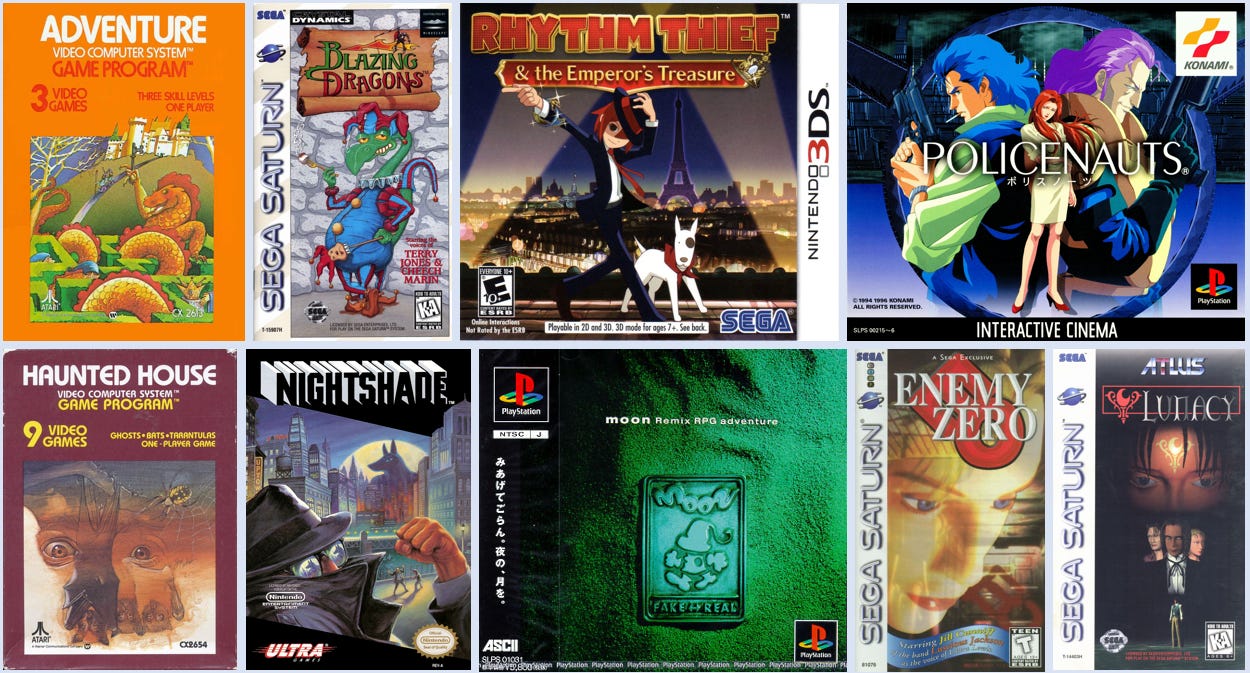
In this episode, we’re going to talk about console and handheld adventure games from the 1980s, 90s and 2000s that often offered players a different style of gameplay, but still had those puzzle-solving story-driven sensibilities. Join us on this journey through games you’ve may have loved, some you may have heard of and some you’ve probably never played with Sean Jordan, your Great Game Guide!-------------------------------------------------------------------Season 1, Episode 12: The Adventure Where Seeing is Believing, Part 10Enjoy the show? Please share it with a friend! And be sure to like it on your platform of choice or leave a glowing review.You can contact Sean via Substack or BlueSky (@greatestgames.substack.com)And if you enjoy this show, you should check out The Greatest Games You (Probably) Never Played at https://greatestgames.substack.com, Sean’s free newsletter featuring tons of great games that are obscure, overlooked, forgotten or otherwise unknown!-------------------------------------------------------------------Copyright 2026, Sean J. Jordan. Some Rights Reserved. Permission is granted for the noncommercial, free distribution and archival of this episode.Music “The Great Game Guide Theme” written by Sean J. Jordan using Online Sequencer (https://onlinesequencer.net/)Questions? Concerns? A burning desire to talk about obscure video games? Contact Sean via Substack or Bluesky. He’d love to hear from you!--------------------------------------------------SOURCES:https://www.avclub.com/easter-eggs-the-hidden-secrets-of-videogameshttps://www.pcgamer.com/80s-adventure-game-onry-senki-took-horror-gaming-in-a-slower-spookier-direction/http://www.hardcoregaming101.net/d/ https://gamefaqs.gamespot.com/boards/917844-d/80392231 (Archive of http://www.1up.com/features/kenji-eno-breaks-silence.html)“What is a Visual Novel?” academic paper - https://dl.acm.org/doi/pdf/10.1145/3474712-------------------------------------------------EPISODE 12Coming up in this episode –We’re going to talk about console and handheld adventure games from the 1980s, 90s and 2000s including a deeper look at a few great titles and an overview of how the genre was shaped by the Japanese adventure game scene!I’m Sean Jordan, and I am your Great Game Guide. Get ready for a survey of many of the great adventure games you may have played, may have heard of … or may have missed! In 1980, Atari released a game for its Virtual Console System, later known as the Atari 2600, called Adventure. The game was originally intended to be a graphical adaptation of the mainframe Adventure that took place in the Colossal Cave by Will Crowther and Don Woods, but designer Warren Robinett ran into a few problems as he was designing the game.First of all, the console system didn’t have anywhere near the memory that a mainframe computer had, which meant that the game needed to be designed using some very clever techniques designed to maximize the limited available space.Second, the game’s graphical output was very limited in terms of how it displayed environments, items, characters and enemies.And finally, the game had to be designed to work with a single-button joystick rather than a keyboard that could accept more sophisticated text input.Robinett worked on the game for a year while a disbelieving management team tried to discourage him from continuing the project. It went on to be a million-seller for Atari, providing a surprisingly sophisticated fantasy gaming experience for the era and allowing players to explore a thirty-room kingdom, locate items within castles and battle dragons.Oh, and get pestered by a very annoying bat.It was a groundbreaking game in 1980, but today, Adventure is more famous for something else – being the first game to contain an “Easter Egg” due to a secret room Robinett hid in the game with a simple credit of himself as the game’s author. The reason he had to hide it at all was because Atari’s President, Ray Kassar, believed programmers were prima donnas and he didn’t want them to receive public credit for their work, both because they were not paid well and because it would make it easier for competitors to poach them. But the hidden room made it in to the final build, and Atari didn’t even know it existed until players started writing in inquiring about it.According to Steve Wright, who was the manager of the Atari Home video game department at the time, Atari’s management wanted to remove the code for future printings of the game, but he persuaded them that not only would it cost too much to do so, but that gamers would love finding “Easter eggs” like this in their games. It was a metaphor that stuck, and Wright started insisting that every game include something like this, leading to several games at least including the developers’ initials. Adventure is now famous not just for being one of the great Atari 2600 games, but also for establishing the idea of a game developer receiving credit in a home console game.But by the time the game had shipped, Warren Robinett had moved on to co-found The Learning Company, and the basic ideas and mechanics he’d developed for Adventure went on to shape some of their graphical edutainment computer games including Rocky’s Boots, Think Quick! and the surprisingly sophisticated programming adventure Robot Odyssey. His ideas also shaped a few Atari 2600 games like the Swordquest series and Haunted House, and also 1979’s Superman, which shipped before Adventure and which was built by John Dunn using some of Robinett’s ideas.But in the wake of the 1983 market crash and the death of the second-generation consoles, adventure gaming on console games transitioned away from Robinett’s style and largely began either adapting the Japanese style popularized by Yuji Horii’s 1983 game The Portopia Serial Murder Case, the Filmation style popularized by Ultimate Play the Game’s 1983 isometric adventure Knight Lore or the point and click style of computer adventure games like Uninvited, Shadowgate and Déjà Vu as well as Maniac Mansion and King’s Quest V: Absence Makes the Heart Go Yonder!, all of which, by the way, got actual ports to the NES.So did Princess Tomato and the Salad Kingdom, a Hudson Soft adventure originally released for home computers in Japan, and also a remake of a 1986 Nihon Falcom computer adventure role-playing game called Taiyo no Shinden: Asteka II that was localized for the NES in North America as 1988’s Tombs & Treasure.But the NES also got a few original adventure games of its own. One of these is Beam Software’s Nightshade, a 1992 release that’s an honest to goodness point and click adventure with some light combat. Like a lot of adventure games, it’s lighthearted, and the premise is that Metro City’s superhero has been dispatched and a supervillain named Sutekh unites all the criminal gangs under his banner. A trenchcoat and trilby hat-wearing vigilante in sunglasses named Mark who prefers to go by the name Nightshade (but is sometimes called “Lampshade” or “Nightcart” by the denizens of Metro City) decides to take on Sutekh and the four criminal gangs under his control, but he has to solve a number of puzzles to do so. It’s a fascinating game that definitely has become a cult classic over time, but which was almost entirely ignored when it first debuted. Today, it’s far easier to play since you can use save states; the original game had to be completed in a single sitting.The 1989 NES game Who Framed Roger Rabbit? is also an adventure game, though not a very good one. As Eddie Valiant and Roger Rabbit, you search around Hollywood, Toontown and the surrounding areas for pieces of Marvin Acme’s will. You also have to talk to characters you run into on the street or in buildings and search for items and joke punchlines, the latter of which Roger uses to get out of trouble when Judge Doom’s weasels catch up with him. The game looks great – it was made by Rare for publisher LJN Toys, and it honestly has a lot of good ideas in it, but as an adventure game, it’s boring and repetitive and doesn’t make enough use of the movie’s incredible ideas.I also consider David Crane’s 1989 NES game A Boy and His Blob: Trouble on Blobolonia an adventure game because it involves exploring a Pitfall II-style world and making use of your blob pal Blobert, who can transform into different things when you feed him various flavors of jellybeans. There’s a puzzle solving aspect to this because you have to deduce the right transformations needed to overcome different challenges that you face and also do a little bit of lateral thinking to understand how the jellybean flavors correspond to Blobert’s powers. The punch jellybean, for example, turns Blobert into a hole because it plays into the phrase “hole punch.” The ketchup-flavored jellybean will make Blobert catch up with you. And the Licorice jellybean turns Blobert into a ladder because… um, they both start with L?Codemasters also released a 1992 game for its Aladdin modular cartridge system on the NES called Linus Spacehead's Cosmic Crusade, and while it’s a point and click adventure and platformer hybrid, I can’t recommend it as more than a curiosity.Beyond all of these, a couple of action games infused the Japanese menu-driven style of adventure gaming in some interesting ways. One of those games is Dr. Chaos, which is part Castlevania-style platformer in a haunted house and which turns into a point and click first-person adventure game when you enter rooms. And on the Sega Master System, there’s Spellcaster, a localized port of a game based on the Peacock King manga that starts out as an action sidescroller set in Japanese mythology but turns into a first-person adventure game halfway through.You might get the sense that adventure games just weren’t very popular on console systems, and you’d be right. What’s far more common are action adventure titles like The Legend of Zelda, Metroid, The Battle of Olympus, Faxanadu or Castlevania II: Simon’s Quest where players have to explore large worlds, collect items or powers and overcome obstacles to progress, with a lighter emphasis on puzzle-solving.And yet on the Sega Genesis, players did get Scooby-Doo Mystery, an honest-to-goodness Day of the Tentacle-style adventure game starring the Scooby gang. This game debuted in 1995 and was developed by Illusions Gaming Company and it’s honestly really good if you enjoy adventure games. It even breaks up the gameplay into two episodes, and in both of them, Fred, Daphne and Velma get trapped and need help from Scooby and Shaggy. The first is called ‘Blake’s Hotel’ and features a guy in a monster suit who’s terrorizing everyone to scare them out of the hotel, who chases you through hallway doorways and who’s revealed to be exactly who you thought it was once he’s captured. The second is called ‘Ha Ha Carnival’ and it involves a phantom clown who’s scaring everyone on a boardwalk and sabotaging some of the rides. Once again, he’s stopped because of those meddling kids.I’m not even a big Scooby Doo fan and I had a blast with this game. Give it a try!Another interesting point and click adventure for both the SNES and the Sega Genesis is the 1994 release Pac-Man 2: The New Adventures, though the twist is that you don’t control Pac-Man directly, but instead guide him as he wanders around Pac-Land and shoot at things that might affect him with a slingshot. It’s a very odd concept for a Pac-Man game and its unusual control scheme takes some getting used to. The game’s broken up into four missions with a couple of intermissions to play some classic Pac-Man, but the gameplay and art style more closely resembles the 1984 Pac-Land platform game that adopted a lot of the Hanna Barbera cartoon aesthetics.Both Scooby Doo and Pac-Man 2 illustrate a trend for many console adventure games going forward – they were games largely made for kids based on popular characters or intellectual properties. There are games like the 1996 adaptation of the movie Casper on the PlayStation, Saturn, 3DO and Game Boy Color, which is an isometric adventure game with heavy puzzle elements. There’s the game Tiny Toon Adventures: Buster and the Beanstalk, originally released in 1996 for Windows but better known for its 1998 PlayStation version, which features a mixture of platforming and point and click adventuring. And there are the Game Boy Color and Advance Hamtaro games such as 2001’s Ham-Hams Unite! and 2002’s Ham-Ham Heartbreak featuring cute hamsters who have to learn “Ham-chat” words that also serve as an expanding dictionary of actions Hamtaro can take within the game. There’s the 2001 platformer adventure on the Game Boy Color, SpongeBob Squarepants: Legend of the Lost Spatula, and there’s also the 2006 direct to video movie tie-in The Barbie Diaries: High School Mystery.But I also want to mention Blazing Dragons, a 1996 adventure game on the Saturn and PlayStation made by The Illusions Gaming Company, the same developer that made The Scooby Doo Mystery. While this is a licensed game as well – it’s based on a Canadian cartoon show by Nelvana created by Terry Jones of Monty Python fame along with Gavin Scott – the lack of familiarity most gamers will probably have with the property is an asset towards enjoying the game, because it’s very much in the vein of Discworld, but with dragons!The premise of the show is a sort of twisted take on Arthurian legends where dragons in the castle of Camelhot sit around the Square Table under the guidance of King Allfire, who holds the legendary sword Exaliburn. The show and the game center on Squire Flicker, who serves under Sir Loungelot, a lazy but favored knight who constantly forces Squire Flicker to complete tasks for him that he can take credit for.Obviously, the show has a lot of terrible puns, but the writing’s a lot more clever than you might assume, and the voice acting is top-notch, featuring the voices of Terry Jones, Cheech Marin and Harry Shearer, who’s not only famous for being a member of the fictional band Spinal Tap but also one of the main voice actors on The Simpsons.The game itself could have been a lazy FMV adaptation, but nope – this is a true icon-driven point and click adventure game with pixel art characters, painted backgrounds, inventory puzzles, dialogue trees and even the odd arcade sequence. Even more surprising, this game is truly fun – it has a complete story to tell, doesn’t require any familiarity with the source material and it’s amazingly well-crafted all around. I think if it’d been released on Windows as well it might have made a slightly bigger impression, and it’s every bit as good as the Sierra and LucasArts adventures of the era.But console adventure games that didn’t fit into the licensed adaptation mold tended to fit into some of the styles more popular in Japan – anime and manga-style games, visual novels and dating sims and mysteries.And, of course, games designed to provide a spine-tingling sense of horror.In 1981, Atari released James Andreasen’s Haunted House, an adventure game in the style of Adventure that replaced that game’s blocky avatar with a pair of eyes wandering around a dark four-story mansion filled with rooms populated by ghosts, spiders and bats. The game was well-known for the rather frightening sense of atmosphere provided by its spooky sound effects, flashing lightning and, in the harder game modes, persistent darkness. Suffice it to say that few 8-bit adventure games managed to be anywhere near as tense or scary as Haunted House was, and it’s still a bit nerve-wracking today. On home consoles, however, few games bothered to deliver the horror vibes that Haunted House was able to pull off.But in Japan, horror adventure games became popular on home computers thanks to developers like System Sacom, which produced the Novel Ware line of games, the adult game developer Fairytale’s Dead of the Brain series and Soft Studio Wing, the creators of Mirrors and Onryō Senki, the latter of which even includes a protective ofuda design on the box to ward off evil spirits.But as far as consoles go, one of the most notable horror adventure games of the 1990s was the Mega CD game Yumemi Yakata no Monogatari, which came out in 1993 in Japan from System Sacom and SEGA. Vik Tokai published a North American port in 1994 for the Sega CD under the name Mansion of Hidden Souls, offering players a spooky Myst or 7th Guest-style mansion exploration with pre-rendered full-motion video sequences transitioning between screens. The hidden souls the title refers to are butterflies representing other souls who’ve gotten trapped in the mansion and who sometimes help you along the way as you attempt to rescue your sister.The 1994 sequel, which was this time published by Sega as a launch title for the Saturn console, is confusingly called The Mansion of Hidden Souls but has you take on the role of June, one of the butterflies in the mansion who’s tasked with trying to figure out why the moon has gone blood red, which is weakening the mansion’s power. Most of the game is spent talking to the other inhabitants of the mansion, and it’s honestly a very weird sequel because it sort of continues the story without preserving the horror vibes of the original. It’s also notorious for bad voice acting and uncanny valley-style floating heads.If you’re going to play any of System Sacom’s games, the one to try is Lunacy, a 1996 Saturn game published by Atlus. It’s similar in style, but a bit better than either of its predecessors and the chief complaint about it is that the first half is something of a walking simulator – sure, you can wander around, but the game tends to guide you to where you need to go and there’s not much to interact with besides watching the story play out. This time, you play as an amnesiac named Fred who’s arrived in a place called Misty Town and who’s trying to find the City of Moons so he can escape a death sentence. The second half of the game is where all your choice and agency as a player finally arrive and allow you to complete actions that impact the game’s ending. Unfortunately, the game’s a bit clunky as adventures go and you’ll probably need a walkthrough to know how to obtain the ending you want. There’s also very little reason to play The Mansion of Hidden Souls before it – there’s no important storyline connection, just more of a thematic one.One other adventure horror series I want to mention is the loosely-connected trilogy from Kenji Enjo’s studio, Warp. I’ll mention first that Kenji Eno was known for being one of those unhinged, boundary-pushing game creators in the mold of Suda51 or Swery65, and if you ever read The Untold History of Japanese Game Developers or any of the interviews with the man, you’ll see just how wild he was. He was also a provocateur of the highest order, perhaps because he also had a background as a musician and knew how to play the press for attention. One of his most famous stunts was in 1996 when he was showing off one of his games to the Japanese press and had it start out with a PlayStation logo that morphed into a Saturn logo so he could announce that he was going Saturn-exclusive. It was horribly offensive to Sony, especially since it was their press event.The three games for which Warp and Kenji Eno are best known are the loosely-related D, D2 and Enemy Zero, all of which share some common ideas but are entirely different games with no continuity between them. One of the oddest conceits is that each game stars the same heroine, Laura, but she always has a different last name and is treated like an actress starring in standalone stories.The original D was first released for the 3DO and, surprisingly, was the game that sold the best of the three, perhaps because it was also ported to the PlayStation, Saturn and PC afterwards. It’s an absolutely bizarre game where Laura Harris is sent into a hospital where her father, Richard, has barricaded himself and reportedly killed a bunch of people inside. She’s supposed to get him to surrender. But as she steps foot in the hospital and sees a bunch of corpses on the ground, she winds up in a medieval castle in an alternate dimension and has to explore it, 7th Guest-style, while she uncovers the mystery of what her father has been up to. The uncanny valley-style plastic human characters aren’t too engaging, but the game does have a few shocking moments worth seeing. And yes, a lot of the game’s weirdest moments have to do with cannibalism.But rather than describe it, let me just encourage you to check it out for yourself, because the plot leads to a pretty bizarre connection to a famous monster whose name also begins with D. Or you can just watch a playthrough, because even though this game was released on multiple discs, all that FMV means it’s a relatively short experience you’ll finish in a couple of hours.D-2 was supposed to be the killer app for Panasonic’s ill-fated M2 console, which was being designed to replace the 3DO. The original version was supposed to be a sequel featuring Laura’s son and featuring a different D as a villain – this time the Devil himself! But that game never got finished, and what we instead received was a Dreamcast follow-up featuring Laura Parton, a plane crash survivor who winds up in the Canadian wilderness where she and her fellow survivors discover others have blossomed into hostile mutants with plant-like tendrils. There are also evil angels to contend with. The story at first sort of seems like it’s inspired by The Thing, but it’s way crazier and turns into a survival horror shooter as it goes, complete with a leveling system to give Laura more health as she kills more monsters. The ultimate story is sort of an Eldritch horror sort of conflict with evil aliens who want to annihilate mankind, but who are thwarted by Laura and her connection to the Earth Mother. It takes a lot of cues from the style of Metal Gear Solid, complete with lengthy cutscenes.This game is sprawled across 4 CDs and is significantly longer than the original D. Also, the end credits sequence ends with a bunch of stock footage of Earth’s history and many alarming statistics about how overpopulated the world is about to get and how crummy things are for us and everyone else here, which, again, if you’ve finished Metal Gear Solid, seems like D-2 took some pretty direct inspiration from Hideo Kojima but went a different way with it.Warp’s other famous game is Enemy Zero, in which Laura Lewis is trapped on a space station with invisible aliens that are killing everyone. The game is also divided between FMV sequences and 3D exploration sequences with some first person shooting, in which Laura has to locate the aliens with an audio device that tells her when they’re in range of her gun sights. Unfortunately, though, it doesn’t produce stereo sound so it doesn’t quite work as an auditory 3D signal. That’s a shame, because it’s a neat idea.The game’s definitely inspired by the film Alien, but it’s got its own wrinkles, and while I don’t want to ruin the story, I would definitely encourage you to go in with your eyes open that this game is hard. One hit and you’re dead, forcing you back to the main menu to reload. Fortunately, there are checkpoints where you can save, but unfortunately, they are limited due to the use of a mechanic where saved games are stored on an audio recorder where a save takes 3 charges and loads deplete one. You only have 64, which means you can run out. Enemy Zero’s reputation for being one of the Saturn’s obnoxiously difficult games is well-earned. I would recommend the 1998 Windows version, however – it looks and plays better. Much like the actor character of Laura, some of the cast of Enemy Zero show up in D-2 in different roles. Again, this is a really interesting idea, and it helps make some of the weirder stuff between the three games feel like it’s connected in a broader way, even though none of it is. These games are all very interesting, but I wouldn’t say any has aged particularly well, and the main reason you’d want to play any of them today is for the absolutely bonkers storytelling.Another horror-themed adventure game was Human Entertainment’s 1995 Super Famicom game Clock Tower, which was inspired by the 1985 Italian film Phenomena, better known as Creepers in the US and UK, though this version is about 20 minutes shorter than the original. In the movie, which stars Jennifer Connelly as Jennifer Covino, an American girl attends a Swiss boarding school and has to track down a serial murderer who’s killing other girls at the school. Oh, and Jennifer has a telepathic link to insects for some reason, and makes friends with a chimpanzee named Inga. It’s a weird movie.But Clock Tower takes some of its ideas and adapts them into a maddeningly tough survival horror game about an orphan named Jennifer Simpson who’s taken in, along with other orphaned girls, to live in castle-like mansion called the Clock Tower owned by the Barrows family. Jennifer soon finds one of her fellow orphans murdered and is chased by a terrifying and heavily deformed boy with a huge pair of shears – the Scissorman. Jennifer has to find a way to escape him, but winds up uncovering a deeper plot involving his mother, his brother and a devil-worshipping cult. It’s a 2D point and click adventure game with pixel art-style graphics, but also quite tense and timing-oriented and really difficult to solve without a lot of trial and error.Clock Tower was recently remade by WayForward in 2024’s Clock Tower: Rewind, and it looks and feels like the original but now has animated cutscenes, voice acting and some amazing new songs by Dale North that feature vocals from the Silent Hill series’s Mary Elizabeth McGlynn and NieR series’s Emi Evans. It’s a great way to play the game.Of course, outside of Japan, the game that most people would know as Clock Tower is actually the 1996 sequel, which was released on the PlayStation. This game involves the Scissorman hunting down Jennifer and her new adoptive mother Helen, and the two have to find an artifact called the Demon Idol, return to the Clock Tower and open a portal to Hell to destroy Scissorman for good. Though the game is in 3D, it retains the same basic point and click control scheme as the Super Famicom game and feels quite different from Resident Evil, which debuted the same year.The Clock Tower series got two more games – one in 1998 called Clock Tower: Ghost Head but released in the West as Clock Tower II: The Struggle Within and a 2002 PlayStation 2 game called Clock Tower 3, which eschews the point and click style for direct control over your character. Neither game is connected in story or even has you visit the Clock Tower mansion – the premise becomes more of a theme about school girls running away from terrifying killers and monsters. And unfortunately, the series has stayed dormant ever since.One other horror adventure from the PlayStation is FromSoftware’s 1998 title Echo Night, a first person game aboard a haunted ship that has you solve puzzles and help spirits solve their personal problems and atone for their regrets. It’s a fairly short and rough-around-the-edges adventure I can’t really recommend to anyone but the curious. There are two sequels – one only released in Japan and a PlayStation 2 sequel from 2004 called Echo Night: Beyond – as well as a spiritual successor from 2018 for VR called Déraciné.Speaking of which, there are also many other 1990s horror adventure games from Japan that have never made it into North America, and I can’t even pretend to be an expert in them because I don’t speak or read Japanese. I come across them occasionally, like the 1999 SNK game Athena: Awakening from the Ordinary Life that stars Psycho Soldier’s Athena Asamiya. If you want to dive into those sorts of games, you’ll need to learn Japanese, but you’ll find plenty to play.Recently, a rather intriguingly named digital game called Space Adventure Cobra: The Awakening shipped on Windows and modern consoles. It’s developed by Magic Pockets and published by Microids and based on a 1970s and 80s manga and anime series by Buichi Terasawa featuring the psychogun-armed, blonde-haired adventurer Cobra, who battles space pirates led by Lord Salamander and duels with Crystal Boy or Bowie – it depends on the translation – who’s a man made out of incredibly strong glass. Cobra has an assistant named Lady Armaroid and a complicated relationship with triplets with the last name of Royal who each have parts of a treasure map tattooed on their backs.It’s a fun story; total 80s cheese with a Total Recall or Bourne Identity framing device thrown in for good measure. And it’s also pretty mature in its themes and attitudes towards sex and nudity, which might explain why it was very popular in France despite being only a minor hit in Japan. So it’s surprising to see a modern retro-style action game based on it given that it’s not really trying to make a comeback as a property and it’s not exactly a nostalgic anime series for anyone else in the world.But it’s even more surprising that this isn’t the first time a Cobra game has been released with some connection to France. Loricels made two of them for home computers in the 1980s, simply titled Cobra and Cobra 2. And there was also a Mega CD game called The Space Adventure released in 1995 by Virgin interactive Entertainment’s European division.But The Space Adventure was actually created by Hudson Soft as a 1991 PC Engine sequel to the 1989 PC Engine CD game Cobra: Kokuryū Ō no Densetsu, and while both North America and Europe got the sequel on Sega’s CD-ROM console, the original game, which tells the first part of Cobra’s story, was never released.That’s a shame, because The Space Adventure is a decent game in its own right. It’s also the first game to ever receive an ESRB rating of M due to the extreme violence, skimpy outfits and outright nudity present in the game. But more than anything, it’s a typical example of the Japanese style of adventure game we’ve already discussed when I mentioned Hideo Kojima’s Snatcher a few episodes back – a menu driven experience depicted by selecting actions accompanied by still or slightly animated images with occasional moments of controlling your character. In Cobra’s case, that’s on his spaceship, or in certain corridors, where you get to walk up and down paths and move between rooms in third person perspective.The game’s story more or less follows the manga and the anime adaptation, leading to a climactic battle with Crystal Boy. There are many twists and turns that get you there, including quite a few moments of ultra-violence and one midgame encounter with an ancient giant robot. Cobra’s almost always up for a fight with a grin on his face and a cigar hanging out of his mouth, and when he is in trouble, he can count on Lady to come and rescues him as the plot requires it. Everything looks cool and there are even sections with some voice acting. I’m not sure why critics panned this game so much in the 1990s – it’s a decent experience today, and surprisingly lengthy for a console adventure, clocking in around 10-15 hours the first time around.Another outer space adventure game from Japan that many English-speaking gamers would like to see get an official release is Hideo Kojima’s Policenauts, which came out in 1994 on the NEC PC-98 before getting ported to the 3DO, PlayStation and Saturn in the following years. Unlike Snatcher, which draws so heavily from Blade Runner that it might as well be called a manga-style adaptation, Policenauts feels more like its own thing – sort of a buddy cop in space story, sort of a hard science fiction meditation on the problems with space colonization and organ trafficking, sort of a procedural murder mystery. Sure, it draws from many influences – especially Lethal Weapon – but it feels more original.As a game, it’s primarily a visual novel style of adventure in the style of J.B. Harold Murder Club where you exhaust every available menu option to proceed and, like Snatcher, there are shooting sequences. The story has a few twists and turns and even two different prologues, but it’s an entertaining and surprisingly straightforward ride that takes about 10 hours to get through.The biggest problem with Policenauts is that it’s never officially been translated into English, which meant that some of the slyer references made to the game in Metal Gear Solid went right over players’ heads. For example, Meryl Silverburgh is a main character in Policenauts, FOXHOUD tattoo and all, and the protagonist from Policenauts, Jonathan Ingraham, smokes the same brand of secondary smoke-less cigarettes as Solid Snake. And Snake’s real name – David – is an allusion to Meryl’s partner, Dave Forrest, in Policenauts, though it’s a bit tongue in cheek, since Dave’s a pacifist who shoots to wound and Snake is constantly telling Meryl to shoot to kill.Thankfully, a massive fan translation effort resulted in the PlayStation version of the game receiving a high-quality English translation in 2009, and if you want to play it, the good news is that it’s not hard to do so provided you can get your hands on the original discs or an image of them. I’d say the mystique of Policenauts is probably a bit stronger than the game itself, but it’s still well worth playing.Another PlayStation-era adventure game long stuck in Japan has been Moon: Remix RPG Adventure, a 1997 release by Love-de-Lic that only recently got a full worldwide release in English and other languages. Now, I’m going to be honest and say I that I have not played this game all the way through myself, and with good reason – it’s only been available in English the last few years and my focus has been on games from the 80s and early 90s during my research project, The Greatest Games You (Probably) Never Played. I’ll get to Moon one of these days. But I’ve played the first few hours, I’ve watched some playthroughs to get what it’s about, and let me tell you - it’s a brilliant game I’ll be excited to spend more time playing when it’s time.The premise of the game is that you begin as a hero in the style of Dragon Quest and make your way to the final boss, a dragon. But before you finish the battle, the game pulls back to reveal a boy playing a video game on his TV, and his mom orders him to stop playing and go to bed. Before he can, he’s mysteriously absorbed into the TV and falls into the world of the game, landing next to the towspeople of the castle in the Moon world where the Hero resides in a land called Love-de-Gard. The boy is a spirit who can’t be seen but who can be understood, so he puts on a few spare clothes an old lady gives him – she mistakes him for her grandchild – and walks around town in a green stocking cap, a pair of gloves, a pair of boots and a vest, which is all anyone can see of him. He’s also contacted by a benevolent Queen who tells him to get to know the townspeople and help them with their problems.This sets up the first part of the game, which is basically built around the conceit of, “what does the rest of the game world do when a JRPG hero isn’t around?” And honestly, it’s kind of a miserable place because the hero is so obsessed with leveling up that he’s abusing the world around him, particularly the monsters, who are really just animals and whose corpses are strewn about the woods and whose spirits need to be reunited with their bodies so they can be taken to the moon and resurrected. He’s also stealing from people, bothering them with inane questions and murdering their pets in a misguided effort to save the villagers from animals that look dangerous. Every opportunity to help a person or a creature is essentially a puzzle to be solved, and as you do, you earn love, which in turn helps you to level up your love level and gain more actions so you can travel further in the world.It’s a wonderfully subversive adventure game that looks and plays like an RPG but which has no combat and forces you to do good by helping people instead of battling your way to glory. The characters and game world are absolutely captivating, the game’s look is distinctive and the soundtrack is amazing. I particularly adore the game’s fusion of traditional art, pre-rendered art and Claymation, and nothing in this game, even the design of the hero, looks like any other RPG or adventure game you’ve played before. The story’s also really funny and interesting and has a lot of heart, as you might expect.Fans of Toby Fox’s Undertale and Deltarune will definitely see a lot of thematic similarities between those games and Moon, and the game’s artwork reminds me a lot of the TV World in Chapter 3 of Deltarune since Tenna very closely resembles the look of characters from Moon. While it wasn’t a direct inspiration, Fox has said in interviews that just hearing about Moon while he was working on Undertale helped shape his own concept. But I’d suggest the pacifist route in Undertale and the complex character interactions of Deltarune are very much in the vein of what Moon pulled off back in the late 1990s. If you enjoy those games, you’ll love this one too!Love-de-Lic made some other unusual games like the 1999 adventure puzzler UFO: A Day in the Life and the 2000 evolutionary strategy game LOL: Lack of Love, both of which were only released in Japan. When Love-de-Lic folded, some of the staff went on to form Punchline, which created the very odd 2002 PlayStation 2 kissing game Chulip and the interesting 2006 psychological horror game Rule of Rose. Some of the staff later formed a new developer called Onion Games to release 2016’s Dandy Dungeon: Legend of Brave Yamada, the global port of Moon and a 2024 Moon sequel called Stray Children.Well, I’ve done it to myself again – I had a whole other section on Japanese visual novels to talk about and I realized that this episode was getting far too long. And so I’m going to file those away for next week so we can go into a lot more detail and instead talk about a few other console and handheld adventure games worth mentioning.Let’s begin with the 1997 PlayStation and Saturn game Swagman, which was created by Core Design and which honestly defies easy description. It’s an action-adventure game sort of in the style of The Legend of Zelda depicted from a top-down view, and it superficially looks a bit like Zombies Ate My Neighbors, but with pre-rendered sprites and backgrounds.But this is an adventure game through and through about a brother and sister who are on vacation in a place called Paradise Falls where a sinister being called Swagman is unleashing monsters and trapping the adults in perpetual nightmares as he rounds up the Dreamfly fairies. You begin the game as Zack and have to rescue your sister, Hannah, who’s captured in the opening cinematic by Swagman’s goblin-like Skallywag minions. Eventually, both of you have to venture into the nightmare realm known as the Terrortries to rescue the fairies who make up a group called the Dreamflight so they can spread enough Dreamdrew to counteract Swagman’s nightmare-inducing Dream-Ash. Oh, and Zack and Hannah’s hit points are measures in Zees, and if they lose them all, the dream is over and they, too, are consumed by nightmares.I realize this all sounds like the fever dream of a person who’s spent too much time imbibing in some odd substances of their own, but Swagman is actually a really neat game. Though it is an action title with boss battles and a Zelda-style emphasis on exploration, rescuing fairies, collecting keys, blowing holes in walls and progressing into new areas, you also pick up items that extend your abilities and often have to think a bit to solve the game’s surprisingly involved puzzles. Zack and Hannah also can transform into monsters when they enter a mirror and step into the Dream World.While Swagman didn’t earn super great review scores when it was released, it’s actually well worth your time to play today, particularly on the Sega Saturn.As for more traditional adventure games, Capcom produced a pretty neat one in 2001 for the Game Boy Advance called Gyakuten Saiban, which means “Turnabout Trial.” In this game, a rookie lawyer named Ryuuichi Naruhodou has to successfully argue cases in court, including two against an aggressive opponent named Reiji Mitsurugi, who’s never lost and who gets angrier and more cunning in defeat until he himself winds up a murder suspect. The game was popular enough to warrant two Game Boy Advance sequels, but Capcom’s American division started pushing for a localization as well. The resulting game was christened Phoenix Wright: Ace Attorney, and it debuted on the Nintendo DS in 2005 to low expectations.Obviously, it caught on, because the series, which is now simply called Ace Attorney, is still going strong. But for many American gamers, myself included, Phoenix Wright: Ace Attorney was the game to expose players to the modern style of Japanese visual novels and detective games. In each chapter of the first release, players are charged with investigating a crime, gathering clues, preparing a defense and then getting into the thick of things in the courtroom, where the prosecutors will introduce arguments that need to be interrupted and refuted with hard evidence. The tennis-like rhythm of things going your way and then suddenly going the wrong way as a new argument is introduced makes these games tense and fun, and the wacky characters, strange contrivances, ridiculously permissive judge and the fact that at one point you have to put a parrot on the stand make this game incredibly memorable.The Nintendo DS version also allowed players to shout “Objection!,” “Hold it!” or “Take that!” into the microphone and also to play a brand new fifth chapter prosecuted by Phoenix Wright’s rival Miles Edgeworth with some added touchscreen elements. While both of the other Game Boy Advance games were also localized for North America and Europe and ported for the Nintendo DS, they didn’t receive any other features. Fortunately, every sequel since has been released worldwide in some form.And this includes the 2012 crossover game Professor Layton vs. Phoenix Wright: Ace Attorney, co-developed by Capcom and Level-5, the studio behind the Professor Layton games.We might as well talk about Professor Layton as well, because each of the games in his series is an adventure game with traditional puzzles to solve like brain teasers and logic puzzles and even manipulation puzzles like sliders or a jigsaw puzzle. The first game, Professor Layton and the Curious Village, was released in 2007 in Japan for the Nintendo DS and a year later in North America. Unlike a lot of DS games of the era, the Professor Layton games feature animated cutscenes and occasional voice acting,The setup of the games tends to be the same from entry to entry – Professor Hershel Layton is dressed like Arense Lupin and is part Indiana Jones, part Sherlock Holmes and, in the third game, part Doc Brown from Back to the Future, and he’s accompanied by his young assistant Luke Triton, the equivalent of Sherlock Holmes’s Dr. Watson. The series was originally intended as a trilogy, but Level-5 had such success that it started creating prequels and side stories for subsequent entries, and a new sequel, Professor Layton and the New World of Steam, is due out sometime this year to finally continue the story.As adventure games, the Professor Layton games are primarily little drips of story between arbitrary puzzles, with lots of talking head dialogue and accordion music in between. The beginning and the end of the game tend to be where most of the interesting storytelling takes place, and thus these games are less about the adventure than the destination. Even so, they’re fun and interesting and extremely well-made.Another interesting adventure game from around the same time is the 2007 Capcom-developed game Zack & Wiki: Quest for Barbaros' Treasure, a truly remarkable title for the Wii that uses the game’s unique controller to facilitate a point and click adventure while also including some minigames that often involve shaking the Wiimote. Zack is a young pirate boy and Wiki is a monkey friend who can fly by spinning his tail. Along with their crew, The Sea Rabbits, Zack and Wiki are following the directions of the skull of Captain Barbaros to find an island of treasure… but of course they have an adversary, the Rose Rock gang led by the beautiful but annoying Captain Rose.But the really treacherous character is of course Captain Barbaros, who betrays Zack and has a personal grudge against Wiki. The game’s story is primarily told through non-voiced dialogue, but since it’s in full 3D and has you point and click to move Zack around, it really does feel like a substantial adventure game. It feels more like One Piece than The Secret of Monkey Island, but it’s still quite fun.I’m not sure why this game got overlooked as badly as it did – it’s really good and well-made, with great graphics, a fun story and wonderful characters. It also makes amazing use of the Wiimote by having you do things like build Rube Goldberg-type machines, play rhythm games, complete laser puzzles, go fishing and so much more.One final game I wanted to mention this episode is Sega’s 2012 Nintendo 3DS title Rhythm Thief & the Emperor's Treasure, a truly one of a kind fusion of adventure gaming, rhythm gaming and platforming that really deserves more attention. The story is absolutely bonkers and involves the resurrection of Napoleon in France in some vague era in the 20th century, and you play as a boy named Raphael who’s leading a double life as the thief Phantom R. The adventure portion of the game involves running around Paris both during daylight and nighttime hours in visual novel style and occasionally dipping into minigames. The production values are amazing, and the music and character art add a lot of charm to the Parisian setting. Don’t miss this one – it’s truly an underrated gem.If you’re paying close attention, you may notice I just mentioned the visual novel style of gameplay, which is a major subgenre of adventure gaming in Japan. So in our next episode, I’m going to give you a crash course in Japanese visual novels, murder mysteries, eroge and dating sims. Many of these games have never made it outside of Japan, but some of the ones that have, like Clannad and Steins;Gate, are considered some of the best narrative games ever made. Don’t miss it!And now that we’ve brought console gaming and PC adventure gaming to a point where things are starting to converge in the 21st century, our next episode after that will talk about how games like Omikron: The Nomad Soul, Fahrenheit, which is also known as The Indigo Prophecy, Microids’s adventure games including Amerizone: The Explorer’s Legacy, the Syberia games, Post Mortem and Still Life and Index+’s really wild Dracula: Resurrection series all moved us forward. And we’re also going to talk about the rest of the Quantic Dream library and Daedalic Entertainment as well as a few of the other European series of note.And then we’ll bring things to a near-conclusion by talking about the influence of Telltale Games and indie studios like Dave Gilbert’s Wadjet Eye Games, Yahtzee Croshaw’s Fully Ramblomatic Games, Crystal Shard, AGD Interactive, Clifftop Games and Grundislav Games, as well as a few more! And when that’s all said and done, we’ll close things out with some perspective on why adventure games are still relevant today and why they’ve seen such a resurgence over the last decade. And I’ll also set things up for us to begin a new series to talk about another genre that features progression-based storytelling, lots of variety and a long tradition of evolution in gaming – the platform game.If you enjoy this show, you can read this series every week on my Substack at Greatestgames.substack.com, where you’ll also find brand new articles on other great games you’ve never played.And you’re always welcome to talk with me on Bluesky!I’m Sean Jordan, I am your Great Game Guide, and I’ll be back next week with more to explore! THIS WEEK’S RECOMMENDED GAME TO TRYBefore I let you go every week, I close out the show with a game I want you to try that’s a little off the beaten path. This isn’t sponsored content and I don’t have any financial stake in anything I recommend; these are games that I think are really good but don’t have as much exposure as some of the more popular ones.This week, I’m recommending Decline’s Drops, a 2024 action platformer from, and I’m going to butcher this I’m sure, the French game developer Le Moulin aux Bulles (la moo-lan-oh-byool). It’s not a complicated game or even a particularly fresh take on the genre. You play as a puppet girl named Globule armed with boxing gloves, a dash mechanic, a double jump and a dodge roll, and you make your way through levels gathering dew drops and defeating the six heads of a hydra who wrecked your garden.Gameplay-wise, it’s a lot like Donkey Kong Country Returns by way of Super Smash Bros., and that’s not a bad thing. The controls are tight, the animations are smooth and you have enough variety to your attacks to keep things interesting. There are puzzles to solve and collectibles to pick up, as well as some great boss encounters.No, what makes this game stand out is the absolutely gorgeous hand-drawn artwork and a wonderful soundtrack. Decline’s Drops is a tremendously beautiful game that’s fun to play simply because it’s so much fun to watch and hear. Globule is an adorable animated character with hose-like arms and legs to give her a lot of motion, and her enemies are things like chickens and frogs and slugs rather than the same old sorts of bad guys. It’s not a super long platformer, either, requiring at most about 10 hours to finish.It’s well worth the $15 it normally costs, but you can easily find it on sale if you look, and I myself found it in a bundle. Give it a shot! It’s a really enjoyable time.https://store.steampowered.com/app/1500180/Declines_Drops/ This is a public episode. If you would like to discuss this with other subscribers or get access to bonus episodes, visit greatestgames.substack.com
NOW PLAYING
Season 1, Episode 12 – The Adventure Where Seeing is Believing, Part 10
No transcript for this episode yet
Similar Episodes
Mar 26, 2026 ·1m
Mar 19, 2026 ·34m
Feb 18, 2026 ·11m
Feb 11, 2026 ·45m