
EPISODE · Feb 12, 2026 · 50 MIN
Season 1, Episode 4 – The Adventure Where Seeing is Believing, Part 2
from The Great Game Guide · host Sean J. Jordan
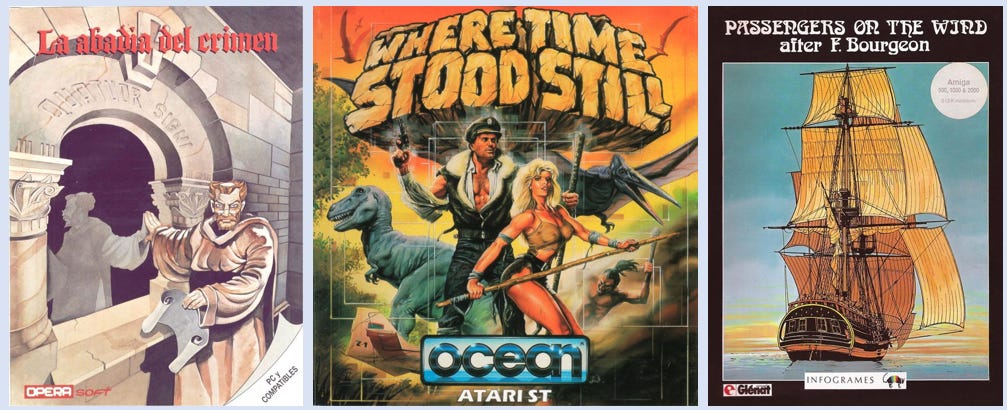
In this episode, Sean details tons of other 1980s adventure games from North America, Europe and Japan, from Transylvania to Tass Times in Tonetown to Mewilo to the MacVenture games and more! He’s Sean Jordan, and he is your Great Game Guide!(And yes, Sean has a cold, so pardon his creaky voice and the sounds of sniffling here and there!)-------------------------------------------------------------------Season 1, Episode 4: The Adventure Where Seeing is Believing, Part 2Enjoy the show? Please share it with a friend! And be sure to like it on your platform of choice or leave a glowing review.You can contact Sean via Substack @greatestgames (https://greatestgames.substack.com) or BlueSky (@greatestgames.substack.com)And if you enjoy this show, you should check out The Greatest Games You (Probably) Never Played at https://greatestgames.substack.com, Sean’s free newsletter featuring tons of great games that are obscure, overlooked, forgotten or otherwise unknown!-------------------------------------------------------------------Copyright 2026, Sean J. Jordan. Some Rights Reserved. Permission is granted for the noncommercial, free distribution and archival of this episode.Music “The Great Game Guide Theme” written by Sean J. Jordan using Online Sequencer (https://onlinesequencer.net/)Questions? Concerns? A burning desire to talk about obscure video games? Contact Sean via Substack or Bluesky. He’d love to hear from you!--------------------------------------------------SOURCES:https://arstechnica.com/gaming/2013/06/heirs-of-infocom-where-interactive-fiction-authors-and-games-stand-today/https://www.filfre.net/tag/berlyn/https://www.mobygames.com/game/90/tass-times-in-tonetown/https://dn710309.ca.archive.org/0/items/Tonetown_Times_Newspaper_HQ/Tonetown_Times_Newspaper_HQ.pdfhttps://www.theverge.com/2013/10/1/4791566/timothy-learys-neuromancer-video-game-could-have-been-incrediblehttps://advgamer.blogspot.com/2013/04/game-31-mean-streets-introduction.htmlhttp://www.hardcoregaming101.net/beyond-shadowgate-2024/https://shadowgate.fandom.com/wiki/Before_Shadowgate_(Worlds_of_Power)Before Shadowgate: https://web.archive.org/web/20010819174552/http://www.shadowgate.com/circle/novella.htmlhttps://obscuritory.com/essay/muriel-tramis-interview/Coming up in this episode –We’re going to step away from Sierra On-Line for a bit and take a look at some of the other graphical adventure games that came out alongside theirs in the 1980s and early 1990s, including adventures from Penguin Software, Accolade, Konami, Riverhill Soft, Denton Designs, Artech, Coktel Vision, Ultrasoft, ICOM Simulations, Interplay, Access Software, Activision and Cyan.I’m Sean Jordan, and I am your Great Game Guide. Let’s delve into adventure games you might be less familiar with that helped to shape the point and click genre we recognize today!What is an adventure game, and what separates it from other genres of gaming? I don’t mean to ask this question in some sort of navel-gazey way where we explore all the possible definitions of the term and then wind up pretty much agreeing that an adventure game is what we thought it was all along. In the 1980s, role-playing games and adventure games as we think of them today were both marketed as adventure games, and it took years before people started recognizing those two types of games as being not just mechanically different, but as having a different kind of appeal to different kinds of players.While we’re at it, let’s ask ourselves – what truly separates a text-based adventure game from a true graphical one? You might say, “graphics!”, but as I’ve discussed in our earlier episodes, it was pretty fashionable in the mid-80s to create or remake text-based adventures with some static illustrations to help make the games more marketable, even if the illustrations didn’t add much to the gameplay. On the other hand, Roberta Williams’s Hi-Res Adventures were proto-graphical adventure games because the games were built around your being able to see what was happening onscreen in a way that illustrated text adventures like The Hobbit or Amazon or The Pawn or even Infocom’s graphically splendid late 80s adaptation of James Clavell’s Shogun were not.You might also say “a text parser,” but it wasn’t until the 1990s that most adventure games had ditched the text parser and started to adopt mouse-driven inputs. You can blame King’s Quest V for really popularizing icon-driven point and click gameplay. It wasn’t the first game to offer it, but it was so popular with both gamers and critics that it pushed the genre forward. At least, mostly. We’ll talk about some of the most stubborn holdouts, like Legend Entertainment, in another episode.I would argue that what makes a graphical adventure game truly different from a text-based adventure is more of a feel than a list of features. Text-based adventures tend to draw your attention to the actual text that the developer authored, and that’s where you’re going to find all of the cues you need to advance through the game. Even illustrated text-based adventures can be played competently without graphics. The pictures don’t add anything meaningful to the gameplay.But graphical adventure games rely on you responding to the visual cues onscreen and often don’t describe those details effectively in the text descriptions. In the earliest graphical adventure games, like Mystery House, the graphics help to set the mood and create an atmosphere for the game that isn’t left entirely up to your imagination to fill in.I can actually offer a really good example of this from a game we haven’t talked about yet, one from 1982 that was written by a high school student named Antonio Antiochia, who created a text-based adventure centered around horror movie monsters like a vampire and a werewolf and a goblin and a witch and even space aliens. He submitted his work to a guy named Mark Pelczarski, who’d started a publisher called Penguin Software and, along with another developer named Jon Niedfeldt, created a program called The Graphics Magician for the Apple II. It was based on an earlier program called Magic Paintbrush Pelczarski had written, and similar to the graphics drawing routines Ken Williams wrote for Sierra, this program broke images down into vectors that could be drawn onscreen and filled in rather than trying to store entire finished graphic files.Pelczarski told Antiochia to illustrate the game, and this smart decision led to an adventure that was able to more effectively set a mood that fit its theme of attempting to rescue a princess named Sabrina before dawn, when she would die. But one of the most distinctive aspects of the game was a werewolf who’d stalk you mercilessly around the map, showing up onscreen in a fear-inducing silhouette.Unlike Sierra’s Hi-Res Adventures or Scott Adam’s Graphic Adventure series, the artwork for Transylvania didn’t feel like a hodge-podge of assorted images. Its artwork had a certain cohesive style that, while still amateurish by today’s standards, made the game come to life in a way that a lot of other adventures didn’t. If you remember that game I talked about a couple of episodes back called Vampire’s Castle, a pure text adventure with a frustratingly limited parser and terse descriptions of things? Transylvania did what that game was trying to do, but correctly.In fact, it was good enough to be ported pretty widely to many different home computer standards and also to receive a 1985 sequel called The Crimson Crown, which leans even more heavily into its graphics, and a 1990 sequel called Transylvania III: Vanquish the Night, a quite underrated game that might have been more popular if it hadn’t continued to use a text parser.But it wasn’t the only adventure game from Penguin Software, which would eventually change its name to Polarsoft. In 1983, the publisher also launched a sword and sorcery-style fantasy adventure called The Quest, a game that looks like an RPG from its packaging and theme, but which is really just a text-based adventure. You don’t even get a sword until late in the game!And in The Quest, we see the difference between what Transylvania pulled off and what an illustrated text adventure game looks like, because this one’s just a series of trails and paths with some occasional scenes you’ll come across, but not really much to look at. Even so, the illustrations later in the adventure do help to communicate ideas that go beyond the text, like showing off skeletons or warning signs… or a sexy gal named Lisa inside a rather modern-looking house who’s a nice change from the seemingly endless tunnels you have to travel through after you meet her and together discover some Aztec-style ruins.I don’t really recommend The Quest, by the way. But if you want to play something sort of like it, a 1982 game from Ultrasoft called The Mask of the Sun used its graphics to get you off boring walking trails and instead depict the idea of driving in a jeep between different locations on the map. This game’s notable for featuring some rudimentary animation and also some occasional sound effects, both of which were rare in adventure games of this era.One of the neater scenes involves assembling a jaguar statue, only to have it transform into an actual jaguar in front of you and then saunter off. Another involves stepping into a dark room where the graphics vanish and the text describes that you hear the sounds of snakes nearby. Suddenly, a snake appears in the darkness onscreen! It’s a fun way to add some drama to what would otherwise just be fairly unexciting text.If you happen to enjoy The Mask of the Sun, Ultrasoft also made a sequel set in Asia called The Serpent’s Star where you have to track down the city of Kara-Koram in Tibet.Let’s take a moment now to talk about some early graphical adventures in other parts of the world. In the UK, a company called Legend released a very interesting 1983 title for the ZX Spectrum called Valhalla that anticipated a lot of the ideas Roberta Williams would use in King’s Quest a year later. I doubt she ever saw this game – I wasn’t even aware of it myself until recently! – but it’s basically a sidescrolling adventure game where you wander around locations in Asgard, Midgard, Hell and Valheim in search of six treasures and type commands into a text parser. It’s nowhere near as sophisticated as King’s Quest in terms of movement or puzzles, but it’s definitely one of the earliest adventure games that can’t rely on text alone and absolutely requires graphics to portray what’s happening onscreen.Another UK-only adventure game from the ZX Spectrum was the 1984 game Tir Na Nog by Gargoyle Games. This one’s pretty wild, featuring the Celtic mythological hero Cuchulainn, which means there’s plenty of action. The gameplay involves a lot of sidescrolling movement down paths that occasionally have a crossroads allowing you to move up or down or into doorways. But it’s an adventure game at heart, requiring you to solve rather cryptic puzzles to advance. It’s also quite well-animated, using parallax scrolling to add a sense of depth and a detailed walking animation to give Cuchulainn some presence in the very visual game world he inhabits. I recommend this one if you’re willing to give ZX Spectrum games a try, and the 1985 prequel, Dun Darach, is even better.Moving to the other side of the world, let’s look at Japan, where Yuji Horii created an interesting game called Portopia Renzoku Satsujin Jiken or Portopia Serial Murder Case for the Sharp X1 in 1983. If you’ve ever played a Japanese adventure game, this one will feel very familiar because the graphics are shown in a small pane while there’s a text scroll on the bottom half of the screen to provide clues and dialogue and some menu options on the right hand side. In fact, this style of gameplay got so popular that it not only became the template for other Japanese adventure games, but also Yuji Horii’s far more famous role-playing game, Dragon Quest, which came out the next year.What’s interesting about Portopia Serial Murder Case is that it was designed around the same basic philosophy Roberta Williams developed for King’s Quest about creating a more non-linear adventure with some scripted scenes to make the gameplay feel like you were moving through a series of vignettes you stumbled upon rather than being forced to follow a pre-scripted path. Given that Japanese gamers were primarily familiar with Mystery House and a handful of other illustrated text adventures, it’s fascinating to see how the genre evolved into both crime-solving mysteries like Portopia Serial Murder Case as well as more varied fantasy fare.One of the earlier Japanese adventures, Hudson Soft’s 1984 game Salad no Kuni no Tomato-hime, better known in North America as Princess Tomato in the Salad Kingdom, started life as a rather bizarre illustrated text adventure that only accepted English commands before getting ported to the Famicom in the menu-driven style Portopia Serial Murder Case had established.But you’ve really got to see the original to believe it – the artwork is absolutely gorgeous considering the simplicity of the graphics hardware of the day, and the decision to use fruit and vegetables becomes clear since they can be depicted with expressive faces while also having simple enough shapes that they can be rendered clearly onscreen. The thing I find most impressive is how dramatically each screen depicts things as boring as buildings or pathways – always from interesting angles showcasing great use of 3-point perspective and making nearly every moment of the game visually striking.These early 80s efforts were nothing compared to what was coming a few years later, however, and as computer game graphics became more sophisticated, so did the adventure games that were incorporating them.In our previous episode, I described Ken and Roberta Williams as one of gaming’s first power couples. But of course, they’re not the only couple to have ever worked together on a game, and another couple who was involved in the creation of adventure games was Michael and Muffy McClung Berlyn.A little bit of background on Michael Berlyn – he was a writer and novelist who started out at Sentient Software before moving to Infocom as an implementor and writing Suspended, Infidel and Cutthroats and also joining the team to create Infocom’s one of a kind digital board game Fooblitzky, a dismal flop of a cool idea which we’ll talk about in a future episode. Michael soon bounced around between large publishers like Activision, Electronic Arts, Accolade and even created a game you probably have heard of called Bubsy in: Claws Encounters of the Furred Kind, an animal mascot platformer we will also talk about in a later episode. Muffy assisted Michael on several of his games as a writer and contributor, but most of the games she’s credited on aren’t titles that are widely familiar today, including Oo-Topos, Altered Destiny and Dr. Dumont’s Wild P.A.R.T.I..After awhile, Michael burned out on making console games and tried to start a new publisher called Cascade Mountain Publishing to focus on interactive fiction. It made it just a couple of years, and he and his wife largely vanished from game development before emerging making mobile interactive story games for casual audiences under the label Flexible Tales. These titles included The Art of Murder, A Taste for Murder, Reconstructing Remy, Ogg! and the wonderfully-named Grok the Monkey, also known as Carnival of Death. Unfortunately, all of those mobile games have been delisted and I could barely find any information about them in my research.I also sadly must say that Michael Berlyn passed away from cancer in 2023.But let’s go back to the 1980s, where Michael and Muffy were younger game developers also teaching creative writing at Harvard. According to an interview Michael gave to a MobyGames contributor, the two liked to play on Harvard’s motto, “Veritas,” which means truth in Latin, by saying “very tass” to agree with something as being true. Their students picked up on it and started using it to describe things that were hip or cool.That’s part of the origin story behind their 1986 adventure game Tass Times in Tonetown, a graphical adventure game that started out under the working title Ennio: The Legend Begins, referencing the hip dog in the game who is a pet named Spot in our reality but a celebrity journalist named “Ennio the Legend” in the alternate reality of Tonetown. And as the manual’s opening poem asks, “are you tass? Are you tone?” And even if you’re not, you might find this adventure to be a quirky favorite, because it really is quite different from anything else from the mid-80s, or the decades that came after, really. The included 4-page Tonetown Times newspaper definitely gives you a feel for this intriguing alternate reality.One of the interesting aspects of Tass Times in Tonetown is that it uses a graphical interface to accompany its text parser, and you can navigate the game with a joystick or mouse and type in occasional commands instead of relying entirely on the parser. The game’s bold graphics, fun fashions and bizarre characters add a lot of charm to the adventure, and the images are even lightly animated, which was not common for games of the era.While this game clearly falls in the realm of “cult classic” rather than “major hit,” Michael and Muffy got another shot at taking players into a different reality at Accolade with Altered Destiny. It’s a 1990 graphical adventure game that looks quite similar to Space Quest III, but which involves a modern day human named P.J. Barrett getting sucked into a portal in his TV and wandering around a strange new world called Daltere, eventually learning he has to find the Jewel of Light to save the galaxy from an evil alien. Unfortunately, Altered Destiny also featured a text parser in a year where gamers were getting more used to mouse-driven commands thanks to adventure game publishers such as Sierra On-Line and LucasFilm Games. It’s an interesting, but also clunky, adventure game to play today.Michael also worked on another adventure game series at Accolade that began with Les Manley in: Search for the King, a Leisure Suit Larry-style adventure game that’s very funny, but which was likewise hampered by its text parser. The 1991 sequel, Les Manley in: Lost in L.A. adopted the point and click style of the Sierra games but also went for inserting mostly cringey digitized graphics in close-ups instead of character animations to suit the game’s otherwise traditional point and click style. It’s kind of jarring.Speaking of Accolade, the company wasn’t always chasing Sierra’s lead, and one of their more innovative adventure games by Distinctive Software, called Accolade’s Comics, came out in 1987 with the promise of allowing players to play a branching story starring Secret Agent Steve Keene, Thrillseeker! At the beginning of the game, you’re given the choice to investigate what’s happening with some strange fire hydrants spontaneously reproducing around town or visit Vienna in search of a professor who’s gone missing. The game is presented in comic strip form and you choose Steve Keene’s dialogue choices to shape the story. While the game was designed for 8-bit computers and the graphics are low-resolution, the cartoony charm does make this one an adventure worth experiencing, even if the story itself is largely a framing device for a bunch of so-so minigames.Activision released an interesting graphical adventure game in 1986 called Portal and no, it’s not the one you’re thinking of, but instead something more akin to what we’d call a “walking simulator” today written by Rob Swigart, who’s also since made a novelization of the game available. The premise is actually pretty neat – you’re a human astronaut who’s been away from Earth for 100 years and you return to find everything’s gone wrong in your absence. Tapping into a global network, you and your helpful AI companion Homer try to uncover clues to figure out where humanity went. It’s a truly interesting game that’s well worth experiencing.Another Activision adventure from this era that’s quite unique is called Hacker, a game that famously shipped without a manual and challenged players to figure things out for themselves. It simulates breaking into a remote computer terminal and eventually stumbling on a global conspiracy that requires you to take control of autonomous robotic drones to travel through a subterranean tunnel between cities so you can locate contacts and gather evidence to foil the conspirators. This game came out in 1985, and a sequel, Hacker II: The Doomsday Papers, followed in 1986. I recommend them both.If you recall our previous episode about text-based adventure games being adapted into bookware, you might wonder when the first true graphical adventure games based on books debuted. One of the earliest was Interplay’s adaptation of William Gibson’s cyberpunk novel Neuromancer, which was intended to tie into a film adaptation that never happened. Interplay got the rights after a prior attempt by psychologist and psychedelics enthusiast Dr. Timothy Leary fell through. Interplay’s version wasn’t nearly as ambitious as what Leary had in mind, but it did turn out to be a competent point and click adventure game where players used a cursor to click on icons and environmental elements, all while a Devo song called “Some Things Never Change” plays in the background.By today’s standards, Neuromancer doesn’t look anything like a cyberpunk game beyond its forays into Cyberspace. It’s brightly colored, the characters speak in cartoon bubbles and the main character, Chase, often has a smile on his face as he explores Chiba City. The razorgirl Molly Millions, a major character in the book, doesn’t make any appearance in the game, and you also never travel around the world or get into any of the crazy intrigue that occurs in the book.Even so, it’s long been one of the only visual adaptations of the famous novel, and until the Apple TV show comes out at some point in the future, it’s one of the only ways to experience the story without just reading the book, which you absolutely should, by the way.And I’m looking forward to a future episode where we can talk about the cyberpunk genre in a lot more detail.But now, let’s transition over to the Macintosh, where a developer called Cyan published a game through Activision called The Manhole using the Mac’s HyperTalk programming language. It’s a whimsical adventure for children quite similar to, but not explicitly based upon, Alice in Wonderland. It’s also the sort of mouse-driven experience where you click on the screen to make everything happen – there’s no parser, and beyond some cartoon dialogue bubbles or labels on things, very little text. It’s also a splendid-looking title with gorgeous graphics even in its original black and white version. Cyan followed it up with a couple of other kid-friendly adventures called Cosmic Osmo in 1989 and Spelunx and the Caves of Mr. Seudo in 1991, but if you know this developer by name, it’s probably because of their 1993 smash hit, Myst, which became a turning point for graphical adventure games. We’ll talk about it in our next episode as we explore the influence of multimedia gaming on the genre.I want to mention one more 80s adventure game from North American developers, and it’s Mean Streets, a 1989 release from Access Software starring a detective named Tex Murphy, who’d go on to star in a number of games, including a sort-of remake in 1998 called Tex Murphy: Overseer. Mean Streets definitely takes some cues from Blade Runner and has a dystopian cyberpunk vibe, but it leans a little more heavily into the tropes of hard-boiled detective fiction as you roam around San Francisco in the year 2033. The game was originally intended to be a story-driven follow-up to Access Software’s 1987 space flight sim adventure hybrid Echelon, but it turned into more of a pure adventure, fusing hand-drawn and digitized graphics to tell its story. Fortunately, these were a little more convincing than those in games like the Les Manley sequel.As the series evolved, writer Chris Jones, who also stars as Tex Murphy in the games, took more and more of a role in designing them as traditional adventures and ditching the elements derived from Echelon. The 1992 sequel, Martian Memorandum, added in digitized video, something that would become a staple of this series as it became one of the showcases for multimedia gaming.Again, we’ll cover that in our next episode. But for now, let’s turn our attention back overseas for some other adventure games from the late 1980s.In 1980, author Umberto Eco published an Italian-language novel called The Name of the Rose, a fantastic murder mystery set in the medieval era that included elements of Catholicism, monastic life, semiotics and classic literature. The book received a 1986 Hollywood film adaptation starring Sean Connery and Christian Slater, but it did a poor job of translating the cerebral story and also completely changed the ending. As usual, the book is better than the movie, and I’d recommend the novel to anyone who enjoys literature for its ability to provoke you to think.I mention this because as we talk about European adventure games, we can turn to 1987, when the Spanish publisher Opera Soft released a game called La Abadia del Crimen, which means The Abbey of Crime, and it was pretty clearly an adaptation of The Name of the Rose in all but name. As it happens, Opera Soft couldn’t get the rights to the book, so they had to change the story enough to keep the game original. Even so, this surprisingly strong isometric adventure managed to be one of the jewels in the crown of the Spanish software scene during a time now referred to as the Golden Era of Spanish Software between 1983 and 1992. Sadly, the game has never been officially released in English and is only playable in English with a fan patch. Fortunately, it’s not too hard to find one, and it’s entirely worth your trouble.Another isometric adventure game from the same era is 1988’s Where Time Stood Still, a truly remarkable game from Denton Designs in the UK where a family and their plane’s pilot crash in a strange prehistoric land and have to try to survive a harrowing journey to safety. Part of what makes the game so interesting is that it’s possible for some of your characters to die, limiting your options in dealing with hazards or the people you encounter. The limited graphics also allow the game to make strong use of its black and white classic movie vibe – an effect Denton Designs had used in their 1986 isometric adventure The Great Escape, but which fits this game’s atmosphere so much better.Over in France, the publisher Infogrames created a two-part adventure game series for the MSX called Passengers on the Wind, based on the comic book series by Francois Bourgeon. I’ve never read the comics myself, but the games are supposed to follow their seafaring historical fiction plot very closely, and they also replicate the look of comic books with paneled artwork, speech bubbles and a graphical interface. The 1986 original game involves a seaward journey to Africa from Brittany, France during the time of the French Revolution and allows players to take on the roles of many different characters. The 1987 sequel has the crew land in Western Africa and further explores the dynamics of the trans-Atlantic slave trade.On that note, I also don’t want to forget the French studio Coktel Vision, which in 1986 hired a game designer named Muriel Tramis, widely acknowledged not only as the first black female game developer, but also as the Roberta Williams of France. Her first game, Méwilo debuted in 1987 and told a story about the town of Saint-Pierre on the Caribbean island of Martinique the day before a volcano would erupt and destroy the town. This game had particular relevance to Muriel Tramis because it’s set on the island her family is from, but the story also puts you in the shoes of a paranormal investigator who’s looking for a zombie that’s reputed to be the spirit of a slavemaster. Unfortunately, the game was only released in French and German, and many of her other games from the 1980s only came out in French. One that did make it to the US is 1989’s Emmanuelle: A Game of Eroticism, which is based on the erotic 1974 novel that’s been the inspiration for plenty of pornography, but the game itself was not well-received because it’s told from the perspective of the man trying to seduce the book’s sexually liberated female rather than from the female’s point of view. Another of her erotic games, Geisha, debuted in 1990 and got a multinational release as well, but it’s not a game I’d recommend.We’ll talk more about Muriel Tramis when we get to the 1990s, because she’s also the driving force behind the family-friendly Gobliiins series and the cartoony adventure The Bizarre Adventures of Woodruff and the Schnibble, both of which were published outside of France by Sierra On-Line.Another French developer who was making adventure games in the late 1980s was Exxos, a label of ERE Informatique known for some really strange and surreal games like Captain Blood and Purple Saturn Day. They’d later go on to reform as Cryo Interactive, but as Exxos, they released a strange point and click adventure game through Infogrames called Kult: The Temple of Flying Saucers, but released in the United States as Chamber of the Mutant Sci-Fi Priestess. This game is incredibly bizarre, taking a lot of design cues from the artwork of H.R. Giger and featuring a disembodied fetus in the upper corner of the screen and an action menu that resembles some sort of alien creature. Oh, and you also get to fight lizardman aliens. It’s definitely a trip.In 1989, the similarly French publisher Ubisoft published developer Computer Dream’s cyberpunk spaceport game B.A.T., which means Bureau of Astral Troubleshooters. It’s a really good-looking adventure game where the action is presented in graphic novel-style frames, and while there’s plenty of text to read, the game itself involves clicking rather than attempting to type commands into a text parser. The first game’s a tad on the short side, though, and it’s really the 1992 sequel, B.A.T. II – The Koshan Conspiracy, that delivers on the promise the first game shows.And one more French developer worth mentioning from 1989 is Delphine International, who released the absolutely visually striking time travel game Future Wars: Adventures in Time, an interesting but way too short adventure that is most famous today for the involvement of Eric Chahi, who’d go on to create Another World, also known as Out of This World, in 1991. But Delphine got to make a more high-profile adventure game in the meantime, 1990s’ 007: James Bond - The Stealth Affair, which tells an original story about Ian Fleming’s classic spy but delivers a point and click adventure game experience as good as anything else that was on the market that year.Delphine followed this game up with 1991’s Cruise for a Corpse, a game that feels like it might have started as an Agatha Christie adaptation before being retooled as an original game. Even so, it’s a gorgeous point and click adventure and offers a compelling mystery to solve, and that leads us to another subgenre of graphical adventure games we haven’t really talked about yet: murder mysteries.In 1983, Free Fall Associates released a crime-solving game through Electronic Arts called Murder on the Zinderneuf where you play as a detective trying to solve a crime aboard a dirigible where fifteen different passengers are suspects. Every single time you play, the clues change, as does the identity of the killer and his or her motive, and it’s up to you to try to figure out how to get the right information in time to accuse the killer before the Zinderneuf lands.This basic concept is more or less the structure for many mystery games, though as the years went on, the mysteries tended to cement the identity of the killer and make the gameplay more linear as a result. This of course allowed for more sophisticated puzzles, but it also meant that the games lost a lot of their replay value.Killed Until Dead is one of the games that held onto the idea of randomizing the details. It debuted in 1986 developed by Artech and released through Accolade and, I must admit, has a gripping yet absolutely silly title. But the game also doesn’t take itself seriously. The premise is that five mystery writers have checked in to your hotel and you have to catch one who intends to murder another one before the deed actually happens. You do this by conducting incredibly intrusive surveillance with listening devices, cameras and room sweeps. Even so, the game itself is a lot of fun and involves some pretty serious logic puzzles to solve.Interplay’s Borrowed Time, released through Activision in 1985, takes the opposite approach of providing a linear mystery you solve by visiting suspects at the right times in the right places. The game is basically a text adventure with an added graphical user interface on top, and it’s built on the text parser from the game Mindshadow, but the graphics go a little beyond just illustrating the plot, providing animations and even some details that you can’t get from the text alone, particularly when it comes to hidden objects.The Scoop is a 1987 point and click adventure from Dale Disharoon and Telarium based on a novella by the London Detection Club, a group of writers that included Agatha Christie as a member. The game’s actually about a reporter, not a detective, who’s trying to save the newspaper The Daily Courier from going out of business and has to solve a series of crimes resulting in two murders. The game’s somewhat aggravating because it requires you to be in the right places at the right times to hear characters in the game world give needed information, but modern players who are used to roguelikes will have no trouble restarting the game over and over to get the details right.Murder on the Mississippi is a 1986 mystery adventure game from Activision that’s basically a parody of Agatha Christie’s novel Death on the Nile. Instead of traveling in Egypt, you’re heading up the Mississippi River on a steamship from St. Louis to New Orleans. As Sir Charles Foxworth, you have three days to solve the murder. The game plays a little differently from other adventure games because you control it with a joystick instead of the keyboard, and this led the game to be ported to some Japanese systems and the Famicom. Unfortunately, the Japanese versions are so bad this game is well-known as a kusoge, or “crappy game.” The American version, however, is quite playable, and even fun, particularly on the Commodore 64.Speaking of Japan, let’s turn our attention for a moment to Riverhill Soft’s Murder Club, also known in Japan as the first game in the J.B. Harold series. The premise of the game is that you’re a private detective who has to go around and talk to people to gather evidence to locate the murderer of a rich man. If you’ve played modern visual novel-style mysteries like the Ace Attorney games, you’ll have a pretty good understanding of how this game’s menu-driven dialogue trees and opportunities for action work – you can question witnesses, review old cases, examine evidence and even visit the crime lab. In Japan, this game led to several sequels that even culminated in a fully digitized multimedia game in 1994.Another Japanese game in a similar vein is Hideo Kojima’s Snatcher, which also uses the menu-driven interface Japanese adventure games have tended to utilize since Portopia Serial Murder Case, but which takes place in a cyberpunk world that’s more or less Blade Runner with some different names for things, like JUNKER Runner for Blade Runner and Snatcher for Replicant. Snatcher is not only a fun mystery game with some unexpected bursts of action, but also features the cute Metal Gear mk. II mech as your constant companion. Kojima’s 1994 adventure game Policenauts is similar mechanically, but entirely different in terms of tone and structure.One more game I want to mention from outside the US is The Detective, a 1986 UK Commodore 64 game by Argus Press Software where you control Inspector Snide of Scotland Yard. Your job is to investigate the mansion of Angus MacFungus, who’s recently been murdered. Similar to Murder on the Mississippi, the game’s joystick-driven with a menu that pops up when actions are available. Though it’s an isometric game, the graphics are quite cartoony and distinctive, quite similar in style to Maniac Mansion, but with more of a British flair. As the game progresses, more murders happen, and you have to solve the case before time runs out. But part of the fun is understanding how the NPCs move around the mansion and how you can use secret passages to shorten your time traveling around it.Surprisingly, the 1980s didn’t have a lot of Sherlock Holmes games, something that would become a staple in the 1990s multimedia era. Infocom and Challenge’s 1988 Sherlock: The Riddle of the Crown Jewels was a text adventure, and the 1986 Commodore 64 game 221 B Baker St. was a board game adaptation. Bantam Software did create a 1985 Macintosh game called Sherlock Holmes in “Another Bow”, but it’s so easy it’s not worth recommending.Beyond everything we’ve discussed, the 1980s also had a great run of mystery games on the Macintosh, so good that they’re today referred to as the “MacVenture” games. And if hearing about them gives you a sense of Déjà vu, you know what’s coming next.You don’t have to be super familiar with the history of the Apple Macintosh to know that the computer was released in 1984 following a very famous advertisement playing up the whole “let’s tear down Big Brother with our hip new computer” idea. The Apple Macintosh was one of the first mainstream personal computers to be driven by a graphical user interface, and though it was certainly a niche machine that appealed to a certain type of computer user, the clean graphics, windowed environments and mouse-driven interface made the Mac a lot less intimidating to a casual user than a typical keyboard-driven command-line computer.But one thing the Macintosh is also famous for is its lack of games, though that notion is a little overblown. According to MobyGames, the Mac had about 300 games released between 1984 and 1989 and close to 2000 games released in the 1990s. A lot of these were ports, of course, and even the Mac’s own exclusives tended to get ported to more popular platforms where they could sell better.In 1985, a little developer in Wheeling, Illinois called ICOM Simulations created one of the Mac’s first truly great games, a graphical adventure game called Déjà Vu: A Nightmare Comes True. The game takes place in Chicago in the 1940s and puts you in the shoes of a gumshoe with a bad case of amnesia who has to clear his own name from a murder for which he’s been framed.It’s quite different from many other graphical adventure games of the era because you have to find an antidote to cure your memory loss and fill in gaps in the backstory. Failing to take the antidote on time can actually cause you to lose your mind entirely and wind up in a mental hospital, and it’s easy to wind up in that state when you get out on the streets and start getting hassled by a time-wasting mugger. Déjà Vu is definitely a game where even knowing the exact sequence of required events won’t necessarily get you through the adventure without having to reload or start over, and Déjà Vu is also rather infamous for killing your character suddenly and without much warning.But the other thing about Déjà Vu that’s notable is that everything is entirely cursor-driven. There is no text to type in and you can interact with objects in the game world directly by clicking or double-clicking on them, depending upon which version you’re playing. This interface design made sense on the Mac with its including mouse, but it also allowed the game to be ported to other platforms like the Commodore 64 and even the Nintendo Entertainment System, where the cursor could be moved around with a joystick or d-pad instead of a mouse. Déjà Vu is so well-designed as an adventure game that even on these less graphically-intensive 8-bit platforms, the game plays well and remains fun. In fact, I’d hazard to say far more people have played the slightly sanitized NES version than the Macintosh original.ICOM’s next game debuted in 1986, but instead of offering another hard-boiled detective story, this game, Uninvited, has you survive a car accident and go searching for your missing sibling at a nearby mansion that’s noticeably decrepit and almost certainly haunted. As the game progresses, it becomes clear that the place was once the home of a powerful sorcerer whose evil apprentice trapped the souls of many of the people who lived there. And if you somehow survive all the danger but don’t complete the game within a proscribed set of moves, you, too, will become one of its undead residents.Uninvited is often considered the lesser of the MacVenture games because it’s tremendously difficult and requires players to piece together cryptic clues found around the mansion to solve puzzles. You also have to locate the lengthy magic phrases used to cast spells and type them in to use them. It’s also the one case where the NES port is probably the best version to play because it gets rid of the time limit, offers clearer hints and lets you select spells from your inventory, among other changes.ICOM Simulations followed this one up with a far more popular adventure in 1987 called Shadowgate, and while it is similar to Uninvited since you’re exploring a Warlock’s castle this time around, the setting is more clearly grounded in a medieval fantasy world and you’re a more traditional hero-king saving the day than a hapless adventurer trying to piece things together. Unlike Uninvited’s move limit, Shadowgate has a finite number of torches you can use, and once you’re out of them you stumble in the darkness and break your neck.Shadowgate’s most defining quality, however, is how gleefully it kills you. This is a game where you will die a lot and the game will take seemingly delight in describing your demise. In fact, some of the game’s darker elements managed to sneak past Nintendo of America’s censors, so even the NES version retains a lot of the horror-infused flavor of the original, and it’s definitely the best-known and most popular version today. Even so, there’s a certain charm to playing the game on the Mac because the black and white graphics add to the horror, and the game’s balance of battling monsters, solving puzzles and collecting the three pieces of the Staff of Ages needed to stop the Warlock Lord make for a compelling adventure that feels a bit like an RPG even if it’s more firmly rooted in traditional adventure game mechanics.Shadowgate was so popular it inspired a 1993 TurboGrafxCD sequel exclusive to North America called Beyond Shadowgate, but it is very different, looking and playing much more like a Sierra-style adventure game with more cartoonish graphics. This is not to be confused, by the way, with a 2024 game published by Zojoi that plays much more like the NES port of the original and which is based on a sequel design document by the game’s co-creator, Dave Marsh, that was never used. It takes place a few decades after Shadowgate and stars a hero named Del who’s trapped in the castle.There’s also a 1999 sequel called Shadowgate 64: Trials of the Four Towers developed by Infinite Ventures for the Nintendo 64 that also stars a hero named Del, but this story takes place centuries later and has a far more fleshed-out storyline that involves stopping an evil apprentice from resurrecting the Warlock Lord.And there’s even a prequel novel! If you recall in an earlier episode, I mentioned Seth Godin’s “Worlds of Power” youth novel series written by the fictitious author F.X. Nine. Most of these books are really terrible, but the book Before Shadowgate actually had some input from the original developers, Dave Marsh and Karl Roelofs. No need to track the book down, though – Infinite Ventures released it freely on their website and you can check the show notes if you’d like to give it a read!ICOM Simulations’ final MacVenture game definitely feels like history repeating itself, because it’s the 1988 sequel Deja Vu II: Lost in Las Vegas. But this time, the action moves out of Chicago and doesn’t involve an amnesia storyline. It’s instead a more conventional private eye type of story where you have to find a way to track down some missing mob money before a hitman decides you’re out of time and ends the game for you. It’s not quite as memorable as the original game and feels like a more conventional graphic adventure game in many ways, but it’s also notable for some rather obtuse puzzles that practically require you to consult a walkthrough.After the MacVenture series, ICOM Simulations largely moved on to making games for the TurboGrafx-16 and TurboGrafxCD as well as creating the Sherlock Holmes: Consulting Detective multimedia series for the PC that shifted their focus from graphical adventure gaming to the flashier, but less interesting, full motion video adventures. They also developed some Looney Tunes Super Nintendo games through Sunsoft before they got acquired by Viacom and started cranking out games based on cable television IPs like Rocko’s Modern Life, Aaahh!! Real Monsters and MTV’s Beavis and Butt-Head.ICOM’s last great game before this shift was, quite fittingly, a full-motion video adventure in the style of Shadowgate but also based on a popular IP at the time. It was called Dracula Unleashed, and we’ll definitely cover it when we talk about multimedia adventure games in a future episode.But for now, we really need to finish out the 1980s by talking about LucasFilm Games and the advent of Sierra On-Line’s SCI interpreter, which led to the modern style of point and click adventure games we still play today and which allowed some other power couples and female creators beyond Roberta Williams to make some truly great graphical adventure games!And we’ll cover that, and more, in our next episode!If you enjoy this show, you can read this series every week on my Substack at Greatestgames.substack.com, where you’ll also find brand new articles on other great games you’ve never played.And you’re always welcome to talk with me on Bluesky!I’m Sean Jordan, I am your Great Game Guide, and I’ll be back next week with more to explore!THIS WEEK’S RECOMMENDED GAME TO TRYBefore I let you go every week, I close out the show with a game I want you to try that’s a little off the beaten path. This isn’t sponsored content and I don’t have any financial stake in anything I recommend; these are games that I think are really good but don’t have as much exposure as some of the more popular ones.This week, I want to recommend Rosewater, a point and click adventure game from Grundislav Games and designed by Francisco Gonzalez. The premise of the game is that you’re a writer named Harley Leger who’s taken a newspaper job in the frontier town of Rosewater. Your first assignment is to cover a Wild West frontier show being performed in town by Gentleman Jake Ackerman, a quick-witted Buffalo Bill-type who can talk himself into trouble as quickly as he can talk himself out of it. He’s also relying pretty heavily on his young assistant, Danny Luo, to do the actual trick shooting and cowboy stuff.Later on, you head out on a treasure hunt and soon stumble onto a plot involving an errant scientist who’s behind some wild technology that feels like an offshoot of Rosewater’s predecessor, the 2019 steampunk adventure Lamplight City. And this is where the game gets interesting, because you begin acquiring other allies and soon embark on a road trip where you begin playing through vignettes that can last a few minutes or involve a far deeper encounter. Over time, you get to know all of your allies far better as Harley learns more about their backstories, and there are many points where you have to make choices in the game that impact the outcome of those relationships.Though Rosewater takes place in the fictional world of Vespuccia, its reflection of our own Wild Western frontier is interesting because it offers some critique of the dynamics of the day through both a historical and modern lens. There are ne’er do wells who try to scam you, freedom fighters who are trying to hold onto their land, native tribes who are trying to balance kindness and caution, and even a religious cult that’s trying to make a better life for its people by covering up a dark secret. Once you reach the city of El Presidio and move into the endgame, Rosewater makes you feel like the journey you’ve been on has been more than just a sequence of events, but a true adventure across a wild land where anything can happen.It reminds me a lot of the Sierra On-Line games Gold Rush! and the Conquests of Camelot and Conquests of the Longbow games, and that’s high praise, because I love those games and wish there were more adventures like them.Rosewater is worth the $20 asking price – it’s a surprisingly lengthy game with great voice acting, a memorable story and distinctive artwork – but as of this writing, I’ve seen it on sale as low as $15 on Steam and GOG. That’s a great value, and you can often even find it bundled with Lamplight City, another tremendously worthwhile game that of course has some intersection with this one. Be sure to play them both!https://store.steampowered.com/app/1226670/Rosewater/ This is a public episode. If you would like to discuss this with other subscribers or get access to bonus episodes, visit greatestgames.substack.com
NOW PLAYING
Season 1, Episode 4 – The Adventure Where Seeing is Believing, Part 2
No transcript for this episode yet
Similar Episodes
Mar 26, 2026 ·1m
Mar 19, 2026 ·34m
Feb 18, 2026 ·11m
Feb 11, 2026 ·45m