
EPISODE · Mar 2, 2026 · 42 MIN
Season 1, Episode 7 – The Adventure Where Seeing is Believing, Part 5
from The Great Game Guide · host Sean J. Jordan
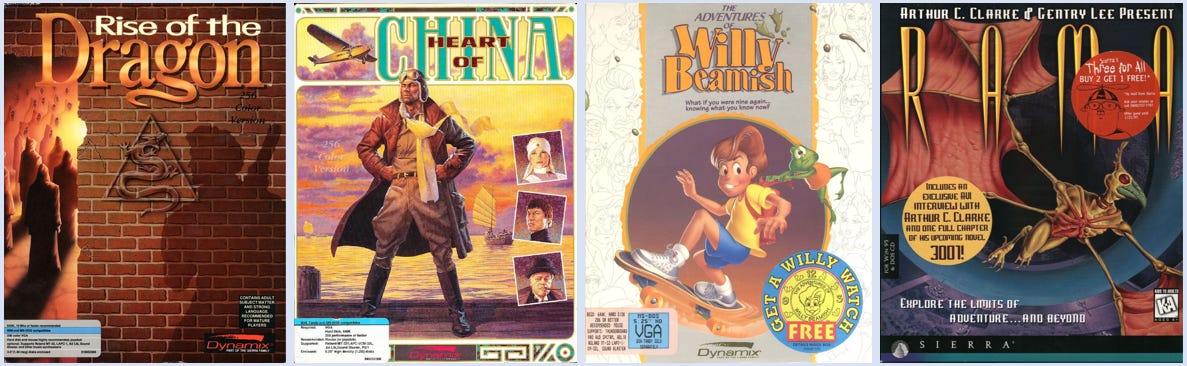
In this episode, we’re going to talk about some of the other adventure games published by Sierra from Coktel Vision and Dynamix including the Gobliiins games, the Inca games, The Adventures of Willy Beamish, Rise of the Dragon and Funny Bone Interactive’s Stay Tooned! Sean will take you on an expedition through games you’ve probably never played. He’s Sean Jordan, and he is your Great Game Guide!-------------------------------------------------------------------Season 1, Episode 7: The Adventure Where Seeing is Believing, Part 5Enjoy the show? Please share it with a friend! And be sure to like it on your platform of choice or leave a glowing review.You can contact Sean via Substack or BlueSky (@greatestgames.substack.com)And if you enjoy this show, you should check out The Greatest Games You (Probably) Never Played at https://greatestgames.substack.com, Sean’s free newsletter featuring tons of great games that are obscure, overlooked, forgotten or otherwise unknown!-------------------------------------------------------------------Copyright 2026, Sean J. Jordan. Some Rights Reserved. Permission is granted for the noncommercial, free distribution and archival of this episode.Music “The Great Game Guide Theme” written by Sean J. Jordan using Online Sequencer (https://onlinesequencer.net/)Questions? Concerns? A burning desire to talk about obscure video games? Contact Sean via Substack or Bluesky. He’d love to hear from you!--------------------------------------------------SOURCES:https://www.sierragamers.com/Heart-of-China/“Inca People” song: https://www.youtube.com/watch?v=gdskBQ5uS-Q--------------------------------------------------Coming up in this episode –We’re talk about Sierra’s educational adventure games including the Dr. Brain series, the EcoQuest games and Pepper’s Adventures in Time, and then we’re going to take a look at what Dynamix was up to with The Adventures of Willy Beamish and Rise of the Dragon and also what Coktel Vision added to adventure gaming with the Inca games, The Adventures of Woodruff and the Schnibble, Gobliiins and more. I’m Sean Jordan, and I am your Great Game Guide. Consider this the B-side to last week’s episode of more familiar Sierra games from the 1990s, because we’re gonna cover some titles you may have seen or played as well as some you may even not be aware of!When people think Sierra On-Line, they tend to think first of games with “Quest” in the title – King’s Quest, Space Quest, Police Quest, Quest for Glory, Conquest of Camelot, The Colonel’s Bequest, and, of course, Leisure Suit Larry, which doesn’t have quest in the title, but promises a titillating view of some body parts that at least rhyme with quest.But I covered Leisure Suit Larry and many of those other titles in last week’s episode, and so it seems only fitting that we cover the opposite end of the spectrum now by starting out with the Sierra Discovery titles, an edutainment line that started life in the 1990s and which were geared more generally towards children. Many of these games featured an animated style that helped to sharpen the studio’s skills as graphical adventure games progressed from the painted realism of the early 1990s to the cartoonish buffoonery of the mid to late 1990s.One of the most notable series is the quadrilogy of Dr. Brain games created by Corey Cole, which began in 1991 with Castle of Dr. Brain and eventually spawned the Island, Lost Mind and Time Warp of Dr. Brain between 1992 and 1996. The Dr. Brain games were marketed as part of the Sierra Discovery edutainment series due to their puzzles and allusions to science and math, but beyond the first one, which was the only entry in the series in which Corey Cole was involved, I don’t find any of these particularly special or worth recommending today. Sierra also produced two remakes of Roberta Williams’s Mixed-Up Mother Goose and a sequel called Mixed-Up Fairy Tales designed by Lori Ann Cole under the Discovery era. We’ve covered the original AGI version of Mixed-Up Mother Goose already, but I’ll note that the 1991 version came with digitized speech on both the floppy and CD-ROM edition and fully ported the game’s action to the point and click system common to the SCI1 games, though there are some differences between the two versions in terms of gameplay as well as some changes from the original. There’s also the 1995 Mixed-Up Mother Goose Deluxe, which looks and plays like an adventure game storybook and offers Super VGA graphics and lots of well-produced music to entertain the little ones, though it has some pretty awful voice acting. I actually prefer the 1991 version to it.But Mixed-Up Fairy Tales only got one version, and it’s actually quite a good game for what it is. When it starts, you choose your gender and appearance from some pre-selected avatars and begin wandering around a fairy tale village where, as you might expect from the title, things need to be set right so you can help various fairy tale characters from the tales of Cinderella, Beauty and the Beast, Snow White, Jack and the Beanstalk and the animals who intend to become the Bremen Town Musicians complete their stories. The game looks great and has a wonderful soundtrack of arrangements from classical music. If you have an hour or two to kill with a little one and don’t mind reading the text to them, it’s a decent time.The Sierra Discovery series had a few other games as well. The 1992 game Quarky & Quaysoo's Turbo Science was produced by Jeff Tunnell Productions. If you don’t know who Jeff Tunnell is, by the way, he was one of the co-founders of Dynamix, which we’ll talk about in a bit, and he broke off in 1990 to form his own development studio, which created games like The Incredible Machine, Sid & Al’s Incredible Toons and 3-D Ultra Pinball. His team also made three graphical adventure games we’ll cover in more detail when we talk about Dynamix later in this episode.Quarky & Quaysoo's Turbo Science is about two space creatures who race around with other aliens using science to help their vehicles gain an edge. The game’s broken up into animated screens where you answer quiz questions about various science-related events before you hop in your vehicle and move on to the next checkpoint. It’s well-animated and mildly fun for an educational title, but a bit tedious due to all the pop-ups with science questions you need to answer to advance. What’s most notable about this game is its emphasis on strategy, which is a bit unusual for an adventure game – it actually rewards skillful play and encourages players to learn to answer questions correctly so they can beef up their racing gear earlier on in the game.1993’s Pepper's Adventures in Time is a more conventional point and click adventure game with a red-haired girl named Pepper traveling to different eras in time to save her dog, Lockjaw. While it doesn’t feature voice acting, the game’s dialogue is presented in cartoon bubbles. This game is actually a legitimately decent adventure that’s mildly educational but also quite funny, perhaps because it was designed by many of Sierra’s all-stars, including Bill Davis, Mark Seibert, Jane Jensen, Josh Mandel, Gano Haine and Lorelai Shannon, who’d all worked on many of the Sierra games most people know today. The game’s graphics and animation are also wonderful, very much portrayed in the same quirky style of the Nickelodeon and Cartoon Network shows of the 1990s. If you’re a fan of the Hoagie section of LucasArt’s Day of the Tentacle where you get to interact with the founding fathers of the United States, you will love this game. It even has a scene with Benjamin Franklin and a mad scientist character named Uncle Fred!Sierra Discovery’s EcoQuest series is also worthwhile, less an educational series than a product of the sort of preachy environmentalism of the early 1990s that spawned things like Free Willy and Captain Planet and the Planeteers.The first game, 1991’s EcoQuest: The Search for Cetus, was created by Bill Davis and designed by Gano Haine and Jane Jensen, and it’s an easy point and click adventure where a ten-year-old boy named Adam Greene befriends a distressed dolphin named Delphineus, who happens to be able to speak perfect English for some reason. The two eventually head out on a journey to the undersea kingdom of Eluria in search of a whale king named Cetus, with Adam learning about underwater ecosystems and pollution and marine conservation along the way.The 1992 sequel, which is simply titled Lost Secret of the Rainforest, was this time led by Gano Haine and features a slightly older Adam now able to speak to all sorts of animals – and y’know, that was probably how they should have played things in the first game, just making Adam a Dr. Doolittle type from the start.This time, Adam’s on the ground above, exploring tropical rainforests in search of some medicine to help a distressed tribe. I personally think this game’s a little more interesting than the first EcoQuest, but also guilty of the white savior narrative you often see with stories about indigenous tribes. It also gets a little Indiana Jones-ish towards the end when you start exploring ruins. I’d recommend giving this one a try if you haven’t, because it is a fun and worthwhile adventure that’s not nearly as preachy as you might assume.But a word of warning - if you like voice acting in your adventure games, only the first EcoQuest got an upgrade to a multimedia talkie edition.Alongside Sierra’s edutainment series, the publisher was also busy localizing games from the French publisher Coktel Vision that also had a strong appeal to children. Ken Williams had already had Sierra localize some Japanese action titles like Thexder, Silpheed, Sorcerian and Zeliard from Game Arts, but the Coktel Vision games were a better fit for the publisher because many of them were adventure games. In fact, with the exception of the educational series Adibou and a few of their earlier games, Sierra published almost everything Coktel Vision developed from 1990 through 1996 and even decided to purchase them, with a sale closing in 1993. Coktel Vision remained a part of Sierra throughout the 1990s, and while I won’t bore you again with the convoluted history lesson of late 1990s mergers and acquisitions in software publishing that eventually knocked Sierra out of business, let’s just say that by the early 2000s, Coktel Vision was a shadow of its former self.But in the 1990s, it was still a popular and exciting European studio that produced some really interesting games, many of which were directed by Muriel Tramis, who’s often known as “The Roberta Williams of France.” We talked about her in the previous episode of this show, but we didn’t get to her most famous series, co-created with the artist Pierre Gilhodes: Gobliiins, which currently just released its sixth installment, by the way, but which debuted in Europe in 1991 and saw its first three games come out in 1992 through 1994 in North America through Sierra.The premise of the original game is that you control three goblins – which is why the game’s title has three I’s in the word Gobliiins – and solve puzzles to locate some magic components so you can stop an evil wizard and rescue your king. This is not a traditional adventure game, because it’s broken up into single-screen levels, but the point and click interface makes it really feel like one. Each of your three goblins has a different power and personality, and the result is a game that feels like a cross between Lemmings and The Lost Vikings. It’s really fun and original, and I highly recommend it today!The second game, Gobliins 2: The Prince Buffoon, only has two I’s in its name because you only control two goblins this time around. This one feels more like an actual adventure game because you pick up items and move between screens to accomplish goals. The third game, Goblins 3, has one I in its name because – guess what? Just one goblin this time around! But Sierra for some dumb reason decided to call it Goblins Quest 3. Instead of controlling multiple goblins this time around, your lone character recruits sidekicks to help out with different tasks.Coktel Vision is long gone, but Gobliiins lives on thanks to Pierre Gilhodes. The more recent games from 2009, 2023 and yes, this year, 2026 all feature the same art style and characters as well as the goofy pseudo-speak gibberish the characters make when they talk. The fourth and fifth chapters both have three I’s in their name, so they take after the style of the original game. And the sixth chapter, which has two I’s in its name, is a direct sequel to Gobliins 2 and certainly the best-looking game in the series thanks to some really gorgeous painted artwork and awesome animations.I’m so glad these games are still a thing, and I’m also glad I got a chance to explain their odd naming convention to listeners who actually might care about it!Coktel Vision also produced another game series in a cartoony style called Playtoons. There were five of these, all released between 1994 and 1995, and while they are really more like living storybooks and aren’t adventure games in the traditional sense, their big idea was that players could create animations from assets included in the stories they owned. Unfortunately, the fifth game never got released outside of Europe, and I don’t think the other four sold very well based on the scant information I’ve been able to find on them. Each of the games has such a distinctive European look that they’re not nearly as interesting as something like Sid & Al’s Incredible Toons, which was definitely better tuned to the sensibilities of an American audience.Likewise, I don’t think Coktel Vision found too much success in North America with The Bizarre Adventures of Woodruff and the Schnibble, a 1994 point and click adventure game directed by Muriel Tramis and once again featuring the visual style of Pierre Gilhodes. This game is sometimes presumed to be a part of the Gobliiins series, but it’s actually a standalone game set in its own continuity.So in The Bizarre Adventures of Woodruff and the Schnibble, you play as Woodruff, a wild man who wakes up outside the house of Professor Azimuth having forgotten pretty much everything, including why he’s disturbed to find a button from a missing teddy bear, why society is prejudiced against creatures called “boozooks” and why he can’t remember the meaning of the word “schnibble.” He also has forgotten – or perhaps never learned – how to read, so none of the local literature or signage around town can help him. Oh, and he doesn’t have any shoes, which is a problem he has to solve almost immediately in the game to progress.And so Woodruff has to get his bearings by wandering around and talking to people, many of whom are self-absorbed and who speak cryptically about the Schnibble, which to some is a force for good that makes the world a better place, but to a sad boozook seems to be some sort of messiah and to a cult of believers seems to be a roaming beast who punishes the unrighteous.If you haven’t picked up on it already, this game involves a lot of made up words to keep straight in your head, including “tobozon,” which is a sort of tablet-like device where you can input nonsensical strings of words to see recordings of things like a message from Professor Azimuth or the local news. The game even makes fun of how odd all of this is with a brief cutscene where one of the game’s animators is sitting near his computer, reading the script and questioning what he’s being asked to depict. This sort of fourth wall breaking is par for the course in this game, and if you’re the sort of person who loves to see characters doing zany stuff for no reason, hear fart noises when you trigger actions or battle villains with on the nose names like BigWig., you’ll enjoy this adventure. It has a simple point and click interface with a context-sensitive cursor and it’s well-illustrated and animated, with some really distinctive graphics and surprisingly decent voice acting for the era. Many of the puzzles involve making use of the game’s strange vocabulary to use the tobozon or compel other characters to act.Unfortunately for gamers of the 1990s, The Bizarre Adventures of Woodruff and the Schnibble was probably a little too out there to be a hit. It’s not nearly as accessible as Sierra’s mainstream games and its French sensibilities made it a little too offbeat. The localization team also neglected to translate some of the captions into English, which means you absolutely must play it with the audio on. I think modern gamers who are more used to playing indie games from all over the world will probably find it a little more palatable, but it’s definitely a weird one that you have to go into with an open mind. I’d suggest playing the Gobliiins games first.But if your sensibilities are a little more in the realm of American animation, Sierra also published an adventure game in 1996 by Funny Bone Interactive called Stay Tooned!. It opens up with an FMV sequence that leads to a television where you take control of the remote and have to change channels to watch several different shows ranging from old cartoons to parodies of things you might recognize like “Whinefeld” or “The XXX Files” or “Steven Seagull’s In the Line of Danger.” But what eventually happens is that you stumble on a cartoon where the characters break out of the TV, and their escape cartoonizes the world around you, including your apartment building. A blue cartoon cat named Chisel swipes your remote, and you have to retrieve it in order to zap Chisel, his pink twin sister Pixel and the other toons like the neurotic cat Fiddle, the easily irritated bulldog Schmooze, the cheerfully aggravating dog Scoops, the mad scientist Dr. Pickles, the purple gelatinous Dad joke-spouting creature known as The Glob and a bunch of German accented-critters known as the Uberbugs back into their world.Stay Tooned! is an absolutely wild adventure that’s full of arcade action sequences and other odd events and happenings. But it’s also not a conventional point and click adventure game because you don’t control a character onscreen. It’s more like a twisted, cartoony version of one of the MacVenture games by way of Who Framed Roger Rabbit?. It’s the sort of game where Pixel the cat may steal your cursor, where the toons will lock you up in the Wild West jail cell you thought you were going to put them in or where Chisel the cat will ask if you want to play catch, toss a lit bomb at you and then, when you manage to toss it back and blow up an entire floor of your building, a cow dressed up like Smokey the Bear will pop up and say, “Only Moo Can Prevent Hallway Fires.”And yes, that is an actual sequence in the game.You’ll also encounter the game’s lead programmer Ben Howard, who occasionally shows up in the game in video clips. He first appears at the beginning to give you tips on how to play, but you’ll also find him in secret areas or breaking the fourth wall whenever it’s funny.I love Stay Tooned!, and I cannot believe this game has lingered in obscurity for decades now. It’s filled with great gags, fun minigames and interesting moments I absolutely would have loved back in the 1990s when I was watching Animaniacs, Pinky and the Brain and Freakazoid! on TV and it’s really incredible that this game got overlooked.As with many of the other late 90s Sierra games, I think it would have benefitted from being available on a console system.Sadly, the only way to play it today is the same way you’d play most of the games featured in this episode – by getting Windows to cooperate or finding an emulator capable of running it.Let’s go back to Coktel Vision for a moment and talk about one of their most visually distinctive and ambitious series of games: Inca, which had two parts released in 1992 and 1993 in Europe and published in North America by Sierra in the years that followed. This series is about as high concept as it gets, taking the quest for the fabled city of El Dorado into space and pitting the Inca against the Spanish in a battle across the stars, complete with starships that look like Spanish galleons and Incan Tumi tools, Spaniard warriors wearing 16th century metal armor and Nazca lines decorating everything.While these games were definitely an acquired taste in the 1990s due to their fusion of adventure game and Wing Commander-style arcade action mechanics, they have an impressive combination of full-motion video and gameplay that kind of feels unlike anything else you’ve ever played. The first game is definitely the better of the two, putting you in control of an Incan warrior named El Dorado who has to gather the Time, Energy and Matter gems to battle Aguirre, the commander of the Spanish army. The game of course includes a lot of Incan artwork and locations like Machu Pichu, but you also have to interact with the Mayans at one point in the game for some reason. Oh, and Inca has several mazes to navigate, though they’re thankfully made more fun by shooting gallery sequences where you blast digitized sprites of actors in Spanish army costumes.The sequel is definitely ambitious and has such a crazy story I’m not even going to attempt to explain it. While I prefer the first game, I love them both and definitely recommend them.I also want to mention that the both games’ CD-ROM edition soundtracks are incredibly good, and there’s even a soft rock song called “Inca People” by J.M. Marrier that really deserves to be played more. But the second game definitely is let down by a less sophisticated use of full-motion video and some really hammy voice acting.Coktel Vision created a similar, but less interesting, game in 1995 called The Last Dynasty, but it’s less of an adventure game and more of a space sim with full motion video sequences that occasionally give way to first person puzzle solving. The story is sort of like a low-rent take on the movie The Last Starfighter, where a wannabe astronaut named Mel Raauq and his friend Dok make contact with some aliens and wind up taking control of a spaceship and fighting the forces of the galactic tyrant Lord Iron. It’s not a bad game at all, but it’s also not nearly as memorable as either Inca game.As for more traditional adventure games, Ween: The Prophecy is another early 90s Coktel Vision game Sierra localized for North America by dropping the name of the adventure’s main character, “Ween,” from the title. It’s a distinctive-looking game with great graphics and gameplay reminiscent of the second Gobliiins adventure where puzzles are fairly sequential, but its sensibilities are different enough from Sierra adventures that it isn’t for everyone. I’d even caution fans of The Bizarre Adventures of Woodruff and the Schnibble about this one, because it’s not nearly as engaging as that adventure.The main complaint seems to be that the game’s scant on story and heavy on inventory and object-placement puzzles, which is true, but it also has a strange, dreamlike atmosphere that includes some peculiar sequences where costumed characters show up onscreen in FMV sequences and speak to you. If you enjoy adventure games that are willing to go to weird places, Ween: The Prophecy might be a good one to try.A less polarizing game is the 1993 adventure Lost in Time, which was developed by Muriel Tramis and released in two parts in Europe due to its size. And while this game has many redeeming qualities, I’m going to warn you right away that talkie edition has some occasionally atrocious voice acting in its North American version where it sounds like the same handful of people voiced all the characters.The premise of Lost in Time is that a woman named Doralice [SJ1] is mysteriously sent back in time from 1992 to 1840 to explore a wooden ship that in her time was a shipwreck. Aboard the vessel, she encounters several different characters who gradually help her to understand what is happening. I don’t want to say too much more because the story works best if you know very little about it going in, but suffice it to say that this is a tale involving time travelers and Doralice has a connection to them somehow. This isn’t too much of a giveaway, because the game’s box is subtitled, “He plotted your doom centuries before you were born.”The game is played in the first person and uses intercut animated sequences in smaller overlay panes to communicate movement, but it does have an inconsistent visual style due to some scenes being pre-rendered and others being hand-painted. The game’s characters are digitized sprites of actual actors, and the game will also occasionally cut away to a view of Doralice’s eyes as she investigates or speaks. It’s a neat trick that probably allowed the development team to conserve resources during a time when games needed to be able to fit on floppy disks, but the version most people in North America might have played is probably the CD-ROM edition, which didn’t have the same constraints.One interesting facet of Lost in Time is that it evokes some of the same themes from Muriel Tramis’s earlier adventures, including themes about slavery and indigenous peoples. This game in particular has some interesting relationships between characters of different ethnic backgrounds, and Doralice herself is dark-skinned and has an indefinite racial identity. In the 1990s, this was incredibly progressive, and that may be one reason Doralice looks like a white woman and most of the other characters are also white on the game’s North American box. In Europe, the box art features the ship upon which the game begins.Muriel Tramis’s last adventure game published by Sierra was 1996’s Urban Runner, and it’s a tremendously interesting full motion video game featuring rooftop parkour chase sequence like you might see in the 2008 first person platformer Mirror’s Edge… at least at the beginning of the game. But the running hinted at by the game’s title and interface ends pretty quickly, and unfortunately, the excitement of the introduction sequence quickly gives way to a more conventional adventure game where the tension evaporates as your character, Max, tries to clear his name from a murder he’s been mistaken for committing.This eventually leads to uncovering a conspiracy that also threatens Adda, a woman who’s connected to a drug trafficking ring Max was initially investigating. And as plots go… Urban Runner doesn’t have the best one. After you escape the initial chase, it turns into a fairly nonsensical detective story that feels like it was rewritten several times to go along with the footage the development team was able to actually get from a far more ambitious film shoot that didn’t quite work out. Given that Urban Runner ran famously over budget and had to be a major hit to even break even, I’m probably not too far off in my assessment there, and this is a game with basic cable sensibilities, unconvincing acting, incoherent camera angles and a very bland narration by Max that’s delivered at a rapid speed but a flat inflection that makes it sound like the actor is just trying to get through his lines.And I should mention – the main actor is Brandon Massey, who also stars in Police Quest: Open Season. Oddly, most of the dialogue in the game isn’t spoken during the filmed scenes but is overdubbed, and there are even scenes where the actors are pretending to speak but there are no actual lines of dialogue.The game’s puzzles, for better or for worse, are largely simple and easy to understand inventory puzzles, and there’s even a hint system if you get stuck. Unlike Coktel Vision’s other games, most puzzles don’t require a lot of lateral thinking. Unfortunately, a few of them are time-based, which means you have to put up with some aggravation here and there. I’m not really sure it’s worth it, because Urban Runner’s story doesn’t pan out too well and the choice of endings are both ridiculously anticlimactic and barely changes what happens.As you might guess, I recommend Urban Runner more as a curiosity than a great game. Unlike a lot of other Muriel Tramis games, it’s missing the sense of social justice that gives most of her other adventures more of an edge. It’s a pretty sad outcome because it cost so much to make that Coktel Vision shifted to exclusively making educational games from that point forward.Unlike Sierra’s Roberta Williams, who had a hit with Phantasmagoria the year before, the “Roberta Williams of France” had gambled on full motion video adventures and lost.And I want to be clear in saying I take no joy in that statement, because Muriel Tramis is an important creator who not only helped build Coktel Vision into one of France’s greatest game publishers in the 80s and 90s, but who also revolutionized European adventure games and educational software. She is often recognized as the first black woman who designed a video game, and she’s championed both women and black creators throughout her career and was even the first woman in France to be appointed a Knight of the Legion of Honour back in 2018.So let’s celebrate her for what she’s done. She’s truly one of the greats. In 1984, Jeff Tunnell and Damon Slye founded a software developer in Oregon to create a Battlezone-style game for the Apple II called Stellar 7. This development studio, Dynamix, would go on to create many groundbreaking games throughout the 1980s that used 3D polygonal engines and digitized graphics and sound in ways that were well ahead of the curve. In addition to a sequel to Stellar 7 called Arcticfox, some of their 1980s games included The Train: Escape to Normandy, Caveman Ughlympics, MechWarrior, Deathtrack, Project Firestart, David Wolf: Secret Agent and the fantastic arcade action-style combat flight sim, A-10 Tank Killer.But Dynamix was still just getting warmed up when they were acquired by Sierra On-Line in 1990, because the games they’re really known for today include classics like The Incredible Machine, Red Baron, the Front Page Sports games, the Metaltech, Earthsiege, Starsiege and Tribes games and 3-D Ultra Pinball,Dynamix wasn’t really known for adventure games, but under Sierra, the studio released five of them. One game, Space Quest V: Roger Wilco – The Next Mutation, was covered in our previous episode. But the other four are all definitely worth talking about as well, especially since two of them were quite popular and most really hold up today.One of those games is Rise of the Dragon, a cyberpunk adventure game that’s so clearly inspired by Blade Runner that the main character is literally named William “Blade” Hunter. In the Sega CD talkie version of the game, he’s voiced by Cam Clarke, a voice actor I’ve mentioned before because, among other characters, he’s the guy who voiced Leonardo in the original Ninja Turtles TV show as well as Liquid Snake in Metal Gear Solid. It’s a little jarring to hear him in this game trying to be a hard-boiled detective, but I’ve gotta say, Sega CD cyberpunk adventure game fans of the early 1990s were sure lucky to have this game and Snatcher available on the same console. My parents would have killed me if I’d brought either of them home.The original version of the game, though, was on DOS, and it’s actually quite a good-looking version that makes use of a limited color palette and lightly animated cinematic-style scenes to convey a sense of the same sort of dystopian mid-21st century Los Angeles the movie Blade Runner brought to life. The graphics are painted and drawn in the style of an underground graphic novel, and as the title suggests, the game involves a world in which Asian corporations and gangs have become quite prominent in society, which is kind of a defining quality of the cyberpunk genre. Instead of replicants, Blade hunts drug dealers who are mutating citizens of LA with a substance called MTZ, and while I don’t want to spoil the game’s surprise ending, I will say that this plot element means the title is far more literal than you might realize!One of the most interesting things about Rise of the Dragon is that the game will occasionally break into action sequences where Blade has shootouts with armed foes. These are definitely the weak spot of the game due to their clunky controls, but they’re skippable in the computer versions. On the Sega CD, you do get better controls, but the arcade sequences are also mandatory.Rise of the Dragon was very influential for its time because it played quite differently from other point and click adventures. It’s largely played in the first person and mouse-driven, much like the MacVenture games, but it also features dialogue trees and an internal clock that governs characters’ actions. The game’s story was surprisingly mature for its time and really felt like it was trying to deliver a more grounded, plot-driven adventure than the lighter fare seen in many Sierra and LucasArts games. Playing it today, it’s a little less impressive because so many of its ideas were integrated into the genre over the 1990s, but I still do recommend it – it’s one of my favorite games of that era.Dynamix followed Rise of the Dragon up with the Indiana Jones-styled game Heart of China, and perhaps because we already had a great Indiana Jones adventure game when Heart of China debuted in 1991 and another on the way the following year, the game just feels less exciting than Rise of the Dragon overall. But it’s still a fun and worthwhile adventure game, and I do recommend it as one of those games you probably missed but still ought to play.The plot, which is told through an opening cinematic featuring digitized characters, involves the kidnapping of a girl named Kate Lomax by an evil warlord named Li Deng who is holding her in a fortress in Chengdu. As the former World War I fighter pilot Jake Masters – but everyone, including the game’s dialogue window, calls him Lucky - you have to head to Hong Kong, rescue Kate and get her back to her father in Paris to collect your reward money, but the longer you take, the smaller that reward is. Your journey takes you through Mongolia, Nepal and Istanbul as the story twists and turns, and your willingness to build a relationship between the three characters and your negotiation skills has an impact on the story overall.One of the interesting things about Heart of China is that you also play portions of the game as the ex-ninja Zhao Chi and as Kate once she’s been set free. And yes, I know that it doesn’t make a lot of sense to have a Chinese character also be an ex-ninja. Chalk that up to ninjas just being really popular in 1991.Heart of China also has a couple of arcade action sequences – one where you drive a tank down a polygonal 3D landscape with bitmapped trees and another where you have a side-scrolling duel on top of the Orient Express train cars. Both are pretty intuitive and fun but also, mercifully, skippable.The other interesting thing about Heart of China is that the game has a number of endings. I haven’t seen an exact count, but I know that beyond the deaths, there are at least five mentioned in the official hint book, including one where Kate leaves Lucky in Istanbul to marry a princess while she returns home. The game will even tell you where the plot is branching so you can go back and try different things out.I hope I’ve at least whetted your appetite for this underrated adventure game. I will say that it’s not the most culturally sensitive game I’ve ever played, but I also didn’t find any parts where it was playing on racist 1930s movie serial stereotypes quite the same way the movie Indiana Jones and the Temple of Doom did, so that’s a plus.But enough of the real world. Let’s move on to the tale of a cartoonish young boy who likes to skateboard, play video games, torment babysitters and annoy his teachers and principal. He’s got two sisters, a terrifying bully, and a loyal pet and, of course, a tree house to hang out in with his friends.And I know, I know, you’re thinking, “Did Bart Simpson get his own adventure game?” But nope, we’re talking about The Adventures of Willy Beamish, a point and click adventure game from 1991 that definitely has a lot of Simpsons-style humor and takes some clear inspiration from that show, but also channels the same sorts of creative, imaginative mischief you’ll find in the comic strip Calvin & Hobbes, which was also very popular at the time.The premise of the game is that Willy, who’s 9 years old, is a master of the Nintari video game console and desperately wants to participate in an upcoming video game championship, but his low grades and the loss of his father’s job at a public relations agency results in him not only losing access to his video games, but also not having enough money to pay the $2,500 registration fee. And no amount of chores Willy can do on his summer vacation will get him anywhere close to earning that money.Fortunately, Willy has some hope. A local company called Tootsweet that runs an artificial sweetener factory in town is having a frog jumping contest, and Willy happens to have a loyal frog named Horny who’s not just his pet, but also his best friend. Horny can easily jump 15 feet when he has the right motivation, but give him some flies and a Slam Dunk Cola and he can even beat the champion Turbofrog!Things are soon looking up for Willy’s dad Gordon, too, because he gets a job managing PR for Tootsweet. But what he doesn’t realize is that the company’s president, Leona Humpford, is planning to set Gordon up to take the fall for a plumber’s strike she’s crookedly arranged with union leader Louis Stoole. The strike will eventually result in causing the local sewers to overflow and pollute the town, a crisis Leona plans to turn to her advantage since she also owns the town’s sludge processing plant, which the game suggests produces the actual raw ingredients for the sweetener. Oh, and Leona’s also behind the frog jumping contest, which is a ruse to gather all the tastiest frogs in town so she can enjoy some frog legs. This lady’s evil!The story’s good and filled with great characters, but what’s actually most memorable about the game is how it looks and plays like a cartoon. Sure, it’s not quite as sophisticated as some of the later games from the 1990s in its animation, but it has a strong sense of art design that really make the town of Frumpton and its inhabitants feel believable.Playing the game all the way through is like enjoying a lengthy feature film where the kid is smarter than the adults, but also rather innocent in the face of the bleak, toxic adult world that are threatening to crush his hopes and dreams. You know the main character’s going to prevail, but where you’re also excited to see what sorts of hijnks and misadventures he’s going to get into next, whether it’s trying not to push his little sister too high on the swing, battling a babysitter who turns into a bat, befriending Japanese tourists who are secretly a clan of ninja or literally flushing a giant toilet to dispose of the bad guys and save his father from being ruined.The original 1991 release is a fantastic game on its own, but Sierra eventually released a talkie edition on CD-ROM and a Sega CD port that has some extra features. I will say that the voice acting is hit or miss, but the talkie version adds in additional animations for the characters as they’re speaking, so it feels more like a cartoon as a result.If you have yet to play The Adventures of Willy Beamish, you need to play it immediately. It’s a classic and one of my all-time favorite games.I’ve got one more Dynamix adventure to mention, and it’s quite different because it wasn’t developed by Jeff Tunnell Productions. It’s a 1996 adaptation of the Arthur C. Clarke novels Rendezvous with Rama and Rama II, with the latter novel’s co-author, Gentry Lee, serving as the game’s designer and writer. As you might recall, this was actually the second game based on this particular novel series – the first came out in 1984 and was developed by Telarium.The premise of Rama is that an alien cylindrical object has entered the solar system and the authorities on Earth, having used up all the Greek and Roman pantheon names, have turned to Hindu deities and named this object Rama. The game follows the plot of the second novel much more than the first, and how that hits you really depends on whether you liked the second novel – many Clarke fans were divided on it. But I will say that both Arthur C. Clarke and Gentry Lee appear in this game in some of the full motion video scenes, and it’s pretty cool to see a famous author interacting with his own creation and encouraging the player.As for how the game plays, it’s more in the style of Myst with some full motion video sequences featuring actors mostly at the beginning of the game. Once you actually make it aboard Rama, it’s pretty much just a series of puzzles to solve and occasional bits of story. How engaged you remain depends on how much you care about exploring the ship and solving logical puzzles and math problems. There are a couple of events that occur to give the story a sense of urgency, but honestly, puzzle-solving’s the main objective here.Sadly, the game hints at a sequel – Arthur C. Clarke himself even mentions it in the game’s final scene – but Dynamix never got a chance to make it. Sierra thought the game was going to be a huge hit and really miscalculated how interested people still were in adventure games in 1996. They should have paid attention to the commercial failure of another science fiction adventure game based on a famous writer’s work, 1995’s I Have No Mouth and I Must Scream, which we’ll cover in the next episode.And even more sadly, Dynamix didn’t make any more adventure games after Rama. Most of their output after that was just sequels and expansions, with their only hits being Starsiege: Tribes in 1998 and its sequel in 2001. Sadly, the latter game was also one of their last, because Dynamix was fully shut down in August of that year and several of the core team went on to found a new development studio in Eugene called GarageGames, which would spend the next 20 years supporting its Torque game engine and working on commercial simulators and educational software. We’ve reached the end of the road for Sierra and its development studios, and I’d like to close out this episode by mentioning that while I’m not sure Sierra would have fared too well in the 2000s as everything shifted to 3D, the games industry was definitely a far less interesting place without Sierra taking big risks and trying new things. As toxic and difficult as the Sierra workplace could be at times, the people who worked there often talk about it as being one of the best jobs they ever had, and the creative freedom many of the designers at Sierra were able to obtain from Ken Williams despite his primary focus on making a lot of money was pretty remarkable for the time.It’s pretty much an established fact that the point and click adventure game genre died in North America by around 2002, and it’s only because gamers in Germany and Eastern Europe developed such a strong love for solving puzzles and playing through adventures that the genre was ever able to make a comeback about 10 years later. Sure, people credit DoubleFine for its famous Kickstarter campaign that brought us Broken Age, and Telltale Games did a lot to try to keep adventure gaming evolving as a genre. But the fact that we have so many commercially viable point and click games today isn’t due to nostalgia or a steady stream of remakes and reboots of older titles; it’s because there’s an appetite for new adventure games that these hardcore genre fans helped to create.But before we can talk about all those modern adventures, we still need to cover the games we haven’t talked about from the 1990s.After all, there were plenty of other 90s adventure game developers of note, and I owe you an update about what Steve Mertetzky was up to at Legend Entertainment and Boffo Games during that decade making games like Spellcasting and The Space Bar. And we also need to talk about the efforts of developers and publishers like Westwood Associates, Interplay, Adeline Software International, Humongous Games, Activision, Revolution Software, Cryo, Perfect Entertainment and MicroProse!And then we’ll turn our focus to the multimedia era of the mid to late 1990s and the transition to FMV and full-3D adventures in the declining days of the genre, covering titles like Myst, The Longest Journey, Burn:Cycle, Chronomaster, The Journeyman Project, The 7th Guest, Blade Runner, The Last Express, Black Dahlia and The Neverhood. And of course we have an obligation to accept Douglas Adam’s invitation to take a trip on the Starship Titanic.Then we’ll finally close by touching on the 21st century contributions of studios like Telltale Games, Double Fine, Daedalic Entertainment, Amanita Designs, Wadjet Eye Games and Quantic Dream. We’ll cover all of that and more in our next few episodes!If you enjoy this show, you can read this series every week on my Substack at Greatestgames.substack.com, where you’ll also find brand new articles on other great games you’ve never played.And you’re always welcome to talk with me on Bluesky!I’m Sean Jordan, I am your Great Game Guide, and I’ll be back next week with more to explore! THIS WEEK’S RECOMMENDED GAME TO TRYBefore I let you go every week, I close out the show with a game I want you to try that’s a little off the beaten path. This isn’t sponsored content and I don’t have any financial stake in anything I recommend; these are games that I think are really good but don’t have as much exposure as some of the more popular ones.This week, I want to recommend Is This Seat Taken?, a 2025 puzzle game by Poti Poti Studio SL that started out on Android and received a port to the PC by Wholesome Games Presents. And this game is wholesome, because it involves helping a bunch of little anthropomorphic shapes find seats in a variety of social situations like movie theaters, diners, train cars and stadiums while also indulging their picky preferences. Some don’t want to shower, and others don’t want to sit next to people who smell bad. Some want to be near their kids, and others want to be anywhere but beside a kid. Some want to make lots of noise and have fun while others want to be quiet and read a book. And the game’s all about optimizing these situations in visual logic puzzles that are quite fun to solve and occasionally even challenging, though never in a rage-inducing way.The game’s just $10 on Steam, the Switch eShop and mobile stores and it’s worth every penny. It’s fun on any platform and well worth a few hours of your time! This is a public episode. If you would like to discuss this with other subscribers or get access to bonus episodes, visit greatestgames.substack.com
NOW PLAYING
Season 1, Episode 7 – The Adventure Where Seeing is Believing, Part 5
No transcript for this episode yet
Similar Episodes
Mar 26, 2026 ·1m
Mar 19, 2026 ·34m
Feb 18, 2026 ·11m
Feb 11, 2026 ·45m