
EPISODE · Mar 16, 2026 · 59 MIN
Season 1, Episode 9 – The Adventure Where Seeing is Believing, Part 7
from The Great Game Guide · host Sean J. Jordan
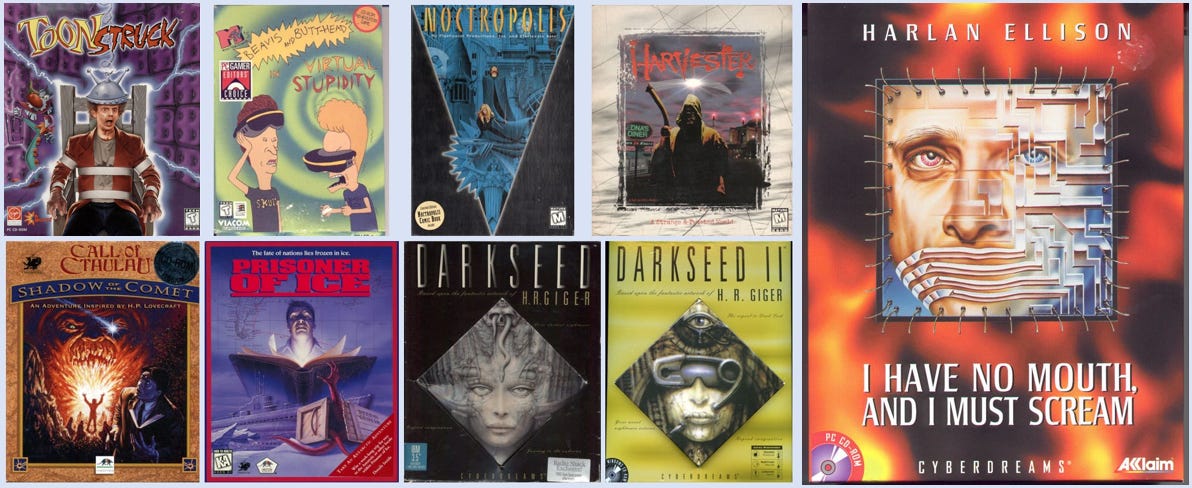
In this episode, we’re going to talk about 1990s point and click adventure games made yet another group of like Westwood Studios, Cryo, Access Software, Cyberdreams, Infogrames, Revolution Software, Viacom and more! Join us on this expedition through games you’ve probably never played with Sean Jordan, your Great Game Guide!-------------------------------------------------------------------Season 1, Episode 9: The Adventure Where Seeing is Believing, Part 7Enjoy the show? Please share it with a friend! And be sure to like it on your platform of choice or leave a glowing review.You can contact Sean via Substack or BlueSky (@greatestgames.substack.com)And if you enjoy this show, you should check out The Greatest Games You (Probably) Never Played at https://greatestgames.substack.com, Sean’s free newsletter featuring tons of great games that are obscure, overlooked, forgotten or otherwise unknown!-------------------------------------------------------------------Copyright 2026, Sean J. Jordan. Some Rights Reserved. Permission is granted for the noncommercial, free distribution and archival of this episode.Music “The Great Game Guide Theme” written by Sean J. Jordan using Online Sequencer (https://onlinesequencer.net/)Questions? Concerns? A burning desire to talk about obscure video games? Contact Sean via Substack or Bluesky. He’d love to hear from you!--------------------------------------------------SOURCES:Shelley Day’s court case: https://www.justice.gov/archive/usao/waw/press/2005/dec/day.htmlThe KGB File: http://thekgbfile.50webs.com/index.htmlRick Gush on Kyrandia: https://web.archive.org/web/20021122190852/http://www.adventuregamers.com:80/display.php?id=110https://muds.fandom.com/wiki/Kyrandiahttps://www.well-played.com.au/broken-sword-parzivals-stone-has-been-delayed/Harvester on GameGrumps: https://www.youtube.com/watch?v=H_lcJD7-gOohttps://kotaku.com/how-harlan-ellison-s-most-famous-short-story-became-an-1827327887https://www.pcgamer.com/saturday-crapshoot-i-have-no-mouth-and-i-must-scream/-------------------------------------------------EPISODE 9Coming up in this episode –We’re going to talk about all sorts of point and click adventure games from the 1990s that weren’t published by Sierra, including The Legend of Kyrandia, Beneath a Steel Sky, Dark Seed, Call of Cthulhu, Dune, Broken Sword: Shadow of the Templars, Beavis and Butthead and of course, Harlan Ellison’s I Have No Mouth and I Must Scream!I’m Sean Jordan, and I am your Great Game Guide. Get ready for a survey of many of the great adventure games you may have played, may have heard of … or may have missed! One name you haven’t heard much about since we left LucasArts a few episodes ago is Ron Gilbert, and you might wonder what he was up to after leaving LucasArts following Monkey Island 2: LeChuck’s Revenge. And the answer is, “making dozens of games with his colleague Shelley Day,” another established game developer who’d worked at LucasArts. Together, they’d found Humongous Entertainment and make games about characters like Putt-Putt, Fatty Bear, Freddi Fish and Pajama Sam, with many of these point and click adventures utilizing the SCUMM engine.But because these games are for little kids, I don’t feel a lot of need to go into detail about them. Suffice it to say Ron Gilbert did eventually return to modern adventure games and we’ll cover him in later episodes.And as for Shelley Day… well, that’s a sad story, and you look her up in the show notes if you want to see why she and Gilbert parted ways.But I bring up Ron Gilbert because he’s one of the few adventure game creators who really stayed active in the 1990s working on point and click adventure games and not trying to evolve things into 3D or to chase after trends like pre-rendered artwork or controller-friendly mechanics. He’s also one of the people who most influenced the style of point and click adventure games by not only articulating a philosophy he largely followed, but also by showing people how it could be done with the first two Monkey Island games.And as we’ve already discussed with games like Simon the Sorcerer and Discworld, that Monkey Island style was pretty prevalent throughout the 1990s, especially with Tim Schafer’s Full Throttle and some of the less aggressive Sierra games. But not everyone was copying that style, and one developer that certainly tried to do its own thing was Cryo Interactive, a French developer founded by several folks from ERE Informatique. While ERE was bombastic and included the intergalactic logo for Exxos in its branding, Cryo adopted the face of a female android in a sleep pod, first seen in the French-only puzzle game Extase, based on a minigame called “Brain Bowler” in ERE’s truly odd 1989 outer space Olympiad, Purple Saturn Day.Cryo’s next project was an adventure game based on Frank Herbert’s epic science fiction novel, Dune, in 1992, but which also drew heavy visual inspiration from the 1984 David Lynch feature film adaptation, even using the film’s logo and a production still of Kyle MacLachlan as Paul Atreides in a stillsuit on the cover of several editions of the North American release. According to the credit, MacLachlan’s appearance was licensed for the game, probably to help enhance its marketability.Within the game, some characters resemble the film’s actors. Feyd-Rautha Harkonen still closely resembles Sting, for example, and Lady Jessica looks a lot like Francesca Annis. Virgina Maden’s Princess Irulan also shows up in footage from the film to narrate the story in the Sega CD version. Other characters, however, like Thufir Hawat, Baron Harkonen and Duncan Idaho, look so different they’re not remotely recognizable.Dune is a fascinating point and click adventure because it takes place from the first person perspective as you control Paul Atreides visiting various sites on the planet of Arrakis, but it also transforms into a strategy game about midway through once the Harkonens kill Duke Leto and you have to work to evict them from strongholds.Throughout the game, the Fremen recognize you as Muad’Dib and pledge their loyalty to you as you visit their sietches, and a lot of the political and social dynamics of the book and film are relaxed to make the adventure simpler and more focused. But you still get to fly around in ornithopters, ride sandworms and raise armies… as well as fall in love with Chani, whose fate is a little happier in this telling than the source material where she’s only permitted to be Paul’s concubine when he seizes the Imperial throne.Cryo’s work on the game, however, was famously troubled due to a number of issues going on behind the scenes, and as they were working on their Dune game, an American developer called Westwood Studios was building one of its own, a real-time strategy base-building and resource-gathering game that would come out the same year as Dune II: The Building of a Dynasty. It’s one of my favorite games of all time, by the way, and the direct inspiration for Blizzard’s Warcraft: Orcs & Humans and Westwood’s own Command & Conquer series. But we’ll talk about those games another time.As for Westwood, we’ll come back to them in a few minutes, because they, too, were building adventure games in the 1990s.But I want to touch on a few other games Cryo released in the 1990s that were also adventure games, including their 1992 adventure KGB, which has a reputation for being one of the most difficult graphical adventure games ever made, and yet which is still well-regarded as being a legitimately good game. And by the way, there is a 1993 CD-ROM re-release called Conspiracy that adds in some clips where Donald Sutherland plays the main character’s deceased father, but these scenes really just provide some vague advice and don’t add much to the game.The premise of KGB is that the Soviet Union is days away from collapsing in 1991 and you are an officer named Captain Maksim Mikhailovich Rukov, or either Maks or Rukov for short, who’s joined the KGB’s Department P and who has to investigate some problems within the KGB that eventually lead to an assassination plot to murder Mikhal Gorbachev, the General Secretary of the USSR.I’m not sure exactly how historically accurate the game actually is, but in real life, there was a failed coup attempt in August of 1991 that involved the KGB and the State Committee on the State of Emergency, more popularly known as the “Gang of Eight,” who opposed Gorbachev’s policies of perestroika and glasnost, which meant restructuring and transparency.KGB is all about spycraft and catching some of the slipperiest people you’ll ever see in an adventure game through a variety of methods, such as recording conversations and making use of a snuff film as leverage.The KGB conspirators are very hard to pin down, and wouldn’t you know it, they also have a corrupt CIA ally in the mix as well as a man who’s been surgically altered to look like Gorbachev and who’s been brainwashed so he can go on TV and resign the presidency in place of the actual Gorbachev, who gets kidnapped. Your main ally is your Uncle Vanya, an older man in a wheelchair who’s been working undercover at the KGB and who pulled strings to get you on the job. He also has a friend named Major Vovlov who serves as your bad-tempered boss and the game’s ultimate antagonist.Because the game is so challenging, I recommend consulting a website I’ve linked in the show notes called The KGB File to help you through it. KGB is definitely a game made for adults who want an engaging and sophisticated plot; it doesn’t hold your hand and it has some seriously mature themes it explores along with a lot of Russian names to keep track of from a surprisingly large cast of characters. There are drugs and prostitutes and murders and multiple layers of bureaucracy to keep track of. If you enjoy the intrigue aspects of Metal Gear Solid games, you might find KGB to be a really engaging experience.Another Cryo’s adventure game is from 1995: Aliens: A Comic Book Adventure, which is also for mature audiences and might seem more accessible, but it’s a polarizing game for multiple reasons. It’s based on the Dark Horse comic book series from the 1990s, primarily the graphic novel Aliens: Labyrinth, to which this game is actually an adaptation but also a sort of sequel.In the graphic novel Aliens: Labyrinth, the plot revolves around a scientist and former Colonial Marine named Tony Crespi who’s sent to a research space station to secretly monitor Colonel Doctor Paul Church, who’s experimenting on Alien Xenomorphs by putting them in a dark, labyrinth-like maze and learning about how they hunt and make decisions. But it all sort of goes Jurassic Park and, predictably, tragedy occurs.The game takes place at a time that would simply be defined as “later” and isn’t officially part of the Dark Horse canon despite drawing liberally from it. You play as Lt. Col. Hericksen, not-so-subtly named for the actor Lance Henriksen who played Bishop in the Aliens film. The gameplay is interesting because it’s sort of a point and click adventure due to Hericksen’s appearance in many scenes, but it also looks and plays like a 3D Myst-style game at times.Even so, this one is mostly a point and click adventure with dialogue trees, inventory puzzles and illustrated characters who pop up in visual novel-style conversations. But there are also some RPG elements and turn-based strategy sequences where you pilot an exosuit and battle Xenomorphs and facehuggers and, towards the end, Colonial Marines.It’s a surprisingly pretty and interesting game, though the illustrated characters and the pre-rendered scenes do clash a little bit. The voice acting is also pretty bad and clashes with the otherwise dark atmosphere of the game. But probably the biggest complaint about Aliens: A Comic Book Adventure is that it’s so easy to make mistakes and undo all your hard work, and it doesn’t help that the game is also quite buggy. My advice is to play with a walkthrough, because the game isn’t so much challenging as it is limited by a bad interface, time constraints and poor directions.But if you like your games dark and gritty and set in the future, you might want to check out what Westwood Studios had on tap in 1990 with a different adventure also based on a book.Infocom’s final years as an Activision adventure game imprint gave rise to a few graphical adventure games and RPGs, many of which were created by Brett W. Sperry and Louis Castle’s Las Vegas-based game studio, Westwood Associates, soon after renamed Westwood Studios. One of Westwood’s earliest games was a 1990 DOS point and click adventure and RPG hybrid called Circuit’s Edge, based on the novel When Gravity Falls by George Alec Effinger. While the game has a cyberpunk feel to it, you’ve never played a setting quite like this because the premise of the story is that the Islamic Arabic culture has become the principal world power and you play as an investigator named Marid Audran who lives in the city of the Budayeen and gets caught in a web of intrigue involving a client he’s framed for murdering and a crime lord benefactor who hires him to get to the bottom of what really happened.Now, I want to specify that Circuit’s Edge is more a role-playing game with an involved story than a true adventure game. The interface shows stats on the side, a small graphical window with character portraits beside it and a big text box underneath, and moving through the Budayeen is similar to the first person navigation around the town of Skara Brae in The Bard’s Tale. But the game also follows a lot of the classic adventure game conventions of having you collect inventory, solve puzzles and talk to NPCs fairly liberally. There are also a lot of very adult themes in the game, including quite a bit of prostitution and even nudity. It’s interesting and worth checking out, if for no other reason than it tells a story that is quite different from most other games of the era.Westwood’s next adventure series is one of the ones it’s best-known for, and the proper name of the series is Fables & Fiends, though this was retooled later to reflect the first game’s subtitle, The Legend of Kyrandia. This initial chapter debuted in 1992 and features a character named Brandon, an orphaned young man who has to battle the murderous jester Malcolm, who’s escaped his magical confinement and is using the magical Kyragem to sow mischief around the land, including turning Brandon’s grandfather, the powerful wizard Kallak, into stone. In many ways, the game feels like a King’s Quest-style adventure, though apparently, at least according to the game’s writer and the designer of the sequels, Rick “Coco” Gush, Westwood licensed it from an earlier MUD game called Kyrandia by Richard Skurnick and Scott Brinker, though the inspiration appears to be superficial at best.The Legend of Kyrandia is a true point and click adventure game in the style of a Sierra or LucasArts adventure with all the elements you’d expect – gorgeous artwork, an inventory scroll at the bottom of the screen and a context-sensitive cursor that allows you to interact with the game world depicted in the top two thirds of the screen. The music by Westwood’s house musician Frank Klepacki is wonderful, and there was even a CD-ROM talkie version released alongside the disk-based version with voice acting, though it’s kind of cringey and nowhere near as good as what Westwood would start to be known for once they started shipping games like Command & Conquer.The story is basically what you’d expect – as Brandon, you are the chosen one who has to prove his mettle as a hero, discover your claim to the throne and overcome the mischievous machinations of Malcolm, who shows up occasionally to bother you, but who never comes across as particularly menacing. You also befriend a young alchemist named Zanthia who teaches you how to make potions. That might seem like an unimportant detail, but as you’ll see in a moment, she’s not a trivial character.The Legend of Kyrandia is supposed to be a comedy, but it’s really more in the realm of “lighthearted” than comedic. The jokes are mostly just slapstick or Brandon grumbling about things, and Malcolm has to be one of the least funny jesters in the history of gaming, and also one of the least capable. Suffice it to say he’s the sort of villain who tells you not to go into the room you need to go into to defeat him, and then also is the sort who’s easily defeated by a trick a child would see through. He’s also kind of annoying, a point that’s not lost on Zanthia when she returns in the second game as its protagonist.And the second game is a little confusing to identify at first because it was originally published in 1993 as Fables & Fiends: The Hand of Fate with a box that didn’t match the first game’s storybook aesthetic and instead depicts a purple hand inset inside an even larger hand and which doesn’t really say “The Legend of Kyrandia - Book 2” anywhere. The back cover’s text is hard to read due to a confusing layout and since Malcolm and Brandon are nowhere to be seen, it’s hard to connect this game to its predecessor. Even worse, the title screen for the game itself also just says “The Hand of Fate.”But if you play the game, especially if you’re playing the CD-ROM talkie edition, it’s pretty clear you’re playing a sequel as Brandon’s voice kicks off a narration and shows some familiar scenes and characters as Brandon explains that the world is disappearing, piece by piece, and that Zanthia has been selected to retrieve a stone from the center of the world. In fact, later versions of the game even received new box art more in line with the first game and more clearly calling this game “Fables & Fiends – The Legend of Kyrandia Book Two” with no mention of the Hand of Fate, but instead a painted picture of Zanthia traveling through the skies on her quest.And make no mistake – marketing issues aside, The Hand of Fate is a superior game to the original in every way. It’s more imaginative, it’s funnier, it has better puzzles and Zanthia is just a far more charismatic character than Brandon, with a dry wit and a recast voice actress who adds so much more to the character in the talkie version. And actually, the voice acting in this game is better all the way around, much more in line with the best of Sierra and LucasArts. Frank Klepacki’s score even ups the ante this time with a little more variety and some funk as well as some island-style music. It’s pretty clear the Westwood team took some inspiration from The Secret of Monkey Island instead of King’s Quest this time around, right down to featuring a segment with pirates, but it results in such a better game it was honestly a good move.Zanthia’s travels are of course not straightforward, and she not only attempts to visit the center of the world, but also wanders around swamps, castles, coves, lava pits, the high reaches of the world and even across a rainbow bridge into the surreal realm of the Wheels of Fate. One of the most-lauded aspects of the game is that she approaches her challenges with a certain confidence and world-weariness that’s unusual for adventure games of the era. She even changes her outfits to suit the places that she goes.But if you ask me, the best aspect of the game is that there’s no Brandon and no Malcolm. And unfortunately, the game’s standalone story ends with a cliffhanger where Malcolm is freed, setting up a sequel for him to make his return.The Legend of Kyrandia: Book Three: Malcolm’s Revenge came out in 1994 and while it is very clearly part of the series from the box art and the introductory cinematic, it also looks and plays a bit differently from the other two games. The hand-drawn aesthetic is replaced by largely pre-rendered backgrounds, the inventory bar that lines the bottom of the screen in the previous two games is gone, popping up only when needed, and the gameplay is occasionally interrupted by pre-rendered cutscenes. The credits sequence also has full-motion video sequence featuring the development team at Westwood, with Malcolm causing havoc around the office. You can even see Joe Kucan, who famously played Kane in the Command & Conquer games, make an appearance as the game’s vocal recording director.And speaking of the acting, Malcolm, thankfully, has been recast with a nastier, more villainous voice for this sequel, and since you play as him this time around, it’s good to see the character be less of a cartoon clown and more of an actual bad guy. That is, of course, assuming you keep him in that persona – this game actually allows you to choose if you want to lie to other characters or be nasty, measuring Malcolm’s behavior with a meter that appears next to the inventory bar.As adventure games go, Malcom’s Revenge isn’t much of a revenge tale; rather, it’s one of the most surreal, bonkers ones you’ll ever play, with much of the game devoted to realms with talking animals and obnoxious humans who tend to get under Malcolm’s skin. As you might expect, he becomes an unlikely hero and has to kick a group of pirates out of Kyrandia to restore things to the way they used to be. In the end, all he really wants to do is take a nap, but he’s unfortunately blamed for pretty much everything that goes wrong in Kyrandia, which means he also has to clear his name before the game is over.While Malcom’s Revenge is often thought of as a step down from The Hand of Fate in terms of its adventure game credentials, it’s still a decent adventure game with an absolutely killer soundtrack that’s very much in line with the sort of funky hip-hop industrial tunes you’d hear in Command & Conquer. The strong production values help make the game fun, and thankfully, the humor is a lot sharper than Malcolm’s first outing.Westwood worked on one more point and click adventure game in the 1990s, and while it was a bit of a slow burner in terms of sales, it did make a positive impression and has since become a true classic. The name of that game? Blade Runner, based on the 1982 feature film of the same name and released in 1997 with an eye for recreating many of the movie’s strongest visuals while telling a parallel story to Rick Deckard’s adventures with the escaped Nexus-6 replicant units led by Roy Batty.The game focuses on a rookie Blade Runner named Ray McCoy who winds up on the trail of a warrior poet replicant named Clovis who is leading a group of rogue replicants who are all suspects in a crime involving murdering animals – a heinous crime in a future were real animals are exceedingly rare. McCoy has to hunt down all of Clovis’s replicants, but the way the game is structured, who those replicants actually are is randomized, and there are multiple endings available, some of which include McCoy himself being a replicant.One of the most notable things about Blade Runner is how well it nails the aesthetic of the film. The team at Westwood not only recreated some of the locations, camera transitions and lighting effects, but also extended the world out with new places that look as if they came from scenes we just didn’t get to see in the film. Many of the film’s characters make an appearance and are voiced by the original actors, and the new characters are all voiced by established screen actors, some of whom, like Jeff Garlin and Lisa Edelstein, went on to became quite famous.The graphics were also quite interesting for the time, fusing pre-rendered footage and a sort of voxel-based rendering of the characters that was able to be done in software without a 3D accelerator card. In the 1990s, this was crucial since it meant delivering graphics that looked 3D without actually having to be 3D. While the game looks movie-accurate in many places, everything was created specifically for the game and nothing was used from the film footage. Since the target resolution was lower than we’d use today, the game does have a sort of grainy look and feel to it that modern ports have not been able to fix since the original source code was lost, but it’s still a darned impressive-looking game that’s still one of the best and most authentic cyberpunk stories out there.I would love to talk more about Blade Runner, because I’m a huge fan of the original novel Do Androids Dream of Electric Sheep?, the Ridley Scott film and the game itself. It was one of the first games I reviewed as a pro game reviewer back in the 1990s and definitely one of my favorites I ever got to write about. But what I’ll ask you to do instead is just go out and get yourself a copy and play it, because it’s one of the best adventure games of the late 1990s and short and straightforward enough that you can play it multiple times and see its many variations.And while I don’t think you’ll need a walkthrough, I will say that there are some pretty good guides that explain how the innerworkings of the game function, and if you want to see the thirteen different endings the game has, you’d be wise to use them!In the 1990s, Ray McCoy was far from the only detective in a trenchcoat running around a post-apocalyptic 21st century California, and some of his stiffest competition came from a character introduced by Access Software in 1989 in an adventure game called Mean Streets. I covered this game way back in Episode 4 of the podcast when we talked about 80s adventure games, and listeners may recall that this is the first game featuring Tex Murphy, a character who’d come to be played by Chris Jones, who posed for the digitized pictures of Tex in this game. The game was originally supposed to be a follow-up to Access Software’s 3D flight game Echelon, which is why it included a 3D engine for flying Tex’s car.The 1991 sequel, Martian Memorandum, ditched the 3D in favor of a more conventional adventure game design with some digitized movies and sounds, and it is an interesting adventure in its own right, largely focusing the gameplay built around dialogue and interrogations, with a handful of inventory puzzles to help grease the conservational wheels.Unfortunately for Martian Memorandum, it’s also sort of the black sheep of the series today because the next few games not only brought back the 3D gameplay by allowing Tex to walk around and explore the game world first person style, but also added in significantly more digital footage to make the games feel more like interactive movies. We’re going to talk about all of these games – Under a Killing Moon, The Pandora Detective, the Mean Streets remake Tex Murphy: Overseer and even the more recent 2014 revival Tesla Effect – in our next episode as we cover 3D and FMV games.But Access Software made some other adventure games in the 1990s, and both of them are quite a bit more obscure than the Tex Murphy games. The first of these is 1990’s Countdown, a point and click adventure that uses digitized characters, portraits and backgrounds to tell a story about an amnesiac CIA agent who wakes up in a mental hospital in Turkey and has to escape so he can foil a terrorist plot. While I know that this sounds like pretty well-trod territory, Countdown is one of the better games using the old Bourne Identity setup, and one of the most interesting things about it is that the game includes a dialogue system where you can try different approaches as you talk with other characters and sometimes get really interesting outcomes, though one of the game’s biggest faults is how you can wind up in unwinnable situations and find yourself having to replay earlier sections. It’s definitely a game where you need to save often.The first half of Countdown is definitely the stronger portion as you find a way to escape your room in the mental hospital and gear your bearings. One of the nicer aspects of the game is that you only enter rooms where you can actually do something and otherwise navigate using a top-down map. This limits the number of red herrings you have to deal with in screens or locations that are really just there to string important areas together, and once you finally are able to travel around the Mediterranean in the second half of the game, it feels like the game world really opens up, though you have to be careful you don’t waste precious time going places too far out of the way. The game could also give you some more hints about what you have to do, however – a lot of essential items are hidden and you need to get used to using the move command on just about everything you see.Beyond the frustrations around Countdown’s difficulty, which are easily solved today with walkthroughs and longplay videos, there are some goofy things that make it endearing. For example, you run into a fellow patient who’s sitting nude in an interrogation room and making goofy faces while you talk to him. Many of the other characters don’t look so much like actors as corporate drones Access Software grabbed from a nearby office and asked to make some funny faces. Your main character, who’s named the oh-so-creative name of Mason Powers ugh looks like an Eddie Bauer model in a button-up shirt and khakis.There’s also a bad guy named Scorpio and another character named McBain, which is quite funny if you enjoy The Simpsons but which we can’t really fault the developers for since the show hadn’t introduced those characters yet. Call that a happy coincidence.I really recommend Countdown and hope more people will check it out – it’s way better than Sierra’s 1990 thriller adventure Codename: ICEMAN and while it’s a bit dated and has a pretty anticlimactic ending, there’s a lot of fun to be had if you bother to play through it.The 1992 point and click adventure game Amazon: Guardians of Eden is a little harder to recommend because it has aged so badly. It’s very easy to confuse this game with Sierra Discovery’s Lost in the Rainforest, but it’s actually quite a different game, much more in the style of Indiana Jones or the 1984 film Romancing the Stone and featuring some absolutely dated tropes from old movie serials and the 1958 film Wild Women of Wongo, a movie that designer Chris Jones enjoyed so much that he adapted ideas from it. I’m assuming he did so because the movie’s in the “so bad it’s good” camp, but the problem is that the game itself doesn’t feel like it’s in on the joke.Amazon is broken up into fourteen short chapters that play sort of like a movie serial. You’re Jason Roberts, a researcher in search of your brother Allen, who disappears in the Amazon during an expedition due to what seems to be foul play. On his journey, Jason meets an attractive blond white woman named Maya who seems to hate men but of course turns out to be a scout for a tribe of literal Amazons who live in the Amazon, complete with low-cut outfits and grass skirts or swimsuit bottoms. Oh, and did I mention the actual natives are cannibals who are wowed by little tricks you do with your inventory items and apparently believe white-skinned people are gods?Sensitivity to other cultures is pretty lacking here, as is a sense of direction – background NPCs will have elaborate backstories, narration will take over when the game doesn’t want to depict the next logical action, and the game rarely tells you what you actually need to do in order to advance the plot. There are also moments where the story will end one chapter of the serial and then recap what just happened. It sort of feels like this is all by design in some sort of parody of other adventure games, but again, it’s not executed well enough that the designers tip their hand to show you it was on purpose.One of the weirder things about the game is the audio narration, which sounds like it’s being delivered by an infomercial announcer reading a script rather than an actor attempting to set the mood. Many of the other lines in the game that get an audio reading also tend to be of the overly flat or scenery-chewing variety, as if the actors were just the folks Access Software could round up from their social circles. The audio is also noticeably highly compressed, but you can’t be too picky about that because the game was only released on floppy disk.Another odd aspect of the game is the graphics are about half digitized and half hand-drawn. The main character, Jason, has a digital portrait, but his walk-around avatar is noticeably illustrated. Many of the other characters he encounters are digitized from real actors, but some, especially the native Amazon tribe later in the game, look like they came from a storybook. It’s really jarring visually, and it feels like Access Software’s ambition may have exceeded their grasp, especially since this game uses a Super VGA display mode.But by far the weirdest thing is that the game features a number of death scenes preceded by glowing red letters that say “SHOCK WARNING” before showing your often not-so-gruesome demise. There’s also a weird note in the credits that no insects were harmed in the making of the game, which is weird because a giant ant that murders Jason in one of the death scenes. Again, you have to imagine this was all part of an attempt to spoof the source material and amuse the audience, not to play any of this seriously.I’m not saying Amazon: Guardians of Eden is a bad game by any means – it’s reasonably engaging and has some good moments. But it’s definitely not Access Software’s best, and when we talk about Tex Murphy in our next episode, we’ll see how far they were able to evolve adventure gaming with a far better setting and design.Another adventure game I can only recommend as a curiosity comes from Revolution Software, and that’s not because it’s a bad game so much as their first attempt at a genre they’d go on to master later on. This game came out in 1992 originally for the Amiga and it’s called Lure of the Temptress. I don’t even really want to spend a lot of time describing it because it’s honestly a pretty dull game where even the promise of a sexy villainess is barely realized since she has so little presence in the game. You mostly see humans who are under the oppression of pig-faced monsters called Skorl, and even an encounter with a dragon mid-game is anticlimactic. If you want to try Lure of the Temptress, it’s freeware now and easy to try out. But you’d be better off playing Revolution’s next game, which is also freeware, but much more interesting: the 1994 cyberpunkish point and click adventure Beneath a Steel Sky, a game that was mostly popular in Europe in the 1990s but which has since become an international cult classic that even got a sequel in 2019.The premise of Beneath a Steel Sky is that you are a survivor of a helicopter crash in the Australian Outback who was raised by Aboriginees who live there. You’re given the name “Robert Foster” because the tribe spots a can of Foster’s Lager in the wreckage. As you grow up, you build a companion robot named Joey who can be upgraded into other robots during the game. And this is really useful, because you’re kidnapped and taken to a place called Union City, where you have to escape the minions of LINC, a powerful computer mainframe that runs the city.By the way, most of this backstory is relayed through comic book artwork drawn by Dave Gibbons, the co-creator and artist of Watchmen. It’s really neat.As the game proceeds, you have to work your way through the city and learn more about who you really are and how you’re connected to LINC. I won’t spoil the story, because it’s actually interesting, but it has heavy overtones of Aldous Huxley’s Brave New World with Foster playing the role of the Savage, but also inverting things so he’s the savior of a dystopian society instead of the self-flagellating misfit of a misguided utopia.Beneath a Steel Sky is also notable for having a fairly interesting tone with lots of humor interspersed within the game’s more serious science fiction premise. The writing is good and the voice acting helps to bring the characters to life, though I find Robert a Joey a bit grating since Robert sounds like a generic hero and Joey’s voice sound like’s it’s filtered through a cheap electric fan.Revolution’s defining moment, however, is their next game, 1996’s Broken Sword: The Shadow of the Templars, which was released in North America under the rather stupid name Circle of Blood. The game opens with an amazing and lavishly animated introduction in Paris where the main character, the American tourist George Stobbart, is sitting outside his favorite café when a sinister-looking clown drops off an accordion loaded with explosives and blows the place to smithereens, killing a mysterious old man in the process. And as soon as the animation ends, the game puts you right into the scene, maintaining roughly the same level of animation and launching George into a lengthy adventure investigating why this strange bombing even happened, though he finds no help from the local French authorities, who seem more interested in covering up the case than solving the mystery.George soon meets a photojournalist named Nicole “Nico” Collard who becomes his ally in uncovering what’s really happening, and the two find themselves mixed up in an intriguing story that involves the Knights Templar and a group of Neo-Templars who are trying to acquire the power of an ancient deity. Unlike most adventure games, which can be beaten in a few hours, Broken Sword is a really long game that can last a dozen or more hours in your first playthrough thanks to a lot of lengthy conversations that make the characters feel as if they exist to do more than just hand out puzzle clues and inventory items as well as some fun puzzles that never get in the way of the game but do require some thought here and there.The original version of Broken Sword is great, but if you play it today, chances are good you’ll be playing the Director’s Cut edition from 2009 that adds in additional Nico scenes where she’s actually playable and kicks off the game with her own introduction, which adds in a sinister mime who appears to be involved in the murder plot. This version also adds in portraits for the characters whenever they’re speaking and comic book panel-style action windows, especially in the new scenes. I’m personally not sure that Broken Sword needed all this extra content, as it was fine on its own, but it did help the game to reach a broader audience on the Nintendo Wii, Nintendo DS and mobile devices.The 1997 sequel, Broken Sword II: The Smoking Mirror, sends George on a quest to rescue Nico from a group of cultists who are trying to once again obtain the power of a God, this time from the Mayan mythology. Once again, this is a lavishly animated game with absolutely stunning graphics and lots and lots of fully voiced dialogue, but it’s also noticeably shorter than the original. I definitely recommend this one, but it feels like a made for TV sequel rather than a true continuation of the original game.From the third game onward, the Broken Sword series has changed things up with each entry, but each also has a much longer and more satisfying story than the second game. 2003’s Broken Sword: The Sleeping Dragon is an action adventure game with some climbing and platforming mechanics and also gives you direct control over the characters rather than a point and click interface, which is good, because it was also released on the Xbox and, in Europe, on the PlayStation 2.The fourth game, Broken Sword: The Angel of Death, released in 2006, only made it out on Windows computers. It’s once again a 3D game, but this time, it uses a point and click interface in some parts and direct control in others. It’s somewhat polarizing because it initially sidelines Nico and instead introduces a blonde American woman named Anna Maria, but it’s a fine adventure on its own and worth playing if you’re invested in the series.The most recent game, Broken Sword 5: The Serpent's Curse, debuted in 2013 as part one of a two-part series that concluded in 2014. This chapter returned to the more traditional point and click animated style of the original game and it’s easily the best-looking game in the series. The story and puzzles are a little less inspired, but if you’ve bothered to play the first four games, you’re of course going to want to see what happens to George and Nico in the fifth, particularly since this story’s mystery comes the closest to many of the themes explored in the first game, though this time it’s a Gnostic cult trying to destroy God with the help of Lucifer himself. The game also hints at the end that George and Nico might finally get together, which will hopefully be what will happen in the upcoming Broken Sword: Parzival’s Stone, which keeps getting delayed, but which series creator Charles Cecil continues to say is coming.Here’s to hoping we’ll see it soon.I know you’re probably worried that we’re getting close to the dregs now that we’ve talked about so many fantastic 1990s point and click adventure games already, but I promise that we still have a few left worth mentioning.And since Broken Sword is so lavishly animated, this seems like as great a time as any to bring up another game that evokes that feeling of watching a cartoon: the 1997 adventure game from Burst and Virgin Games called Toonstruck, starring the great character actor Christopher Lloyd as Drew Blanc, a human who gets pulled into the animated world he’s created. It felt like Christopher Lloyd was in everything around this time after Who Framed Roger Rabbit and the Back to the Future movies really raised his stature, and this game has plenty of other famous 90s staples from comedies and animation, including Ben Stein, Tim Curry, Dan Castellaneta, Jeff Bennett, Corey Burton, Rob Paulsen, April Winchell, Tress MacNeille, Jim Cummings, Frank Welker, David Ogden Stiers and Dom DeLuise.Yes, this is the rare adventure game where the voice cast isn’t just imitating famous actors, but actually has a cast full of them!The premise of the game is that Drew Blanc is the creator the Fluffy Fluffy Bun Bun Show, a show that pays his bills but which he hates. He really wants to build a show around his snarky purple cartoon character Flux Wildly, but his studio head isn’t interested in that and demands more cute bunny designs instead. Drew falls asleep and enters the world of his creations, where he finds out that an evil character named Count Nefarious is changing the world of Cutopia into a dark and twisted place, and Drew and Flux have to stop Nefarious and save the world from disaster.If I have a complaint about the story, it’s that Drew and Flux only briefly see the effects of Nefarious’s evil plan before they’re already taking on a quest to undo it. It makes the story feel poorly-paced and completely erases the stakes established in the first part of the introduction, and I don’t feel like Toonstruck ever fully recovers from that choice. If you’re here for story or puzzles, you’ll find Toonstruck to be quite a letdown. It’s better to just play it as a game that’s full of cartoon antics and enjoy the ride, because this game’s way more of a looker than anything else.Of course, if you want something starring cartoon characters who are way stupider, there’s another animated adventure game from Viacom Games that’ll be right up your alley: the 1995 game MTV’s Beavis & Butt-Head in Virtual Stupidity, a pitch-perfect adventure game that feels like the cartoon show has come to life on your computer, complete with the same disclaimer and introduction at the beginning and plenty of included animation. When you finally get to play the adventure game itself, you get to take Beavis and Butt-Head around Highland High School, annoying Daria and interacting with Principal Vicker and Mr. Buzzcut and hocking loogies off the roof in the first of several minigames.As far as a plot, there’s about as much of one as you’d expect from a game starring Beavis & Butt-head. They’ll sit on the couch and watch music videos, they’ll try to follow around their aggressive idol Todd and they’ll annoy Mr. Anderson or their boss at BurgerWorld or even get tossed in prison for awhile. The interface for the game is somewhat like the one LucasArts used in Full Throttle, allowing you to pull up a sort of radial menu with icons for actions. You can also choose whether or not you want Beavis or Butt-head to respond in conversations with various characters.The result is a really funny game that makes amazing use of its license and which honestly is one of the stronger mid-1990s point and click adventure games, right up there with anything LucasArts or Sierra published and extremely well-crafted all around. The various arcade action minigames keep the adventure game elements from becoming too tedious, but they also don’t wear out their welcome. The game’s plot, while meandering, fits the characters perfectly, and unlike every other Beavis & Butt-Head game made in the 1990s, you’re not doing anything the duo wouldn’t do. The end of the game even has them get locked in the trunk of Todd’s car so that Daria can overhear them making stupid jokes and rescue them, only for Beavis and Butt-head to return home, having learned nothing. It’s a perfect ending to a surprisingly great adventure game, and probably the best adaptation of a cartoon show until 2014’s South Park: The Stick of Truth pulled off a similarly great game.And just to illustrate how bad things could have been, GT Interactive published its own adventure game in 1999 called Beavis and Butt-Head Do U. and it’s pretty boring and completely unchallenging despite trying to replicate the same gameplay.But let’s now turn to a few of the other great adventures of the 1990s that dip a little more into the realm of horror instead of animated antics.We’ll start with a title published by Electronic Arts and developed by Flashpoint Productions called Noctropolis, and it is a fascinating fusion of digitized characters, gorgeous artwork often warped by a fishbowl perspective and full-motion video. The game begins in our world, where a comic book shop owner named Peter Grey is reading through his favorite comic, which features a trio of villains named Luscious, Tophat and Desperado facing off with a shadowy caped hero named Darksheer and his beautiful sidekick Stiletto. Darksheer’s powers come from an ancient Egyptian substance called Liquidark. It’s peak 1990s Image Comics-style cheese; the heroes don’t have a code against killing and there’s plenty of T&A, but everyone also avoids swearing and the heroes agonize about their crimes to a priest. The intro is surprisingly lengthy and nearly the size of a full comic book.Then Peter has a dream about a vampire succubus seducing him and wakes up to receive a package from a courier with another comic inside, this time detailing the formation of a new supervillain team under the leadership of a mysterious villain named Flux. An obelisk appears and Peter steps inside, and steps out into perpetually dark world of the “City of Night,” Noctropolis. With Darksheer missing, Peter assumes his identity and teams up with Stiletto to take on this new threat.As you can probably already tell, this game was made for a certain target audience and was marketed as being sexy and violent, though there’s actually very little sex or violence in the actual game. It’s actually a lot sillier than it looks. One of my favorite puzzles involves getting a dog who’s guarding a platform to jump into a huge pit by dangling a sausage on a string in front of him, with a pitiful howl playing as he falls for it. It makes me laugh every time.But much of this game involves wandering around and reading lots of text. And I mean lots of it – think of a comic where there’s more captions than dialogue and where the action is told to you as often as it’s shown. All of the dialogue itself is fully voiced and acted out by one of the hammiest green screen casts you’ll ever see, but the production values are high, and once again, we have a game that pulls off a lot of what Phantasmagoria was trying to do, but more effectively.Noctropolis is definitely a game I’d recommend, both for its endearingly cheesy story and its beautiful graphics. Even your pop-up action menu looks interesting as you see the verbs you can use divided up into sections atop a pyramid-like triangle. It’s more style than substance and quite a tease, like the 90s comics it’s imitating, but it’s a definitely an adventure unlike any other you’ve ever played.Another sort of wacky horror game from the same era is called Harvester, and it was made by DigiFX Interactive and published in Europe by Virgin Interactive and in North America by a schlockhouse publisher called Merit Studios in 1996. And Harvester is schlock of the highest order, a horror game where you play as an amnesiac named Steve Mason who awakens in 1953 in a town called Harvest where everyone seems to be more than a little off. Every character you meet feels like they’re playing a role in a 1950s sitcom that’s simmering with anger and resentment underneath, sort of like Twin Peaks meets Silent Hill. Things quickly get weird in ways I don’t want to describe because so much of the fun of this game is its shock value.And Harvester is shocking. At different points in the game, full motion video sequences will play where Steve watches absolutely bewildering things play out, and they’re rendered more interesting by the fact that the acting in this game is so endearingly bad that you’ll find yourself wanting to rewatch certain scenes and imitate the tortured dialogue. If Mystery Science Theatre 3000 had ever found an adventure game to feature, it’d be Harvester, and I mean that in the best possible way, because it’s absolutely entertaining to play through, provided you’re old enough to handle its gore and clumsy handling of sex.Speaking of which, the Game Grumps, who are the closest thing to video gaming’s MST3k, have a great video featuring Harvester, and it’s in the show notes!But if you’d like your horror games a little less silly, you might want to turn to Infogrames’s two Call of Cthulhu adventures from 1993 and 1995. The first is called Shadow of the Comet, and it’s generally regarded as an excellent take on the H.P. Lovecraft Cthulhu mythos, placing you in the New England coastal village of Illsmouth and having you investigate a case where a scientist went mad during the previous passing of Halley’s Comet. As you arrive in town in 1910 three days before the comet can be observed, some of the people in the town are standoffish and suspicious, and some have strange characteristics that suggest they may be connected to the horrific Old Ones, ancient evil eldritch beings who are worshipped as gods by the local cultists but who will bring about the end of the world if they’re successfully summoned.For those familiar with the Mythos, you encounter Yog-Sothoth, Dagon and of course Cthulhu in the course of the game, and you’ll also hear a namecheck for at least one other elder god as well. The story is a combination of elements from several Lovecraft stories including “The Dunwich Horror,” “The Shadow Over Innsmouth” and of course “The Call of Cthulhu,” but it does depart in a couple of ways. First of all, most of the residents of Illsmouth are not evil and actually are glad that you rid them of the evil cultists in a surprisingly upbeat ending, which is atypical for a Lovecraft-based story. Second, you face the elder gods directly but never succumb to insanity, another common trope of Lovecraft’s tragic heroes.While Shadow of the Comet isn’t perfect by any means, it plays like an icon-driven Sierra adventure and has a lengthy, interesting plot to uncover and some memorable character interactions and great horror scenes.The sequel, Prisoner of Ice, hews much more closely to the story “At the Mountains of Madness” and while the original game had a nice illustrated style, this one uses digitized characters walking around painted backgrounds. It also shifts the plot forward to 1937 and adds in some Nazis, which is honestly where the game gets pretty silly. While it’s tangentially connected to the original game in a very unsatisfying manner, it’s also half as interesting and about a quarter of the length of it. I honestly don’t recommend it unless you are really curious.Another horror series you should check out, however, is Dark Seed, which was released in two parts in 1992 and 1995 by Cyberdreams and which prominently features the artwork of H.R. Giger, best-known for the design of the Alien Xenomorph in the feature film Alien. You play as Mike Dawson, a mustachioed self-insert of the game’s creator and owner of a newly purchased old mansion that turns out to be a gateway to a parallel world that’s sort of like the Upside-Down in Stranger Things. He dreams that an alien embryo gets shot into his brain, and sure enough, this creature, the Dark Seed, is intended to hatch from his head and destroy his world, paving the way for the ancients from the Dark World to take over.Dark Seed is a very average adventure game with an oppressive timing mechanic and tricky puzzles, and thus it’s best-played with a walkthrough. But the reason you’d even want to is because the story is interesting, the horror atmosphere is tense and the graphics are incredible, utilizing large swaths of Giger’s artwork to create the Dark World and give the game a true sense of otherworldliness. The higher resolution used in the game necessitated a more restricted color palette for the graphics hardware of the day, and that actually adds a distinctive quality to the game, with our world being rendered in browns, greens and blues and the Dark World having a cold, sterile white, blue and gray quality to it. The frame around the gameplay window also changes from ornate curtains to alien gargoyles framing a monitor.The second Dark Seed was made without Mike Dawson’s involvement, but the character in the game is still based on him. H.R. Giger’s artwork still features prominently, but the game’s far more digitized this time around, using a blend of photography and pre-rendered objects. Chris Gilbert plays Mike this time, and he sounds ten years younger despite the fact that this game’s a sequel. Tone is also a problem. Crowley, Texas is not nearly as good a setting as the mansion from the first game, and the motivation of catching a Dark World shapeshifter is a lot less pressing than getting an evil alien embryo out of your head.The game’s music is absolutely awful and the normal world just feels… off. I’ve seen people compare it to David Lynch works like Blue Velvet or Twin Peaks and I think that comparison is appropriate since the intent of the scenes seems to be to skewer small town culture. Once you get into the Dark World, though, the game goes a bit bonkers, and by the end of the game, the body count’s surprisingly high and the ending has a twist that you’ll either love or hate, but which made it impossible to make a third game with Mike Dawson as the lead.That’s just as well, because Cyberdreams published another game the same year based on the Harlan Ellison short story “I Have No Mouth and I Must Scream,” and the game is notable for having Ellison’s involvement. It was a commercial flop that has since become a cult classic, though I’ll warn you it’s very much a love it or hate it kind of game.I’m going to presume listeners probably don’t know much about Harlan Ellison, but he was a well-respected and award-winning science fiction writer primarily known for television and magazine stories. He was always a polarizing figure in his lifetime, outspoken about his conviction that writers deserve to be paid and credited for their work, obsessive about creative control and also quite happy to torch collaborators, producers and Hollywood studios when he felt his work was being tampered with.He had a long feud with Gene Roddenberry over the Star Trek episode “The City on the Edge of Forever,” which he originally wrote. He hated Roddenberry’s rewrite and made such a stink that he published several of the teleplays in a 1995 book that included a lot of self-important essays.He also sued a lot of people, quite famously including James Cameron, alleging that The Teminator’s core concept was stolen from one of Ellison’s old Outer Limits episodes called “Soldier.” The connection was tenuous at best and it’s debatable Ellison’s idea about a time-traveling soldier was even that original, but he got his settlement from Orion Pictures all the same.Ellison was also an outspoken critic of the video games, which he said were “time wasters.”So you can imagine what a mess Cyberdreams had on its hand trying to market their ambitious adventure game, which has a gripping and memorable title, but which is based on an absolutely bonkers story about a supercomputer named AM that kills off the global population except for five people – a woman and four men – and then extends their lives and changes their bodies so it can torture them indefinitely.In the short story, the humans eventually escape to go and find some canned food and wind up killing each other. But one survives, and AM turns him into a gelatinous blob who no longer has a mouth or any ability to end his own life – hence the title.In the game, this is one of the endings, but the story is changed to AM coming up with a new way to torture everyone by playing a game in which they each enter a sort of psychodrama and have to find a way to defeat AM. The game sort of follows the same template of the later Persona RPGs where each character has to overcome a flaw and find a way to live with their past, but two of AM’s three supercomputers that make up its electronic brain have sympathy on the humans and attempt to help them.The game is incredibly messed up and features a number of endings, including an actually happy one as well as a lot of unhappy ones where your chosen character in the final chapter becomes a blob. Curiously, Ellison didn’t seem to understand that the game was winnable and bragged both before and after release that the only way to win was not to play – perhaps a promise Cyberdreams had made during production but chickened out on in the final build. But Ellison still looms large over the game – he voices AM and he clearly really loved having the chance to play his most psychopathic character, because he relishes reading those lines in the game.I do want to mention that there are some very controversial aspects of the game, not the least of which is the trauma and rape of the lone female character, Ellen. But there’s also a Nazi scientist named Nimdok who AM relates to the most, but who resulted in the game being censored in France and Germany, making the game almost impossible to win since you need Nimdok – or at least the knowledge he has - to be able to get the actual good ending without consulting a walkthrough or guessing at a puzzle. That might account for why Ellison was confused about the game actually having one.As a point and click adventure, I Have No Mouth and I Must Scream is a fascinating game well worth playing today. It’s unique in how it plays, it has a strong story that will keep you captivated and it’s fairly short and not too difficult. Just be aware that it’s not for everyone, and if you’re easily triggered by trauma, this game’s going to be an intense suffering simulator you’d best avoid.There’s one more series I want to cover before we close out this week, and it’s The Lost Files of Sherlock Holmes, a surprisingly well-crafted adventure game series from Mythos Software and Electronic Arts that uses a point and click style to set Holmes and Watson out and about exploring London and investigating cases. The first game 1992’s The Case of the Serrated Scalpel, puts you on the trail of either Jack the Ripper or, as Holmes suspects, a clever copycat who has left behind the clue of a scalpel with a serrated blade.The game is portrayed in an illustrated style with a verb and dialogue panel on the bottom third of the screen and the action shown in the top two thirds. Much of the interaction involves examining things and letting Holmes and Watson talk to one another, and there are of course some inventory puzzles and other basic deductions to be made.This is largely a traditional point and click adventure game with a lot of text to read and dialogue trees to exhaust as you search for clues and try to trap people with deductive logic so they’ll provide needed information. The story isn’t based on one of Sir Arthur Conan Doyle’s tales and thus feels a bit twisty turny and contrived at times, but it’s still a decent take on the source material.There’s also a 1996 sequel called The Lost Files of Sherlock Holmes: Case of the Rose Tattoo which ditches the illustrated look and feel of the original game for digitized characters and tries to recreate Victorian London with period costumes and scenes. I actually prefer the look and feel of the 1992 game to this one, but I can’t deny that it’s an impressive sequel that succeeds in using filmed digitized characters on sets far better than Sierra’s experiments with Phantasmagoria did the year before. The game world feels substantial and, when you’re out on the streets, even alive. The detailed map of Victorian-era London is also a lot of fun, particularly if you know the city and can spot locations that correspond to today.Both games are also right up there with ICOM Simulations’ full motion video series Sherlock Holmes: Consulting Detective, which we’ll discuss next week.We’ve covered so much ground in our adventure gaming series that I know you’re thinking, “Sean, there is no way there could possibly be more 1990s point and click adventure games we need to discuss. You’ve covered them all!”If only that were true! I have here in front of me a list of a whole bunch of games I didn’t even get a chance to cover, and if you take a look at the written version of my script on greatestgames.substack.com, you can find all of these games along with links to their entry on MobyGames.And by the way, let me clarify: have I played all these games through? Heck no! At most I’ve played enough to get an impression of what they have to offer, and in a few cases, I’ve just watched video playthroughs or read about them. But here’s the thing. Many of these games came from smaller publishers or from outside the US and UK, and as a result, they didn’t get as strong of coverage and don’t have the same sorts of fanbases as more popular games. That doesn’t mean they’re bad! It just means that they’re obscure and that one of them might become your new favorite game if you play it and like it.So, once you exhaust all of the other games we’ve discussed, give some of these a shot!And with that, we’ve reached the end of our exploration of point and click adventure games from the 1990s! In our next episode, we’re going to finally cover the multimedia era of the mid to late 1990s and the transition to FMV and full-3D adventures in the declining days of the genre, covering titles like Under a Killing Moon, Myst, The Longest Journey, Burn:Cycle, Chronomaster, The Journeyman Project, The 7th Guest, The Last Express, Black Dahlia and The Neverhood. And of course we have an obligation to accept Douglas Adam’s invitation to take a trip on the Starship Titanic.And guess what? We haven’t really covered console and handheld adventure games, so we’re going to talk about those too. Count on an episode devoted to those!Then we’ll finally close by touching on the 21st century contributions of studios like Telltale Games, Double Fine, Daedalic Entertainment, Amanita Designs, Wadjet Eye Games and Quantic Dream.We’ll cover all of that and more in our next few episodes!If you enjoy this show, you can read this series every week on my Substack at Greatestgames.substack.com, where you’ll also find brand new articles on other great games you’ve never played.And you’re always welcome to talk with me on Bluesky!I’m Sean Jordan, I am your Great Game Guide, and I’ll be back next week with more to explore! THIS WEEK’S RECOMMENDED GAME TO TRYBefore I let you go every week, I close out the show with a game I want you to try that’s a little off the beaten path. This isn’t sponsored content and I don’t have any financial stake in anything I recommend; these are games that I think are really good but don’t have as much exposure as some of the more popular ones.This week, I’m recommending Mini Motorways, a game by Dinosaur Polo Club that came out in 2019 on iOS devices as part of Apple Arcade before getting a port to Windows in 2021 and the Switch in 2022. It’s the follow-up to their earlier minimalist train game Mini Metro, and while it’s not quite as simple as drawing lines on a route map, it’s a little more strategic because you have a few tricks up your sleeve to route traffic that weren’t there in the earlier title.The game is presented in a minimalist SimCity sort of format where you need to connect homes of a certain color to destinations of the same color using roads, of which you have a limited number of tiles you can use. As the weeks advance, you earn tools like stoplights, roundabouts, tunnels, bridges and highways that can help you deal with traffic jams and route traffic more effectively. The game goes until you have a destination that’s not receiving enough traffic, and then it ends, allowing you to start over and try again.I enjoy this game because it’s simple and fun and doesn’t take much of my time, and yet has enough layers of complexity to make loading up a new map a challenging and interesting experience for a coffee break or a few moments of Zen. For $10, it’s a good deal, and even better, it’s often on sale and offered in a bundle with the equally great Mini Metro. Give it a try – it’s really wonderful!https://store.steampowered.com/app/1127500/Mini_Motorways/In 1990, we’ve gotEarthrise (1990)https://www.mobygames.com/game/2151/earthrise/The Hugo Trilogy (1990-1992)https://www.mobygames.com/game/71030/the-hugo-trilogy/Murders in Space (1990)https://www.mobygames.com/game/4803/murders-in-space/ In 1991,The Adventures of Maddog Williams in the Dungeons of Duridian (1991)https://www.mobygames.com/game/5024/the-adventures-of-maddog-williams-in-the-dungeons-of-duridian/Spaceship Warlock (1991)https://www.mobygames.com/game/22016/spaceship-warlock/Suspicious Cargo (1991)https://www.mobygames.com/game/54818/suspicious-cargo/ In 1992, we’ve gotCoktel Vision’s Bargon Attack (1992)https://www.mobygames.com/game/13178/bargon-attack/Eternam (1992)https://www.mobygames.com/game/1368/eternam/Hook (1992)https://www.mobygames.com/game/20230/hook/Rome: Pathway to Power (1992)https://www.mobygames.com/game/2232/rome-pathway-to-power/ 1993,Black Sect (1993)https://www.mobygames.com/game/2571/black-sect/Blue Force (1993)https://www.mobygames.com/game/1478/blue-force/ 1994,Igor: Objective Uikokahonia (1994)https://www.mobygames.com/game/2170/igor-objective-uikokahonia/Inherit the Earth: Quest for the Orb (1994)https://www.mobygames.com/game/4008/inherit-the-earth-quest-for-the-orb/ 1995,Bureau 13 (1995)https://www.mobygames.com/game/6601/bureau-13/Chewy: Esc from F5 (1995)https://www.mobygames.com/game/2339/chewy-esc-from-f5/Dračí Historie (English: Dragon History) (1995)https://www.mobygames.com/game/44689/draci-historie/Flight of the Amazon Queen (1995)https://www.mobygames.com/game/352/flight-of-the-amazon-queen/Teen Agent (1995)https://www.mobygames.com/game/6423/teen-agent/ 1996,Housemarque - Alien Incident (1996)https://www.mobygames.com/game/1924/alien-incident/Down in the Dumps (1996)https://www.mobygames.com/game/652/down-in-the-dumps/Fable (1996)https://www.mobygames.com/game/1893/fable/Imperium Romanum (1996)https://www.mobygames.com/game/6300/imperium-romanum/ 1997,Ark of Time (1997)https://www.mobygames.com/game/2156/ark-of-time/Tony Tough and the Night of Roasted Moths (1997)https://www.mobygames.com/game/7659/tony-tough-and-the-night-of-roasted-moths/U.F.O.s (1997)https://www.mobygames.com/game/4556/ufos/VooDoo Kid (1997)https://www.mobygames.com/game/16006/voodoo-kid/ And in 1998,Galador - The Prince and the Coward (1998)https://www.mobygames.com/game/30716/galador-the-prince-and-the-coward/Team17 - Nightlong: Union City Conspiracy (1998)https://www.mobygames.com/game/2564/nightlong-union-city-conspiracy/Hopkins FBI (1998)https://www.mobygames.com/game/3994/hopkins-fbi/ As for 1999? There really weren’t any notable point and click adventures from that year we haven’t already covered except for Cookie’s Bustle, a peculiar Japanese point and click adventure that’s most famous for being targeted by a copyright troll from 2022 to 2023 to try to erase all evidence of its existence. It’s only playable in Japanese without a fan patch and it’s quite dark and challenging despite its cutesy exterior, so while it’s a fun curiosity, it’s not an easy game to pick up and play. This is a public episode. If you would like to discuss this with other subscribers or get access to bonus episodes, visit greatestgames.substack.com
NOW PLAYING
Season 1, Episode 9 – The Adventure Where Seeing is Believing, Part 7
No transcript for this episode yet
Similar Episodes
Mar 26, 2026 ·1m
Mar 19, 2026 ·34m
Feb 18, 2026 ·11m
Feb 11, 2026 ·45m