
EPISODE · Jun 1, 2021 · 1H 22M
Season 2, Episode 23: "No Regrets when drinking Piquettes"
from The Make America Grape Again Podcast · host The Wine Monk
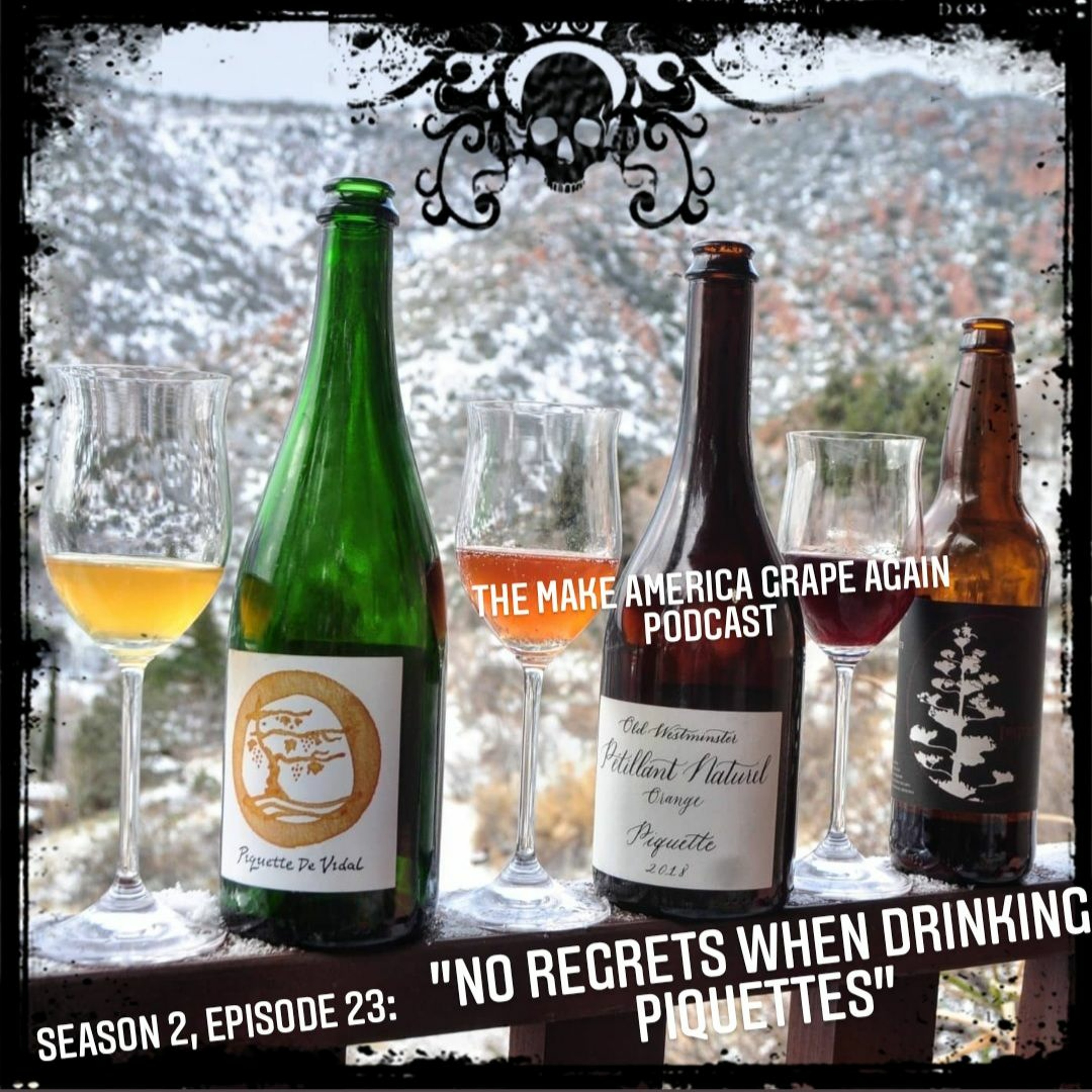
Lately, in the American wine scene, a new beverage with ancient roots has been taking the world by storm: Piquette. Occasionally described as "White Claw for Wine Lovers," Piquette is a low-alcohol fizzy beverage made from adding water to the grape pomace left over after grapes have been pressed for wine. This water-pomace mix is then fermented until the result reaches somewhere between 5%-9%; about the same percentage of alcohol that one normally finds in beer or hard seltzer. Incidentally, this makes Piquette the nigh-ideal beverage for day drinking in the warm summer months. The oft-made comparison to White Claw is where the title for this episode comes from, courtesy of Mitch Ermatinger of Native Species Winery in Grand Rapids, Michigan. He has made some very entertaining stickers and T-shirts with that saying that you all should check out. However, unlike hard seltzers, Piquette has a long history. The name most commonly used to describe these beverages, Piquette, is derived from the French word for "prickle"; referring to the slight fizz present in most versions of this drink. Piquette was said to have been the preferred drink of vineyard workers at the lunch table, since the low alcohol content encouraged post-lunch productivity, rather than the alcohol-fueled stupor that could be expected from wines with a higher percentage of alcohol. In Italy, Piquette has various names including acqua pazza, acquarello and vinello. That being said, nearly all European winemaking countries have their own version of Piquette, which is usually made and consumed by field workers and their families. The fact is, Piquette was a great way to stretch what one could make from a given harvest. But, Piquette has ancient roots too. The Greeks and Romans made versions of this drink too. The Romans, calling it lora, often considered this beverage to be a meager, cheap-to-produce drink. Since it was made from what basically amounts to the leftover scraps of winemaking, it was usually given to slaves and field workers. Times have changed, however. What was once seen purely as a drink for the poor working folk has rapidly skyrocketed into popularity in the twenty-first century. Why this is the case, I'm not sure, though I have my theories. The Marxist in me wants to complain about the gentrification of poor culture to appease the ever-thirsty desires of the rich bourgeoise for novelty, I'm not so sure that has a lot to do with it. There is the simple fact of the matter that most wineries are on the knife-edge of a budget and making Piquette increases the amount of inventory, and therefore the amount of money that flows into a winery, but I'm not so sure that's a major cause either. Instead, I would argue that modern sanitization techniques, even in wineries focused on Natural Wine, has made it possible for winemakers to combat and prevent the bacterial infections which could easily occur otherwise, and controlling the ones that do occur... which can partially lead to the intriguing flavor profiles you get in many Piquette wines. Basically, this means that modern Piquette tastes far better than its ancestors. Combined with a plague which often lead to day drinking in quarantine, and you have a perfect storm to increase this beverage's popularity. But I digress. In this episode, podcast newcomer Brianna Nation of Page Springs Cellars joins all of us to drink some Piquette, and share her experiences about making it-- she made the Piquette de Vidal that features as the second vintage of the recording. We also drink two Piquettes from Saeculum Cellars, another Arizona Winery, and one from Old Westminster Winery in Maryland. Drink up, folks! Remember, No regrets when drinking Piquettes! Oh, and since one of the Piquettes from Saeculum Cellars is made of Cabernet Franc, that brings our current total for this varietal to 8.
What this episode covers
Lately, in the American wine scene, a new beverage with ancient roots has been taking the world by storm: Piquette. Occasionally described as "White Claw for Wine Lovers," Piquette is a low-alcohol fizzy beverage made from adding water to the grape pomace left over after grapes have been pressed for wine. This water-pomace mix is then fermented until the result reaches somewhere between 5%-9%; about the same percentage of alcohol that one normally finds in beer or hard seltzer. Incidentally, this makes Piquette the nigh-ideal beverage for day drinking in the warm summer months. The oft-made comparison to White Claw is where the title for this episode comes from, courtesy of Mitch Ermatinger of Native Species Winery in Grand Rapids, Michigan. He has made some very entertaining stickers and T-shirts with that saying that you all should check out. However, unlike hard seltzers, Piquette has a long history. The name most commonly used to describe these beverages, Piquette, is derived from the French word for "prickle"; referring to the slight fizz present in most versions of this drink. Piquette was said to have been the preferred drink of vineyard workers at the lunch table, since the low alcohol content encouraged post-lunch productivity, rather than the alcohol-fueled stupor that could be expected from wines with a higher percentage of alcohol. In Italy, Piquette has various names including acqua pazza, acquarello and vinello. That being said, nearly all European winemaking countries have their own version of Piquette, which is usually made and consumed by field workers and their families. The fact is, Piquette was a great way to stretch what one could make from a given harvest. But, Piquette has ancient roots too. The Greeks and Romans made versions of this drink too. The Romans, calling it lora, often considered this beverage to be a meager, cheap-to-produce drink. Since it was made from what basically amounts to the leftover scraps of winemaking, it was usually given to slaves and field workers. Times have changed, however. What was once seen purely as a drink for the poor working folk has rapidly skyrocketed into popularity in the twenty-first century. Why this is the case, I'm not sure, though I have my theories. The Marxist in me wants to complain about the gentrification of poor culture to appease the ever-thirsty desires of the rich bourgeoise for novelty, I'm not so sure that has a lot to do with it. There is the simple fact of the matter that most wineries are on the knife-edge of a budget and making Piquette increases the amount of inventory, and therefore the amount of money that flows into a winery, but I'm not so sure that's a major cause either. Instead, I would argue that modern sanitization techniques, even in wineries focused on Natural Wine, has made it possible for winemakers to combat and prevent the bacterial infections which could easily occur otherwise, and controlling the ones that do occur... which can partially lead to the intriguing flavor profiles you get in many Piquette wines. Basically, this means that modern Piquette tastes far better than its ancestors. Combined with a plague which often lead to day drinking in quarantine, and you have a perfect storm to increase this beverage's popularity. But I digress. In this episode, podcast newcomer Brianna Nation of Page Springs Cellars joins all of us to drink some Piquette, and share her experiences about making it-- she made the Piquette de Vidal that features as the second vintage of the recording. We also drink two Piquettes from Saeculum Cellars, another Arizona Winery, and one from Old Westminster Winery in Maryland. Drink up, folks! Remember, No regrets when drinking Piquettes! Oh, and since one of the Piquettes from Saeculum Cellars is made of Cabernet Franc, that brings our current total for this varietal to 8.
NOW PLAYING
Season 2, Episode 23: "No Regrets when drinking Piquettes"
No transcript for this episode yet
Similar Episodes
Mar 26, 2026 ·1m
Mar 19, 2026 ·34m
Feb 18, 2026 ·11m
Feb 11, 2026 ·45m