
EPISODE · Nov 25, 2019 · 28 MIN
Season 2, Episode 4: The Forgotten Pinot (Oregon vs. Germany)
from The Make America Grape Again Podcast · host The Wine Monk
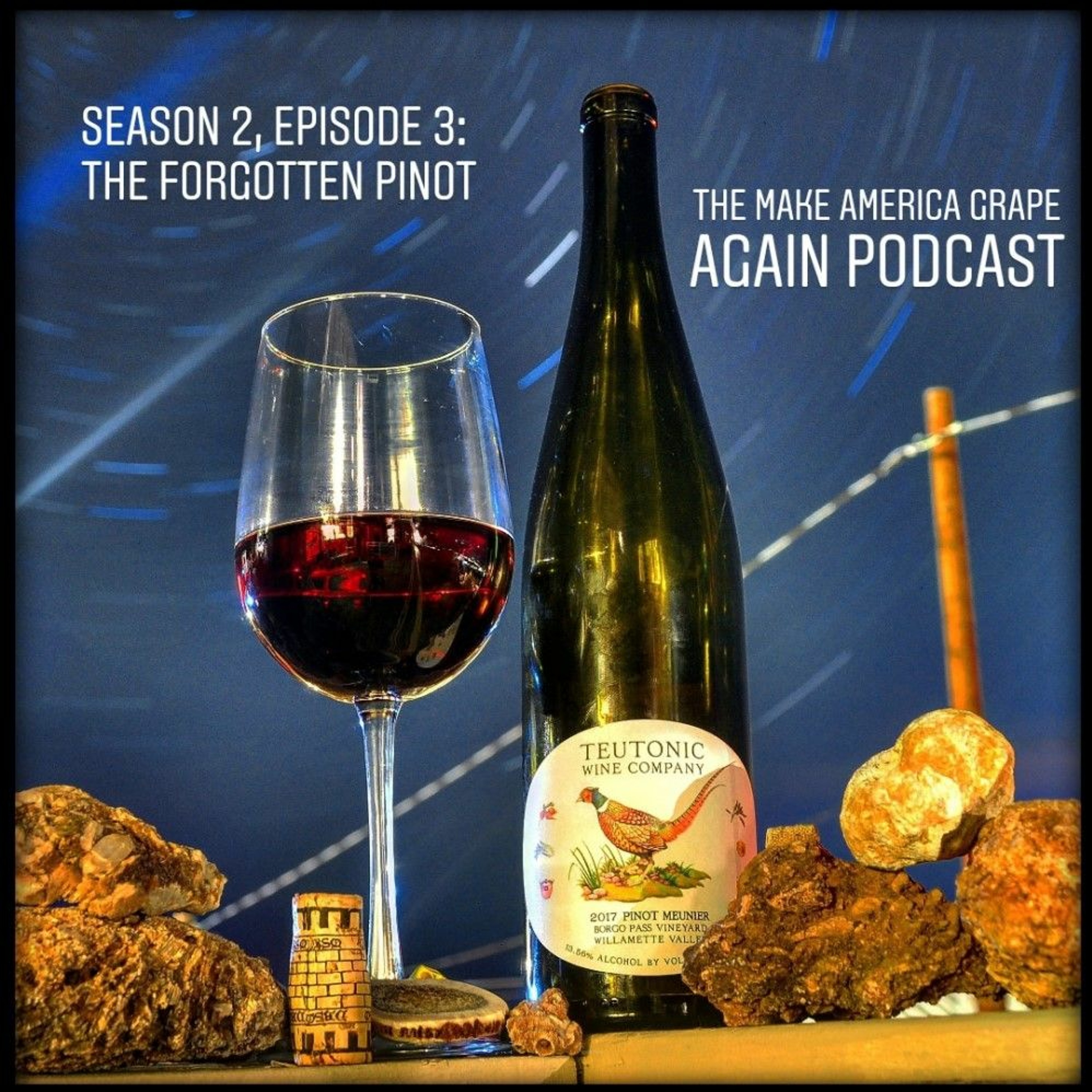
Everyone knows Pinot Noir. Most folks know Pinot Gris, aka Grigio. Pinot Blanc has a few die-hard fans even among the general public. But Pinot Meunier, despite its common use in making Champagne, seems to remain the province of wine geeks alone. In this episode, the gang tackles the challenge, when we compare the 2017 Pinot Meunier from Teutonic Wine Company (sourced from Borgo Pass Vineyard in the Willamette Valley of Oregon), with the 2015 Darting Pinot Meunier from Pfalz, Germany. In this episode, we also talk about wine-making techniques and compare the Old-World style of Winemaking, to the New World style, and touch again upon the subject of Natural Wine. I REALLY need to do an episode just focusing on Natural Wine at some point. This also reminds me, I need to reach out to the folks at the fine Natural Disasters for a collaboration on the subject... I digress. A word about tonight's (today's?) grape of the episode: Pinot Meunier. Also known variously as Meunier, Schwarzriesling, Müllerrebe, and Miller's Burgundy, this grape gets its name (and most of its synonyms) from the flour-like dusty white down which is found on the underside of the leaves; like the result of grinding wheat. First mentioned by name in the 16th century, Pinot Meunier is what is known in the plant world as a Chimeric Mutation, where different plant genes are expressed in different places. In the case of this varietal, the inner cell layers are composed of a Pinot genotype which is close to (if not identical to) Pinot noir, but the outer, epidermal, layer is a mutant, distinctive, genotype. I have no idea how this happens, but it is my understanding that the genetics of most Pinot varietals are about as stable as my average mood, and therefore the plant can mutate simply if you look at it in a funny way. Of note: Pinot Meunier is apparently almost one-third of all the grapes planted in Champagne, but the French don't like to talk about this fact and prefer to emphasize the use of Pinot Noir and Chardonnay... though I will say the best Champagne I've ever had was a Grower's Champagne (the Vallée de la Marne Rive Gauche Extra Brut from Bereche & Fils) made of 100% Pinot Meunier, so, uh, take that, popular kids! Or something? I acquired this bottle of the 2017 Teutonic Pinot Meunier directly from their tasting room in Portland, Oregon, while visiting there last September; the German example was acquired from Lloyd's Liquors, in Prescott, AZ.
What this episode covers
Everyone knows Pinot Noir. Most folks know Pinot Gris, aka Grigio. Pinot Blanc has a few die-hard fans even among the general public. But Pinot Meunier, despite its common use in making Champagne, seems to remain the province of wine geeks alone. In this episode, the gang tackles the challenge, when we compare the 2017 Pinot Meunier from Teutonic Wine Company (sourced from Borgo Pass Vineyard in the Willamette Valley of Oregon), with the 2015 Darting Pinot Meunier from Pfalz, Germany. In this episode, we also talk about wine-making techniques and compare the Old-World style of Winemaking, to the New World style, and touch again upon the subject of Natural Wine. I REALLY need to do an episode just focusing on Natural Wine at some point. This also reminds me, I need to reach out to the folks at the fine Natural Disasters for a collaboration on the subject... I digress. A word about tonight's (today's?) grape of the episode: Pinot Meunier. Also known variously as Meunier, Schwarzriesling, Müllerrebe, and Miller's Burgundy, this grape gets its name (and most of its synonyms) from the flour-like dusty white down which is found on the underside of the leaves; like the result of grinding wheat. First mentioned by name in the 16th century, Pinot Meunier is what is known in the plant world as a Chimeric Mutation, where different plant genes are expressed in different places. In the case of this varietal, the inner cell layers are composed of a Pinot genotype which is close to (if not identical to) Pinot noir, but the outer, epidermal, layer is a mutant, distinctive, genotype. I have no idea how this happens, but it is my understanding that the genetics of most Pinot varietals are about as stable as my average mood, and therefore the plant can mutate simply if you look at it in a funny way. Of note: Pinot Meunier is apparently almost one-third of all the grapes planted in Champagne, but the French don't like to talk about this fact and prefer to emphasize the use of Pinot Noir and Chardonnay... though I will say the best Champagne I've ever had was a Grower's Champagne (the Vallée de la Marne Rive Gauche Extra Brut from Bereche & Fils) made of 100% Pinot Meunier, so, uh, take that, popular kids! Or something? I acquired this bottle of the 2017 Teutonic Pinot Meunier directly from their tasting room in Portland, Oregon, while visiting there last September; the German example was acquired from Lloyd's Liquors, in Prescott, AZ.
NOW PLAYING
Season 2, Episode 4: The Forgotten Pinot (Oregon vs. Germany)
No transcript for this episode yet
Similar Episodes
Mar 26, 2026 ·1m
Mar 19, 2026 ·34m
Feb 18, 2026 ·11m
Feb 11, 2026 ·45m