
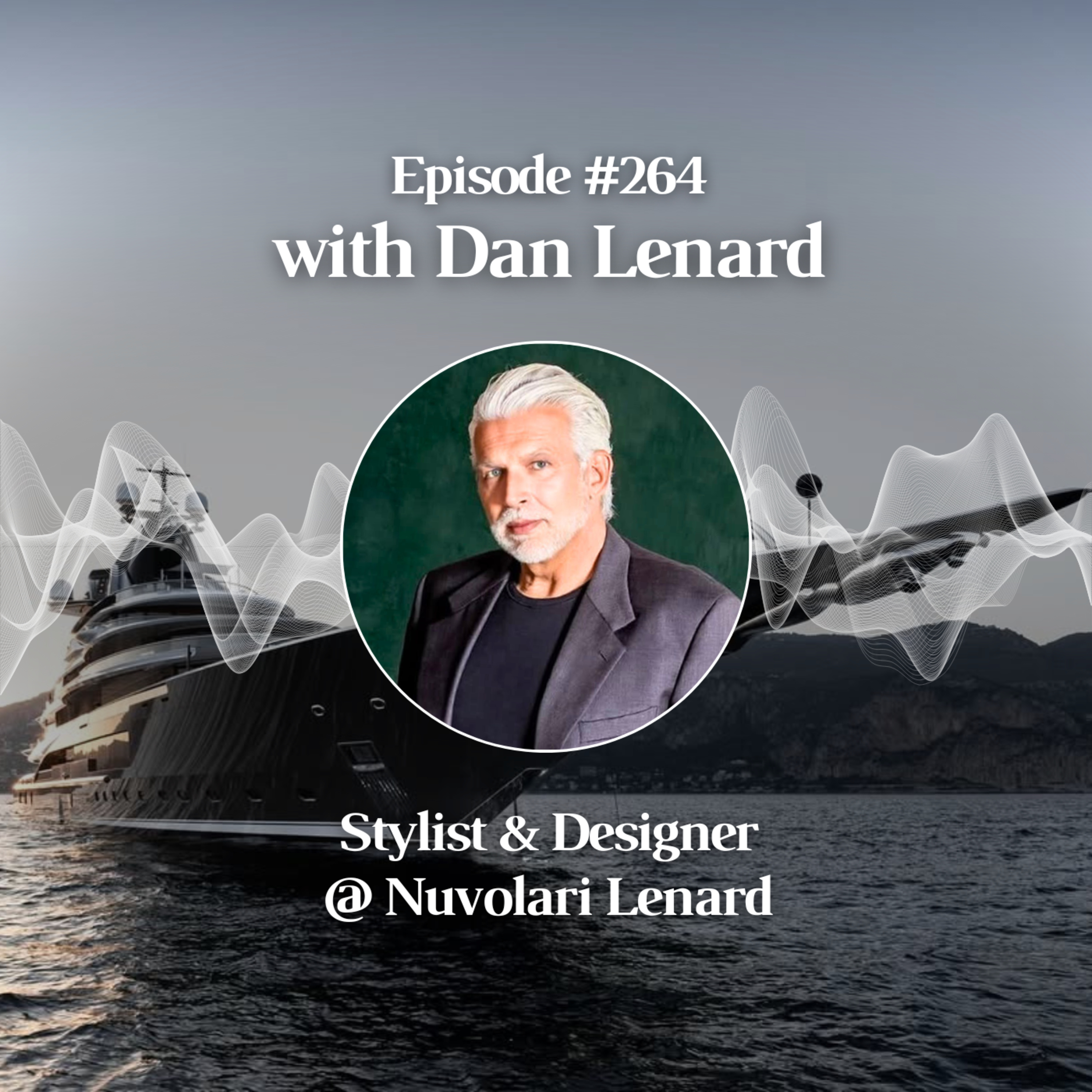
Ladies and gentlemen, welcome back to another SSU Midap, your host, Alvar Nune, to bring you another extraordinary and successful guest today. We have with us, Dalen Art, who is not only the founder of Nulanar, which is one of the most respected design studios that are redefining how to do yards, aircrafts, and experiences at the highest level, but he's also a visionary and somebody that carries purpose in everything he does. He just recently broke a war record in one of the most incredible adventures that I've got to witness. So it's a privilege and an honor to have Dalen Art with us here.
Oh, here we are. So here, the myth, the legend. My friend, welcome to our SSU Midap. It's very exciting to have you here.
And we've known each other now for so many years. And every time I see what you're doing, it just keeps on leveling up. Every time it's like bigger, better, more incredible shipyard that you're designing and building, and then you're transforming that into other different industries, whether it's the aircrafts or experiences. But not only that, you're also recently broke a war record on your own.
Tell me about that, because that's super exciting. You know what? Sailing is actually a very vast field, right? And when you think of sailing, you think of this expensive regatta boats and all these big expert guys running over the oceans.
But you have to know that most of them actually started on a very small boat when they were kids. And if you go ahead and keep on going in your local club as a kid, you become a junior, and then you become a teenager. And somewhere around 18, you are heavy and big enough to actually end up on a laser. The most numerous boat on the world, really, actually.
To give you an idea, I got my new one last September, sorry, September in 24. And its serial number is 225,450. This is how many boats were made, about almost a quarter of a million, I would say, by now. And this means that basically everyone that ever sailed a little bit more seriously, at least once tried a laser.
It's like the boat, the apotelises of all the small sailing boats and the sweet memory of every expert sailor in the world, no? Right. And also mine, because at 16, I started to sail on laser. And this brought me to a crazy idea that at my almost 60, I'm going to be 58 in two weeks now.
Why not going back to roots? Why not going back to where I started really to enjoy sailing? And then I got a little bit into it. And I realized that there are actually some records made with laser.
And laser is very, very difficult boat to live on. It's a boat that you can easily make a race of three, four hours. You can be out for the day with a little bit of water, but staying on a boat on an endurance, let's say, attempt. So leaving day and night and basically being a yacht spent on the smallest possible yacht, well, that's not easy.
And that started to tempt me into thinking of how about if, and at that point, I found the sponsor PSA, the biggest producer of lasers in Australia. They were immediately responding, sending me the boat, like no asking questions. And I tried in September 24 to learn what actually this is all about. My attempt was not going very well.
But then I started again in June, the 25. And I learned even more about it. And again, I had to stop. And then in August, I was fully prepared.
And I was really enjoying. And I made this world record in endurance, which is the distance that you make in this boat, without any assistance, without stopping by the shore, by the boat, or even attaching yourself to any kind of an anchor or floating object. And the most important thing is that you can't stop sailing, because you can't take the sail down on laser. It's a sock being put over the tip of the mast down, like a winter, OK?
So you are condemned on having the sail full time on. And then the problem is sleeping. The problem is when do you rest? The problem is stretching because it's very small boat.
The problem is food. The problem is sun. The problem is strategy. Everything's a problem, suddenly.
The least important thing is how good technically you are as a sailor, because even if you were not good after three or four days, you are very good. Yeah, exactly. What was the total time and distance? I did 325 miles in six days and four hours.
Wow. And I stopped because that was enough for the record. Yeah. And I stopped also because I wanted to do it again.
And slowly. Give me the reason to record. You know what I mean? I love it.
Every year until I can, I will try to go further and further. And then let them try. Yeah. You know, it's such a great story.
And what you said at the beginning, it brought you back to your roots. Because for people that have seen you on social media, that have seen the type of shipyards that you've designed, you are being named and ranked one of the most accomplished designers in the world. Like you see all these massive, super expensive shipyards. And that's you.
And you go from that back to your roots, sailing, wrecking records, having fun. So tell me about what was the true meaning behind? Or what did you feel when you accomplished this world record? Well, first, it's a huge pleasure for me to be connected to the sea.
And this kind of boat, this size of boat, is about six inches from the water. You are very connected to the sea. You're streaming almost, yeah. Yeah.
And all my love for sea actually led me to designing boats, you know? And also through this love for sea, I met my partner, Carlin Vollari. And we are going to be 37 years together in April. Can you imagine that?
Wow, what a journey. I mean, this is longer than being with anybody else. Yeah, exactly. It's actually way more than half of my life by now.
And it's going to go up and my age is going to go up. I don't think I'm ever going to get to half of my life. It's just more than half of my life. So yeah, all our passion for boats starts with passion for the sea, you know?
And I actually really need it, again, a strong connection with the media, which is the sea for me, you know? It's like refreshing your cradle, your basics, from which you are actually taking the love for what you're doing, you know, from, you know? And I really needed that. It was not strategical.
It was not like something I should do. It was something I really needed inside, you know? And it's freeing your spirit again, you know? And you are one of the top world, how shall I say?
Extreme sport tests, aren't you? Like that would be even not enough to say, you know, because extreme today is anything. You are really beyond everybody else. You know how freeing it is when you accomplish something like this, you know, and how much of a charge you get for everything else in your life, you know?
And I just needed that after six years of Dead France Atlantic, I obviously then there was those years with COVID, and then we started to gather together all our businesses, you know? And, you know, six years slipped away without being really strongly back on the sea, you know? And without planning something really expensive and complex, you know, like big boats and oceans crossings and stuff like that. I really thought why not going back to roots, you know?
And this is what actually today I'm more challenged by the laser than I am by any other bigger boat, you know? If you ask me, you want to go out on an 80 footer with the racing crew or you want to have a laser for yourself in the afternoon, laser winds can stop. And all the time, yeah. Wow, you know, you're saying something that is so true and important for people to remember that when you go to your roots, when you go to the passion that ignited that journey, that sometimes charts you up even more than any success that you will accomplish in the path that you're in.
Exactly, exactly, you nailed it. And that's a great reminder. We forget about it often. You know, it's like you start with all kinds of charging and ideas and you're fresh and motivated and you do anything necessary to go ahead and make your career to make your stuff well to succeed.
And this consumes you as well, you know? And a lot of people down the road lose that simply because this is like love. You have to invest in it, you have to renew it, you have to sometimes take time and do stuff you did some time ago with a beloved person, you know? And it's the same with things that brought you into a career into a love for your job, you know?
It's the same thing. One thing that stood out as you were talking about your partner being 37 years in business and all the different tributilizes that you've been going through and you're still standing and not just surviving but thriving, accomplishing some of the most incredible things like you're literally the example of what anybody that is getting in the industry is aiming for. And a question I have for you is, is there a secret formula to maintain yourself in the game for so long and at that level? You know, we never really thought what we have to do.
We were just simply always driven by the same passion, which is how can you do a new thing and better, you know? Our designs are known for not being repetitive. They are all so different between themselves. The people are newcomers, let's say, had a hard time to understand these are all ours, you know?
These are all from Nulalar and Leonard because they look like products of different minds but this is how we like to work, you know? Not discovering a formula and then repeating it and making some kind of a family feeling between our boats or a brand or something, you know? The brand is that each boat is so different from another that each of them becomes a brand in itself, you know? And I can name you a few that, you know, when you know that the boat is a brand by itself, when her name cannot be changed, you buy that boat as a second-hand boat and you rename it, the market, the people will still call it with the old name, right?
You know what I mean? That's a good point, absolutely, that is so true. And I'm saying... Say for instance, you buy Nord if that was even possible.
And you rename it. For the people that don't know that I watch, you know, listen to it, explain quickly what Nord is. But Nord is one of the most complex boats ever built. We designed it to refers to only itself, you know?
It was praised and acclaimed hardly ever. I heard any kind of a critic, not even a critic, but you know, some people may say, okay, I like it, but you know, I have a preferred boat. Okay, that's plausible. No, I mean, but generally it's widely accepted as one of the most recognizable boats ever built.
No, that's the price for it. At the time was half a billion. And that was in 2019 to 2021. We delivered it in COVID, actually.
I don't know what today would be the price, but I would assume it's 25, 30% up at least. No, carry on with the story. I just wanted to set up the tone for those that were not too aware of it, because for those that understand luxury and are in the space, especially with the adding, I mean, you know about Nord for sure, but for those that are tuning in, check it out, because for me, it's one of my favorites for sure. It's about that, as I said, if you had a chance to buy it, let's say, forget already already have the capacity, the financial capacity to buy it.
And you also want it, and you buy it. And you call it with some other name. The whole world will still call it Nord, because that's the name. It's like you would try to rename the Porsche.
Yeah, exactly, exactly. Like somebody buys Porsche, now calls it something else, but there is still 911, but it's called something else. Everybody will always call it Porsche. You can't change that.
So this is what means that the design has been so strong that it created almost a brand out of itself. And brand is a little bit of caricature, because you are not selling this as a product, no? But still, it's brand as a name, as a brand, it's strong enough that you could do other products with that name referring to that yacht, and you would be able to sell them, you know? Totally, 100%.
I think you could do a purse for a woman named Nord, and those that you know that is referring to Nord, the yacht would buy the purse. Oh my God, it's already a strong brand on its own. I agree with you. And one thing that I want to lean on with this is that you've been a creator ever since, and it's about how can you come up with new ideas and concepts to stay unique in everything you do.
And that is a skill that nowadays is getting less and less applied to life. We have no technology that does everything for you and your creativity. It's not as sharp as it was before. So people are trying, as you mentioned, do more, but not necessarily better.
And they're just replicating things faster. So how do you stay sharp and find new ways of continuously innovating and creating? You know, a lot of the input comes from a person, because we actually really connect with the client. And you have to understand the personality, you have to understand the person, and then you basically tailor made it to him, you know?
Not to the wishes that he expressed, not only to that. You actually make a boat that expresses himself, and he would never be able to tell you how that boat should look like to express himself. He would be able, like most of people, telling what he likes that he already made. Or maybe there is some kind of a vague idea that he has.
It's all good, but what we do is we take all that, and then we design it to the personality of the owner, you know? And I can really say that the owners of our designs are very strongly emotionally connected to their boats, you know? It's not just the boat, it's not that something that they build, and okay, yeah, well, we'll do another. We have a problem that a lot of these people actually then cling to this, and they don't really sell it and buy another one, you know?
So we are at the same time also making like the final boat to everybody. That's a typical, you made it, you made it. Yeah, yeah. A lot of these people are right, you know?
I mean, new is not always better. That is his boat, and could you really do it differently? Probably yes, you know, but do you want? Well, no, maybe you are just in love so much with these boats that this is it for your life, you know?
I mean, that's happening, and I can name you, at least 50% of our clients are staying with their boats, you know, and for more than 10 years, let's say, okay? And going. Right, how do you, because this is important too, like to earn the respect and the trust from all these individuals, is it because of the results that you've been having over the years, or how do you maintain and keep an expanding these type of relationships with the most wealthy people in the world? The portfolio, of course, speaks for itself, you know?
It gives you a kind of a credibility that you can do good stuff, you know? But I think that we have been always really working successfully with people because we connected with them on a very, very close level, you know? You know a lot about the person and person is somehow feeling safe to let you discover him or her to the point that it becomes very personal, you know? That's not called a friendship.
It's really a professional understanding of the subject that actually commissioned you the boat, you know? And that is basically where you get really into it, you know? And I think it's building a relationship that makes it, you know? Or you are, and for this you have to be, you know, a certain way, and you know that better than I do.
I mean, you have to be an interesting person, you have to be very cultured, you have to be at home in possibly every possible field that comes to a mind. You have to be able to carry on conversation, you have to be able to stimulate, you have to be able to discuss in a creative and pro-creative way, you know? You have to be somebody that they want to meet to call you and discuss their boat, not other stuff, you know? But they are really having fun discussing their project with you.
And it's becoming also their project. It's their project because you involve them in a way that they are participants, you know? It's not like, okay, sit back, I'm going to give you migration. It's not like that.
We are not that prima don't answer. Yeah, you're working together. Is there a specific approach initially on how to break through and really have them open up and build a relationship or is this a matter of conversations? I think it's a matter of conversations and first feelings, first emotions.
It's a little bit like, again, it's like a relationship in any other way, even in emotional way, a relationship. I think I'm a strong believer in a struck from the sky. I'm not really a believer that you can kind of build a relation through the years and going from friendship to love. I don't believe that.
But some people made it. I don't believe in that. I think it's either snap or it's not. Then from that snap, the things roll like a snowball becomes bigger and bigger and bigger.
But just insisting on something that doesn't have that frequency right at the beginning. Yeah, yeah, yeah, doesn't work. So I think at this point, we attract some clients and some clients attract us. And that actually kind of leads us to meet and to work together and do stuff.
And it's always fun with these people that I was lucky to work with. I learned a lot from them. I had good time with them. We did the boat.
Usually it ends there, because at the end, it's a professional relationship. But it's not a boring thing. It's actually fun. It's actually rewarding, rewarding on many levels, not just on the final product that the end splashes.
And you know, you accomplished the boat's built, shipyards done, owner has it. It's not just that you carry some nice experience out of it, even as a designer, you know, from the relation that you build with the person. Yeah, totally. I'm curious also about just the beautiful relationship and how you're doing all these things, but also on the lows, because it is a lot of pressure.
You're doing something that is worth millions and millions and millions and dollars. There is a lot of sophistication and teamwork that goes into it. So how do you make sure that you minimize the error to ensure that everything goes perfect? Well, first of all, we have a very good team.
You have to know this is not a single man or a new partner or operation, although we may actually be on the top of the ideas with my partner Carlo at the end. The whole team is actually, you know, the guys that work with us and ladies, you have to know that we have people that are 26, 27 years with us, you know. So we really don't have a flow through the office of newcomers and people leaving. You know, we are one of the most hermetically closed offices in the world, you know.
And once somebody fits into the team, it kind of remains, you know, and it's pretty much a, let's say a responsibility of these people that things are flowing because, you know, at the end, it's like a pyramid, you know. Let's say you are a conductor, but then the orchestra, you know, has to play the team perfectly, you know. And it's a lot of people playing a lot of instruments and at least one has to look always the next one next to him, you know, and they are reading the same notes, the same part of the tour. And, you know, the conductor is leading the whole thing.
That's how it works, you know. I mean, otherwise not one symphonic orchestra would be able to perform a symphony without an error, you know. They don't error, you know. They are well played, well tuned into a team, you know.
This is what we accomplished as a studio, yeah. I like a lot because, you know, all the situation we have lived already, you know, technically, you know, I'm not saying the new technical solutions. I'm not talking about that, but situations, you know, where something goes a little bit sideways and how to get it back in the track. We've lived all that, you know, we recognize the situation before it happens, you know, and you can actually lead it back to the track before it actually even looks like an error or a God forbid mistake, you know.
But what you want to actually avoid is not errors and mistakes. You want to avoid even the slight feeling that there is a problem. The whole thing should not seem problematic to the owner and hopefully not even to the yard because the yards would avoid offices that create situations where they have to deal with the problems, you know. So you have two entities that you have to completely preserve from feeling of having a problem, you know.
That's the owner and the yard, you know. And if you can imagine the budget that we spoke before, you know, we often operate with two or even three figure numbers, you know, in the nothing one we haven't seen anymore for a long time. It's always two, you know, three quite often and then it can be probably quite up there high. You have to know that these people don't need the odds.
They want them, but there is no necessity to have it, you know, except your personal joy, fun vanity if you want, or reward for your lifetime as successes that you were accomplished. So you will never run into something like that if that would cause you a problem, you know. You have enough problems in your main business or businesses and you are solving these problems all the time, but this is your job. It's what you do, you know, it's what makes you successful.
Now you're buying a yacht. You really don't want to repeat any of that experience to do that. You know what I mean? So the world problem doesn't exist, you know.
You should not even pronounce that word, a problem. Not even saying there is no problem. The world itself doesn't exist in our language, you know. Right.
I wanted to ask you because there is something very important about what you mentioned on creating this family environment where you've had the same people over 20 plus years and there must be some non-negotiables that you have established as standards in your organization so that everybody's aligned. Because otherwise you wouldn't build this sort of machine and entity that works together. So tell me just a few of them. Like what is some main non-negotiables that you lead by?
Well, obviously the total privacy of the clients and the total non-disclosure of the projects, that's number one. We are very known for not leaking. Yeah. Sorry, I just mow a little.
In yelting itself, I like to compare it. Generally it's like a fruit market. Everybody chatting about everybody. Did you hear?
Did you know? It's really like almost gaining an importance by knowing some stuff and sharing it with people. Well, we don't do that. I mean, we really don't chat about stuff we are doing with anybody.
So if something is secret, it's secret. It's not because somebody has to hide. Some people just reserve not to be discussed while they're doing it because these processes are three, four years long sometimes. And you just don't know what's coming in three, four years.
So you don't want to release information about what you're doing, building a yacht, until it's built. Then it becomes a public domain anyway. So you can't fight anymore. But at least the process itself has to be confidential.
I mean, I think it's the right thing that everybody's entitled to. So that's number one. Second, we don't throw away ideas. So if something didn't pass somewhere, that's still a good idea.
It's somewhere waiting to be again pulled out and re-alaborated. Because you can't really make every time a score. You can make a proposal and doesn't go down. And that doesn't mean that was a bad proposal.
But of course, you don't use it as it is, because after a few years, it's just a very good departure for something new. So we actually get often inspired by our own ideas that we didn't really accomplish. But we hide them and keep them there. So you will hardly ever find those renders and concepts of the Larry Leonard of Unbuilt Yachts around.
We never release our ideas that hasn't been accomplished. We have enough jobs that haven't built. But you will not find our attempts or proposals or renders on the internet. We just don't release that.
That's still there cooking. It's like a tune. You are a composer. You figure out a nice tune.
But right now, it doesn't fit on your record. It's not in the style that you are promoting right now. You keep that tune. It's going to come out in some other shapes someday.
And it's going to sound really, really beautiful. That's how we work. So the second policy, everything we ever done and has not been accomplished is an idea. It's a value that we actually keep.
And we often discuss what was there, why was like this. And then we bring those stuff up, sometimes eclectically, from different projects into something new. But those ideas are valuable. They were a product of some nice moment of some stimulation that brought us to them.
We keep them. We don't share them until it's the time to do that. Of course. 100%.
So that's now confidentiality inside the studio. What we have done, it's always remaining in the studio. It doesn't leave the studio. So that is also another important thing.
The third thing is everybody in our studio is well with everybody. I mean, if it's a boat show, we are a gang. We are a pack. Everybody goes.
And we are a group. Yeah. Yeah. We really hang together.
You know what I mean? It's not like there are people I don't know in the office or something like that. Yeah. I know everybody, everybody knows everybody.
And when it's time to go somewhere, flying somewhere, it's something that you do it with pleasure. Because anyone in our office is good to travel with anyone anywhere, not on professional level only. But actually just having a good conversation in the airplane or on the airport, having a drink together, waiting in a hotel lobby for a meeting or stuff like that. These people are all almost friends, let's say like that.
So we have been living situations where a new person would be called in and promoted to the team and team would not accept it. It was a no-go. I mean, it was not digested and expelled out. Just in 15 minutes.
Yeah. It happens. It happens. And I would never force the team to accept the person that the team doesn't want.
They are totally entitled to have everybody in the whole office pleasant enough to be with, to have coffee with, to have a small talk with. So we are a little bit like a community, like a syndicate. That's the key. That's the key to grow over all these years together.
I love that. Well, look at that. Sorry, just to add this lift from a mind, in order to be like that, you have to be small. It can't be tens and tens of people.
That doesn't work. The team is too big. You have to consider it like a family. We are always somewhere between 12 and 15, never more.
That's it. We have some trainees and people from universities going to the degree. So we are fluctuating a little bit the number. But 12 people, let's say, is the core of our team.
And that's not going to be to 50 or 70. Yeah, it's probably going to be completely compromised. Yeah, 100%. Look, I know that we could be speaking forever, so that's why I wanted to ask you one last question, which we asked all our guests, because I know it's very valuable your time.
And I've enjoyed the conversation. But we want to keep these ones also tight. And I wanted to ask you about luxury. Why is luxury to you?
Well, to me. It doesn't matter what is it to me. Because whatever the answer is for you. Well, obviously, the ultimate luxury is always having your own yacht, because you just really don't respond to anybody when you're out.
That's basically the absence of institutions, the absence of pressure of any kind. The sea is so vast that the space itself gives you freedom. And if that is on a very luxurious and nice object, I can't imagine anything better than that. I love that.
That's great. And that's from a professional point of view. Personal, I would just say, having time to be on the sea. So I'm not actually relating this anymore to a luxury object itself, but to a time and location.
I think that is a real luxury. Having time to be on the sea, in no matter what kind of a boat or yacht or a vessel, but just having time to enjoy this emptiness. I think this is a true luxury. And it's such a beautiful answer.
And it's full circle to the conversation, because we started talking about how you went back to your roots and how you were sailing, because he brought you back to how you were as a kid. And then you went on for this wall wrecker. And now you're really fine. Also, your understanding of luxury as just having the time to be on the sea.
So I will take this on my own personal journey on how to go back into the roots can recharge you and really define the approach on how you're going live. So I appreciate you, my friends. That's been a really, really insightful conversation from one of the best in the field. So I can't wait to see if you're coming here for the boat show.
I know it's in February in Miami. Or any other event I look forward to meeting. We will be for the Palm Beach, because we present a new yacht in the United States. It's a boat built here in Italy, in CRN.
And it's for American client. And we're looking forward, because that's like really the newest from Italy, and it's really high-end. And we are looking forward. So Palm Beach, for me, I think it's second half of March if I'm not wrong.
I look forward to it. I'll pass on Miami, unless something pops up. I'm always ready. We fly the helicopter into the yacht.
We can always do that. I can take you there. Yeah, I know you're doing all kinds of stuff. I know you're pilot for what, three, four years already.
I know something about it. Yes. Good, good, good. I'm still having a dream.
The air, but my mind is actually a glider. I would love to have one day time to have opportunity to fly with the glider. And they're so, so high-end now. They have their own engine.
You can be days in the air if you want. But then it's a glider. But with the auxiliary engine that you can actually use for safety, it's great. It's just so, so high.
Very expensive. Yeah. Well, you're making the good money and keep up the great work. I look forward to doing all these fun adventures, to continue pushing the human limits and to getting inspiring individuals to keep on going.
Because that's what we're doing with this series. We just want other people out there that are involved in the luxury space to find inspirational information from individuals like yourself. And for me as a friend, I love always chatting with you. So I look forward to seeing each other again very soon.
And keep on doing well. Looking forward. Looking forward, myself. Thank you.
Bye-bye. Thanks.