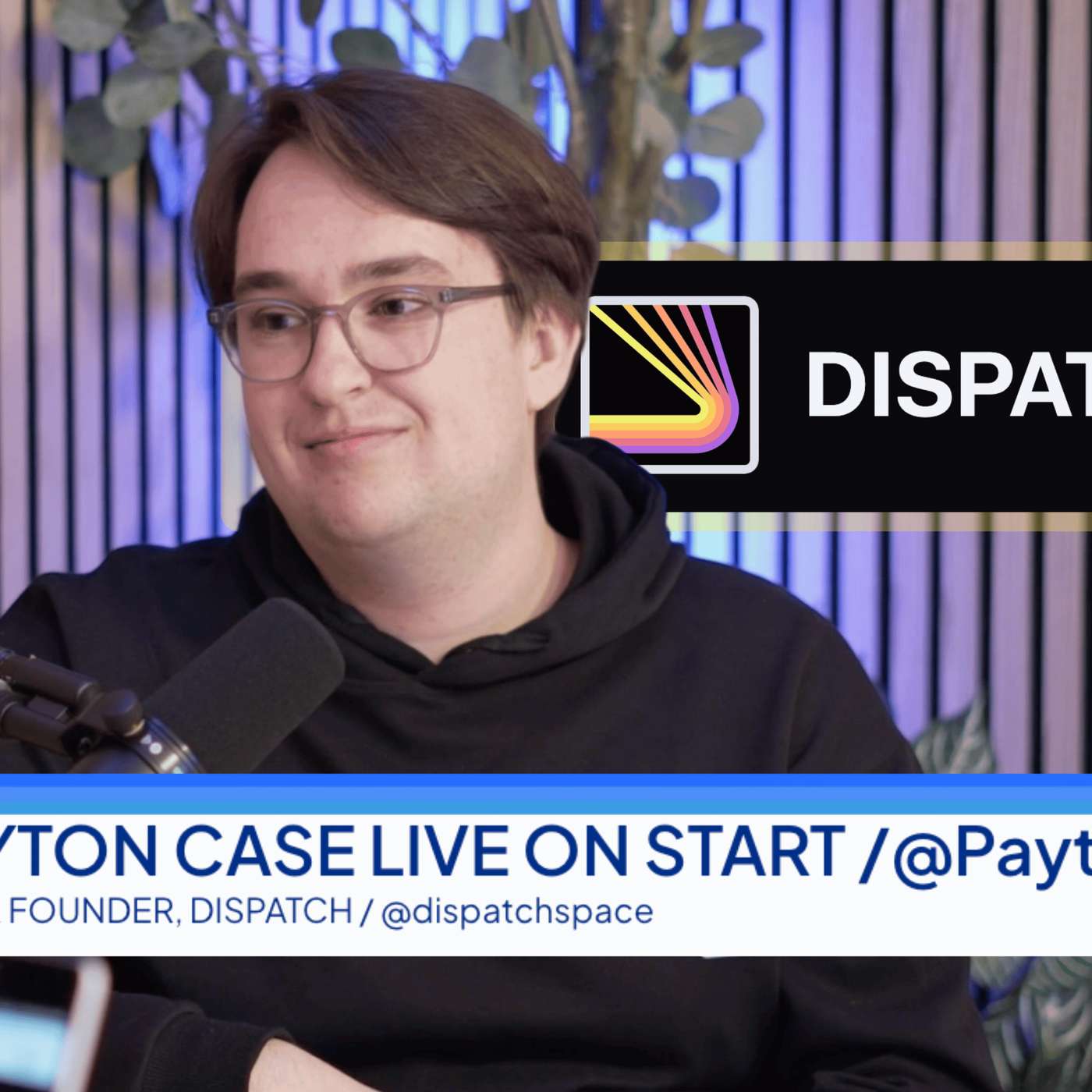
START pod: Payton Case, Co-Founder & CEO, Dispatch: “Satellites for Manufacturing in Space.” episode artwork

EPISODE · May 23, 2026 · 11 MIN

START pod: Payton Case, Co-Founder & CEO, Dispatch: “Satellites for Manufacturing in Space.”

from START · host Fondo

The next big space race won’t be about going up.It’ll be about bringing things back down.After four years building satellites at Astranis, Payton Case realized something: as launch costs collapse, the bottleneck flips.There’s still no infrastructure for manufacturing products in space and returning them safely to Earth.So Dispatch is building it.The thesis is simple: gravity is an invisible constraint on manufacturing.Remove gravity and semiconductor defects drop. Pharmaceutical crystals become more stable. Biological structures that collapse on Earth can solidify in microgravity.To prove the concept, the team built a full-scale heat shield, drove into the Mojave Desert, and blasted it with a rocket engine at 14× expected re-entry force.It survived 6× what they needed.The long-term vision:Factories in orbit. Permanent industrial infrastructure in space.🎙️ Payton Case, Co-Founder & CEO of Dispatch, on Fondo START pod00:12 What Dispatch is building: reusable re-entry vehicles for orbital manufacturing01:16 The next big space race... will involve bringing things back down to Earth02:05 Expanding from re-entry vehicles to industrial space stations02:33 Mojave Desert heat shield testing03:48 Gravity is this invisible constraint on manufacturing04:06 Pharmaceutical crystal growth in microgravity04:53 Semiconductor manufacturing with lower defect rates06:39 Understanding the modern space infrastructure stack08:01 3D printing organs in microgravity09:37 The coolest thing to be done in space has not been thought of yetCheck out dispatch.space‍

The next big space race won’t be about going up.It’ll be about bringing things back down.After four years building satellites at Astranis, Payton Case realized something: as launch costs collapse, the bottleneck flips.There’s still no infrastructure for manufacturing products in space and returning them safely to Earth.So Dispatch is building it.The thesis is simple: gravity is an invisible constraint on manufacturing.Remove gravity and semiconductor defects drop. Pharmaceutical crystals become more stable. Biological structures that collapse on Earth can solidify in microgravity.To prove the concept, the team built a full-scale heat shield, drove into the Mojave Desert, and blasted it with a rocket engine at 14× expected re-entry force.It survived 6× what they needed.The long-term vision:Factories in orbit. Permanent industrial infrastructure in space.🎙️ Payton Case, Co-Founder & CEO of Dispatch, on Fondo START pod00:12 What Dispatch is building: reusable re-entry vehicles for orbital manufacturing01:16 The next big space race... will involve bringing things back down to Earth02:05 Expanding from re-entry vehicles to industrial space stations02:33 Mojave Desert heat shield testing03:48 Gravity is this invisible constraint on manufacturing04:06 Pharmaceutical crystal growth in microgravity04:53 Semiconductor manufacturing with lower defect rates06:39 Understanding the modern space infrastructure stack08:01 3D printing organs in microgravity09:37 The coolest thing to be done in space has not been thought of yetCheck out dispatch.space‍

NOW PLAYING

START pod: Payton Case, Co-Founder & CEO, Dispatch: “Satellites for Manufacturing in Space.”

0:00 11:47

No transcript for this episode yet

We transcribe on demand. Request one and we'll notify you when it's ready — usually under 10 minutes.

21 Millionen - Die Bitcoin Akademie Marco Eberle Bist Du bereit für Deine Bitcoin-Reise? Wir stehen vielleicht am Anfang einer finanziellen Revolution, und Bitcoin ist erst am Start seiner Reise.Hast Du Dich jemals gefragt, was hinter Bitcoin steckt und wie Du ein Teil dieser aufstrebenden Zukunft werden kannst? Hier bist Du genau am richtigen Ort! Rich and Weekly Wondery We’re fascinated with the lives of both the famous and the infamous. From the Kardashians and Kendrick to Britney and the Bravo-verse, RICH AND WEEKLY is your dose of the hottest and latest celebrity news. Brooke Siffrinn and Aricia Skidmore-Williams, hosts of the hit series Even the Rich and Even the Royals, spill the tea, dish the dirt, and tell you exactly what they think. New episodes drop every Thursday.Listen to Rich and Weekly on the Wondery App or wherever you get your podcasts. You can listen to all episodes ad-free on Wondery+. Join Wondery+ in the Wondery App, Apple Podcasts or Spotify. Start your free trial by visiting wondery.com/links/rich-and-weekly/ now. Generally American (A Journey in American English) Christopher M. Chandler, Kris Schauer Hello, Hola, Guten Tag, Bonjour, こんにちは !Welcome everyone, this is a podcast for those wanting to learn about U.S. culture through Standard American English, also known as General American. We talk about various different topics related to the U.S. and the U.S.'s relations with other countries. My co-host and I would like to think of this as more of a journey because you never know where it’ll take us. Plus, since the journey’s more important than the end or the start, we hope that you’ll be willing to join us! Let’s see where it takes us! Talent Stacker Jonathan Mendonsa Data suggests that the average cost of college in 2019 was $122,000 while the entry-level salary for a college graduate at the same time period was 50,000. ROI is a distant memory.hopefully for that that $122,000 the student graduates with a degree and possibly some skills. The reality is, as most individuals approach graduation, they realize that ultimately what they have to prove to their employers that they actually have the skills and since you don't need a degree or permission to start building skills, let’s document the stories and best practices of individuals that crushed the game by focusing on building their skills and their talent stack. Maybe you feel like you don’t have a talent stack. What are the skills you need to be able to generate an above-median income and when paired with interest-led learning this talent stack will allow you to work towards financial independence and design your future?If you're up for this challenge to go from no Talent Stack to designing you

Frequently Asked Questions

How long is this episode of START?

This episode is 11 minutes long.

When was this START episode published?

This episode was published on May 23, 2026.

What is this episode about?

The next big space race won’t be about going up.It’ll be about bringing things back down.After four years building satellites at Astranis, Payton Case realized something: as launch costs collapse, the bottleneck flips.There’s still no infrastructure...

Can I download this START episode?

Yes, you can download this episode by clicking the download button on the episode player, or subscribe to the podcast in your preferred podcast app for automatic downloads.
URL copied to clipboard!