
EPISODE · May 2, 2025 · 19 MIN
Stone, Silence, and Sand: New Evidence of Pleistocene Life in Iran’s Central Desert
from Evolutionary Insights by Anthropology.net · host Anthropology.net
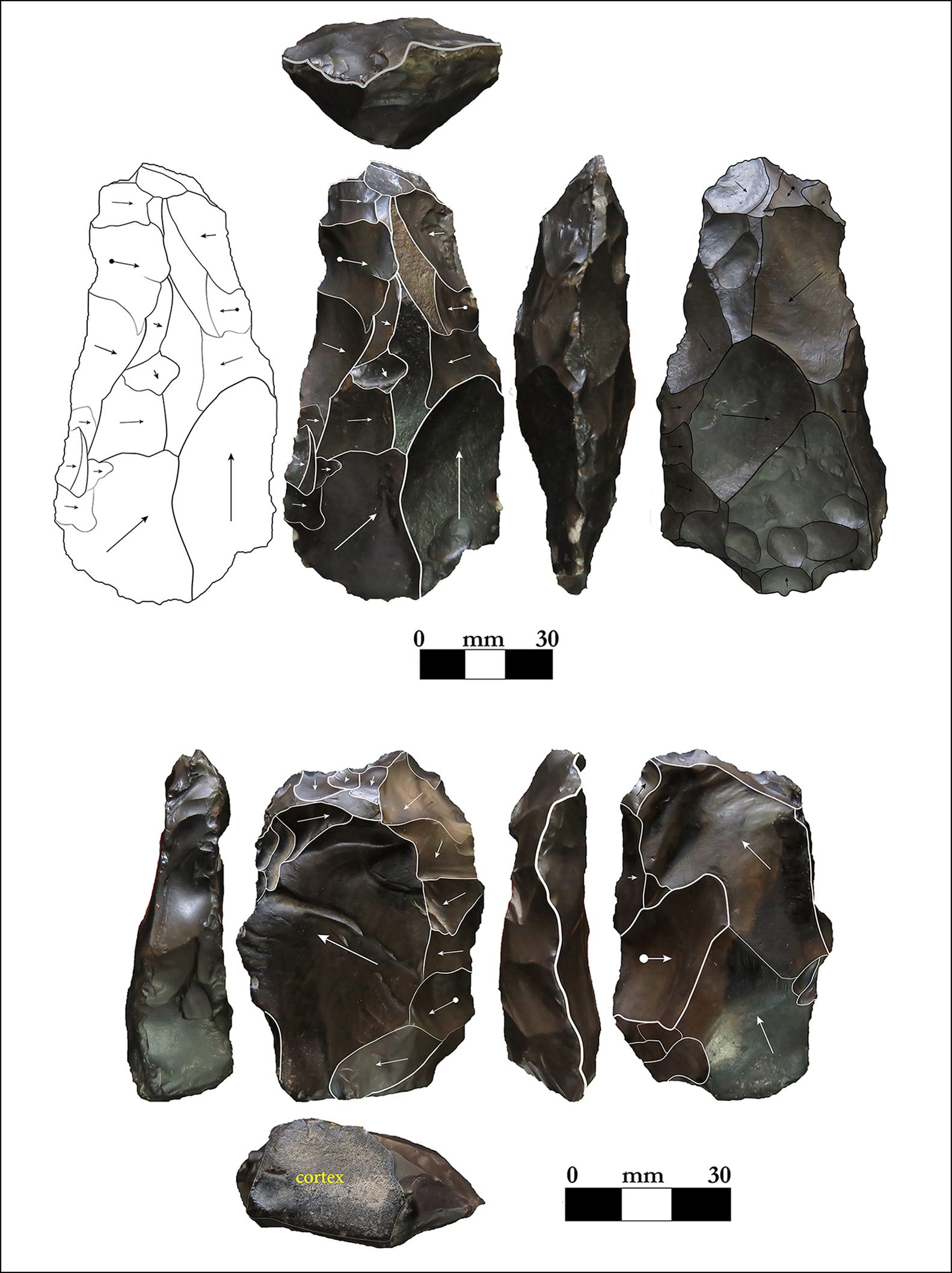
Tracing Human Movement Across the Iranian HeartlandIn the northern reaches of Iran’s Central Desert, nestled between the rugged Alborz Mountains and the flat, wind-worn claylands to the south, archaeologists have uncovered eight scattered landscapes rich in Paleolithic stone tools. These findings from Eyvanekey, Semnan Province, represent the first direct evidence of Pleistocene hominin activity in the central corridor of this harsh, often overlooked region.“The archaeological record here was practically a blank page,” noted Seyyed Milad Hashemi of Tarbiat Modares University, the project’s lead researcher. “This part of the Iranian Central Desert has long been proposed as a potential migration route, but no field surveys had ever confirmed that story—until now.”A New Chapter in an Ancient CorridorPrevious studies had focused largely on the western and eastern edges of the Northern Iranian Central Desert. The central region—arid, remote, and challenging—remained largely uncharted. The 2021 Eyvanekey field project sought to change that.Covering an area of nearly 900 square kilometers, researchers identified eight Paleolithic landscapes, most clustered on ancient alluvial fans and old river terraces. These features had become visible due to wind erosion and surface runoff, stripping away the topsoil to expose a timeworn record beneath.The lithics recovered—1,200 in total—ranged from Middle to Upper Paleolithic. Nearly half were debitage, the leftover flakes from tool production. But the team also found refined tools, including retouched points, Levallois flakes, bifaces, and even a keilmesser—indicating a robust and sophisticated knowledge of stone working.“The presence of tools with basal trimming, convergent scrapers, and Levallois cores underscores the diversity and skill of the hominins who once moved through this desert corridor,” the authors wrote.On the Edge of InnovationAlthough the assemblage includes distinctive Middle Paleolithic signatures—particularly the use of the Levallois technique—it also contains traits more common in later periods. Tools made on blades and bladelets, soft-hammer production, and prismatic cores suggest a gradual transition toward Upper Paleolithic technologies.Yet the lithic traditions here were not carbon copies of what was happening in the Levant or the Caucasus. The Levallois method appears only moderately developed, and many of the tools are typologically atypical.“The Eyvanekey assemblages more closely resemble the opportunistic industries found in central Iran’s Mirak site or the Teshik-Tash cave in Uzbekistan,” Hashemi’s team notes, “rather than the refined techno-complexes of the Zagros Mousterian or the southern Levant.”Filling the Gaps in Pleistocene GeographyIf the Iranian Plateau functioned as a migration route for hominins moving between western Asia and Central or South Asia, sites like Eyvanekey become critical in mapping that journey. This survey adds a missing puzzle piece to the so-called “Northern Dispersal Corridor,” a hypothesized passage used by archaic and possibly early modern humans as they spread across the continent.“These finds support the idea that this corridor wasn’t a theoretical pathway—it was used, repeatedly and substantially, by hominin groups,” said co-author Asqar Nateqi of Islamic Azad University.However, the archaeological material is surface-level. To fully understand the time depth and behavioral contexts of these lithic assemblages, the researchers emphasize the need for future excavations that uncover stratified, in situ deposits.An Unfinished Story in StoneWith its modest yet revealing collection of tools, the Eyvanekey project challenges the notion that deserts are archaeological voids. Instead, the area emerges as a living, shifting record of ancient lives—of travelers, toolmakers, and foragers who crossed the region long before written memory.The research also signals a shift in Iranian Paleolithic studies, urging scholars to look beyond the known hotspots and into the marginal zones—the clay flats, wind-scoured terraces, and buried fan deposits where stories lie just beneath the surface.“It’s only the beginning,” Hashemi concluded. “But it’s a beginning that matters.”Related Research:* Vahdati Nasab, H., & Hashemi, M. (2016).Playas and Middle Paleolithic settlement of the Iranian Central Desert: the discovery of the Chah-e Jam Middle Paleolithic site.Quaternary International, 408(part B), 140–152.https://doi.org/10.1016/j.quaint.2015.11.117* Shoaee, M. J., Vahdati Nasab, H., & Petraglia, M. D. (2021).The Paleolithic of the Iranian plateau: hominin occupation history and implications for human dispersals across southern Asia.Journal of Anthropological Archaeology, 62, 101292.https://doi.org/10.1016/j.jaa.2021.101292* Nishiaki, Y., & Aripdjanov, O. (2021).A new look at the Middle Paleolithic lithic industry of the Teshik-Tash Cave, Uzbekistan.Quaternary International, 596, 22–37.https://doi.org/10.1016/j.quaint.2020.11.035* Golovanova, L. V., & Doronichev, V. B. (2003).The Middle Paleolithic of the Caucasus.Journal of World Prehistory, 17(1), 71–140.https://doi.org/10.1023/A:1023960217881 This is a public episode. If you'd like to discuss this with other subscribers or get access to bonus episodes, visit www.anthropology.net/subscribe
NOW PLAYING
Stone, Silence, and Sand: New Evidence of Pleistocene Life in Iran’s Central Desert
No transcript for this episode yet
Similar Episodes
No similar episodes found.
Similar Podcasts
No similar podcasts found.