
EPISODE · Jul 9, 2026 · 8 MIN
Strait Ahead - Juan de Fuca
from Street Smart Naturalist · host David B. Williams
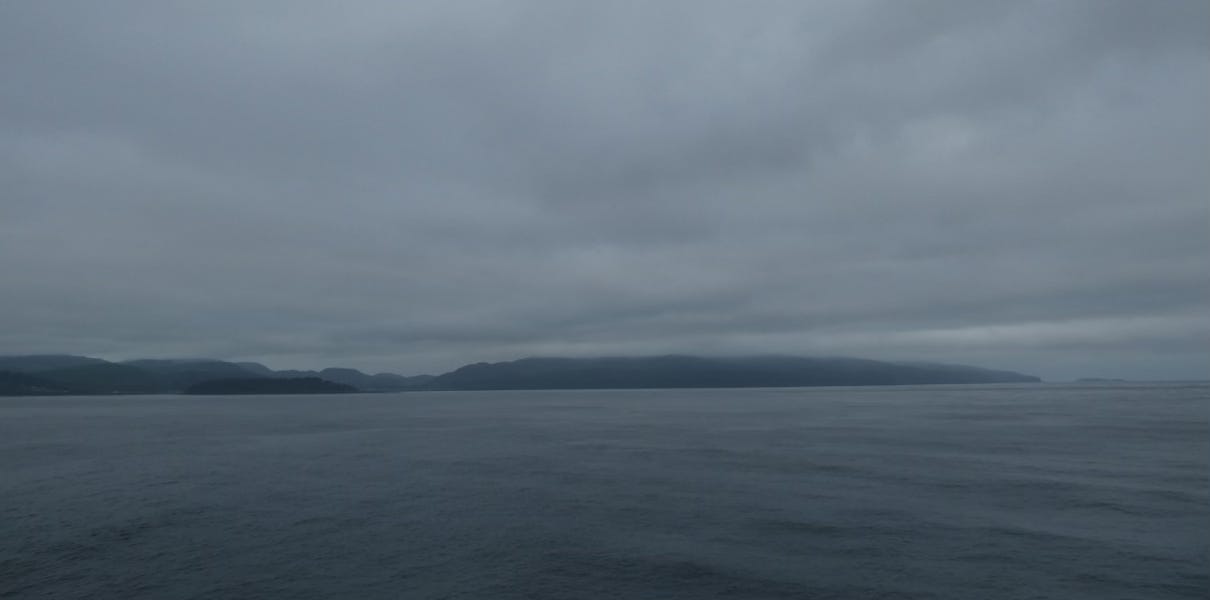
Ever since I started work on my book about Puget Sound, Homewaters, I have wanted to travel in a boat down the length of the Strait of Juan de Fuca. Last week I had the opportunity. It was wonderful.We entered the waterway from the north early morning on Monday, under overcast skies, easterly winds, a 10- to 15-foot swell, and a pleasant temperature. Our ship traveled at about 8 knots, slow enough that it seemed we were not moving until I looked at the land and saw motion. I was alone on deck, my head swiveling as I took in the muted panorama of gray sky, thin band of land, and blue gray water. To the north, lay the forested slopes of Vancouver Island, about seven miles distant, an area I knew little about. To the south was Cape Flattery and Neah Bay, landscape I had trod, which made seeing the trees and foothills from sea more exciting.This southern land is the fabled entrance to the Strait, one supposedly first seen by European explorers in 1592. Leading those men was Apostolos Valerianos, a Greek pilot and mariner. (Of course, Indigenous paddlers have been traveling the waterway for thousands of years.) Better known as Juan de Fuca (no clue why; perhaps he just liked the name), Valerianos told English merchant Michael Lok that he had sailed north from Acapulco until he reached a latitude between 47 and 48 degrees and came to a “broad Inlet of Sea.” After turning east into the inlet, Juan de Fuca had sailed more than twenty days and landed at “divers places” where the land was very productive and abounding in precious metals and pearl. He then returned to Mexico.Tantalizing with its details and suggestion of riches, and its account of possibly discovering the much-sought-after shortcut between North America and Asia, this first description of what we now call the Strait of Juan de Fuca became well-known to mariners and explorers, though more as a curiosity or fable than as fact. Indeed, although most historians have concluded that Juan de Fuca’s story was false, his tale was enticing enough that nearly every explorer who roamed the north Pacific Ocean for the next two centuries mentioned it, even if simply to discredit him. For example, after James Cook, accompanied by a young George Vancouver, sailed by the strait in 1778 and failed to see the opening, Cook wrote in his journal: “It is in the very latitude we were now in where geographers have placed the pretended Strait of Juan de Fuca but we saw nothing like it; nor is there the least probability that iver any such thing exhisted.”Nine years later, Cook was proved wrong. In July 1787, the British fur trader Charles William Barkley sailed south from Nootka Sound and to his “great astonishment . . . arrived off a great opening,” wrote his wife, Frances, in her journal of the trip. “[My] husband immediately recognized [it] as the long lost strait of Juan de Fuca.” Born in 1769, Frances Barkley was seventeen when she accompanied her husband on his expedition beginning in 1786. She became the first European woman to reach the shores of British Columbia, and the first woman to circumnavigate the globe as a woman.In 1792, George Vancouver and his men arrived at what he called the “supposed straits of Juan de Fuca.” Amazingly he encountered an American ship under the command of Robert Gray. Known as the Columbia Rediviva, it would soon become the first known non-Native ship to enter the river, which Gray named after his ship. Vancouver met with classic spring weather of thick rain and dreary sky that became “more unpleasant as the day advanced.” On May 7, after a thorough examination of the shoreline and coves, as well as time repairing sails, brewing spruce beer (“well known to be a great Antiscorbutic”), and getting fresh water, Vancouver and some of his men turned south, and became the first known Europeans to venture into the Whulge (from Lushootseed, meaning a stretch of saltwater), or what later became known as Puget Sound.As we continued down the Strait, the world around us changed. The swell dissipated in the protection of the land and the horizon was no longer a flat straight line. Signs of humanity began to appear, such as a lighthouse, fishing vessels, and buildings. We also encountered new bird species, including Common Murres, Pigeon Guillemots, Rhinoceros Auklets, and gulls, as many more individuals flew along and dabbled around us. Intriguingly, apparently only one person (or at least only one journal writer) on Vancouver’s expedition noted birds. Naturalist Archibald Menzies wrote of “vast flights of water fowl such as Auk Divers Ducks & Wild Geese,” though his focus seemed to more about hunting the birds than admiring them. About seven hours after reaching the Strait, we turned south and entered Admiralty Inlet and Puget Sound. Now, we were in territory I knew well. Unfortunately, low clouds hid the Cascades, but I had fun seeing the entrance to Hood Canal; the lovely, glacial deposits at Double Bluff; a friend’s house overlooking the water; and little Seattle poking its head above the hills. We reached the city about 5:00PM, suitably swathed in low clouds that highlighted the watery nature of this place, my homewaters.Traveling the Strait and the Sound, I felt I was part of a continuum of humanity. Although a relatively young body of water, which formed just 16,500 years ago, after the last Ice Age, this water corridor has been paddled, sailed, steamed, or motored by people for perhaps the last thirteen or fourteen thousand years. Doing so these water travelers have forged lives and created communities, all woven together by this beautiful maritime highway. It truly was a pleasure to become another part of the story of the Strait of Juan de Fuca. It’s not too late to pre-order In the Range of Fire and Ice, signed and with a discount, from Phinney Books.BOOK LAUNCH - September 3 - Third Place Books - Lake Forest Park - Looking forward to my conversation with the wonderful Lynda Mapes at this celebration of my new book!Valerianos’ quotes are from Samuel Purchas, Hakluytus Posthumus; or, Purchas His Pilgrimes: Contayning a History of the World in Sea Voyages and Lande Travells by Englishmen and others, vol. 14.Menzies’ and other quotes on Vancouver Expedition from With Vancouver in Inland Washington Water: Journals of 12 Crewman, April - June 1792, edited by Richard W. Blumenthal Get full access to Street Smart Naturalist: Explorations of the Urban Kind at streetsmartnaturalist.substack.com/subscribe
NOW PLAYING
Strait Ahead - Juan de Fuca
No transcript for this episode yet
Similar Episodes
No similar episodes found.
Similar Podcasts
No similar podcasts found.