
EPISODE · Apr 15, 2026 · 18 MIN
Strike staffing in manufacturing
from RSS Staffing Inc. · host RSS Staffing Inc.
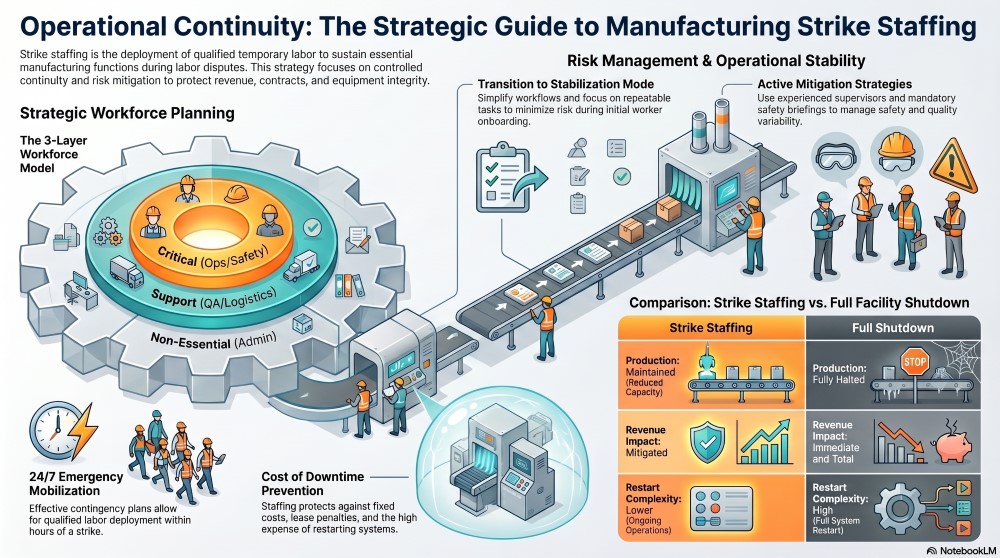
Strike staffing in manufacturing defines operational continuity under labor disruption Strike staffing in manufacturing is the structured deployment of temporary, qualified labor to maintain production, safety, and compliance during a labor strike. It exists to preserve continuity in environments where downtime carries immediate financial, contractual, and supply chain consequences. Manufacturing operations are inherently interdependent. A disruption at one point in the process—whether in machining, assembly, packaging, or logistics—can halt downstream production entirely. Strike staffing mitigates this risk by ensuring that essential functions remain active, even if full workforce capacity is unavailable. The objective is not to replicate the original workforce perfectly. It is to sustain controlled output, protect critical processes, and avoid the operational shock of a complete shutdown. Facilities that understand this distinction approach strike staffing with realistic expectations and structured execution. Why manufacturing plants rely on strike staffing to avoid costly shutdowns Manufacturing plants rely on strike staffing because the cost of stopping production extends far beyond lost output. Every hour of downtime can trigger cascading financial and operational consequences that compound quickly. Fixed costs such as equipment leases, facility overhead, and energy commitments continue regardless of production status. At the same time, missed delivery deadlines can result in contractual penalties, strained customer relationships, and long-term reputational damage. Strike staffing provides a controlled alternative by enabling facilities to maintain partial production and meet priority obligations. Even reduced output can preserve revenue streams and stabilize supply chain commitments. The strategic value becomes clear when considering the broader implications: Protects long-term customer contracts and service agreements Prevents supply chain disruptions that affect downstream partners Reduces the cost and complexity of restarting idle systems Maintains workforce structure and leadership continuity Preserves equipment integrity through continued operation In high-volume or just-in-time manufacturing environments, maintaining even a portion of production can be the difference between operational resilience and systemic disruption. Contingency planning for manufacturing strikes requires precise workforce modeling Contingency planning for manufacturing strikes is the deliberate preparation of labor strategies, operational adjustments, and risk controls before a disruption occurs. It determines whether a facility can operate under constrained conditions or is forced into shutdown. The foundation of effective planning is workforce modeling. Each role within the plant is evaluated based on its impact on production flow, safety requirements, and regulatory compliance. This analysis identifies the minimum staffing levels required to sustain essential operations. Facilities that engage in detailed contingency planning typically structure their approach around three layers: Critical operations layer These roles are non-negotiable and must be filled to maintain any level of production. Examples include machine operators, maintenance technicians, and safety supervisors. Support operations layer These functions enhance efficiency but may be scaled back temporarily. This includes quality assurance teams, logistics coordination, and secondary production support. Non-essential operations layer These roles can be paused without immediate impact on production continuity, such as administrative functions or long-term project initiatives. This tiered approach allows leadership to allocate strike staffing resources effectively, focusing on sustaining the core production engine rather than attempting to replicate the entire workforce. A well-developed contingency plan also includes: Pre-established staffing partnerships and labor pipelines Training documentation designed for accelerated onboarding Clear escalation protocols for production adjustments Defined communication channels across leadership teams Without this level of preparation, strike staffing becomes reactive and inconsistent, increasing the likelihood of operational instability. How strike staffing integrates into existing manufacturing workflows Strike staffing integrates successfully when replacement workers are aligned with existing production systems and guided by structured supervision. Manufacturing environments rely on repeatable processes, meaning consistency is more valuable than speed during initial deployment. Integration begins with documentation. Standard operating procedures, safety protocols, and equipment guidelines must be clearly defined and accessible. Facilities that lack structured documentation often experience longer onboarding times and increased error rates. During the initial phase, operations typically shift into a stabilization mode. This involves simplifying workflows and focusing on predictable, repeatable tasks that minimize risk. Common integration strategies include: Assigning experienced supervisors to oversee each production segment Reducing production complexity during early staffing phases Prioritizing high-value or time-sensitive output Segmenting production lines to isolate potential issues Implementing strict quality checkpoints The goal is to create a controlled environment where replacement workers can perform effectively without introducing unnecessary variability. As familiarity increases, processes can gradually return to normal complexity. Facilities that attempt to maintain full operational complexity from the outset often encounter avoidable disruptions. Operational risks associated with strike staffing must be actively managed Strike staffing introduces operational risk that must be addressed through structured oversight and disciplined execution. The presence of a temporary workforce in a high-precision environment creates exposure across multiple dimensions. The most significant risks include: Risk Area Description Impact Level Safety Compliance Limited familiarity with equipment or procedures High Quality Variability Inconsistent output due to skill differences High Production Efficiency Reduced throughput during onboarding and adjustment phases Medium Equipment Integrity Improper use leading to damage or maintenance issues High Workforce Stability Turnover or inconsistency within temporary labor pools Medium Risk mitigation depends on proactive controls rather than reactive corrections. Facilities must establish clear supervision structures, enforce simplified workflows, and prioritize safety over output during early deployment. A disciplined approach includes: Mandatory safety briefings before any operational task Real-time supervision of high-risk processes Frequent quality checks to detect deviations early Limiting access to complex equipment until competency is demonstrated Facilities that underestimate these risks often experience compounding issues that undermine the benefits of maintaining production. Workforce qualification standards determine strike staffing effectiveness Strike staffing effectiveness is directly tied to the relevance and quality of the replacement workforce. Manufacturing environments vary significantly in complexity, meaning workforce requirements must be aligned with specific operational demands. Basic production roles may be filled with general labor, but specialized processes require targeted experience. Facilities that fail to differentiate between these requirements often encounter inefficiencies and elevated risk. Key qualification criteria include: Experience in similar manufacturing or industrial environments Familiarity with relevant machinery or production systems Ability to follow structured procedures under supervision Physical capability to meet job demands Reliability and consistency under operational pressure Adaptability to rapidly changing workflows Verification processes must be rigorous. Screening, background checks, and skill validation should occur before deployment to ensure that workers can contribute effectively from the outset. Investing in workforce quality reduces onboarding time, improves production stability, and minimizes safety incidents. Regional Supplemental Services (RSS Inc.) provides specialized strike staffing support Regional Supplemental Services (RSS Inc.) provides strike staffing solutions tailored specifically for manufacturing and industrial environments. Their approach focuses on aligning workforce capabilities with plant-level operational requirements rather than supplying generic labor. This specialization allows for faster deployment and more effective integration. Workers are screened with manufacturing conditions in mind, ensuring they can adapt to structured workflows and safety expectations. RSS Inc. typically supports manufacturing clients through: Rapid mobilization of qualified industrial labor Workforce screening aligned with specific production roles Coordination with plant leadership to ensure role accuracy Ongoing management of staffing performance during deployment This level of support reduces the burden on internal teams. Instead of managing workforce logistics, plant leadership can focus on maintaining production stability and mitigating operational risk. In high-stakes environments, this alignment between staffing and operations is a critical advantage. Comparing strike staffing to shutdown strategies in manufacturing Strike staffing and full shutdown represent two fundamentally different approaches to managing labor disruption. The decision between them depends on operational priorities, financial tolerance, and production complexity. Factor Strike Staffing Full Shutdown Production Continuity Maintained at reduced capacity Fully halted Revenue Impact Mitigated but not eliminated Immediate and total Restart Complexity Lower due to ongoing operations High due to full system restart Operational Risk Higher during initial transition Lower operational risk, higher business risk Customer Impact Partial delays but commitments often preserved Significant disruption to commitments Shutdowns may be appropriate in highly specialized environments where replacement labor cannot safely perform required tasks. However, for most manufacturing operations, maintaining controlled continuity provides a more balanced approach to risk and financial stability. What determines the success or failure of strike staffing execution Strike staffing success is determined by preparation, execution discipline, and workforce alignment. Facilities that approach it as a structured operational strategy consistently achieve more stable outcomes. Several factors have a disproportionate impact on results: Depth and accuracy of contingency planning Speed and quality of workforce deployment Strength of supervision and operational leadership Clarity of procedures and expectations Ability to adapt workflows without compromising safety Failure typically stems from gaps in preparation. When roles are not clearly defined, processes are unclear, or workforce quality is inconsistent, operations degrade quickly. Execution discipline ensures that the initial disruption does not evolve into sustained operational instability. FAQ – Strike Staffing for Manufacturing Plants What is strike staffing in manufacturing? Strike staffing is the use of temporary labor to maintain production and operations during a labor strike in a manufacturing facility. Can manufacturing plants operate normally during a strike? Most facilities operate at reduced capacity, focusing on maintaining essential production rather than full output. Is strike staffing safe in industrial environments? It can be safe when supported by strong supervision, clear procedures, and properly qualified workers. How quickly can strike staffing be deployed? Deployment speed depends on preparation, but pre-planned strategies allow for rapid mobilization. What roles are hardest to replace during a strike? Highly skilled technical roles and positions involving specialized equipment are typically the most difficult to replace. Does contingency planning eliminate all strike risk? No, but it significantly reduces disruption and enables controlled operational response. Why do companies choose strike staffing instead of shutting down? They choose it to maintain revenue, meet obligations, and avoid the complexity of restarting operations.
NOW PLAYING
Strike staffing in manufacturing
No transcript for this episode yet
Similar Episodes
Apr 22, 2025 ·32m
Feb 27, 2025 ·0m
Sep 20, 2024 ·57m
Aug 7, 2024 ·16m