
EPISODE · Sep 14, 2022 · 26 MIN
The Chris Hedges Report Podcast with author Nathaniel Philbrick on How George Armstrong Custer Became a Martyr Used to Justify Genocide and US Imperialism
from The Chris Hedges Report Podcast · host Chris Hedges
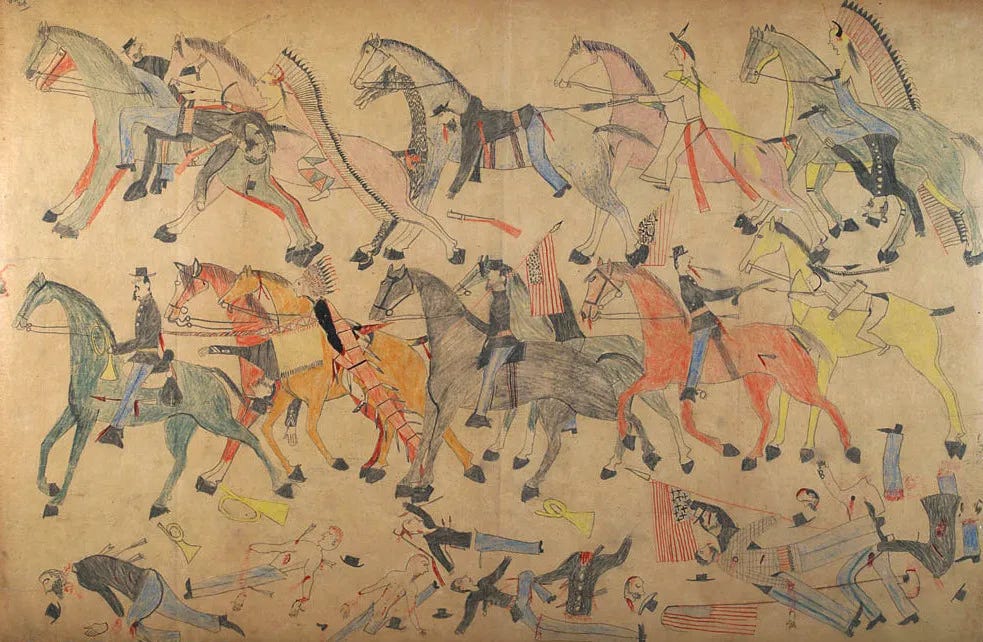
Image: Pictograph by Red Horse, 1881The playwright Eugene O’Neill said that one of the few events worth celebrating in American history took place on June 25, 1876, when Lakota, Northern Cheyenne, and Arapaho, led by Crazy Horse and Chief Gall, annihilated a unit of the 7th Cavalry under the command of Lt. Col. George Armstrong Custer. There are few battles in American history that have generated as much controversy or been as meticulously dissected and examined. And with good reason. The death of Custer and his command stunned the nation. It turned Custer, although he was criticized after the battle by his superiors for impulsiveness and lack of judgment, especially for splitting his force of some 600 soldiers into three battalions, into a martyr for the cause of western expansion and imperialism. His death, portrayed as the ultimate sacrifice for the nation that was at the time celebrating its centennial, was used to justify a massive military campaign against Native Americans that would culminate in the massacre of some 300 Native Americans in 1890 at Wounded Knee, many mowed down with Hotchkiss guns fired by the 7th Cavalry. The remnants of Native tribes were after the battle forcibly relocated to prison of war camps known later as reservations. There is a vast disparity between the mythic presentation of Custer and the reality of the so-called Indian wars. Native Americans, including women, the elderly and children, were slaughtered. The U.S. government repeatedly violated formal treaties to seize land promised in perpetuity to Native Americans. The buffalo herds, which sustained nomadic tribes, were decimated by white hunters. Joining me to discuss this seminal moment in American history is Nathaniel Philbrick author of The Last Stand: Custer, Sitting Bull, and the Battle of the Little Big Horn. This is a public episode. If you'd like to discuss this with other subscribers or get access to bonus episodes, visit chrishedges.substack.com/subscribe
NOW PLAYING
The Chris Hedges Report Podcast with author Nathaniel Philbrick on How George Armstrong Custer Became a Martyr Used to Justify Genocide and US Imperialism
No transcript for this episode yet
Similar Episodes
No similar episodes found.
Similar Podcasts
No similar podcasts found.