
EPISODE · May 30, 2026 · 1H 11M
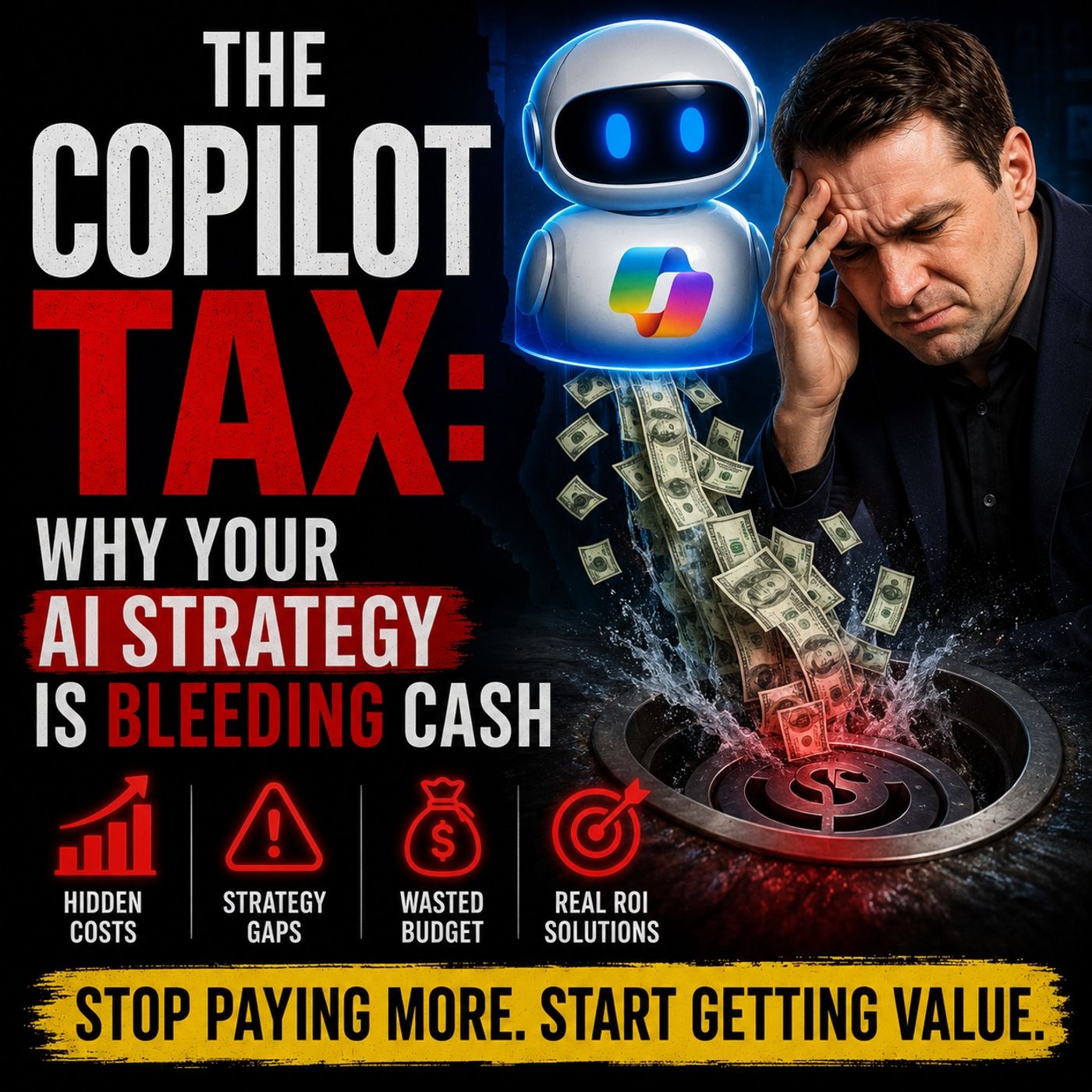
The Copilot Tax: Why Your AI Strategy is Bleeding Cash
from M365.FM - Modern work, security, and productivity with Microsoft 365 · host Mirko Peters - Founder of m365.fm, m365.show and m365con.net
Most organizations believe their AI costs are predictable.They look at the Microsoft invoice, see the $30-per-user Copilot add-on, multiply it by headcount, and assume they understand what enterprise AI is costing them.They don’t.In this episode, Mirko Peters breaks down the hidden financial architecture underneath Microsoft Copilot, Azure OpenAI, Copilot Studio, Security Copilot, and agentic AI systems. What looks like a simple licensing model is actually a layered consumption economy built on tokens, compute, orchestration loops, verification labor, governance overhead, and hidden operational waste.This episode explains why many organizations are dramatically underestimating what enterprise AI actually costs — and why some deployments are quietly bleeding millions of dollars through zombie licenses, idle token waste, poorly governed agents, and low-adoption rollouts.More importantly, the episode explores how organizations can stop the bleeding and build a sustainable, measurable, ROI-driven AI strategy going into 2026.THE REAL COST OF COPILOTThe $30 Copilot license is not the real cost of enterprise AI.It is the entry fee.Mirko explains how Microsoft’s licensing strategy changed dramatically between 2024 and 2026 through price increases, removal of Enterprise Agreement discounts, bundled AI suites, and consumption-based billing models.The conversation explores:E3 and E5 licensing inflationMicrosoft’s E7 Frontier Suite strategyThe end of traditional volume discount leverageAI becoming a fixed operational costThe shift toward bundled dependency ecosystemsThis section explains why organizations often discover the real financial impact of AI during renewal cycles rather than during pilot deployments.TWO BILLING SYSTEMS AT THE SAME TIMEOne of the biggest problems in enterprise AI today is that Microsoft effectively runs two billing models simultaneously.The first is traditional seat-based licensing.The second is variable consumption-based billing driven by tokens, compute units, and AI workload execution.This episode explains how products like Copilot Studio, Azure OpenAI, Security Copilot, and GitHub Copilot blur these billing systems together, creating fragmented visibility across multiple invoices and reporting platforms.Mirko explores how a single AI interaction can trigger:M365 licensing costsCopilot Credit consumptionAzure OpenAI token usageSecurity Compute Unit overagesAgent orchestration costsThe result is a financial model most organizations cannot fully observe in real time.WHAT TOKENS ACTUALLY COSTThis episode provides one of the clearest explanations available of how token economics work inside enterprise AI systems.Mirko breaks down:Input tokensOutput tokensContext windowsReasoning tokensConsumption scalingVariable AI compute pricingThe conversation explains why verbose prompts, oversized context windows, and poorly scoped AI workflows dramatically increase operational costs even when users never realize it.The episode also explores the hidden economic transition happening across the AI industry as vendors move from flat-rate licensing toward fully metered AI consumption models.THE IDLE TOKEN PROBLEMOne of the most important concepts introduced in the episode is idle token waste.These are tokens organizations pay for that produce little or no measurable business value.This includes:Background completions users never readSuggestions immediately discardedOversized context injectionRedundant orchestration loopsAgent chatterPoor workflow routingUnnecessary reasoning cyclesMirko explains how organizations are discovering that between 30 and 60 percent of AI token consumption may be operational waste rather than productive output.The conversation uses GitHub Copilot workflow data and Claude Code optimization patterns to demonstrate how simple governance and orchestration improvements can dramatically reduce AI operating costs.THE LAZY PROMPTING TAXMost users still interact with AI systems the way they use Google.Broad questions. Multiple follow-ups. Repeated clarification loops.This episode explains why that behavior becomes extremely expensive inside token-metered AI systems.Mirko explores how vague prompts create:Longer conversationsLarger context windowsMore output tokensExcessive reasoning cyclesHigher verification overheadIncreased compute consumptionThe discussion explains why prompt discipline is no longer just a productivity issue.It is becoming a financial governance issue.THE VERIFICATION TAXOne of the most important financial concepts in the episode is the Verification Tax.AI-generated outputs still require human review, especially inside legal, compliance, tax, financial, and regulated business environments.Mirko explains why organizations often underestimate the labor cost required to:Validate AI-generated contentCheck citationsReview legal accuracyConfirm compliance alignmentCorrect hallucinationsApprove regulated outputsThe conversation explores how AI can reduce drafting time while simultaneously increasing review obligations, creating hidden labor costs that rarely appear in AI ROI calculations.This section becomes especially important for organizations deploying Copilot into high-risk knowledge workflows.ZOMBIE LICENSES & LOW ADOPTIONThis episode also explores one of the largest hidden cost categories in enterprise AI:Zombie seats.These are paid Copilot licenses assigned to employees who barely use the product or derive little measurable value from it.Mirko explains why many organizations deployed Copilot through broad top-down licensing strategies without redesigning workflows, building adoption programs, or defining clear business outcomes.The result is massive underutilization.The conversation explores:Low adoption ratesWeak workflow integrationLicense wasteFailed rollout strategiesMissing enablement programsLack of ROI visibilityThis section explains why many organizations are paying for AI access rather than AI transformation.WHY BLANKET ROLLOUTS FAILThe episode breaks down the common “license-first” deployment strategy many enterprises used during early Copilot adoption.Organizations bought thousands of licenses expecting productivity gains to appear automatically.But licenses do not redesign workflows.Mirko explains why successful AI deployments require:Role-specific adoption modelsWorkflow redesignGovernance planningTraining programsPrompt librariesMeasurable business metricsStructured rollout phasesThe episode makes a strong case for targeted deployments over organization-wide blanket rollouts.RPA VS AI: THE COST DIFFERENCEOne of the most valuable sections compares AI automation with traditional automation systems.Mirko explains why deterministic workflows are still dramatically cheaper when handled by:RPAScriptsAPIsDeterministic servicesStructured automation systemsAI becomes economically valuable only when workflows require interpretation, judgment, ambiguity handling, or reasoning.This section introduces one of the most important enterprise architecture concepts in the episode:Use AI for judgment. Use automation for execution.THE AGENTIC COST EXPLOSIONAgentic AI systems dramatically increase consumption costs.This section explores how agent workflows consume exponentially more tokens than standard chat interactions due to:Planning loopsTool selectionMulti-agent orchestrationIterative reasoningContext expansionAutonomous workflow executionMirko explains how some organizations experienced massive compute spikes because agent systems lacked:Budget controlsToken governanceCircuit breakersSpend monitoringConsumption policiesThis section becomes a warning about the future of unmanaged enterprise AI systems.WHERE COPILOT ACTUALLY WORKSDespite the problems explored throughout the episode, Copilot absolutely delivers ROI in the right scenarios.Mirko explains where organizations are seeing measurable value:Proposal draftingSales preparationDocument summarizationMeeting recap generationResearch synthesisKnowledge retrievalExcel analysisCross-system searchThe episode explains why the best ROI appears in communication-heavy, document-heavy, and analysis-heavy roles.The discussion also emphasizes that ROI depends heavily on adoption depth rather than license count alone.Become a supporter of this podcast: https://www.spreaker.com/podcast/m365-fm-modern-work-security-and-productivity-with-microsoft-365--6704921/support.
Embed this episode
What this episode covers
Most organizations believe their AI costs are predictable.They look at the Microsoft invoice, see the $30-per-user Copilot add-on, multiply it by headcount, and assume they understand what enterprise AI is costing them.They don’t.In this episode, Mirko Peters breaks down the hidden financial architecture underneath Microsoft Copilot, Azure OpenAI, Copilot Studio, Security Copilot, and agentic AI systems. What looks like a simple licensing model is actually a layered consumption economy built on tokens, compute, orchestration loops, verification labor, governance overhead, and hidden operational waste.This episode explains why many organizations are dramatically underestimating what enterprise AI actually costs — and why some deployments are quietly bleeding millions of dollars through zombie licenses, idle token waste, poorly governed agents, and low-adoption rollouts.More importantly, the episode explores how organizations can stop the bleeding and build a sustainable, measurable, ROI-driven AI strategy going into 2026. THE REAL COST OF COPILOT The $30 Copilot license is not the real cost of enterprise AI.It is the entry fee.Mirko explains how Microsoft’s licensing strategy changed dramatically between 2024 and 2026 through price increases, removal of Enterprise Agreement discounts, bundled AI suites, and consumption-based billing models.The conversation explores: E3 and E5 licensing inflation Microsoft’s E7 Frontier Suite strategy The end of traditional volume discount leverage AI becoming a fixed operational cost The shift toward bundled dependency ecosystems This section explains why organizations often discover the real financial impact of AI during renewal cycles rather than during pilot deployments. TWO BILLING SYSTEMS AT THE SAME TIME One of the biggest problems in enterprise AI today is that Microsoft effectively runs two billing models simultaneously.The first is traditional seat-based licensing.The second is variable consumption-based billing driven by tokens, compute units, and AI workload execution.This episode explains how products like Copilot Studio, Azure OpenAI, Security Copilot, and GitHub Copilot blur these billing systems together, creating fragmented visibility across multiple invoices and reporting platforms.Mirko explores how a single AI interaction can trigger: M365 licensing costs Copilot Credit consumption Azure OpenAI token usage Security Compute Unit overages Agent orchestration costs The result is a financial model most organizations cannot fully observe in real time. WHAT TOKENS ACTUALLY COST This episode provides one of the clearest explanations available of how token economics work inside enterprise AI systems.Mirko breaks down: Input tokens Output tokens Context windows Reasoning tokens Consumption scaling Variable AI compute pricing The conversation explains why verbose prompts, oversized context windows, and poorly scoped AI workflows dramatically increase operational costs even when users never realize it.The episode also explores the hidden economic transition happening across the AI industry as vendors move from flat-rate licensing toward fully metered AI consumption models. THE IDLE TOKEN PROBLEM One of the most important concepts introduced in the episode is idle token waste.These are tokens organizations pay for that produce little or no measurable business value.This includes: Background completions users never read Suggestions immediately discarded Oversized context injection Redundant orchestration loops Agent chatter Poor workflow routing Unnecessary reasoning cycles Mirko explains how organizations are discovering that between...
NOW PLAYING
The Copilot Tax: Why Your AI Strategy is Bleeding Cash
No transcript for this episode yet
Similar Episodes
No similar episodes found.
Similar Podcasts
No similar podcasts found.