
Wait, you're listening to Radio Lab from WNYC. Take this to Jad for Radio Lab, so we were not planning on releasing a podcast today, but then Friday out. The federal government tonight outlining an elaborate, expensive, and extraordinary assault on US democracy. 13 Russian nationals and three Russian companies accused of a massive effort.
Unless you have been living under a rock for the past three days, you've probably heard that the special counsel, Robert Mueller, a guy that President Trump keeps accusing of being engaged in a witch hunt, he has handed down some indictments. The defendants allegedly conducted what they call information warfare against the United States. They say the Russians were right here in the US, too. The indictment says the Russians tried to create chaos, little so far as to travel to key states.
The Russians allegedly sent operatives to America, travelling throughout nine states. Now, the picture that you got from the indictment is that there was this sort of like shadowy network of Russian nationals that infiltrated the country with the idea of sowing chaos in the run up to the 2016 election. And we sort of wondered very simply, like, who are these Russians? And who are these Americans that were manipulated?
How did it, how did it work? How did they feel about things? Now, so what we decided to do for this podcast, just because we were curious, and just because, you know, it's fun for a podcast like ours to try and do fast turnaround stuff on occasion, we decided to see what we could find out. Producer Simon Adler takes it from here.
Hey, Charles, are you there? Hey, how you doing, Simon? I'm doing all right. A little sleepy, but other than that, I'm good.
So not too long ago, I got in touch with this radio producer reporter based in Moscow by the name of Charles Mayes. Do you want to do a video to say hello? Yeah, that'd be great. I'm in a sort of my pajamas, but yes.
That's fine. That's fine. But yeah, it was like three in the morning, New York time. But anyways, the reason I got in touch with him was to have him help facilitate and interpret an interview with this guy.
Hi, my name is Vitaliy Baspalov. I'm from Russia, from St. Spatasbuk. I'm sorry, I'm very bad speak English.
Oh, no, don't worry about it. That's what you got Charles for. Yes, yes, yes. Thank you, Charles, translating.
OK, great. So let's just say with like, where are you from originally? I'm just curious like a little bit about who you are. I think much is in China.
I'm just curious. Yes, yes, yes. So we're talking to Spalov. He's a kid from a small town in Siberia.
Oh, yeah, a small town near Kazakhstan. And he said from an early age, it was clear that he just really didn't fit in up there. Because I was in the U.S. He had blue hair for a time dressed like a goth.
And to be this kind of alternative character in Siberia is not an easy thing. I mean, we tell these stories about walking down the street. And I'm following the U.S. I get that nose.
Kind of tough guys with short haircuts are calling him faggot. He's showing that he's showing that he's not looking at him. And so when he gets a chance to get out, he does. He moves to St.
Petersburg, considered one of the most liberal cities in Russia. And he moves there, not looking for just any job, but specifically to be a journalist. Which he really felt was his calling. Superhero, the best one.
He refers to journalists as like superheroes or Batman. You know, so he heads to St. Petersburg. And he thinks he's all set up.
He's got a job with a local website. He's going to do some editing for them, maybe a little writing. But right away with him, short order, I believe the story is their business dried up and sort of the newspaper. And suddenly, it's out of the job.
Not just in the background, but in the background. And so it's kind of a crisis moment. So he starts looking around and as he describes it, he gets up every day. He starts sending out all these resumes.
He searches, just find anybody who will do anything that will let him use his writing skills. Just trying to find something to do with text. Until finally, after almost a month of this. He comes across this one ad that's not really clear what they're offering or who's offering it.
But it mentions that there's some copy editing to be done, some writing. And the pay scale seems a lot higher. It's promising double the money that most people are offered for working in journalism in Russia. And right away, he just thought this was just weird.
But of course, he's interested. How could he not be? And so he places a call. Now, it's worth noting everything that is about to happen.
We weren't able to fact check 100%. But that being said, it does line up squarely with what others have reported. So anyway, fast forward a couple of days. He ends up having an interview and they offer him the job, which he accepts.
Although I'm still not really knowing what the heck it is he will be doing. Exactly. It's just not really clear what it is. Okay.
So tell me about that first day. Like, you described initially just going into the foyer, the building, into the entrance. The building itself is cement for stories tall. And security is oddly strict.
Like when he went up to them, they required him to hand over a bunch of documents like his passport just to get in. That's his first impression. Yes, they told me on the chat. And so on.
Eventually, his boss shows up. This woman named Anna. She walks down the halls. And he said the whole place had like the feel of a hospital.
Yes, but of course not. He's going to have long corridors with little rooms left and right. People behind keyboards working on computers. And it's almost completely silent.
Except for the tapping of fingers on keys. Anyway, eventually they duck into a room on a show to his desk. This is finally when he gets a sense of what exactly is going on. Anna sits him down and says...
We're doing news about Ukraine. We just want you to write articles. It was 20 articles a day he had to do, sort of massaged the text for. But the thing is, these didn't have to be brand new articles.
Instead, he was told... Essentially, take this article that's already been written, somebody else's article, and add to it, and then change the content so it's 70% original. So what's important to know here is this was 2014, and Ukraine was in the early days of war. The apocalyptic scene in Central Kiev tonight.
This morning, Kiev again awoke to the sound of gunfire. A civil war that Russia wanted to influence the outcome of. And to do so, they started experimenting with this new form of propaganda. That's right.
What you saw was this campaign that was going on two fronts. On the one hand, you had state media, this is pro-government media here. Being broadcast from Russia into Ukraine, spinning the narrative for those watching it. But then you have a certain amount of the population that perhaps doesn't watch state media.
And this is where you get into this effort to kind of plug the holes in the story online. And this... Is what the tally had been hired to do. To seal that story.
So... They told him to take an article that was about Ukraine. For example, according to Vitaliy, there was an incident in which a group of pro-Russian rebels had taken over to school in Ukraine. Essentially holding the kids hostage.
And when the pro-Ukrainian soldiers, when they stormed the school, children died. Now, this actually happened and was covered by the Ukrainian media. But Anna, as I recall her name is... Anna, Vitaliy's boss.
Says, like, look, your goal is to... Take this real news story and rewrite it, leaving out the fact that there were ever any pro-Russian troops there. Creating the impression that the pro-Ukrainian troops had stormed the school in massacre these children for no reason at all. And so, once he had rewritten this article and made these small changes...
...would create a website with a .ua address. This is a Ukraine address. A site that looked like a local online Ukrainian newspaper. Essentially written by Ukrainians for Ukrainian audience.
So he's being asked to write about Ukraine as if he was writing from Ukraine? Yes, exactly. Exactly. And Vitaliy, the way he describes it, while he's working on his newspapers, involving events in Ukraine, pretending to be Ukraine.
Pretending to be Ukrainian journalist, he's citing blogs that are written extensively by Ukrainians. And he's pretty sure that blogger is upstairs in the next level up inside this building in St. Petersburg. So it's a feedback loop.
Well, and so I'm presuming on day one, you've shown up there with these high-minded journalistic ideals. And you have to realize that you've gotten yourself into something that in no way lives up to those ideals. How on earth did that feel? Oh, it's always neutral.
So it's really important to me. So it's really important where he's trying to decide what to do. He says to himself that he had two thoughts, which is, you know, I, A, you get out of there and never come back. Or you do go back and find out more.
What's going on there? And he gets this idea that, you know what, maybe I've got a scoop here. Maybe I can do an investigation. He sort of assigned himself to be kind of an undercover agent?
Exactly. Okay, just to zoom out here for a second. The job that Vitaliy had taken was with an organization known as... The Internet Research Agency.
The Internet Research Agency. The Internet Research Agency. The Internet Research Agency. Which we've heard so much about in these past 72 hours.
It's a private company established in 2013 by a Putin ally named... You have Gennie Pragosian. You have Gennie Pragosian. A Russian businessman with close-tonized Vladimir Putin.
Who, along with being the bearer of a rather strange nickname... Chef to President Vladimir Putin. He's also one of the Russian nationals mentioned in the Mueller indictment. Now, in the early days when Vitaliy was working there, it was his impression that there were roughly a couple hundred people working at the Internet Research Agency.
But at its peak, the organization grew to employ as many as a thousand people. With an annual budget of millions of dollars, handed by a management group, and arranged into departments, including graphics, search engine optimization, information technology, and finance departments. Now, as Vitaliy told us, it was hard to know exactly what happened in this place because everyone was so silent. But over his time there, he was able to make sense of some of it.
The first floor was filled with people just like Vitaliy, writing fake articles for fake sites. Second floor was known as the social media department. And these folks were responsible for pumping out memes, like one where Hillary Clinton is shaking hands with the devil. The third floor was filled with people writing fake blogs.
The same blog that Vitaliy would pull quotes from. The fourth floor, you'd find the YouTube and Facebook content controls along with the cafeteria. The fourth floor, we had some people writing about Ukraine too. Ukraine won.
It was a 24-7 operation. They never stopped making news. They never stopped generating content. Well, and who were your co-workers?
There were quite a few people from other towns of Russia that moved to St. Petersburg. There were some people who said, frankly, activists in the opposition. But there were a lot of people that, you know, they check in, they check out for work, they just punch the clock.
And for them, it was just like mopping a floor or taking out the trash. Did you feel some guilt or misgivings about what you were doing? No, I just didn't talk about the both. He described it as being really stressed out during this whole period.
Yeah. Because while he was, you know, on the one hand, I suppose he's gathering good material for what will hopefully be some grand exposé at this. On the other hand, he just felt like he was just living this lie. Eventually, after three and a half months, Vitaliy did quit.
And as he tells it, he had enough and just didn't feel like he could learn anything else. And so with his months of research, he went on to write an article in Russia that really didn't make a splash at all. In part because the Internet research agency was already a pretty well-known organization in Russia at that time. Essentially, other journalists had just beaten him to the punch.
But then, in the wake of the 2016 election with accusations of Russian meddling beginning to swirl. Tonight, a look inside Russia's disinformation campaign from 26-year-old Vitaliy Besswelloff. The American media took notice and Vitaliy got a call from NBC. Is this it?
This is the building? Yes, yes, yes, of course. The troll factory. But his eyebrow pierce and a pink sweater on, Vitaliy answered questions for this brief evening news segment.
Did you create fake accounts? No, no. Yes, he says. So you believe that this operation was backed by the Kremlin?
Absolutely. Absolutely, he says. Besswelloff also believes it's still up and running. The Kremlin denies it, suggesting reports the factory even existed, might be fake.
And from that moment on, he really became the go-to guy if you wanted to talk to somebody who had worked inside. Journalists from all over the world started reaching out to him, asking for interviews or comments. Keep in mind that they're all international journalists, none of them Russian, until one day, not long after all this. So he gets a call from this national television channel saying, basically, in an hour, we're going to run a story about you and we really want you to come on our talk show.
And he said, look, I'm busy, I'm working, you know, I can't do it. And so, you know, they run with this piece. In this TV studio, on this set that looked like a cross between sort of the Family Feud and an evening news broadcast, the hosts just start kicking Vitaliy apart and flashing images of him on this giant screen behind them. And what they've got is they kind of mine his online persona, they've got him hanging out in it.
In a club making funny faces with the camera. They start kind of digging through his political views, the fact that he's a supporter of the liberal opposition. And they just make him out to be this kind of freak and they're all laughing at him and, you know, he's just an absolute public flogging, a total public humiliation. Wow.
Well, he got caught in his own little misinformation loop there at the end. Yeah, yeah, that's right. What's interesting is Vitaliy, what's interesting is Vitaliy, you know, the way he describes it is that, you know, in some ways, when he was there, they were just starting to figure out the mechanisms, it was getting more sophisticated. And as he's leaving his time as ending at the internet research agency, he says that there was just about this time, he started seeing his posts for vacancies in other languages, including English.
So, in a way, for him, it's this moment where he sees the troll farm, the troll factory suddenly turning outward. Well, now three years later, we know a bit more about this English initiative. In 2014, the company established a translator project focused on the United States. In July of 2016, more than 80 employees were assigned to the translator project.
And many of those employees apparently took some of the moves from their Ukraine Info War playbook and used them, pointed them at the U.S. The Russians also recruited and paid real Americans to engage in political activities, promote political campaigns, and stage political rallies. The defendants and their co-conspirators pretended to be grassroots activists. In fact, I spoke to one reporter who told me about this incident in Houston, when there were two protests happening at the same time.
On one side of the street, a white nationalist protest, and on the other, a group of Americans for Muslims. Turns out both protests were covertly organized by Russians connected to the internet research agency. According to the indictment, the Americans did not know that they were communicating with Russians. And it was this phrase, out of all of the ludicrous revelations of the indictment, that really got us thinking.
Who were these unknowing Americans? How did they end up at these fake protests? And how did they think about it now? So, producer Annie McEwen and I, we started calling around, and we found three people at the center of one of the more famous fake protests mentioned in the indictment.
The so-called Florida Flash Mom. We'll hear all about that after the break. This is RadioLab, we'll continue in a moment. Hi there, this is Kirsten, recording from Orlando, Florida.
RadioLab is supported in part by the Alfred P. Sloan Foundation, enhancing public understanding of science and technology in the modern world. More information about Sloan at www.slone.org. On the broadside, we take you into the heart of the south.
With stories that'll surprise you. Bigfoot apparently loved glow sticks. Next to party, exactly. He's a raver.
And topics that dig into the muddy margins of history. Right, but go to the bad, the ugly. It's not clean at all. It's so messy.
Wait a second, this is actually real. Listen to the broadside. One story, every week, exploring the rich traditions of the south. This is RadioLab on Jada Boomrod.
So after those indictments came down against the three Russian companies and 13 Russian nationals, who were accused of creating fake protests across the country, our producers Simon Adler and Annie McEwen, got interested to try and locate some people who had gone to these protests and maybe unwittingly took part in what was a covert Russian operation. And they managed to find three people. Oh, right, you can hear me? Yes, I can hear you.
Fine. First up, a woman named Ann Ory-Marik Thomas, who lives in Florida. I live in Jupiter, Florida currently. Ann is in her 50s, she works as a real estate agent, and also...
Ocean, no. Hi, long to see you. A singer. Beautiful.
She's also a huge Trump fan, very active on Twitter. And in early August 2016, she was contacted first on Twitter, then over the phone by two guys. Joshua and Matt, UCLA students. They said they were working with Hollywood producers.
Matt and Josh, these are two people from Hollywood? Probably these are film score, right? I don't know. They didn't give me that much information.
But on the phone, Ann thought Joshua's voice sounded familiar. I better not say who I think it is. Who did you think it was? Come on, I'm really curious.
Who do I think it is? John Christopher. Who's that? Who's John Christopher?
His name is Johnny. Johnny, the musician. Wait, this is Johnny, the like, orchestra, new age piano god guy? Yeah, but I think she's just guessing, like there's no actual evidence looking, Johnny, to any of this.
What was the organization they were working with? This was the March for Trump group, and they were a grassroots organization started in the United States, Texas, and California. What did they ask you, or what did they say when they contacted you? Well, they said they were wanting to do rallies at a Hollywood people wanted to hire.
They actually wanted to hire three actors. One to play Trump, one to play Bill Clinton, and one to play Hillary. They basically told her that they wanted to do this like performance art theater protest type thing. Now, at the same time, she was talking to these guys.
On the other side of Palm Beach County, Harry and Nolan, I'm retired. I'm active on Twitter, to a point. Another Trump fan, guy by the name of Harry Miller, who had a pretty big following. 60, 70,000, someone in there, but he also got contacted on Twitter and over the phone.
There was a conversation about a desire to put on a flash mob or something, and supporting Donald Trump. Sorry, who was it that contacted you? I believe his name is Matt. What did Matt say in his original sort of communication?
This is extremely paraphrased because I don't have a distinct memory of all of it. And initially, I was very suspect of him. And the reason I was suspect is because he had a strong accent. And at the time, there was a lot of commotion about Moslems.
I thought he was some who is some kind and was trying to set something up. What did his voice sound like? It wasn't like you know, art American, you know, with articulate. It was it was broken.
Well, and so he said he wanted a flash mob and what did he say he wanted you to do it? He was asking me about making a trailer with a jail type of thing on it. Essentially, the guy with the accent told him, I want you to stage an event where you have a cage and you're going to need to build this cage. But you're going to have this cage and at the event there will be a Hillary Clinton impersonator and a Bill Clinton impersonator and I want you to put them in the cage like you're putting them in jail.
And you should do this outside so that lots of people can see you and they can chant, lock her up, lock her up, and you should take lots of photos and lots of videos and you should send them to us. And I did eventually say yes because he had an elaborate website. He told me it was part of a big group of people. Do you remember the name of the website?
Being patriotic. It's dismantled according to the FBI. In fact, I tried to pull it up. I can't get it either.
What was odd is they insisted on paying me. How did they end up paying for it? They sent me to a check cashing place. And how much money was it?
I found an estimate and I'd written an estimate around $505 for it. But it did come from out of the country. I do recall that. Can you describe what this once the construction was complete?
What your truck looked like? Yeah, I have an F-354 pickup truck. Big truck. Yeah.
And I built a chain link fence, three sides and then one side with a gate. And on four corners I had the American flags of course. And there was a lot of talk about who was going to go in the cage. And he says, we'll hire some actors.
No one would play Trump. No one would play him. And says the two quote you see like guys suggested that she play Hillary. And she agreed.
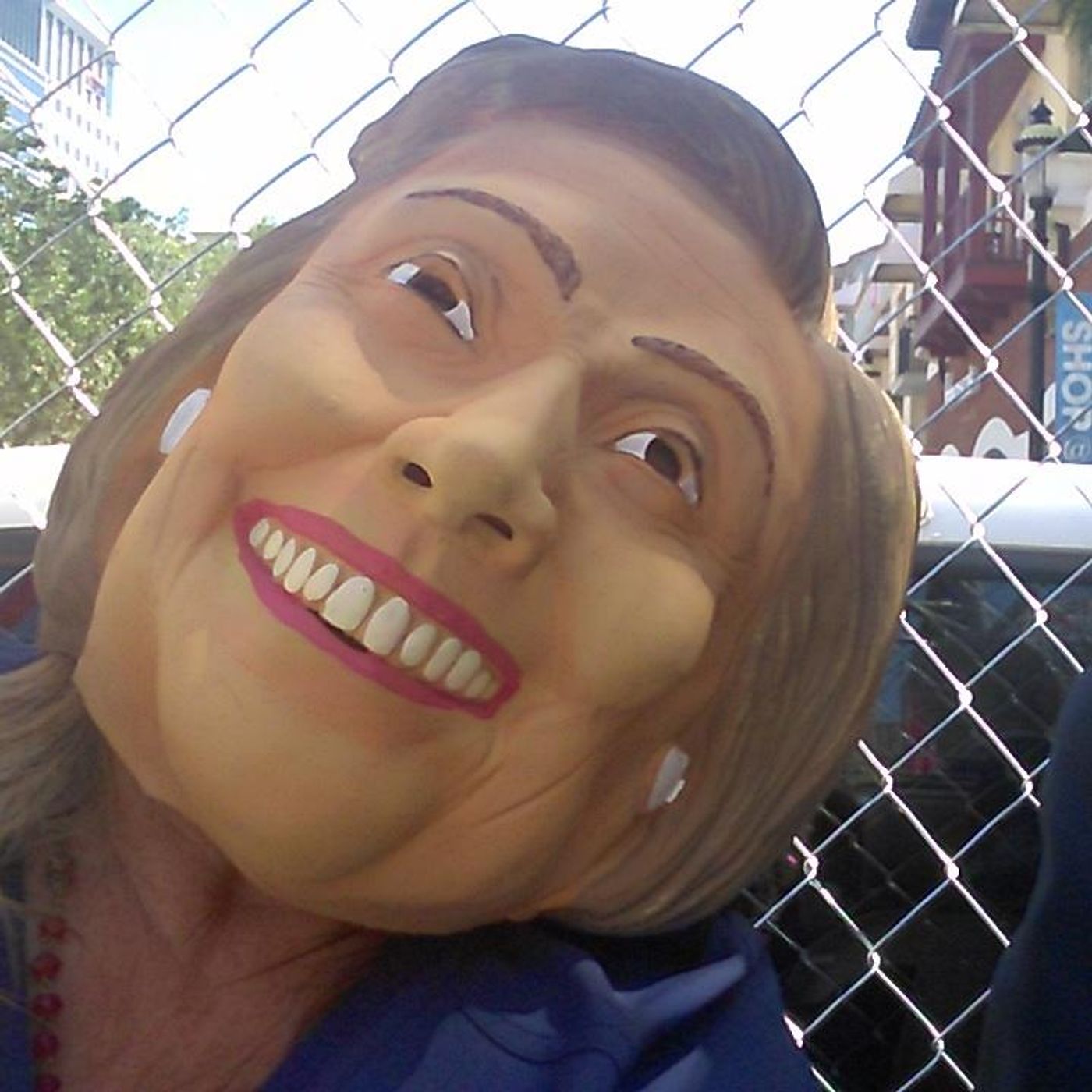
And I need to costume. I need to costume from a nursing outfit and on the back I said in me. So I went to the Hollywood master and I bought a full head mask of Hillary. And so what were you told like show up at this place at this time at this date and you just did it?
I don't know if you know Palm Beach but it was City Place in front of cheesecake factories where this happened. Harry was told to show up August 20th at the cheesecake factory. That's where this was going to go down. Boy that was another thing.
I kept asking are you going to be there? Who's going to run this thing? Where do I go? Oh you just go to the same place.
Oh well. So he shows up in front of the cheesecake factory with his truck with a big cage he built in the back and sure enough there were people there including Anne, just up with Hillary Clinton. We were giving it for him. What were your lines?
Do you remember? Oh, let me see. Let me see. Well, I was supposed to talk about my computer tablet and my email.
And then I was supposed to tell him to joke. She was there with her very good friend Greg who she convinced to be the bill Clinton impersonator. I sort of needed the money at the time. Why did you do Greg to get to prepare to play the part of the Clinton?
I had to shave. I had to shave. Do you normally have like a mustache or something? I shaved once back in the 70s and I shaved again with my Jerry Garcia died and then I shaved and I had to play Bill Clinton.
You shaved like three times in your life? That's bad. How did it feel to be in this cage along with Anne and be like this sort of strange actor in this moving play? Well, first off I was in the dark blue suit and it was August in this border so it's like 94 degrees and all I could think of was I wanted a beer.
That makes sense. I just wanted it to be over here. So you didn't have very much fun? No, I wasn't a lot of fun.
It would just work. Right. It was Annie having fun? Well, yeah, I guess she was.
Bill was supposed to find a lady that would be standing around like a news lady and try to flirt with her. Hey Bill, don't look now but I just seen Monica. Then they put us in channel. She was in the same apartment.
And they sat in the cage for a while. What you see in the Facebook Live video is a few dozen people in the parking lot outside the cheesecake factory. They're just standing around the cage with Annie inside of it who was pretending to be sad about being locked up. She was pretty glad she was a good woman actor.
She was looking exasperated and we spent all that. We spent a day doing that. We took a lot of pictures. Had a good time.
Pictures of course ended up on social media and according to Harry. That thing on Twitter got over 500,000 hits in 24 hours. You're aware that much of the mainstream media at the moment is reporting that this was a Russian. How does it make you feel that there's now this possibility that you were?
Oh, yeah. The FBI came here and talked to me about it. Okay. When did you speak with the FBI?
Oh, they came to my house. Yeah, how long ago? Last week. What did they ask you?
Well, they discussed with me pretty much what you were discussing with me but not in as much death as you did. The young guy was kind of on experience. He was cuter than Christian Bale too. We reached out to the FBI.
There's one with no comment. Are you concerned that you may be part like that you may have been used as a puppet by people in St. Petersburg? No, I wasn't used as a puppet.
But would you have done it? Had they not reached out to you in the first place? Well, I wanted to help Trump. But this is a situation where our own federal government is telling you that this is essentially becoming an interstate conflict where Russia intentionally manipulated people.
Do you find that troubling? Well, we're not all that stupid, Harry Miller and me and his wife and veterans. No, we're not that stupid. You know, this whole thing is being investigated.
And I'm like known as the unwitting real American. So she's referring to a word that Rod Rosenstein used in the press conference made in these indictments. He said that these Russians... They established social media pages and groups to communicate with unwitting Americans.
Unwitting? Unwitting? I'm the one whose idea was to put the date of Benghazi on it, for the new form. I'm not unwitting.
And I'm not a Russian. I'm an American. And I decided that I'd want to vote for Hillary. Yeah, and I guess I'm not saying you're stupid at all.
I think what's interesting here is I don't think you or Greg North or Harry Miller, I think that you all had really good intentions that you believed in this man and you wanted to go out and support him. And I think what gets complicated here now is we find out that even though you supported this man, and maybe in the end of the day you helped him win, that there was some nefarious work going on behind the scenes that led you to do this. And I would have complicated feelings about that. And I'm just trying to figure out if you do or don't.
No, because I do not believe that it'd be the case for the people that I dealt with. I do not think it was a Russian movement. I've got an article up here in front of me. And in the indictment, they refer to Matt Skeiber, who is, I think, the Hollywood man that you talk to, they refer to him as an...
We said from Texas, and he went to UCLA. Okay, excuse me. And he was involved to a certain point, and then he said he was going home. Yeah, I'm looking at a document right here saying that Matt Skeiber is an invented person.
Well, maybe that's an invented name, but he was a young guy. He sounded like what he said he was. Maybe he did give me a bogus name. But you don't believe he was working for Russia?
Well, I don't know, because if he lied about his name, who knows? Can't really tell me. He said his name was Matt, and he would use the only two. And the email that I had was this Josh Milton.
I'll let you know that Josh Milton they're saying is also a made up person. No, but I might be wrong. But I'm not usually wrong. I think it's hilarious.
I really do. Because then obviously what happened from what I gather from this is I was the one dealing with the Russians. How about that one? What do you think about that?
How does it make you feel? I don't think I'm stoked, but I don't see a real motive here on how this could change any votes. And they're claiming it disrupted the election. Where does this interfere with our elections?
I don't know. I don't know how that could be. I really, but again, had they not contacted me. I never in my whole life been up there in a cave on that corner saying, well, I'll open up.
And here he says he understands that looking visible men on the other end of the phone seemed to want was to create a visual stunt, one that they could then take on the road. They wanted me to go to New York. Oh, they did. They wanted me to bring the cage to New York.
Yeah, I told them I would do. I wasn't adverse to that. And the whole thing to him was it just didn't matter if it were Russian or not. But the ends from Greg, the guy who played Bill Clinton, he thinks about the whole thing very differently.
Well, and I know that I was working for the Russians. I would have asked for a lot more money. Okay. But I have never felt good about the thing because I might have had a little bit of influence on Donald Trump being elected.
And I think that was a mistake for America. And it doesn't feel that way. But I do. So is the feeling almost a sort of guilt?
I don't feel guilty. I was being paid to do a job and I did the job and I did the job to the best of my ability and people told me that I did the job well. Okay. Well, so how does it feel to know that you were sort of used?
I find a little irritating. Nobody likes to be used. You're saying to me feels like a bit of a mild word for how I might feel. Well, I don't know.
I'm thinking that this might be played on the radio. So I can't really use the words that I would like to use. Man, I'm pissed at this shit. Well, it sounds like you and Anne have very different interpretations of whether Russia was involved or not.
A second between your relationship? Well, let's see. Do I love any? Yes, I do very, very much.
Do we see eye to eye on everything? No, we don't. We all do crazy things for love. Even dress up like Bill Clinton, shave our beers and go in a prison cage.
No, I've done crazy things in that. But I feel built as an American, not by the Russians, but by my fellow Americans. The Russians can't come here and vote. We voted the way we wanted to vote.
I don't know if I'm making a new century match. Yeah, it sounds a little bit like you're saying that what's frustrating is the fact that it wasn't actually Russia that started the fire. They were just blowing on it and maybe making it a little worse. But the truly disheartening thing is the fact that the fire was ignited here without Russia.
Yeah, yeah, that's exactly what I'm trying to say. I mean, I can't, I can't, I can't, I can't, I can't, I can't talk about this anymore. Call back sometime. Just call back sometime.
I got something to say about everything. I'm old man. Okay, well, we'll make use of that. All right, Greg.
Okay, thank you very much. Bye-bye. Bye now. This piece was produced by Simon Adler and Annam Qun.
We had reporting assistance from Becca Bresler and Charles Mains. Very special thanks to Casey Michelle and Lara Eisenstein and of course to Yani. I'm Chad Abumrond. Thank you guys for listening.
Lee Iy, Naihio's, Jake Arlo, Nager Phatali and Phoebe Whang. Our fact checker is Michelle Harris.