
EPISODE · Feb 23, 2026 · 29 MIN
The Dog at the Gate: On Truth, Power, and the Price of Learning
from Language Matters Podcast · host Elias Winter
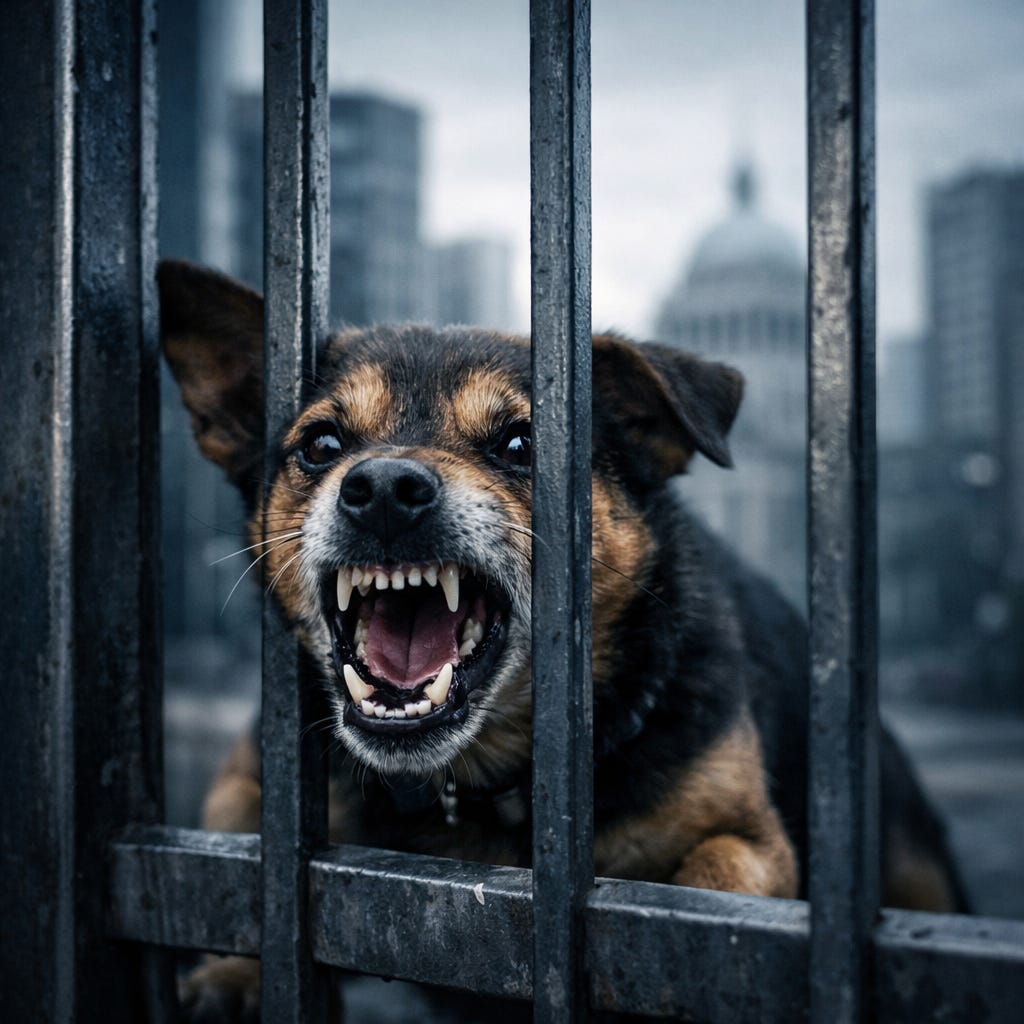
Prologue: The Dog and the EmpireThere is a dog in my neighborhood. Small, tremoring, all ribs and bravado.Every time another dog walks past the gate, it hurls itself at the metal like it believes the universe depends on it.Teeth bared. Hackles up. A high, frantic growl that sounds more like panic than threat.The bigger dogs barely look at it. If the gate ever failed, that little dog would learn—in one instant—how small it really is.It doesn’t matter. The dog isn’t doing cost–benefit analysis. It’s running older code:* Stranger → Possible threat* Threat → Display* Display → Maybe they back offThis is not a reasoned strategy. It is a reflexive performance of strength to ward off humiliation and fear.We would like to believe we are different.We are not.We are the same animal, wrapped in suits and flags and credentials, throwing ourselves at symbolic gates every time something looks like a threat to our status, our identity, our narrative about ourselves. We call it “policy,” “principle,” or “national interest.” Very often, it is simply I must not be made small.Strip away the decor and three things emerge:* Humans do not primarily seek truth.* We seek preservation of identity, status, and coalition.* We then conscript “truth” into defending whatever those older drives have already decided.The question is not whether this happens. History is stacked with examples: the Dreyfus Affair, Iraq’s WMDs, Enron, Theranos, Galileo, Semmelweis, honor duels, post-war Germany.The real questions are:* Why do we cling to stories that are visibly killing us?* How do societies ever learn anything if we spend most of our time growling at evidence?* Is there any form of hope that doesn’t depend on pretending we’re better than we are?To answer them, we have to keep watching the dog—and then look up at empires, companies, laboratories, and marriages, and admit we recognize the posture.I. The Species That Snarls at EvidenceWhen you pass that gate, the dog is not weighing utilities. It doesn’t wonder, “Is this display in my long-term interest?” It feels a surge of threat and moves.The behavior is older than “interest.” It is encoded fear.Our nervous systems were shaped in small groups with short horizons. Survival depended on:* Staying inside the tribe.* Not being seen as weak, disloyal, or strange.* Defending territory, allies, and reputation.You did not survive by being correct in an abstract sense.You survived by not being expelled.So the brain learned priorities:* Protect identity.* Protect coalition.* Protect status.* Only then, if it’s safe, consider that you might be wrong.We bolted “reason” on top of this, but we didn’t rewrite the firmware. We built a very articulate legal department to defend whatever the old animal has already chosen.You can see this reflex in miniature when someone is confronted with disconfirming evidence about their political tribe, their church, their profession:* They do not usually say, “Interesting—let me update.”* They reinterpret the evidence, attack the source, or move the goalposts.The content of the story changes. The function doesn’t:The point is not to discover what is true.The point is to find a story that lets me stay who I am, where I am.We tell ourselves our “interest” is flourishing, truth, goodness. In practice, our nervous system treats “interest” as whatever allows our current identity and tribe to survive one more day.Often, that’s catastrophically misaligned with what would actually be good for us or our descendants.The dog would be safer if it didn’t throw itself at the gate every time.It doesn’t know how not to.Neither do we—by default.II. Four Theaters of the Small DogThis would be harmless if it stayed at the level of barking. It doesn’t. It scales.The same pattern—threat, snarl, denial, delay—plays out in four familiar arenas.1. Politics: National Interest as Perpetual GrowlTake the Dreyfus Affair in France.An innocent Jewish officer, Alfred Dreyfus, is falsely convicted of treason. When evidence emerges that he is innocent and another officer is guilty, the French Army and much of the political class refuse to admit it. Files are hidden, forgeries defended, accusers protected.Why? Because to reverse course would humiliate the General Staff, undermine public trust, and crack the nationalist myth. Institutional prestige matters more than an actual human being.So the state snarls: doubles down on lies, attacks Dreyfus’ defenders (like Émile Zola), and frames doubt as treason.A century later, the script repeats with different costumes.In the run-up to the Iraq War, intelligence on weapons of mass destruction is fragmented and contested. Yet it is presented to the public as near-certainty. Dissenting analysts are sidelined. Skepticism is coded as weakness or disloyalty.Again: the dog at the gate. The performance of resolve matters more than the integrity of the map.Yes, there are rare counterexamples—leaders who course-correct before disaster, peace deals struck just in time. But they are remembered precisely because they push against the deeper reflex.2. Corporations: Performance Over SolvencyLook at Enron.Inside the company, plenty of people know the numbers are theatre—off-balance-sheet entities, mark-to-myth accounting, trading games. But the stock is soaring, executives are lauded as geniuses, analysts cheer from the sidelines.Anyone who questions the story risks being labeled “not a team player.” So they stay quiet. The company keeps growling about innovation and value creation while the gate corrodes beneath it. When the collapse comes, pensions vaporize, careers end, and the same commentators who celebrated the myth write post-mortems about “hubris.”Or Theranos.Engineers know the device doesn’t deliver what Elizabeth Holmes promises. Blood tests fail basic reliability checks. But the narrative—“revolutionizing healthcare”—is so seductive that investors, board members, and media all prefer the story to the data. Whistleblowers are threatened with lawsuits and surveillance.Again: the growl is public; the fear is private.These companies did not lack intelligence. They lacked the willingness to step back from the gate and actually inspect the hinges.3. Science and Intellectual Life: When Evidence Is InsultScience, at the level of method, is our best humility machine. But scientists are human before they are roles.Galileo did not merely offer a new astronomical model. By defending heliocentrism, he implicitly told the Church: your interpretive monopoly is incomplete. Scripture will need rereading. Your sense of cosmic centrality is mistaken.The reaction was not, “Fascinating, let’s revise our theology.” It was trial, condemnation, forced recantation. The institution growled to defend its story.Two centuries later, Ignaz Semmelweis shows that handwashing drastically reduces maternal deaths in Vienna clinics. The data are brutal and clear. The response from many doctors is not curiosity but rage: accepting his results means admitting they have been killing patients with unwashed hands.They attack his methods and his sanity. He dies disgraced; only later do Pasteur and Lister vindicate the core insight.We like to retell these as inevitable triumphs of truth. The part we skip is how the first response to truth was teeth.There are real counter-stories: labs that rush to replicate findings that undermine their own work; disciplines that update guidelines quickly when preliminary evidence points to harm. These moments matter. They show curiosity and conscience can outrun fear.But they are hard-won, not default.4. Intimacy: Private Wars of EgoOn the smallest stage, the pattern looks like Othello and the age of duels.In Shakespeare’s play, Othello is handed increasing evidence that Desdemona is innocent. To accept it would mean admitting he has been played by Iago, that he has misjudged his wife, that his own jealousy is the problem. He chooses the story that protects his wounded pride, even if it means murder.In 18th–19th-century Europe and America, men killed each other in formal duels over slights to “honor.” Objectively insane. But in honor cultures, reputation is survival; not responding to insult is coded as weakness. So you perform lethal confidence to protect status.Translated to now: people would rather end marriages than say, “I was wrong.” They would rather carry generational estrangements than admit they harmed someone they love.All four arenas run the same program:Aggression as pre-emptive defense against humiliation.The dog isn’t trying to conquer the world. It’s trying not to feel small.So are we.III. How We Learn: The Machinery of HumiliationIf we are this defensive, how does anything ever improve?The uncomfortable answer: slowly, brutally, unevenly.We rarely update because the argument was good. We update because reality corners us.1. Learning After ImpactSometimes the crash is total.After World War II, Germany is not nudged into reflection; it is obliterated. Cities in ruins, regime collapsed, crimes exposed in meticulous bureaucratic detail. Under Allied occupation and with massive external pressure, a long process begins:* Denazification (imperfect, but real).* A new constitution with stronger safeguards.* Education that forces future generations to look directly at the Holocaust.* A memorial culture that tries, however inadequately, not to forget.This is one of the rare cases where a society engages in sustained moral reckoning. It did not arise from gentle introspection. It arose from defeat, exposure, and constraint.Financially, Enron’s collapse plays a smaller but analogous role. After the wreckage, the U.S. passes the Sarbanes–Oxley Act, tightening audit requirements and executive liability. Corporations do not become virtuous. But the cost of certain lies increases. The system learns—by hitting a wall and leaving a mark.We like to tell these as uplifting stories of “resilience.” They are also autopsies.Learning is the sediment of humiliation.Our “wisdom” is the scar tissue left by crashed myths.2. Learning by ReplacementChange also arrives through generational turnover.The doctors who mocked Semmelweis never really apologized. They aged out while germ theory, Pasteur, Lister, and later microbiology took over the field. Hospital norms changed. Handwashing and antiseptic procedures became so obvious we forgot they were once heresy.Many scientific and moral shifts follow this pattern:* The old guard resists;* The evidence piles up;* Younger cohorts, less invested in the old prestige hierarchy, accept the new map;* Obituaries quietly clear space on editorial boards and committees.We rebrand this as “progress,” but the mechanism is often demographic exit.3. Learning by EnforcementSometimes we don’t trust time or insight and go straight to rules.After scandals and disasters—financial frauds, workplace deaths, drug tragedies—regulators impose:* Safety standards* Reporting requirements* Inspections* Legal liabilityDoctors wash their hands not because they all had an inner Semmelweis moment, but because the protocol is now baked into training, checklists, and institutional habit. CFOs sign off on financials not because they suddenly feel more honest, but because personal criminal liability focuses the mind.Humility here is not an emotion. It is a regulated behavior.4. The Rare Cases of Proactive LearningTo be precise: not every update waits for catastrophe.There are institutions and leaders who:* Change course when the warning signs are still small.* Sunset harmful but profitable products before lawsuits force them.* Tighten safety standards on early evidence.* Reform abusive policies before exposés.These cases matter because they demonstrate that curiosity and conscience can win rounds without the referee of disaster.But they are fragile victories, always under pressure from the small dog that wants to keep barking until the truck hits it.IV. The Sacrificial ClassThere’s a further obscenity: the costs of learning are not evenly shared.When systems finally conform to reality, they almost never distribute the pain fairly. There is always a sacrificial layer—a class of people who absorb the friction between truth and power.They include:* Whistleblowers inside Enron and Theranos who torched their own careers so others could eventually call those companies “cautionary tales.”* Early truth-tellers in the Dreyfus Affair, vilified and prosecuted before France later celebrated them and rehabilitated Dreyfus.* Galileo under house arrest, Semmelweis dying in an asylum, while later generations teach their names as examples of scientific virtue.* Civil rights leaders beaten, jailed, assassinated before their demands become museum exhibits and public holidays.* Victims of unsafe drugs, cars, and factories whose deaths become statistics in regulatory reports.By the time a warning becomes common sense, the people who made it visible are usually dead, ruined, or politely footnoted.We talk about “the lessons of history” as if they arrived by email.We praise civilizational learning.We rarely apologize to the ones we learned on.And not all suffering even buys reform. Many atrocities sit unreckoned. Many cover-ups succeed. Many lives are simply ground up for nothing.Pain instructs only where power allows it to be recorded, remembered, and acted on.But wherever you see real structural change, if you rewind far enough, you usually find a handful of people who paid an unfair share so the rest of us could tolerate the story of progress.They are the ones pushed against the metaphorical gate while the rest of us stand at the window and say, “We must never do that again.”V. Where Hope Actually LivesGiven all this—defensive wiring, humiliation-driven learning, sacrificial victims—what hope is left that isn’t just narcotic?Not the hope that says, “People are basically good.” The record does not justify that sentence. We are capable of goodness and cruelty, courage and cowardice, often in the same week.Hope that relies on universal virtue will not survive contact with any newspaper.The only durable hope is colder and more respectful of how we actually behave: hope in constraint and design.1. Reality Has a Long MemoryWhatever we believe, atoms, viruses, ecosystems, and balance sheets continue to follow their own rules.We can deny deficits, epidemiology, emissions, or instability for a while. We can certainly punish those who warn us.But reality does not negotiate indefinitely.As a selection mechanism, that matters:* Systems that track reality—even imperfectly—tend to last longer.* Systems that marinate in fantasy eventually collapse, often violently.Delusion is expensive. Accuracy scales.That is one axis of hope: over long enough horizons, reality punishes our worst lies.2. Humility MachinesThe second axis is that we have, against our own nature, learned to build machines of humility—structures that assume we are biased and self-serving and then work around it.* Science: replication, peer review, open data, skepticism by design. A method that treats any single scientist as unreliable and any single result as provisional.* Rule of law: constitutions, independent courts, due process. An architecture born from the assumption that rulers will abuse power if they can.* Audits and transparency: accounting standards after Enron, clinical trial registries after drug scandals, investigative journalism that treats “trust me” as an invitation to dig.* Distributed communication networks: messy, corruptible, yet capable of surfacing what centralized power would prefer to bury.None of these are pure. All can be captured or eroded. But they share a stance:We do not trust ourselves.Therefore, we will bind ourselves.Hope lives there: not in the righteousness of individuals, but in the boring, procedural work of limiting the damage our unrighteousness can do.3. Curiosity and Cooperation Do ExistTo stay honest: not everything good is downstream of catastrophe and coercion.Curiosity is real. So is conscience.Scientists collaborate across borders because they want to know. Communities organize mutual aid because they actually care. Some companies improve ethics and sustainability before regulators arrive, partly because people inside would like to sleep at night.These do not cancel the small dog. But they complicate the picture. They give the humility machines raw material to work with.4. The Quiet MiracleThe fact that we can even name these patterns—that we can say, out loud, “we are wired to snarl at evidence, and we should design around that”—is extraordinary.There is nothing inevitable about a species that:* Writes constitutions limiting its own rulers.* Funds studies that might invalidate its current practices.* Teaches children about Dreyfus, the Holocaust, slavery, Jim Crow.* Encourages young scientists to challenge Galileo and everyone after him.These are acts of disciplined self-distrust.They are us, stepping back from the gate long enough to draw a map of our own madness and then build railings around the worst drop-offs.Hope is not that we will stop being the dog.Hope is that we have learned, in some places and times, to build a fence that keeps our worst reflexes from running the entire show.Hope is not a feeling.Hope is an architecture.VI. The Ethics of Seeing EarlySo what does any of this mean for a single person who sees the pattern a little sooner than the room they’re in?If you’re wired—by temperament, training, or trauma—to notice the crack in the balance sheet, the lie in the doctrine, the doom embedded in the policy, you stand closer to the blow when reality arrives.You feel the pressure before others admit it’s there.You will hear familiar lines:* “You’re being dramatic.”* “Everyone else seems fine with this.”* “You’re over-intellectualizing / too sensitive / not a team player.”At that point you have three broad options.1. CynicismYou decide nothing can be changed. Truth is just another weapon. Everything is power.So you stand at the fence and sneer at everything. You refuse to care, refuse to build, refuse to risk. You call this realism. It’s just another form of fear.2. Comfortable Self-DelusionYou decide you’d rather not know. You stop reading certain signals, avoid certain conversations, align with whatever story seems safest.This buys comfort and sometimes career longevity. It also hollows you out. One day you realize you are helping to paint the gate while pretending not to hear the crash on the other side.3. Tragic AgencyYou accept that truth matters—that misalignment with reality always collects—and that naming what you see will sometimes cost you.You do not confess every thought in every meeting. You are not obliged to die on every hill. Instead, you:* Choose where your dissent has leverage.* Time your interventions.* Build alliances with others who see.* Translate what you know into structures—processes, documentation, standards, guardrails—rather than just speeches.You may still end up in the sacrificial class in some narratives. But the structures you help build can outlive the insecurity of the people who resent you. They become part of the architecture that protects people you will never meet.This is not martyrdom. It is simply living as if reality is real.VII. Standing at the FenceThe dog will be there tomorrow, pressed against the bars, convinced it is saving the world.It is both comic and tragic. It is doing the best it can with the code it has. It does not know that not every movement is an attack; it does not know how small it is; it does not know how brittle the gate might be.We do.We know snarling at evidence doesn’t make us safer. We know humiliation postponed becomes catastrophe. We know our “lessons learned” are written in other people’s blood. We know our nature is not drifting toward sainthood.That knowledge does not make us better animals. But it gives us one advantage the dog does not have:We can design against ourselves.We can decide that certain powers require more than one person’s will. We can embed accounting standards born from Enron, safety protocols born from Semmelweis, constitutional limits born from tyrants, memorials born from Auschwitz. We can remember who paid last time we chose the growl over the truth.The dog at the gate will keep barking. So will nations, companies, parties, egos.The work, for those who can see it, is not to pretend we are different.The work is to build something behind the fence that does not collapse when the gate finally gives way.Hope is not that we will stop being afraid.Hope is that, despite our fear, we still have the capacity to pour concrete, write laws, craft methods, and leave behind structures that hold truer to reality than we do on our worst days.Hope is not a mood.Hope is an architecture we raise against our own cowardice—and then bequeath to people who will never know our names.—Elias WinterAuthor of Language Matters, a space for reflection on language, power, and decline. This is a public episode. If you would like to discuss this with other subscribers or get access to bonus episodes, visit eliaswinter.substack.com
NOW PLAYING
The Dog at the Gate: On Truth, Power, and the Price of Learning
No transcript for this episode yet
Similar Episodes
No similar episodes found.
Similar Podcasts
No similar podcasts found.