
EPISODE · Mar 31, 2026 · 6 MIN
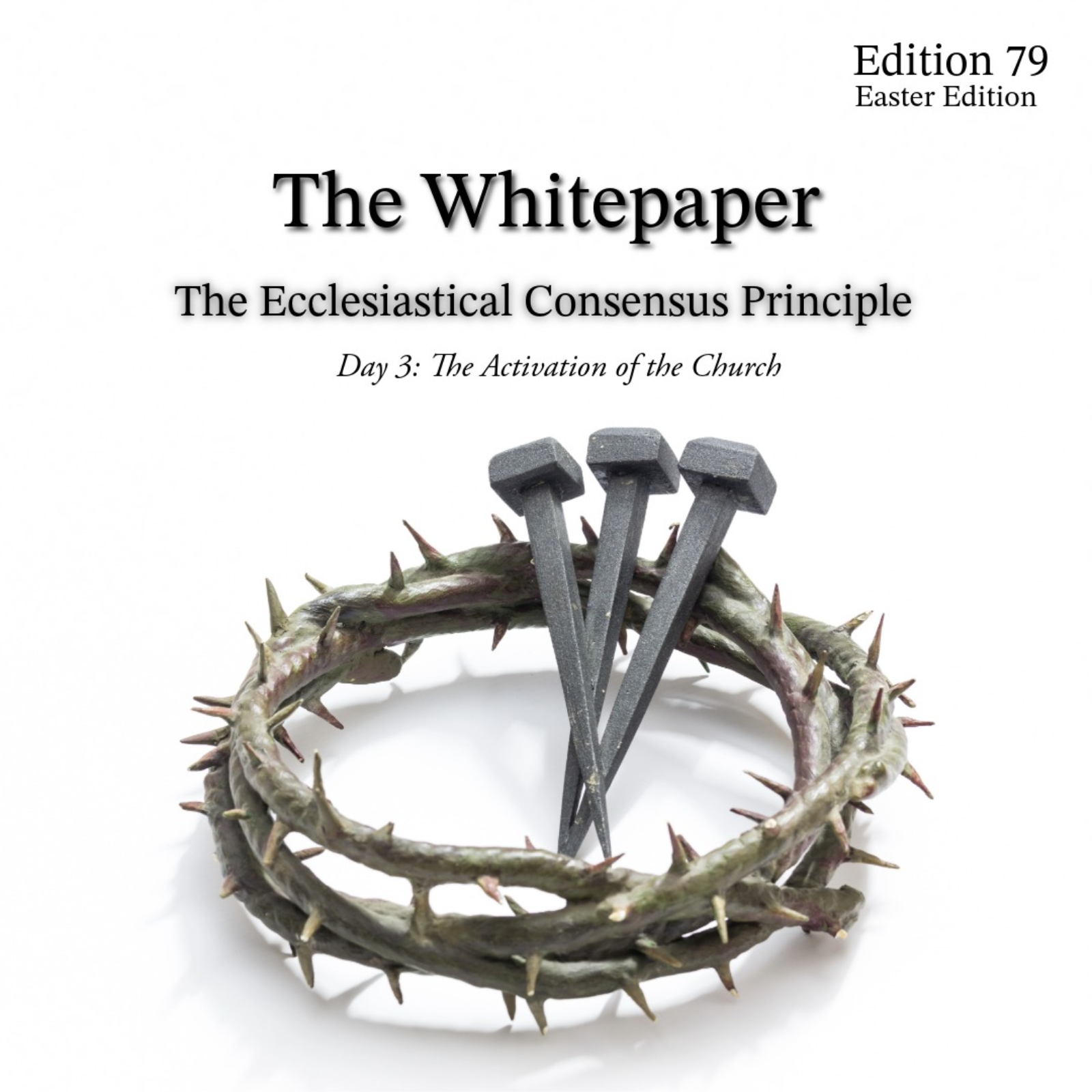
The Ecclesiastical Consensus Principle — Day 3: The Activation of the Church
from The Whitepaper
In this Easter edition of The Whitepaper, Nicolin Decker presents The Ecclesiastical Consensus Principle — Day 3: The Activation of the Church, introducing the structural moment in which the distributed architecture of the Church becomes operational through the coming of the Holy Spirit.This episode advances a central claim: while the mission of the Church originates in Christ and is structurally transferred to His followers, it is at Pentecost that this mission becomes functionally active. The Holy Spirit serves as the enabling force that transforms a gathered group of believers into a distributed, operational system. What was previously instruction and commissioning becomes participation and execution, as individuals are empowered simultaneously to carry the mission forward.From this foundation, the episode introduces a critical architectural development: the distribution of capability and the differentiation of function. Through spiritual gifts, the Holy Spirit allocates distinct roles across believers, creating a system defined not by uniformity, but by coordinated specialization. The Church emerges as a network of interdependent participants, each carrying a portion of the mission while remaining unified through a shared source of authority and guidance.🔹 Core Insight Pentecost is the moment the Church becomes operational—where distributed capability is activated and unified through the Spirit.🔹 Key Themes• Pentecost as System Activation How the arrival of the Holy Spirit transforms the Church from potential to operational reality.• Distributed Empowerment Why the mission is carried simultaneously by many participants rather than centralized in one.• Unity Through the Spirit How distributed participation does not produce fragmentation, but coherence through a shared source.• Spiritual Gifts as Functional Architecture How differentiated roles enable the Church to operate across multiple dimensions simultaneously.• The Body as Interdependent Design Why each believer carries partial capability, requiring coordination and mutual reliance within the system.🔹 Why It Matters The Church is often understood as a community of belief, but this episode reveals it as a coordinated system of action. Pentecost demonstrates that the mission of the Church is not sustained by individual effort, but by distributed empowerment under a unified source. This clarifies how the Church can expand across cultures and generations without losing coherence—because its unity is not maintained by centralization, but by alignment through the Spirit.🔻 What This Episode Is NotNot a reinterpretation of Pentecost. Not a redefinition of spiritual gifts. Not a deviation from scriptural teaching.It is a structural clarification of how the Church becomes operational—and how distributed participation and unified purpose coexist within its design.🔻 Looking Ahead In Day 4, the series will examine how this distributed system continues to grow—exploring replication through discipleship, the expansion of the Church across regions, and the mechanisms through which the mission scales without losing integrity.Read: The Ecclesiastical Consensus Principle. [Click Here]This is The Ecclesiastical Consensus Principle. And this is The Whitepaper.
NOW PLAYING
The Ecclesiastical Consensus Principle — Day 3: The Activation of the Church
No transcript for this episode yet
Similar Episodes
No similar episodes found.