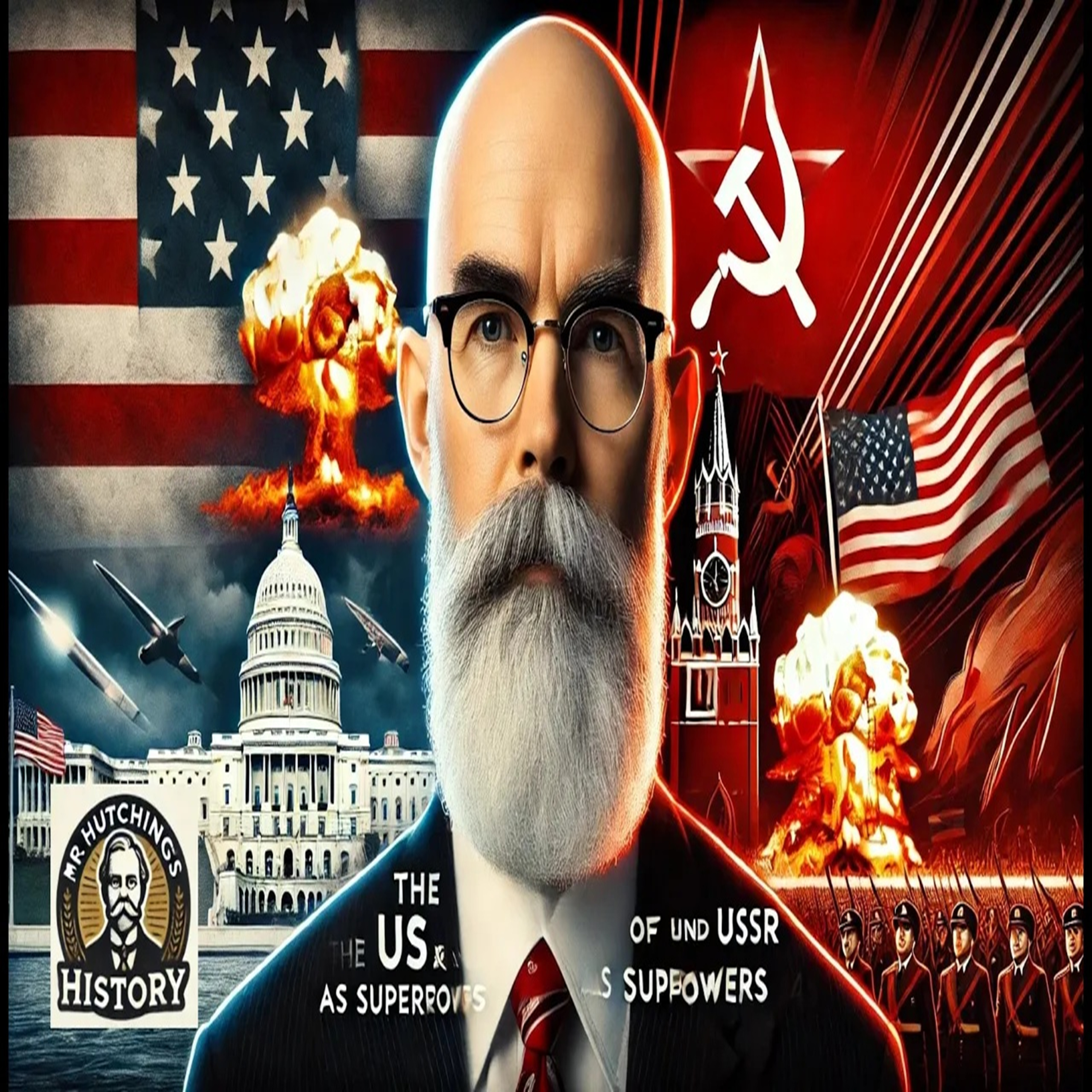
The Emergence of the US and USSR as Superpowers in 1945 episode artwork

EPISODE · Nov 21, 2024 · 16 MIN

The Emergence of the US and USSR as Superpowers in 1945

from Mr. Hutchings History · host Produced, created, and written by Harold M. Hutchings

Welcome toMr. Hutchings History. In this episode, we explore why the United States and the Soviet Union emerged as superpowers in 1945, following the end of World War II. We’ll dive into the military, economic, and political factors that shaped their rise, analyzing key events like the Yalta and Potsdam Conferences and the early stages of the Cold War. Discover the ideological divide between the U.S. and the USSR, with the U.S. representing capitalism and democracy, and the USSR advocating for communism and state control.We’ll also examine the critical role of nuclear weapons, the economic policies of the Marshall Plan, and how these two nations’ military and economic strengths set the stage for a global rivalry. From the devastation of war-torn Europe to the creation of spheres of influence, the U.S. and USSR emerged as the new superpowers that would define the 20th century.Finally, we’ll look at various historiographical schools—Orthodox, Revisionist, Realist, and Post-Revisionist—to better understand the different perspectives on this pivotal shift in global power.#ColdWar #Superpowers #USvsUSSR #Paper2WorldHistory #ColdWarRivalry #MilitaryPower #IdeologicalDivide #MarshallPlan #YaltaConference #PotsdamConference #NuclearWeapons #SovietExpansion #ColdWarHistoriography #USSR #UnitedStates #PostWWIIWorks CitedGaddis, John Lewis. Strategies of Containment: A Critical Appraisal of American National Security Policy during the Cold War. Oxford UP, 1982.Leffler, Melvyn P. For the Soul of Mankind: The United States, the Soviet Union, and the Cold War. Hill and Wang, 2007.Schlesinger, Arthur. The Origins of the Cold War. Harvard UP, 1967.Truman, Harry S. “Truman Doctrine Speech,” March 12, 1947.United Nations Charter, 1945.Williams, William Appleman. The Tragedy of American Diplomacy. W.W. Norton & Co., 1959.Chapters(0:00) Introduction: The Rise of SuperpowersWWII ends, and the U.S. and USSR emerge as dominant global powers, setting the stage for decades of rivalry.(1:00) A World in Ruins: Power VacuumWith Europe devastated and former empires weakened, the U.S. and USSR step in to reshape global politics.(2:00) Military Strength: Air Power vs. Land PowerThe U.S. dominates with nuclear weapons and air superiority, while the Soviet Red Army controls Eastern Europe.(3:10) Economic Strength: Capitalism vs. CommunismThe U.S. becomes an industrial powerhouse, while the USSR relies on state-controlled economies and resource-heavy influence.(4:00) Marshall Plan: Aid or Strategic Move?The U.S. invests billions in post-war Europe, both to rebuild and prevent the spread of communism.(5:10) USSR’s Eastern Bloc StrategyThe Soviet Union consolidates control in Eastern Europe, ensuring a buffer zone against future threats.(6:00) Cold War Begins: A Clash of IdeologiesCompeting worldviews—capitalist democracy vs. communist state control—create deep tensions.(7:00) Truman Doctrine & Containment PolicyThe U.S. vows to stop communism’s spread, increasing hostilities and dividing the world.(8:10) Role of Nuclear Weapons: MAD DoctrineMutually Assured Destruction (MAD) prevents direct conflict but fuels an arms race.(9:00) Proxy Wars: Fighting Through Other NationsSuperpowers avoid direct war but back opposing sides in Korea, Vietnam, and beyond.(10:10) Who Started the Cold War? Competing TheoriesHistorians debate whether Soviet aggression, U.S. policies, or unavoidable tensions led to the Cold War.(11:30) Realist & Post-Revisionist PerspectivesSome argue that miscalculations and fear—not just ideology—drove Cold War policies.(12:40) The Cold War’s Lasting ImpactIts effects still shape global politics, alliances, and military strategies today.(14:00) Lessons from History: Why It MattersUnderstanding the Cold War helps us make sense of modern global conflicts and power struggles.(16:42) Conclusion: Keep Exploring HistoryHistory isn’t just about the past—it shapes the future. Keep questioning, keep learning.

Welcome toMr. Hutchings History. In this episode, we explore why the United States and the Soviet Union emerged as superpowers in 1945, following the end of World War II. We’ll dive into the military, economic, and political factors that shaped their rise, analyzing key events like the Yalta and Potsdam Conferences and the early stages of the Cold War. Discover the ideological divide between the U.S. and the USSR, with the U.S. representing capitalism and democracy, and the USSR advocating for communism and state control.We’ll also examine the critical role of nuclear weapons, the economic policies of the Marshall Plan, and how these two nations’ military and economic strengths set the stage for a global rivalry. From the devastation of war-torn Europe to the creation of spheres of influence, the U.S. and USSR emerged as the new superpowers that would define the 20th century.Finally, we’ll look at various historiographical schools—Orthodox, Revisionist, Realist, and Post-Revisionist—to better understand the different perspectives on this pivotal shift in global power.#ColdWar #Superpowers #USvsUSSR #Paper2WorldHistory #ColdWarRivalry #MilitaryPower #IdeologicalDivide #MarshallPlan #YaltaConference #PotsdamConference #NuclearWeapons #SovietExpansion #ColdWarHistoriography #USSR #UnitedStates #PostWWIIWorks CitedGaddis, John Lewis. Strategies of Containment: A Critical Appraisal of American National Security Policy during the Cold War. Oxford UP, 1982.Leffler, Melvyn P. For the Soul of Mankind: The United States, the Soviet Union, and the Cold War. Hill and Wang, 2007.Schlesinger, Arthur. The Origins of the Cold War. Harvard UP, 1967.Truman, Harry S. “Truman Doctrine Speech,” March 12, 1947.United Nations Charter, 1945.Williams, William Appleman. The Tragedy of American Diplomacy. W.W. Norton & Co., 1959.Chapters(0:00) Introduction: The Rise of SuperpowersWWII ends, and the U.S. and USSR emerge as dominant global powers, setting the stage for decades of rivalry.(1:00) A World in Ruins: Power VacuumWith Europe devastated and former empires weakened, the U.S. and USSR step in to reshape global politics.(2:00) Military Strength: Air Power vs. Land PowerThe U.S. dominates with nuclear weapons and air superiority, while the Soviet Red Army controls Eastern Europe.(3:10) Economic Strength: Capitalism vs. CommunismThe U.S. becomes an industrial powerhouse, while the USSR relies on state-controlled economies and resource-heavy influence.(4:00) Marshall Plan: Aid or Strategic Move?The U.S. invests billions in post-war Europe, both to rebuild and prevent the spread of communism.(5:10) USSR’s Eastern Bloc StrategyThe Soviet Union consolidates control in Eastern Europe, ensuring a buffer zone against future threats.(6:00) Cold War Begins: A Clash of IdeologiesCompeting worldviews—capitalist democracy vs. communist state control—create deep tensions.(7:00) Truman Doctrine & Containment PolicyThe U.S. vows to stop communism’s spread, increasing hostilities and dividing the world.(8:10) Role of Nuclear Weapons: MAD DoctrineMutually Assured Destruction (MAD) prevents direct conflict but fuels an arms race.(9:00) Proxy Wars: Fighting Through Other NationsSuperpowers avoid direct war but back opposing sides in Korea, Vietnam, and beyond.(10:10) Who Started the Cold War? Competing TheoriesHistorians debate whether Soviet aggression, U.S. policies, or unavoidable tensions led to the Cold War.(11:30) Realist & Post-Revisionist PerspectivesSome argue that miscalculations and fear—not just ideology—drove Cold War policies.(12:40) The Cold War’s Lasting ImpactIts effects still shape global politics, alliances, and military strategies today.(14:00) Lessons from History: Why It MattersUnderstanding the Cold War helps us make sense of modern global conflicts and power struggles.(16:42) Conclusion: Keep Exploring HistoryHistory isn’t just about the past—it shapes the future. Keep questioning, keep learning.

NOW PLAYING

The Emergence of the US and USSR as Superpowers in 1945

0:00 16:49

No transcript for this episode yet

We transcribe on demand. Request one and we'll notify you when it's ready — usually under 10 minutes.

The 48 Laws of Power by Robert Greene (Full Audiobook) Robert Greene Amoral, cunning, ruthless, and instructive, this multi-million-copy New York Times bestseller is the definitive manual for anyone interested in gaining, observing, or defending against ultimate control – from the author of The Laws of Human Nature.In the book that People magazine proclaimed “beguiling” and “fascinating,” Robert Greene and Joost Elffers have distilled three thousand years of the history of power into 48 essential laws by drawing from the philosophies of Machiavelli, Sun Tzu, and Carl Von Clausewitz and also from the lives of figures ranging from Henry Kissinger to P.T. Barnum.Some laws teach the need for prudence (“Law 1: Never Outshine the Master”), others teach the value of confidence (“Law 28: Enter Action with Boldness”), and many recommend absolute self-preservation (“Law 15: Crush Your Enemy Totally”). Every law, though, has one thing in common: an interest in t The Laura Ingraham Show Laura Ingraham The most-watched woman in the history of cable news brings her no-holds-barred political and cultural commentary to podcasting with The Laura Ingraham Show. A bestselling author, breast cancer survivor, and mother of three internationally adopted children, Laura was the most listened-to woman in talk radio before launching her own podcast. A trailblazer across media platforms, she brings a unique perspective to this twice-weekly show, drawing on her experience as a white-collar criminal defense litigator and a Supreme Court law clerk.New episodes drop twice a week—delivering the clarity, courage, and common sense America needs. Vampires of the Paper Flower Consortium Elizabeth Guizzetti Come for the evening, stay for eternity! Paper Flower Consortium is a podcast from the largest vampire coven in Seattle. Their stories are told by Loretta Fabron Onfoy, coven historian and librarian, in the hope that the modern vampire's way of life is not lost during the next great language transformation. Some tales in this anthology are horrific, some are droll, some are filled with misadventure--just like any eternal existence. Episodes sponsored by the Paper Flower Consortium's Business Community. The history is followed by questions from curious initiates. Want to ask Lady Loretta a question about vampirism? Have a topic you want to see discussed? Email [email protected] WW2 - the Key Questions, answered by Laurence Rees. Laurence Rees A former Head of BBC TV History programmes, Laurence has specialized in writing books and making television documentaries about World War Two, the Nazis and Stalinism for thirty years. He won a BAFTA and a Peabody for his TV series 'The Nazis: A Warning from History' and a British Book Award for his book on Auschwitz, which is also the world's best selling book on this notorious camp. His book 'the Holocaust: A New History' was described by the Times as 'exemplary' and by the Daily Telegraph as 'the best single volume account of the atrocity ever written'. Educated at Oxford University, for several years he was a visiting senior fellow at the London School of Economics, London University. He holds honorary doctorates from the University of Sheffield and the Open University. Professor Robert Service, of Oxford University, described Rees as 'one of the world's experts on the Second World War'. Sir Max Hastings wrote in the Sunday Times, in a review of Laurence Rees' 'World War Two: Behi

Frequently Asked Questions

How long is this episode of Mr. Hutchings History?

This episode is 16 minutes long.

When was this Mr. Hutchings History episode published?

This episode was published on November 21, 2024.

What is this episode about?

Welcome toMr. Hutchings History. In this episode, we explore why the United States and the Soviet Union emerged as superpowers in 1945, following the end of World War II. We’ll dive into the military, economic, and political factors that shaped...

Can I download this Mr. Hutchings History episode?

Yes, you can download this episode by clicking the download button on the episode player, or subscribe to the podcast in your preferred podcast app for automatic downloads.
URL copied to clipboard!