
EPISODE · May 13, 2026 · 5 MIN
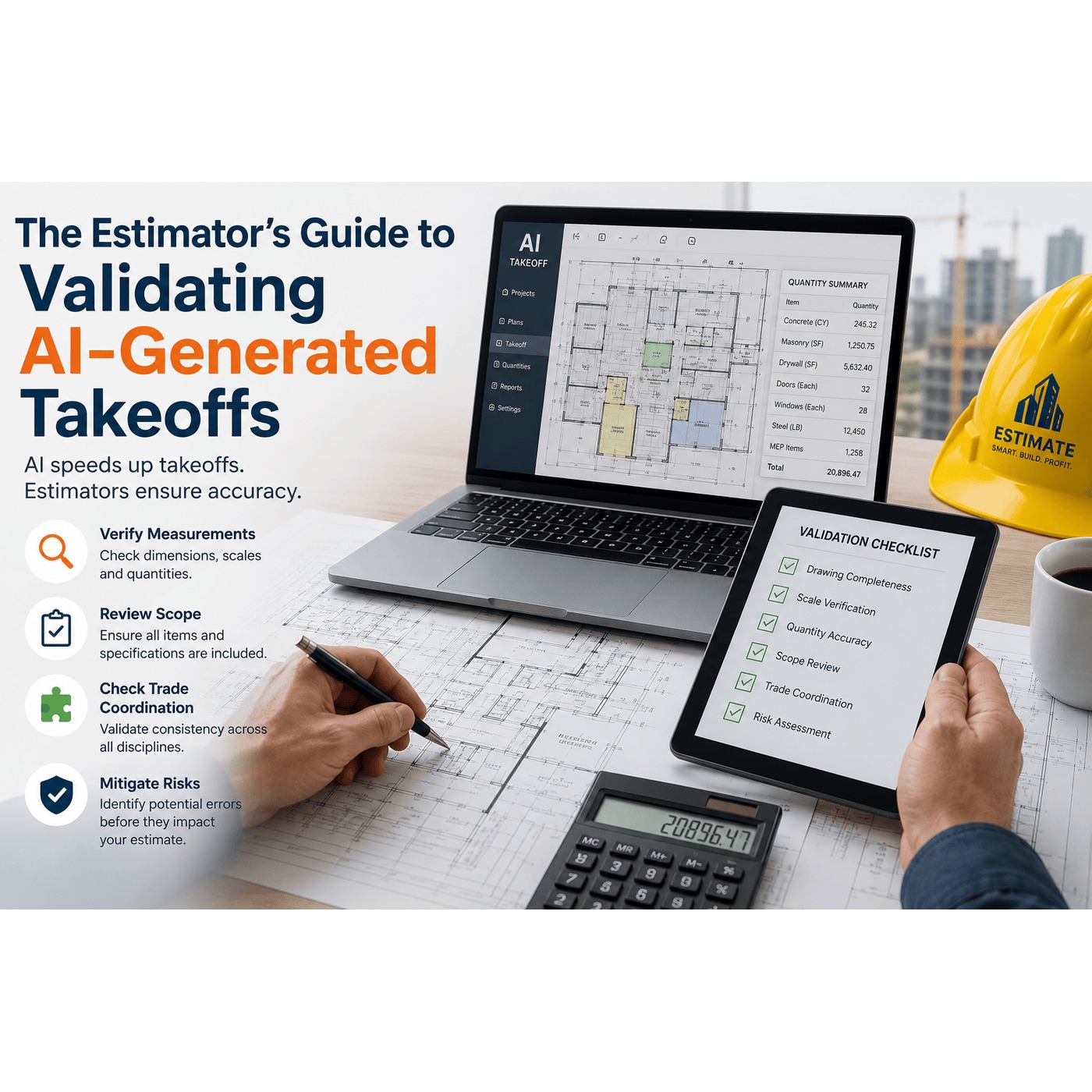
The Estimator's Guide to Validating AI Generated Takeoffs
from Cullen Johns · host Cullen Johns
Artificial intelligence has rapidly transformed the way construction professionals prepare quantity takeoffs and project estimates. In 2026, AI powered software can analyze drawings, recognize symbols, calculate measurements, and organize material quantities within minutes. This technology has significantly reduced manual workload and improved efficiency for contractors, subcontractors, and estimating teams working under tight deadlines.However, faster results do not always guarantee reliable results. Many firms that depend entirely on automated systems eventually discover inconsistencies in quantities, missing scope items, or inaccurate assumptions hidden inside AI generated outputs. This is why professional construction estimating services still rely on experienced estimators to review, validate, and refine takeoffs before final pricing decisions are made. Human oversight remains essential because construction documents often contain ambiguities that software alone cannot fully interpret.Understanding the Role of AI in Modern TakeoffsAI generated takeoffs use machine learning and computer vision technologies to scan digital plans and extract measurable data automatically. The software identifies walls, doors, windows, piping systems, fixtures, structural components, and other construction elements directly from drawings.Modern estimating platforms can now:Detect dimensions from PDF drawingsCount repetitive components automaticallyGenerate quantity summariesOrganize materials by tradeCompare drawing revisionsHighlight possible scope gapsConnect takeoff data with cost databasesThese capabilities save estimators countless hours during bid preparation. Instead of spending days manually measuring plans, professionals can focus more on pricing strategy, risk assessment, and project planning.Still, even advanced AI systems are only as accurate as the information provided to them. Poorly organized drawings, inconsistent layer structures, incomplete design sets, and unclear specifications can all affect output quality.Why Validation Matters More Than EverOne of the biggest misconceptions in construction technology is the belief that AI eliminates human error completely. In reality, AI can introduce new forms of error that may go unnoticed without careful review.An estimator validating AI generated takeoffs must verify:Measurement accuracyScope completenessTrade coordinationDrawing consistencyRevision trackingMaterial interpretationLabor assumptionsSpecification alignmentA single overlooked discrepancy can create substantial financial consequences. Missing concrete quantities, inaccurate framing dimensions, or incomplete mechanical components may lead to underbidding and profit loss.Validation is not simply about checking numbers. It involves understanding the design intent behind the plans and recognizing conditions that software may misinterpret.Common Errors Found in AI Generated TakeoffsAlthough AI systems continue improving, several recurring issues still appear in automated takeoff reports.Incomplete Drawing RecognitionSome architectural or engineering drawings contain overlapping annotations, faded text, or unconventional symbols. AI tools may fail to identify these correctly, leading to omitted quantities.Misclassified ComponentsSoftware can occasionally confuse similar elements. For example, interior partitions may be interpreted as exterior walls, or plumbing fixtures may be counted incorrectly due to symbol similarity.Duplicate QuantitiesIn certain drawing revisions, AI may accidentally count duplicated plan sections multiple times if sheets are not properly identified.Scale Interpretation ProblemsImproper scaling remains one of the most common causes of inaccurate takeoffs. If drawing calibration is slightly off, every measurement generated afterward may become unreliable.Missing Specification ContextAI can measure quantities effectively, but it often struggles to understand material quality, installation methods, or project specific requirements described within specifications.Building a Reliable Validation WorkflowProfessional estimators follow structured review procedures to ensure AI generated takeoffs are dependable before pricing begins.Step 1: Review Drawing CompletenessBefore analyzing quantities, estimators first confirm that all relevant plans, schedules, and specifications are included in the document set.This includes checking:Architectural sheetsStructural drawingsMechanical layoutsElectrical plansPlumbing detailsAddendumsRevision logsMissing sheets can immediately compromise estimate accuracy.Step 2: Verify Scale CalibrationAccurate calibration is critical for dependable measurements. Estimators manually compare AI generated dimensions against known reference measurements within the drawings.Even advanced software may misread scale settings when drawings contain scanning distortions or formatting inconsistencies.Step 3: Perform Sample Manual ChecksExperienced estimators never rely solely on automation. Instead, they manually verify selected portions of the takeoff to confirm consistency.This process may involve:Recalculating wall lengthsVerifying slab areasChecking door countsComparing room dimensionsConfirming fixture quantitiesSpot checking helps identify systematic errors before they affect the full estimate.Human Expertise Still Defines Estimate QualityConstruction estimation involves more than mathematical calculations. Skilled estimators evaluate constructability, sequencing, procurement challenges, labor productivity, regional market conditions, and trade coordination.AI cannot fully understand:Local construction practicesWeather related impactsSite accessibility constraintsLabor shortagesSupplier reliabilityClient preferencesTrade specific installation complexitiesFor example, projects involving advanced building systems often require specialized review by professionals experienced in MEP Estimating Services because mechanical, electrical, and plumbing systems contain interconnected components that automated systems may not fully coordinate accurately.Human judgment remains essential when evaluating practical construction realities that software cannot interpret contextually.The Importance of Trade CoordinationOne major area where human oversight becomes critical is interdisciplinary coordination.AI may successfully generate separate quantities for structural, architectural, and MEP systems, but it often struggles to identify conflicts between them.Estimators must review:Ceiling space conflictsStructural penetrationsEquipment clearance requirementsPipe routing limitationsElectrical access constraintsHVAC coordination issuesWithout coordination review, estimates may overlook costly field modifications later during construction.Risk Assessment Cannot Be Fully AutomatedEvery construction project contains uncertainty. Successful estimators identify risks that may influence cost, schedule, or productivity.These risks may include:Incomplete designsUnstable material pricingDifficult site logisticsPermit delaysLabor availability concernsScope ambiguitiesProcurement lead timesAI systems can identify patterns from historical data, but they cannot fully evaluate project specific risk conditions with the same depth as experienced professionals.Human estimators apply practical knowledge gained from real projects, making their judgment valuable even in highly automated workflows.Training Estimators for the AI EraThe rise of AI has changed the role of estimators rather than eliminating it. Modern estimators now combine technical construction knowledge with digital review skills.Today’s professionals must understand:AI software limitationsData validation methodsBIM coordinationSpecification analysisRisk evaluationDigital workflow managementThe most successful firms are not replacing estimators with AI. Instead, they are equipping estimators with better tools while strengthening review procedures.This hybrid approach delivers both efficiency and reliability.ConclusionAI generated takeoffs have become an important part of modern construction estimating, offering speed, consistency, and improved workflow efficiency. However, automation alone cannot guarantee accurate project costs or complete scope coverage.Construction projects remain complex, dynamic, and heavily dependent on human interpretation. Estimators play a critical role in validating quantities, reviewing specifications, coordinating trades, identifying risks, and applying real world construction knowledge to every estimate.As technology continues evolving throughout 2026 and beyond, the firms achieving the best results will be those that combine advanced AI tools with experienced professional oversight. The future of estimating is not purely automated. It is collaborative, where intelligent software supports human expertise rather than replacing it.
Embed this episode
Ready to play
The Estimator's Guide to Validating AI Generated Takeoffs
No transcript for this episode yet
Similar Episodes
No similar episodes found.