
EPISODE · Dec 30, 2025 · 23 MIN
The Exodus Part 5: Will the Real Mount Sinai Please Stand Up?
from The Jewish Journey: The People, The Land, The Evidence · host Allen Kamrava, MD MBA FACS FASCRS
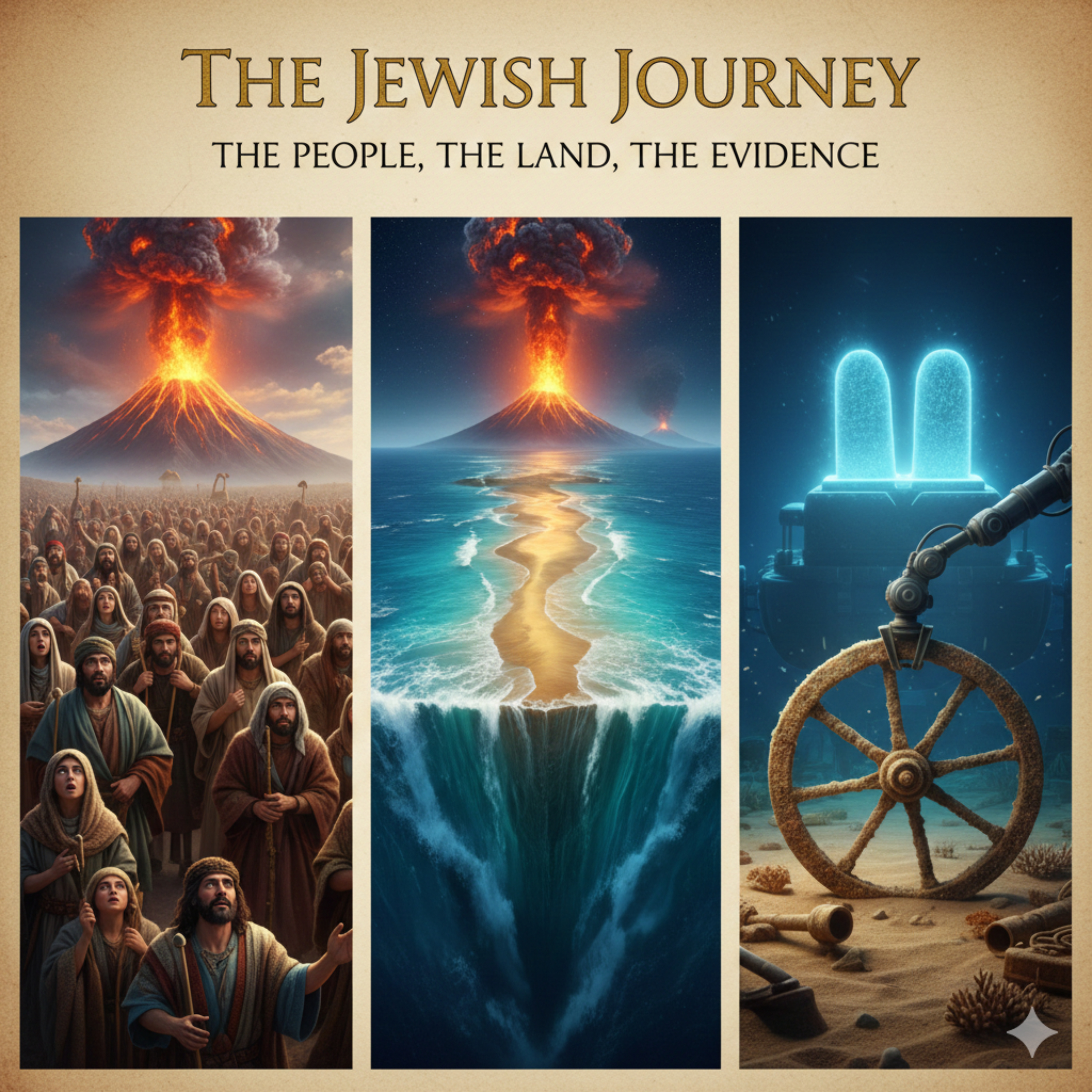
This episode serves as a geographical and theological detective story, concluding that the traditional location of Mount Sinai in the Egyptian Sinai Peninsula is incorrect based on cartography, politics, and geology.The Map Error: For nearly 2,000 years, tradition has placed Mount Sinai at Jebel Musa (St. Catherine’s). However, the hosts explain that early geographers didn't recognize the Gulf of Aqaba as a distinct body of water. Once you acknowledge that "finger" of the sea, the "wilderness beyond the sea" is clearly modern-day Saudi Arabia, not the Sinai Peninsula.The Political Reality: The Sinai Peninsula was Egyptian territory (Ta Mefkat), filled with military garrisons and mines. Moses, fleeing for his life, would not lead a nation of escapees back into Pharaoh’s backyard; he would lead them to Midian, which was outside Egyptian control.The Moses Connection: Moses lived in Midian for 40 years. It is logical that he would lead the people back to the specific mountain where he had already found refuge and encountered the Burning Bush.Volcanic Evidence: The biblical description of Sinai—shaking, smoke like a furnace, fire reaching the heavens, and a loud trumpet-like roar—is a precise match for an active volcanic eruption.The Geological Gap: There are no volcanoes in the traditional Sinai Peninsula. However, Northwest Saudi Arabia (Midian) contains extensive volcanic fields that were active during the time of the Exodus.The "Pillar" GPS: The "Pillar of Fire and Cloud" is reinterpreted not as a small hovering mist, but as the volcanic plume of the mountain itself, visible from hundreds of miles away, acting as a massive beacon leading the Israelites toward Arabia.Survival as Sovereignty: Miracles like the quail and water from the rock are presented as Yahweh commanding nature to sustain His people.The Unmediated Truth: Philosophers like Maimonides used these events to argue that Moses had a unique, unmediated relationship with God, making the Law delivered at this "Mountain of Fire" an absolute divine decree.Conclusion: The Exodus was a "theological secession" from Egypt. By moving the mountain from Egypt to Arabia, the narrative establishes Yahweh’s total sovereignty over the physical world and a new cosmic order for the Israelites.The Core Argument: Sinai belongs in Arabia (Midian)The Scientific "Smoking Gun": The Volcano TheoryLogistics and Theology
Embed this episode
NOW PLAYING
The Exodus Part 5: Will the Real Mount Sinai Please Stand Up?
No transcript for this episode yet
Similar Episodes
No similar episodes found.
Similar Podcasts
No similar podcasts found.