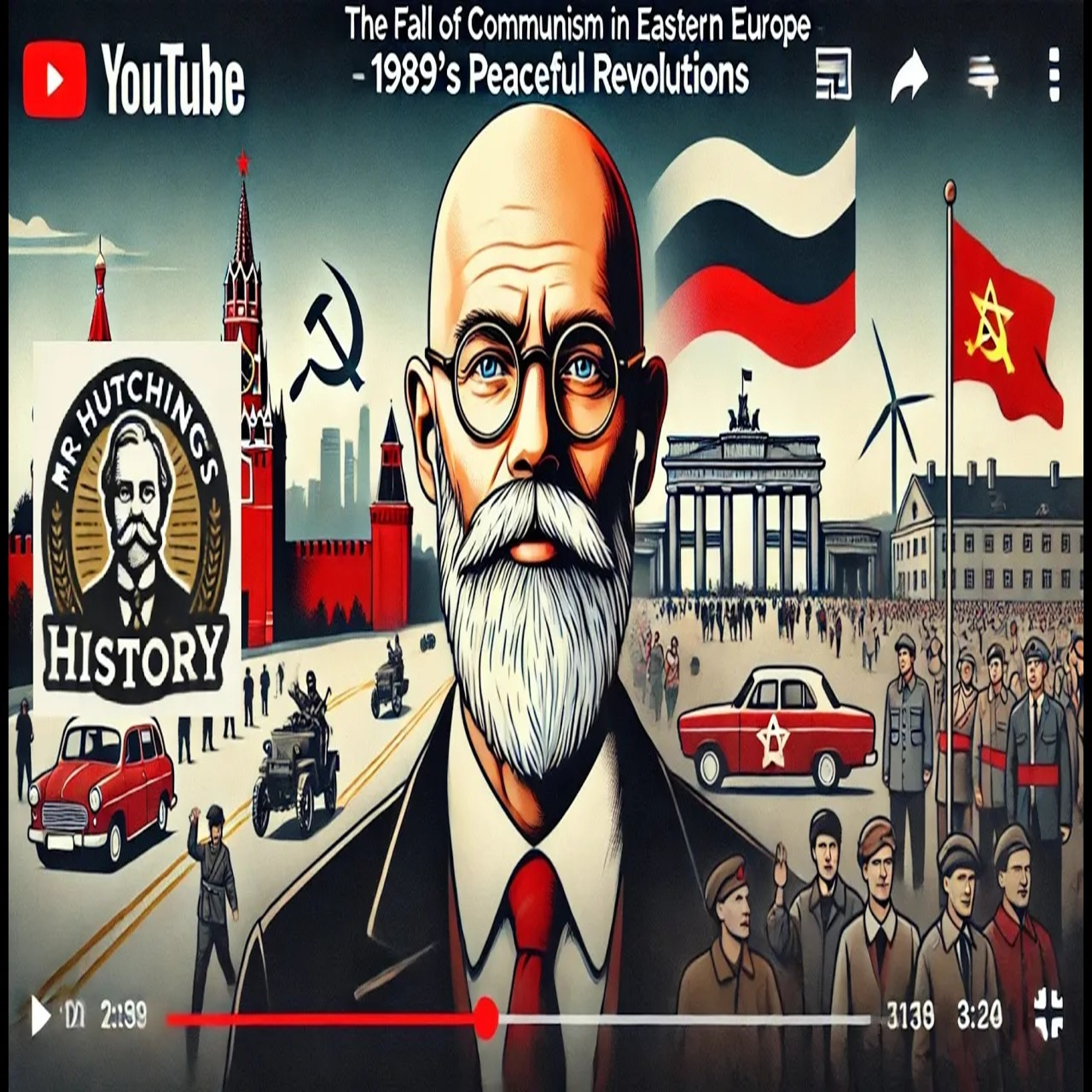
The Fall of Communism in Eastern Europe – 1989’s Peaceful Revolutions episode artwork

EPISODE · Nov 21, 2024 · 13 MIN

The Fall of Communism in Eastern Europe – 1989’s Peaceful Revolutions

from Mr. Hutchings History · host Produced, created, and written by Harold M. Hutchings

Welcome to Mr. Hutchings History, where we analyze pivotal moments that shaped modern history. In today’s episode, we examine the peaceful revolutions of 1989 that led to the fall of communist regimes in Eastern and Central Europe. From Poland to East Germany, Hungary to Czechoslovakia, and Romania's violent uprising, these revolutions redefined the political landscape of Europe.Poland: The Solidarity movement led by Lech Wałęsa set the stage for the fall of communism, with significant influence from Gorbachev’s reforms and the Catholic Church.Hungary: Hungary’s peaceful transition through dialogue, including the reburial of Imre Nagy, symbolized the collapse of Soviet influence from within.East Germany: The fall of the Berlin Wall in November 1989 marked the symbolic end of Soviet control, following mass protests and the exodus of East Germans.Czechoslovakia: The Velvet Revolution saw peaceful protests leading to the collapse of the regime and the election of Václav Havel as president.Romania: In contrast, Romania’s revolution was violent, ending with the execution of Nicolae Ceaușescu and his wife.Historiographical Debate: We explore differing interpretations of Gorbachev’s role, highlighting how his policies of non-intervention in Eastern Europe accelerated the downfall of communism.#Paper2WorldHistory #ColdWar #FallOfCommunism #1989Revolutions #SovietCollapse #EasternEurope #Gorbachev #SolidarityMovement #BerlinWall #VelvetRevolution #RomanianRevolution #EndOfTheColdWar #SuperpowerTensions #IBHistoryWorks CitedBrown, Archie. The Gorbachev Factor. Oxford UP, 1997.Gaddis, John Lewis. The Cold War: A New History. Penguin, 2005.Garton Ash, Timothy. The Magic Lantern: The Revolution of '89 Witnessed in Warsaw, Budapest, Berlin, and Prague. Vintage, 1999.Judt, Tony. Postwar: A History of Europe Since 1945. Penguin, 2005.Chapters(0:00) Introduction: The Year Everything ChangedHow did 1989 bring the collapse of communist regimes across Eastern Europe?(0:20) Poland: The Solidarity Movement Sparks ChangeShipyard workers in Gdańsk, led by Lech Wałęsa, ignite a national movement.(1:40) The Government’s Crackdown and Underground ResistanceMartial law is declared, but Solidarity continues to fight in the shadows.(2:35) The Role of Pope John Paul IIThe Polish Pope’s visit inspired resistance—was this the beginning of the end?(3:10) Hungary: Reform from the Inside OutInstead of revolution, Hungary dismantled communism gradually and peacefully.(4:10) The Reburial of Imre Nagy: A Historic ShiftHungary’s acknowledgment of past mistakes signals a break from Soviet control.(5:00) The Fall of the Berlin Wall: A Symbol of FreedomEast Germans flee through Hungary—pressure mounts, and the wall crumbles.(6:40) The Velvet Revolution in CzechoslovakiaPlaywright Václav Havel leads peaceful protests that topple the government.(8:10) Romania: A Bloody End to Communist RuleUnlike other revolutions, Nicolae Ceaușescu’s downfall ends in violence.(10:20) Gorbachev’s Role: No More Soviet Military InterventionThe USSR’s decision not to send troops allowed these revolutions to unfold.(11:45) 1989’s Legacy: The Power of Peaceful ChangeWhat does this year teach us about the potential for nonviolent resistance?(12:30) Looking Ahead: History is Still Being MadeHow do the events of 1989 connect to today’s world?

Welcome to Mr. Hutchings History, where we analyze pivotal moments that shaped modern history. In today’s episode, we examine the peaceful revolutions of 1989 that led to the fall of communist regimes in Eastern and Central Europe. From Poland to East Germany, Hungary to Czechoslovakia, and Romania's violent uprising, these revolutions redefined the political landscape of Europe.Poland: The Solidarity movement led by Lech Wałęsa set the stage for the fall of communism, with significant influence from Gorbachev’s reforms and the Catholic Church.Hungary: Hungary’s peaceful transition through dialogue, including the reburial of Imre Nagy, symbolized the collapse of Soviet influence from within.East Germany: The fall of the Berlin Wall in November 1989 marked the symbolic end of Soviet control, following mass protests and the exodus of East Germans.Czechoslovakia: The Velvet Revolution saw peaceful protests leading to the collapse of the regime and the election of Václav Havel as president.Romania: In contrast, Romania’s revolution was violent, ending with the execution of Nicolae Ceaușescu and his wife.Historiographical Debate: We explore differing interpretations of Gorbachev’s role, highlighting how his policies of non-intervention in Eastern Europe accelerated the downfall of communism.#Paper2WorldHistory #ColdWar #FallOfCommunism #1989Revolutions #SovietCollapse #EasternEurope #Gorbachev #SolidarityMovement #BerlinWall #VelvetRevolution #RomanianRevolution #EndOfTheColdWar #SuperpowerTensions #IBHistoryWorks CitedBrown, Archie. The Gorbachev Factor. Oxford UP, 1997.Gaddis, John Lewis. The Cold War: A New History. Penguin, 2005.Garton Ash, Timothy. The Magic Lantern: The Revolution of '89 Witnessed in Warsaw, Budapest, Berlin, and Prague. Vintage, 1999.Judt, Tony. Postwar: A History of Europe Since 1945. Penguin, 2005.Chapters(0:00) Introduction: The Year Everything ChangedHow did 1989 bring the collapse of communist regimes across Eastern Europe?(0:20) Poland: The Solidarity Movement Sparks ChangeShipyard workers in Gdańsk, led by Lech Wałęsa, ignite a national movement.(1:40) The Government’s Crackdown and Underground ResistanceMartial law is declared, but Solidarity continues to fight in the shadows.(2:35) The Role of Pope John Paul IIThe Polish Pope’s visit inspired resistance—was this the beginning of the end?(3:10) Hungary: Reform from the Inside OutInstead of revolution, Hungary dismantled communism gradually and peacefully.(4:10) The Reburial of Imre Nagy: A Historic ShiftHungary’s acknowledgment of past mistakes signals a break from Soviet control.(5:00) The Fall of the Berlin Wall: A Symbol of FreedomEast Germans flee through Hungary—pressure mounts, and the wall crumbles.(6:40) The Velvet Revolution in CzechoslovakiaPlaywright Václav Havel leads peaceful protests that topple the government.(8:10) Romania: A Bloody End to Communist RuleUnlike other revolutions, Nicolae Ceaușescu’s downfall ends in violence.(10:20) Gorbachev’s Role: No More Soviet Military InterventionThe USSR’s decision not to send troops allowed these revolutions to unfold.(11:45) 1989’s Legacy: The Power of Peaceful ChangeWhat does this year teach us about the potential for nonviolent resistance?(12:30) Looking Ahead: History is Still Being MadeHow do the events of 1989 connect to today’s world?

NOW PLAYING

The Fall of Communism in Eastern Europe – 1989’s Peaceful Revolutions

0:00 13:22

No transcript for this episode yet

We transcribe on demand. Request one and we'll notify you when it's ready — usually under 10 minutes.

The 48 Laws of Power by Robert Greene (Full Audiobook) Robert Greene Amoral, cunning, ruthless, and instructive, this multi-million-copy New York Times bestseller is the definitive manual for anyone interested in gaining, observing, or defending against ultimate control – from the author of The Laws of Human Nature.In the book that People magazine proclaimed “beguiling” and “fascinating,” Robert Greene and Joost Elffers have distilled three thousand years of the history of power into 48 essential laws by drawing from the philosophies of Machiavelli, Sun Tzu, and Carl Von Clausewitz and also from the lives of figures ranging from Henry Kissinger to P.T. Barnum.Some laws teach the need for prudence (“Law 1: Never Outshine the Master”), others teach the value of confidence (“Law 28: Enter Action with Boldness”), and many recommend absolute self-preservation (“Law 15: Crush Your Enemy Totally”). Every law, though, has one thing in common: an interest in t The Laura Ingraham Show Laura Ingraham The most-watched woman in the history of cable news brings her no-holds-barred political and cultural commentary to podcasting with The Laura Ingraham Show. A bestselling author, breast cancer survivor, and mother of three internationally adopted children, Laura was the most listened-to woman in talk radio before launching her own podcast. A trailblazer across media platforms, she brings a unique perspective to this twice-weekly show, drawing on her experience as a white-collar criminal defense litigator and a Supreme Court law clerk.New episodes drop twice a week—delivering the clarity, courage, and common sense America needs. Vampires of the Paper Flower Consortium Elizabeth Guizzetti Come for the evening, stay for eternity! Paper Flower Consortium is a podcast from the largest vampire coven in Seattle. Their stories are told by Loretta Fabron Onfoy, coven historian and librarian, in the hope that the modern vampire's way of life is not lost during the next great language transformation. Some tales in this anthology are horrific, some are droll, some are filled with misadventure--just like any eternal existence. Episodes sponsored by the Paper Flower Consortium's Business Community. The history is followed by questions from curious initiates. Want to ask Lady Loretta a question about vampirism? Have a topic you want to see discussed? Email [email protected] WW2 - the Key Questions, answered by Laurence Rees. Laurence Rees A former Head of BBC TV History programmes, Laurence has specialized in writing books and making television documentaries about World War Two, the Nazis and Stalinism for thirty years. He won a BAFTA and a Peabody for his TV series 'The Nazis: A Warning from History' and a British Book Award for his book on Auschwitz, which is also the world's best selling book on this notorious camp. His book 'the Holocaust: A New History' was described by the Times as 'exemplary' and by the Daily Telegraph as 'the best single volume account of the atrocity ever written'. Educated at Oxford University, for several years he was a visiting senior fellow at the London School of Economics, London University. He holds honorary doctorates from the University of Sheffield and the Open University. Professor Robert Service, of Oxford University, described Rees as 'one of the world's experts on the Second World War'. Sir Max Hastings wrote in the Sunday Times, in a review of Laurence Rees' 'World War Two: Behi

Frequently Asked Questions

How long is this episode of Mr. Hutchings History?

This episode is 13 minutes long.

When was this Mr. Hutchings History episode published?

This episode was published on November 21, 2024.

What is this episode about?

Welcome to Mr. Hutchings History, where we analyze pivotal moments that shaped modern history. In today’s episode, we examine the peaceful revolutions of 1989 that led to the fall of communist regimes in Eastern and Central Europe. From Poland to...

Can I download this Mr. Hutchings History episode?

Yes, you can download this episode by clicking the download button on the episode player, or subscribe to the podcast in your preferred podcast app for automatic downloads.
URL copied to clipboard!