
EPISODE · Apr 23, 2026 · 18 MIN
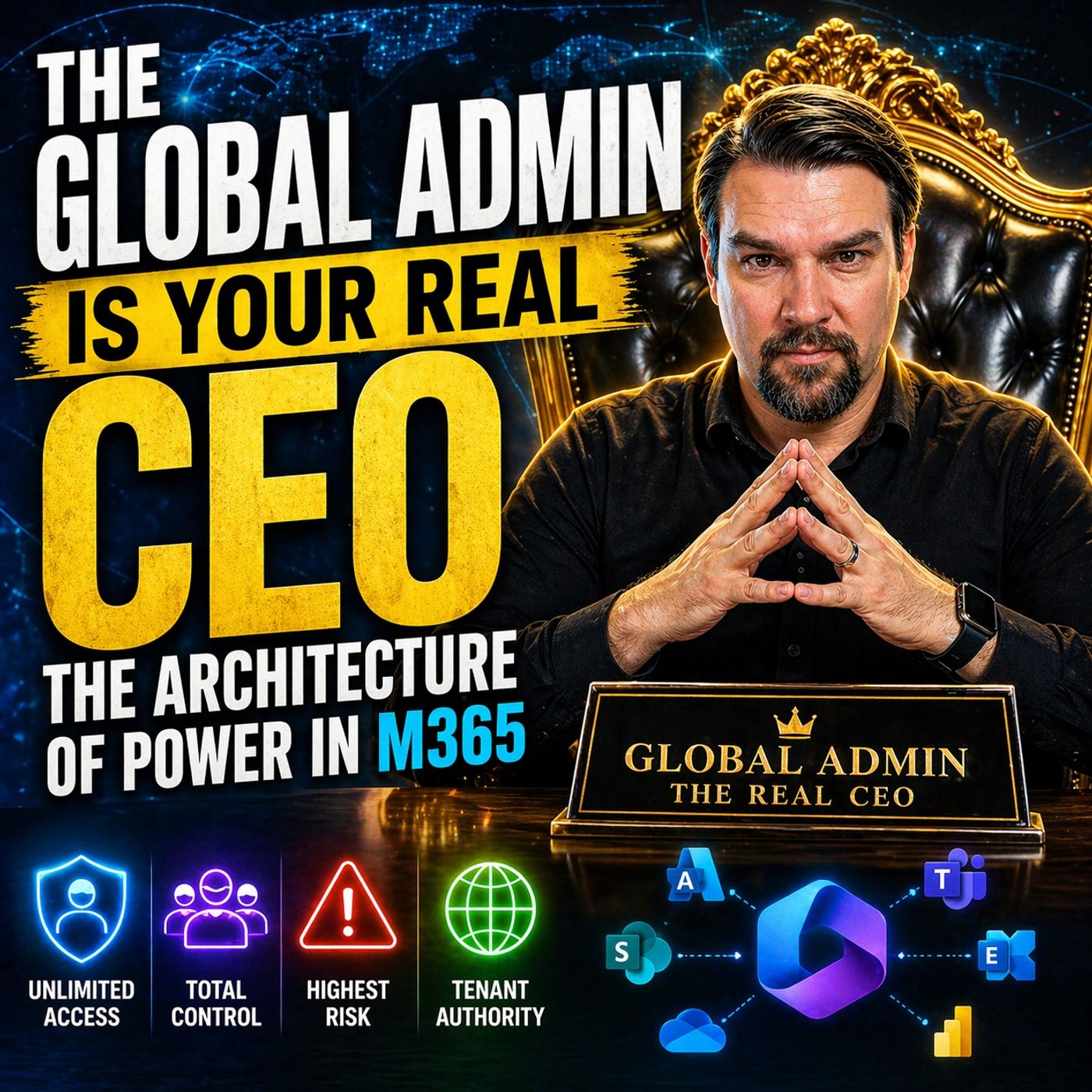
The Global Admin is Your Real CEO: The Architecture of Power in M365
from M365.FM - Modern work, security, and productivity with Microsoft 365 · host Mirko Peters - Founder of m365.fm, m365.show and m365con.net
The corner office is a psychological artifact. We associate power with titles, offices, and org charts. But in modern enterprises, authority doesn’t sit in a chair — it lives inside your Microsoft 365 tenant configuration. Your org chart is a diagram.Your permissions are reality. Executives define strategy. But nothing actually happens until someone with the right role clicks “Apply.” If the architecture says no, the mandate dies. This is the shift most organizations haven’t fully grasped yet. We’re no longer operating in a hierarchy of titles. We’re operating in a hierarchy of access.👑 THE GLOBAL ADMIN AS THE REAL CEO In Microsoft 365, power is not symbolic. It is absolute. The Global Admin role isn’t just another IT permission set. It is the highest authority inside the tenant — effectively the sovereign of your digital environment. A Global Admin can:Reset any user’s credentialsAccess any data across workloadsOverride security controlsChange tenant-wide configurations instantlyThat level of access fundamentally reshapes corporate power structures. Because the person who controls the system controls reality.⚠️ THE SHADOW LEADERSHIP PROBLEM Here’s where things start to break. Most organizations don’t have a few Global Admins. They have dozens — sometimes over 100. At that point, you don’t have governance. You have digital feudalism. Power is no longer concentrated in leadership. It’s distributed across a hidden layer of admins who can override decisions at any time. This creates a dangerous dynamic:Policies become optionalSecurity becomes negotiableExecutive decisions become reversibleAnd the people holding that power are often far removed from the boardroom.🧩 THE REAL ISSUE: CONVENIENCE OVER CONTROL The Global Admin role was designed as a break-glass emergency mechanism. Instead, it has become the default solution for convenience. Someone needs access? Assign Global Admin.Something breaks? Use Global Admin.Too complex to scope properly? Just grant Global Admin. Each shortcut weakens the architecture. Because every additional Global Admin is another person who can bypass the rules entirely.📉 THE ROLE CONCENTRATION RATIO Most organizations underestimate how concentrated their real power is. A handful of individuals — often just three or four — can override decisions affecting hundreds of managers and employees. This creates a disconnect between:Who is supposed to have authorityWho actually has controlAnd that gap is where risk lives.🔍 VIGNETTE: THE SILENT DATA EXPOSURE This is where theory turns into reality. A company prepares for a confidential merger. Leadership believes the data is locked down. Inside the tenant, an admin grants temporary access to fix a small issue. It’s meant to last minutes. It never gets reverted. Months later, sensitive merger data becomes searchable across the organization. No breach. No hack. No alert. Just a single click that outlived its intention. This isn’t a failure of people. It’s a failure of architecture. Because the system doesn’t care about intent.It only enforces permissions.🤖 COPILOT AS THE GREAT REVEALER For years, organizations relied on obscurity as a form of security. If data was hard to find, it was considered safe. That assumption is now gone. Copilot doesn’t create new access. It simply exposes existing access at scale. It removes friction and surfaces information instantly. That means:Old permission mistakes become visibleOvershared content becomes searchableHidden risks become immediate realitiesIn many tenants, the majority of data is already overshared. Copilot just makes that visible.⚡ WHY AI CHANGES EVERYTHING Before AI, discovering sensitive data required effort. Now it requires a prompt. The system no longer depends on users knowing where to look. It aggregates everything they are allowed to see — instantly. This transforms governance from a background concern into a frontline risk. If your architecture is weak, AI will expose it.🧠 THE RISE OF THE AI ADMINISTRATOR To address this shift, a new role is emerging: the AI Administrator. This role introduces a more precise model of control, moving away from the all-or-nothing power of Global Admins. AI Administrators focus on:Governing agent accessManaging consent and data exposureMonitoring AI-driven interactionsControlling how automation operates across the tenantThey act as the bridge between strategy and execution. Not just managing systems — but managing delegated intelligence.🔥 VIGNETTE: THE SECURITY POLICY OVERRIDE During an active attack, security teams deploy stricter access controls. An executive gets blocked while trying to close a deal. They escalate directly to a Global Admin. The admin disables the policy to “help.” The deal goes through. The attack continues. This is the hierarchy of the click in action. Short-term convenience overrides long-term security. And once again, the architecture defines reality — not the policy. 🔄 THE 30-DAY POWER SHIFT Fixing this doesn’t require more policies. It requires removing standing power. The transformation starts with visibility. Most organizations don’t know how many privileged roles actually exist in their tenant. Once exposed, the next step is reduction. Key actions include:Auditing all Global Admin assignmentsReducing standing privileges by 80% or moreMoving to Just-In-Time access modelsLimiting permanent Global Admins to break-glass accountsDelegating permissions with precisionThis shifts the model from centralized control to controlled distribution.🎯 FINAL TAKEAWAY: THE CLICK ALWAYS WINS We’ve built organizations around titles. But Microsoft 365 operates on permissions. That means: The person with access defines reality. Not the org chart. Not the policy. Not the mandate. If you want your strategy to survive execution, your architecture must enforce it. Because in the end, the click always beats the mandate.🔔 SUBSCRIBE & CONNECT If this changed how you think about power in Microsoft 365:Follow the podcast on Apple PodcastsLeave a review to support the showConnect with Mirko Peters on LinkedInBecome a supporter of this podcast: https://www.spreaker.com/podcast/m365-fm-modern-work-security-and-productivity-with-microsoft-365--6704921/support.
Embed this episode
What this episode covers
The corner office is a psychological artifact. We associate power with titles, offices, and org charts. But in modern enterprises, authority doesn’t sit in a chair — it lives inside your Microsoft 365 tenant configuration. Your org chart is a diagram. Your permissions are reality. Executives define strategy. But nothing actually happens until someone with the right role clicks “Apply.” If the architecture says no, the mandate dies. This is the shift most organizations haven’t fully grasped yet. We’re no longer operating in a hierarchy of titles. We’re operating in a hierarchy of access. 👑 THE GLOBAL ADMIN AS THE REAL CEO In Microsoft 365, power is not symbolic. It is absolute. The Global Admin role isn’t just another IT permission set. It is the highest authority inside the tenant — effectively the sovereign of your digital environment. A Global Admin can: Reset any user’s credentials Access any data across workloads Override security controls Change tenant-wide configurations instantly That level of access fundamentally reshapes corporate power structures. Because the person who controls the system controls reality. ⚠️ THE SHADOW LEADERSHIP PROBLEM Here’s where things start to break. Most organizations don’t have a few Global Admins. They have dozens — sometimes over 100. At that point, you don’t have governance. You have digital feudalism. Power is no longer concentrated in leadership. It’s distributed across a hidden layer of admins who can override decisions at any time. This creates a dangerous dynamic: Policies become optional Security becomes negotiable Executive decisions become reversible And the people holding that power are often far removed from the boardroom. 🧩 THE REAL ISSUE: CONVENIENCE OVER CONTROL The Global Admin role was designed as a break-glass emergency mechanism. Instead, it has become the default solution for convenience. Someone needs access? Assign Global Admin. Something breaks? Use Global Admin. Too complex to scope properly? Just grant Global Admin. Each shortcut weakens the architecture. Because every additional Global Admin is another person who can bypass the rules entirely. 📉 THE ROLE CONCENTRATION RATIO Most organizations underestimate how concentrated their real power is. A handful of individuals — often just three or four — can override decisions affecting hundreds of managers and employees. This creates a disconnect between: Who is supposed to have authority Who actually has control And that gap is where risk lives. 🔍 VIGNETTE: THE SILENT DATA EXPOSURE This is where theory turns into reality. A company prepares for a confidential merger. Leadership believes the data is locked down. Inside the tenant, an admin grants temporary access to fix a small issue. It’s meant to last minutes. It never gets reverted. Months later, sensitive merger data becomes searchable across the organization. No breach. No hack. No alert. Just a single click that outlived its intention. This isn’t a failure of people. It’s a failure of architecture. Because the system doesn’t care about intent. It only enforces permissions. 🤖 COPILOT AS THE GREAT REVEALER For years, organizations relied on obscurity as a form of security. If data was hard to find, it was considered safe. That assumption is now gone. Copilot doesn’t create new access. It simply exposes existing access at scale. It removes friction and surfaces information instantly. That means: Old permission mistakes become visible Overshared content becomes searchable Hidden risks become immediate realities In many tenants, the majority of data is already overshared. Copilot just makes that visible. ⚡ WHY AI CHANGES...
NOW PLAYING
The Global Admin is Your Real CEO: The Architecture of Power in M365
No transcript for this episode yet
Similar Episodes
No similar episodes found.
Similar Podcasts
No similar podcasts found.