
EPISODE · Feb 10, 2026 · 46 MIN
The Information Exchange: The State of the Art
from The Information Exchange · host Brendan Keeler and Pryce Ancona
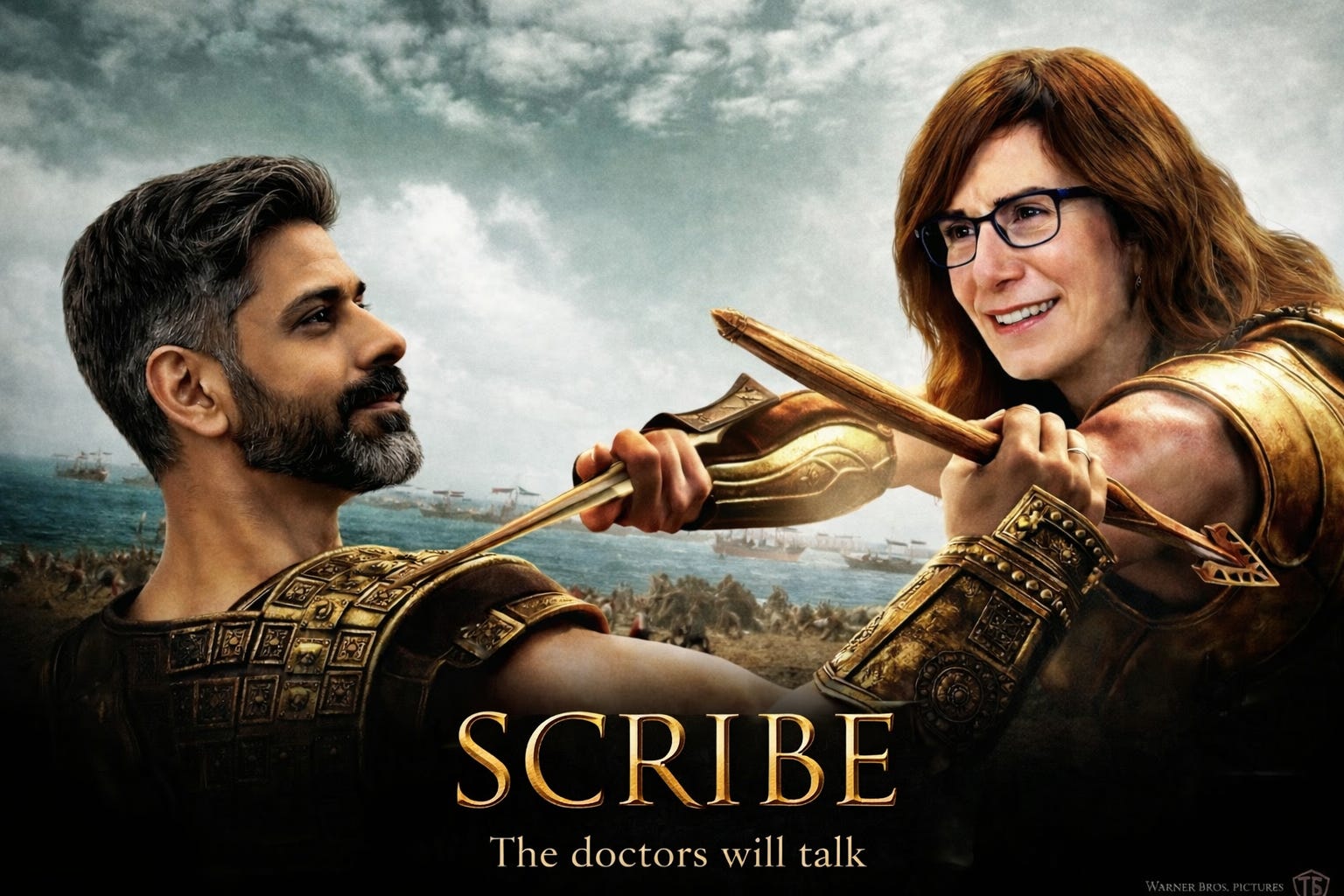
February is not slowing down. With Brad still on the road, Pryce and I announce the official name of this not-a-podcast: The Information Exchange! Shout out to Nathan from Availity for the inspiration here.Beyond that, we cover a dense run of platform moves, regulatory signals, and courtroom skirmishes that all point in the same direction: tighter competition at the core of healthcare infrastructure:* We dig into Epic’s ambient AI launch and what it means for third-party scribes,* Why USCDI v7 is a real inflection point (appointments included), despite the competitive angles of exposing future care* How imaging interoperability is finally getting regulatory attention* A look at Veeva v. Epic and what non-competes reveal about where system-of-record battles are headed.It’s the perfect plane ride fare as we all head to the ASTP Annual Meeting in DC this week. Can’t wait to see you there.Relevant Articles* The Scribe That Launched a Thousand Takes* Apple Earnings and OpenClaw by Dithering* Moats Matter Again by Travis May* USCDI v7 and the End of Incrementalism* Much Ado about Diagnostic Images* SMART Imaging Access by Josh Mandel* Veeva v. Epic: The Talent Battlefield* The Veeva v. Epic ComplaintChapters* Introduction and Announcement (0:00 - 0:24): Brendan and Pryce introduce the podcast and announce its name, “The Information Exchange.”* Weather and Personal Updates (0:24 - 0:54): Pryce talks about the weather in San Antonio and his excitement for summer.* Discussion on Epic’s Ambient Scribe (0:54 - 3:31): Pryce and Brendan discuss Epic’s release of an ambient scribe and its implications for the market.* Competition and Market Dynamics (3:31 - 5:25): They explore the competitive landscape, pricing, and the impact of Epic’s market presence.* Antitrust and Information Blocking (5:25 - 7:19): The conversation shifts to antitrust issues and information blocking laws affecting the industry.* Interoperability and Regulatory Environment (7:19 - 9:57): Brendan and Pryce discuss interoperability provisions in the US and Europe.* AI and Future of Software (9:57 - 14:15): They speculate on the future of AI in healthcare and its impact on user interfaces and systems of record.* USCDI V7 and Healthcare Data (14:15 - 24:29): The discussion covers the United States Core Data for Interoperability (USCDI) version 7 and its implications.* Diagnostic Imaging and RFI (24:29 - 39:42): They talk about the diagnostic imaging request for information (RFI) and its potential impact on healthcare.* Veeva vs. Epic Lawsuit (39:42 - 46:21): The episode concludes with a discussion on the lawsuit between Veeva and Epic regarding non-compete clauses.TranscriptWe ran the transcript through an LLM to smooth it out. So it’s a rough approximation of the conversation (and in many cases significantly clearer than our rambling), but notably diverges from the word-by-word blows quite a bit.Brendan Keeler (00:00): Alright, ladies and gentlemen, we’re back. It’s Pryce and I; Brad is out on travel again. So, the dynamic duo. We have an announcement. This thing—podcast, pseudo-podcast, not a podcast—it has a name: The Information Exchange. Thank you to everyone who submitted. Prize money will be going out shortly. But as we exchange some information here, what should we start with, Pryce?Pryce (00:30): Well, the first thing I want to tell you is that it is 83 degrees today in San Antonio. So we are back. I’m ready. I’m sorry to everyone else; they probably think I’m sad that I live in Texas, and sometimes it is, but today is Friday. I’ve got allergies because of it, but I’m thrilled and I’m excited for summer.Brendan Keeler (00:36): Don’t flex on them. There are poor people in New York or whatever that are freezing their bums off.Pryce (00:54): But you know what I am thinking about? A much colder place. A place where they just released their own ambient scribe—but don’t call it a scribe! According to Dr. Gerhart, it’s Epic’s release of Art. And I mean, it’s released. Is anyone using it already? Or was it just a press release?Brendan Keeler (01:17): Yeah, they said they’re piloting it, I think with the usual crew in the Madison area.Pryce (01:19): Okay. Group Health Cooperative? Thank you for delivering my first baby. Yeah, so that one’s really exciting for me.Brendan turned me on to a podcast from Ben Thompson and John Gruber called Dithering. It’s like 15-minute episodes, and I’ve learned a ton about FAANG companies and their distribution. This release of an ambient scribe—from the company everyone thinks has the walled garden and all the healthcare data—it begs the question: Do all other ambient scribes wither away?I think the answer is obviously not, but Epic does have distribution. Apart from functionality and integration, Epic has an MSA with every organization they’re trying to sell this to. They have the ability to make it a cheaper implementation because their system is already the source of record. Does that give them tailwinds? Yes. At the same time, everyone I know has an iPhone in their pocket and Apple Maps is way worse than Google Maps. I think with the evolution of info-blocking policy and the market, we’re going to see independent vendors be able to outperform incumbents on their own platforms.Brendan Keeler (03:34): Yeah, I see optimism. If you’re a vendor, you’re not psyched because your goal is to operate in a space where nobody else is. But guess what? That’s not real for real problems. Good problems have many solutions, and Art is another one.From a vendor perspective, you’d hope Epic doesn’t enter, but every EHR—except for maybe MEDITECH—is making their own scribe. Competition should be assumed. Information blocking means Epic better make their technologies available and not preclude competition on a technical level, or they’re going to be at risk of info-blocking. Another point is pricing: more competition means lower prices for providers, which is a positive. One manifestation of Epic behaving anti-competitively would be pricing competition out of existence, but they would be colossally stupid to do so right now.Pryce (05:33): Specifically because that is what the state of Texas is calling out in their lawsuit against Epic.Brendan Keeler (05:46): Right, so where is the bar? We know their pricing; it’s not per seat like many of these scribes. It’s a bucketed license of AI functionality added to your base Epic package. When does it become predatory? As a capitalist, I will always argue for the open market and competition leading to lower prices. It was inevitable this happened. The net result should be better for providers. It doesn’t kill these third-party scribes; they just have to keep doing the next thing.Pryce (06:49): Healthcare is unique in that our industry has info-blocking laws. Meta, Google, and Microsoft are competitive, but they release software on each other’s platforms. Do they have more levers to block each other, or are they equally scrutinized by the FTC?Brendan Keeler (07:19): They’re certainly scrutinized; all of them have active antitrust cases. Consumer technologies are different than horizontal B2B or vertical SaaS. In the US, there’s antitrust stuff, but not many interoperability provisions. In Europe, the Digital Markets Act specifically targets “gatekeepers” and says they must be interoperable and not self-preference.Pryce (07:57): Wait, hold on real quick. Brendan is telling you this is super interesting, but when he went to join this podcast, he accidentally pasted a message about a court addressing a motion to stay on February 11th. Brendan is reading court cases—he’s built different.Brendan Keeler (08:24): I’m built different! But that was about CureIS. February 11th, we’re going to get some decisions. I’ll buy the transcript and we’ll find some juicy stuff in the case against Epic.Pryce (08:28): I’ll let you read that while I do something else. I want to think about the stickiness of systems of record. Dithering mentioned this week that with the proliferation of AI, you can kind of build your own apps in an hour. Is software dying? At the end of the episode, they said systems of record are the safest because that database and the connections between thousands of tables are the most defensible. Do you feel like Epic is uniquely exposed to competition, or do they still have the best understanding of when and why doctors place orders?Brendan Keeler (09:56): It’s all EHRs. In terms of info-blocking, it affects everyone. Enterprise ones like Epic have astronomically higher switching costs and are more resilient. Travis May of Datavant had a great post saying that while systems of record can be disrupted by AI, networks can’t. You have to use existing networks like SureScripts. His thesis is “build network-based businesses.”Even in healthcare, there are extreme advantages to being the dominant vendor, but we made it fairer. With info-blocking, third parties can compete equally on a technical lens. If they are prevented, they can punch back. That’s a pro-competitive law that means you have no excuse except to be better.Pryce (12:19): It is interesting thinking about five years from now. Epic’s moat is 40 years of database work. But the user interface is what AI is going to change entirely. A doctor who is in med school right now at 22 will be 30 by the time she’s practicing. She might just be talking into space with AI software, not even looking at Epic. Maybe we’ll see Epic selling their database systems (like Texas claims they do) instead of their entire suite.Brendan Keeler (14:15): Enterprise software has always been about generalization. As you get bigger, you lose agency—the principal-agent problem. Deterministic software encodes workflows that everyone hates. Very few people like their enterprise software—Trinet, Gusto, Salesforce, Epic—because it’s not the exact workflow they want.But the cooler reality is that people will build user interfaces in a probabilistic way. I can do my thing, you do yours, and it still gets put into the system with data integrity. You see that with scribes: I dictate my workflow, you do yours, and it gets put into Epic in the right fields.Pryce (16:32): Yeah, speak French, speak Spanish—we don’t care, we’ll make sure it gets to the right location. Dithering made the point that even if everyone hates these softwares, they exist because they’re so sticky.Brendan Keeler (17:33): The other big one is that AI for software producers is moving toward marginal costs. The cost of production is rapidly decreasing. Before, Epic had to prioritize and say “I’m never building a PACS or an ERP.” Now, they can go in a lot of directions at once. It’s easier to build a third-party app, but it’s also easier for systems of record to do the “whole damn thing.” The competitive heat is turning up to 11.Pryce (19:40): I don’t like a dog-eat-dog world! Hopefully I’ll find a place to add value because I’ve got three kids to feed. Speaking of the government, we had some action this past week. USCDI V7 was proposed.The United States Core Data Set for Interoperability is referred to by many regulations saying EHRs need to make this data available via API. V7 includes appointments, which is exciting for me as a former Cadence implementer. To force EHRs to make appointment information available programmatically is great for value-based care. On the other hand, some additions like “medication status” seem so basic—how was that not in there before?Brendan Keeler (24:59): The intent is focusing on what’s ahead—the care plan. I’ve been asking “where are appointments?” since USCDI V2. To understand what needs to happen with a patient, you need to see what’s already scheduled. We’ve been in a “kumbaya” phase of data exchange because we were just transferring historic care data. As soon as you include planned appointments or labs, that’s a “value capture” moment. The cynical view is that someone might try to grab that spend, but the administration is trying to support CMS goals. They want to ship and iterate.Pryce (28:39): Right. If you’re a provider and you don’t want another entity to have access to your appointments, don’t sign a business agreement with them. This isn’t forced scope in TEFCA yet. It’s nice that patients can see their scheduled appointments.Brendan Keeler (29:53): The net good is far in excess of the risk. People ask all the time how to use FHIR to get appointments for enrollment triggers, and usually, we have to tell them to use HL7v2. There is a future where business associates can live “FHIR-only,” which isn’t the case today.Pryce (30:50): At Redox, only 5-10% of customers were not using a V2 feed or VPN. Now that it’s becoming a broader swath of forced functionality, this is fun.Brendan Keeler (31:59): Wait, we never said: what is Cadence for the audience?Pryce (32:03): Epic has names for everything. Cadence is scheduling and appointments. Prelude is registration. Shout out to my customers in North Carolina from when I worked at Epic; thanks for being patient with me when I was 21. Now, tell me about the Diagnostic Imaging RFI.Brendan Keeler (32:39): We’ve been hyper-focused on discrete data in the EHR, but every hospital has a PACS (Picture Archive and Communication System). You schedule in Cadence, do the MRI, and that high-fidelity DICOM file goes to the PACS. Most EHRs have a truce with PACS vendors like Agfa or Sectra. PACS systems are unregulated; they aren’t “certified health IT.” So, while the radiologist’s interpretation gets back to the EHR, the image itself is stuck in a “cold, dark room.”If you go to a different hospital, they can see the report but not the image. If you want to see your own images on MyChart, too bad—you have to go to the hospital and they give you a CD. This RFI is about the fact that we’ve ignored this space for too long. Dr. Keane is an interventional radiologist, so maybe it’s personal for him. They’re looking for comments on standards. Other countries, like the Netherlands, have ubiquitous image exchange.Pryce (39:53): We have one more topic: Veeva suing Epic. This one is about competition and Epic’s non-compete clause.Brendan Keeler (39:59): Veeva is essentially the “Epic of life sciences.” They sell CRM and clinical trial software to pharmaceutical companies. They are a big integrated monolith, a system of record. They decided to hire ex-Epic people in Madison. According to the allegations, Epic put Veeva on their non-compete list because they were tired of Veeva offering better salary and conditions.Epic’s non-compete used to include like 5,000 companies—even the YMCA. They trimmed it down to 20 or 30 real competitors. The question is: Is Veeva actually competing with Epic? Epic is starting to sell clinical trial management, and Veeva is selling things to providers, so there are competitive edges. Veeva has a long history of successfully going after non-competes.Pryce (44:58): Epic was a great first job for many, but Veeva is winning favor by going to bat against this.Brendan Keeler (45:36): In a pro-competitive sense, it’s good to allow talent to move to companies that offer better benefits. It allows talent to get what they’re worth. That’s why you see both liberal labor perspectives and the State of Texas attacking the non-compete.Pryce (46:12): Well, you’re a big fan of exchange—whether it’s employee exchange or information exchange. Thanks for joining. I’ve got to run. See ya.Brendan Keeler (46:35): See y’all. Get full access to Health API Guy at healthapiguy.substack.com/subscribe
NOW PLAYING
The Information Exchange: The State of the Art
No transcript for this episode yet
Similar Episodes
Mar 26, 2026 ·1m
Mar 19, 2026 ·34m
Feb 18, 2026 ·11m
Feb 11, 2026 ·45m