
EPISODE · Mar 5, 2026 · 10 MIN
The Invisible Ledger: The Hidden Opportunity Costs in India’s Welfare Spending
from The World Systems Journal · host Poornachandra Upadhya
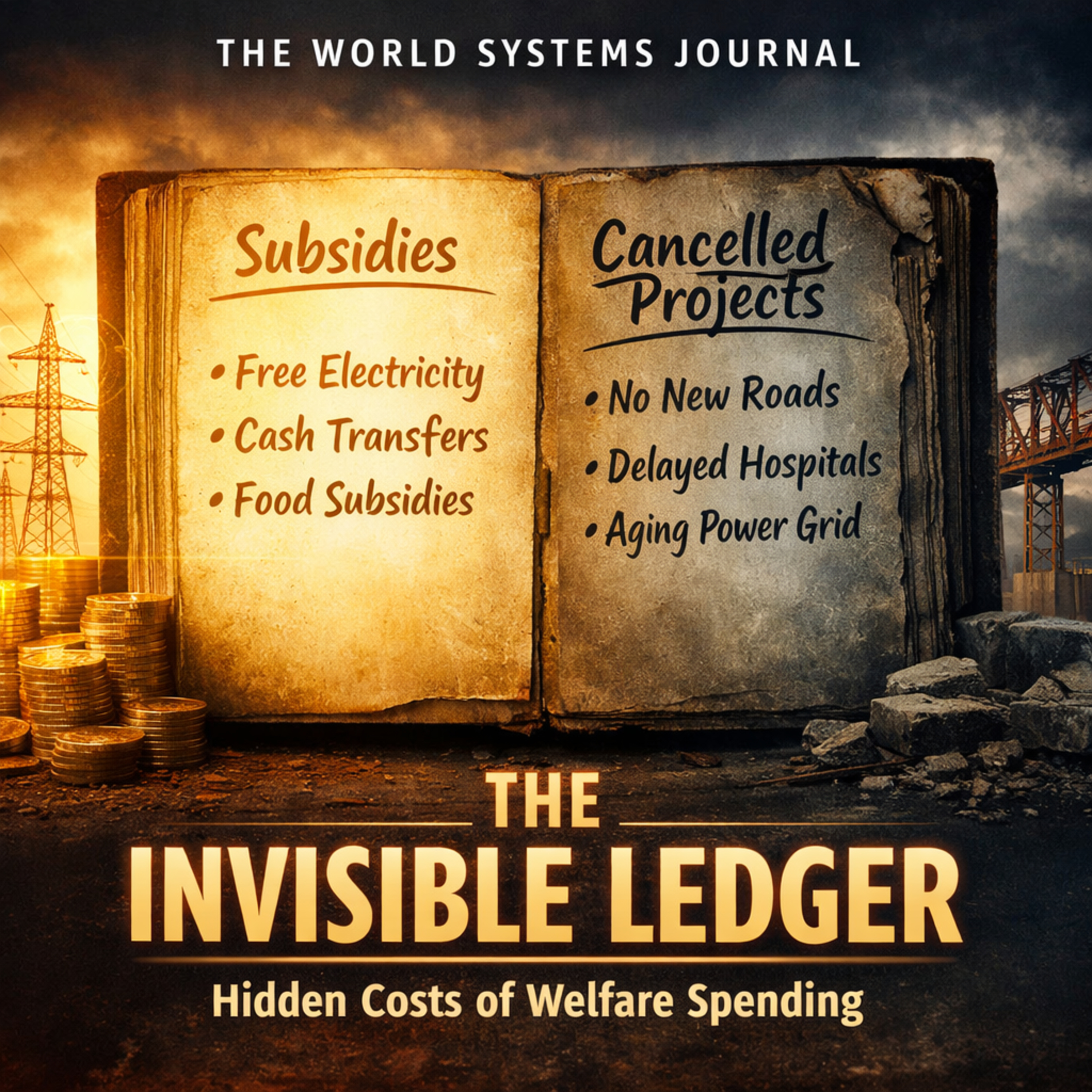
When governments announce welfare schemes, the public conversation usually focuses on what people receive.Free electricity.Cash transfers.Subsidised food.Free bus rides.But economics asks a different question.What did we give up to fund it?Every government budget operates like a ledger. One side is visible — the subsidies, transfers, and guarantees that make headlines. The other side remains largely invisible — the roads not built, infrastructure delayed, groundwater depleted, and fiscal space quietly eroded.In this episode of The World Systems Journal, Poornachandra Upadhya explores the hidden opportunity costs in welfare spending, using real examples from India and around the world.You will hear about:• How free electricity policies can unintentionally accelerate groundwater depletion and financial stress in power distribution systems• Why economists distinguish between revenue expenditure and capital expenditure — and why that difference matters for long-term growth• The capex squeeze faced by Indian states when welfare commitments crowd out infrastructure investment• How fiscal choices can quietly accumulate risks until they explode — as seen in the Sri Lankan economic crisis• The policy trade-off between access and quality, illustrated through Egypt’s bread subsidy dilemma• Why incentives, margins, and unintended consequences are central to good policy designThe episode introduces a simple mental model called “The Invisible Ledger.”For every rupee spent on a subsidy, there is something else that never gets funded.The hospital expansion that never began.The drainage project postponed.The power grid that was never upgraded.Learning to see these hidden trade-offs is one of the most powerful tools in economic reasoning.This conversation is not about being pro-welfare or anti-welfare.It is about asking better questions.Questions like:Which project was cancelled to fund this scheme?Is consumption today crowding out investment tomorrow?What incentives does this policy create?And who ultimately pays the long-term cost?If you want to understand how public spending decisions shape the future of an economy, this episode will help you learn to read what most budgets never show — the invisible side of the ledger.🎧 The World Systems Journal explores systems thinking, public policy, economics, and technology — through calm analysis rather than outrage.
What this episode covers
When governments announce welfare schemes, the public conversation usually focuses on what people receive.Free electricity.Cash transfers.Subsidised food.Free bus rides.But economics asks a different question.What did we give up to fund it?Every government budget operates like a ledger. One side is visible — the subsidies, transfers, and guarantees that make headlines. The other side remains largely invisible — the roads not built, infrastructure delayed, groundwater depleted, and fiscal space quietly eroded.In this episode of The World Systems Journal, Poornachandra Upadhya explores the hidden opportunity costs in welfare spending, using real examples from India and around the world.You will hear about:• How free electricity policies can unintentionally accelerate groundwater depletion and financial stress in power distribution systems• Why economists distinguish between revenue expenditure and capital expenditure — and why that difference matters for long-term growth• The capex squeeze faced by Indian states when welfare commitments crowd out infrastructure investment• How fiscal choices can quietly accumulate risks until they explode — as seen in the Sri Lankan economic crisis• The policy trade-off between access and quality, illustrated through Egypt’s bread subsidy dilemma• Why incentives, margins, and unintended consequences are central to good policy designThe episode introduces a simple mental model called “The Invisible Ledger.”For every rupee spent on a subsidy, there is something else that never gets funded.The hospital expansion that never began.The drainage project postponed.The power grid that was never upgraded.Learning to see these hidden trade-offs is one of the most powerful tools in economic reasoning.This conversation is not about being pro-welfare or anti-welfare.It is about asking better questions.Questions like:Which project was cancelled to fund this scheme?Is consumption today crowding out investment tomorrow?What incentives does this policy create?And who ultimately pays the long-term cost?If you want to understand how public spending decisions shape the future of an economy, this episode will help you learn to read what most budgets never show — the invisible side of the ledger.🎧 The World Systems Journal explores systems thinking, public policy, economics, and technology — through calm analysis rather than outrage.
NOW PLAYING
The Invisible Ledger: The Hidden Opportunity Costs in India’s Welfare Spending
No transcript for this episode yet
Similar Episodes
No similar episodes found.
Similar Podcasts
No similar podcasts found.