
EPISODE · Jun 9, 2025 · 4 MIN
The Myth of the “First World Problem”
from Carl's Mind Chimes Magazine Podcasts · host Carl Cimini
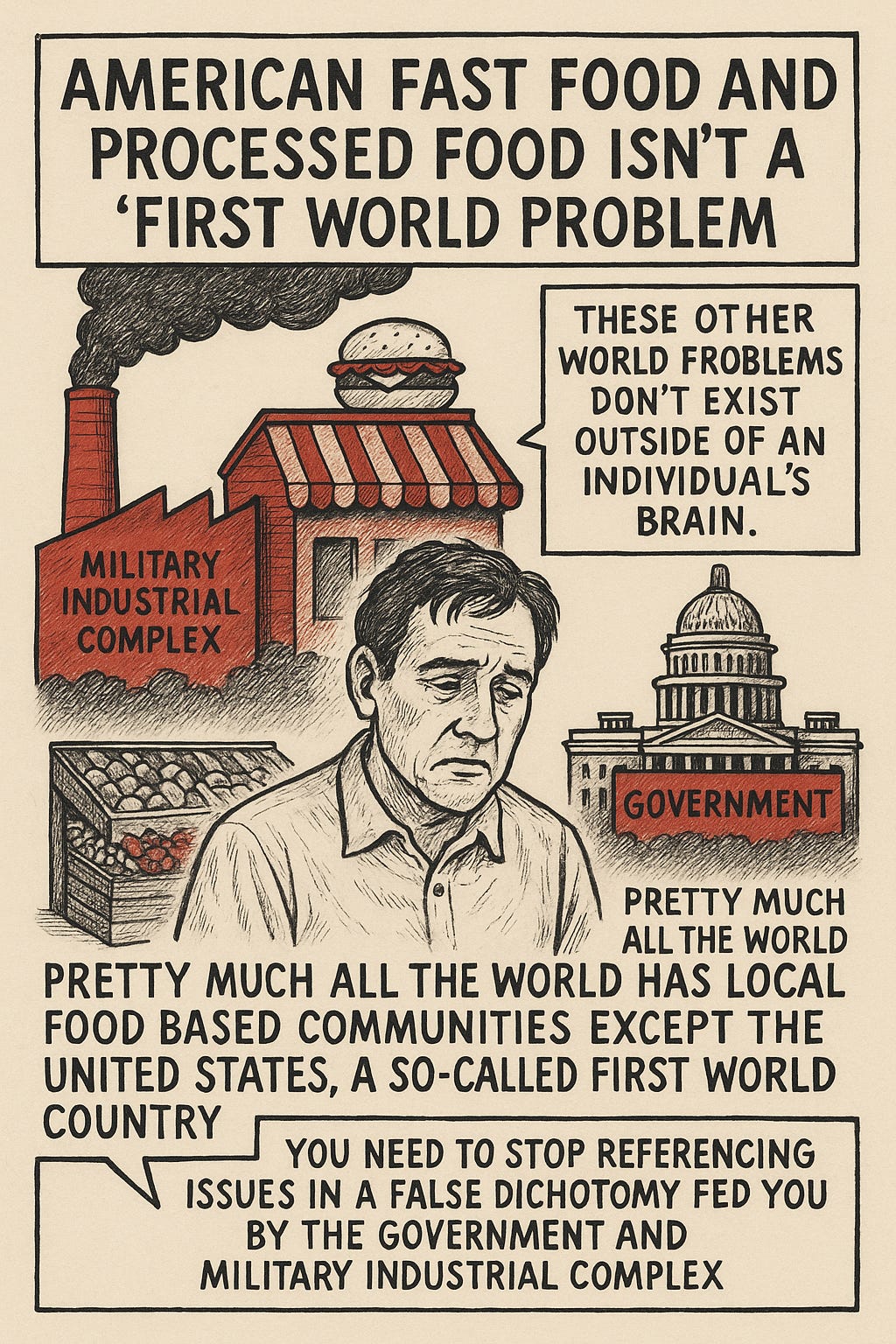
By Carl Cimini –You’ve heard it muttered with smug self-effacement, a sneering apology disguised as a joke: “I know, I know, first world problems.”It’s a phrase that aims to check privilege, to acknowledge the vast disparities of global suffering—yet it often does the opposite. It sterilizes pain, isolates distress, and enshrines a false hierarchy of trauma. Most insidiously, it conceals the structural rot at the heart of the so-called “First World,” a term as outdated and ideological as the Cold War that birthed it.At its core, the “first world problem” label is an anesthetic. It numbs inquiry. It implies that our pain is self-inflicted, unserious, or worse—imaginary.But what if the inverse is true?What if so many “first world problems” are actually engineered problems—deliberate products of the Military-Industrial-Food-Agribusiness-Government Complex—wreaking real, measurable harm on American bodies and communities?Let’s begin with food.The United States, unlike almost every other culture on Earth, has no robust local food tradition. Not anymore.It has drive-thrus.It has dollar menus.It has deep-fried isolation packaged in styrofoam, flavored with sugar, salt, and surveillance.Across much of the world, communities still gather around ancestral dishes, ingredients passed down, grown in soil known to their lineage. Whether it's a Sardinian sheep cheese or a Kenyan ugali or a Vietnamese pho—these are not just meals, they are memory, community, continuity. In America? We’ve industrialized nourishment into product. In the name of freedom, we’ve outsourced our sustenance to profit-driven conglomerates more interested in shelf stability than nutritional stability.The result?We are a nation obese and malnourished at once, sick with preventable diseases, addicted to foodlike substances engineered for compulsive consumption. And then we’re told—implicitly and explicitly—that our suffering isn’t real. That it’s just a “first world problem.”But consider: is the child developing fatty liver disease at 12 from ultra-processed school lunches suffering a false dilemma?Is the grieving mother watching her community hollowed out by diabetes and addiction in a food desert the victim of her own imagination?Or is she, perhaps, a casualty of a war declared not with bombs but with branding?The “first world problem” trope collapses global complexity into a patronizing binary—where those in the Global North are only allowed existential woes, and those in the Global South are granted the dignity of material suffering. But the line between the two is a fiction—convenient for governments and corporations that profit off both war and peace, both famine and feast.And who constructed this myth?The very institutions that reap profit from keeping Americans dependent, fragmented, pacified.The Military-Industrial Complex taught us that foreign bombs were our patriotic duty.The Food-Industrial Complex taught us that self-inflicted poison was our personal failure.The Surveillance Capitalists taught us that our unhappiness was a market opportunity.All of them work in tandem, constructing a new kind of empire: not territorial, but neurological.This isn't conspiracy. It’s capitalism with a flag and a lab coat.And yet we joke, “first world problem,” when the pain is real—just unseen, undignified, unacknowledged.So what’s the way forward?We must retire the phrase—stop apologizing for noticing we are unwell. Start seeing the American condition not as an embarrassing inconvenience, but as an indictment of the systems we’ve been told are modernity’s triumphs.We must rebuild food sovereignty—reclaim localism not as a quaint hobby, but as a radical act of autonomy.We must demand a politics of dignity—one that refuses to rank suffering in colonial terms, and instead centers the human experience over the imperial logic of economic zones.Because here's the deeper truth:There are no “first world” or “third world” problems. There is only the human problem, and whether or not we choose to treat it with compassion, connection, and care.After all, if “first world” means a place where food makes you sick, community is algorithmic, and suffering is mocked as privilege—maybe we ought to rethink the map entirely.“To forget how to dig the earth and tend the soil is to forget ourselves.”— Mahatma GandhiCarl’s Mind Chimes Magazine is a reader-supported publication. To receive new posts and support my work, consider becoming a free or paid subscriber. This is a public episode. If you'd like to discuss this with other subscribers or get access to bonus episodes, visit mindchimesmagazine.substack.com/subscribe
NOW PLAYING
The Myth of the “First World Problem”
No transcript for this episode yet
Similar Episodes
No similar episodes found.
Similar Podcasts
No similar podcasts found.