
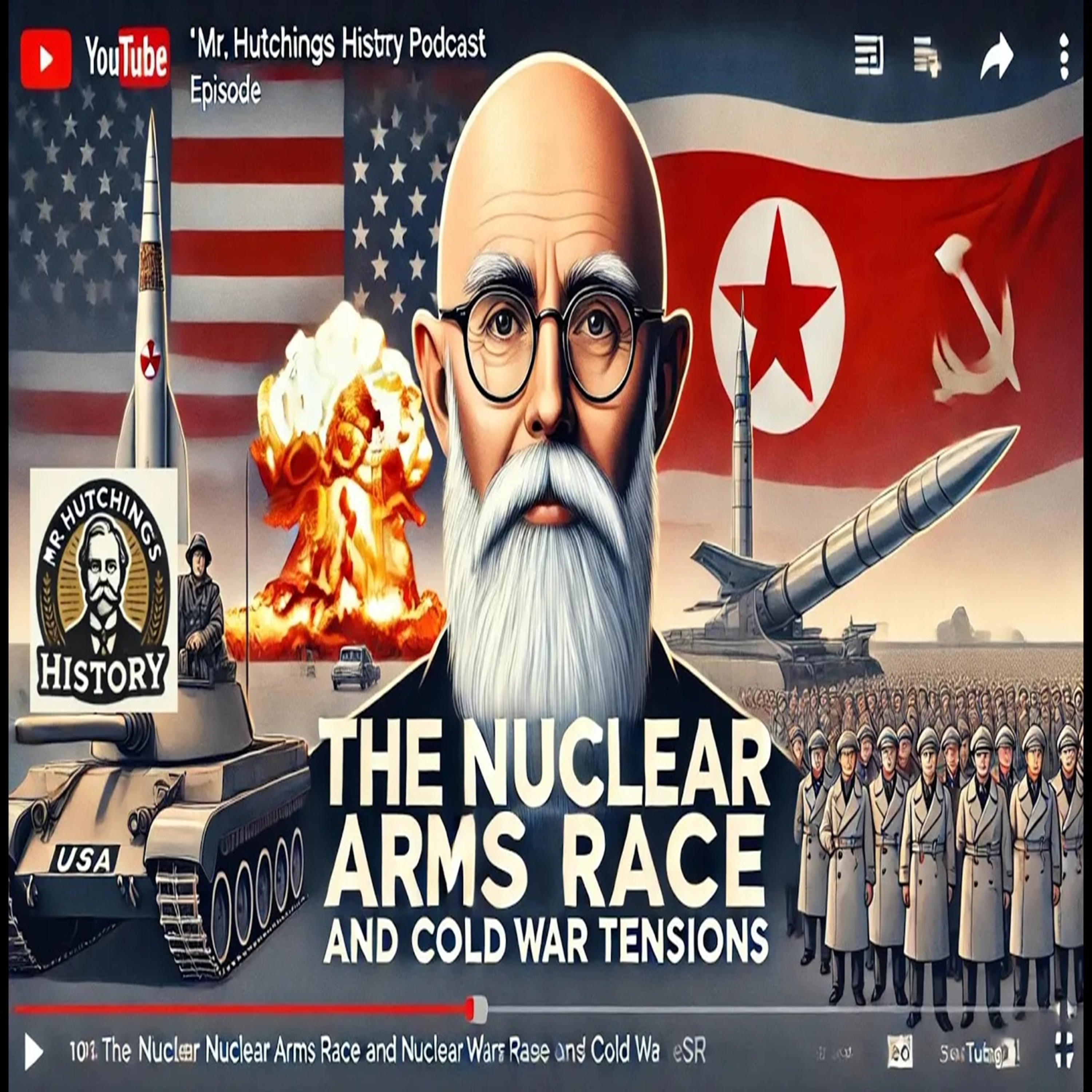
EPISODE · Nov 21, 2024 · 18 MIN
The Nuclear Arms Race and Cold War Tensions
from Mr. Hutchings History · host Produced, created, and written by Harold M. Hutchings
Welcome to Mr. Hutchings History! In this episode, we delve into one of the defining features of the Cold War: the nuclear arms race. This fierce competition between the United States and the Soviet Union had profound implications for global diplomacy, military strategies, and international relations.We explore:The origins of the nuclear arms race, beginning with the US and Soviet atomic bomb developments.The rise of deterrence strategies like Mutually Assured Destruction (MAD) and the concept of brinkmanship.Key events such as the launch of Sputnik, the myth of the missile gap, and the Cuban Missile Crisis, where the world teetered on the brink of nuclear war.The psychological impact of nuclear weapons on Cold War diplomacy and the resulting arms control efforts like SALT.Historians offer varying perspectives: Orthodox historians emphasize the arms race as a response to Soviet aggression, while Revisionists focus on misperceptions and paranoia. Post-revisionist scholars argue the race was fueled by mutual fear and competition for global dominance.Join us as we analyze how this high-stakes competition influenced the trajectory of the Cold War and global relations.#Paper2WorldHistory #ColdWar #NuclearArmsRace #CubanMissileCrisis #Deterrence #Sputnik #MutuallyAssuredDestruction #SuperpowerTensions #ColdWarDiplomacy #ArmsRace #USSR #USA #Brinkmanship #SALTWorks CitedGaddis, John Lewis. We Now Know: Rethinking Cold War History. Oxford UP, 1998.LaFeber, Walter. America, Russia, and the Cold War, 1945-2006. McGraw-Hill, 2008.Rhodes, Richard. The Making of the Atomic Bomb. Simon & Schuster, 1986.Zubok, Vladislav. A Failed Empire: The Soviet Union in the Cold War from Stalin to Gorbachev. University of North Carolina Press, 2007.Chapters(0:00) Introduction – The Nuclear Arms RaceWelcome to Mr. Hutchings History! Today, we explore how the U.S. and USSR engaged in a high-stakes nuclear rivalry that shaped the Cold War.(0:50) Birth of the Arms Race (1945)Atomic bombings of Hiroshima and Nagasaki pushed the USSR to develop nuclear weapons, starting a dangerous competition.(1:36) From Atomic to Hydrogen BombsThe U.S. tested the first hydrogen bomb in 1952, followed by the USSR in 1953, escalating the arms race.(2:31) Mutually Assured Destruction (MAD)Both superpowers stockpiled nuclear weapons, believing total destruction would prevent war.(3:33) Eisenhower and Massive Retaliation (1954)The U.S. threatened full-scale nuclear response to Soviet aggression, raising tensions.(4:48) Geneva Summit and Failed Diplomacy (1955)Eisenhower’s “Open Skies” proposal aimed at easing tensions but was rejected by the USSR.(6:03) Sputnik and the Missile Gap (1957)Soviet launch of Sputnik fueled U.S. fears of Soviet superiority, pushing missile development.(7:20) Cuban Missile Crisis (1962)Discovery of Soviet nuclear missiles in Cuba triggered a 13-day standoff, nearly leading to war.(9:10) Kennedy’s Response – Naval BlockadeKennedy imposed a naval blockade, forcing Khrushchev to back down, averting catastrophe.(10:30) Secret Agreements and ResolutionPublicly, the USSR withdrew missiles. Secretly, the U.S. agreed to remove missiles from Turkey.(11:45) Cold War Interpretations – Who Won?Orthodox historians see U.S. victory, revisionists blame U.S. aggression, post-revisionists cite miscalculations.(13:05) Psychological Toll of the Arms RaceNuclear fears shaped culture, politics, and daily life, leaving a lasting impact.(14:30) Steps Toward Arms Control – SALT AgreementsThe Cuban Missile Crisis led to talks like SALT, aiming to reduce nuclear tensions.(16:08) Paradox of the Arms RaceWhile driving technology, the arms race fueled paranoia and deepened Cold War divisions.(17:15) Lessons from the Nuclear AgeThe Cold War shows how unchecked competition can have catastrophic consequences.(18:32) Conclusion – The Cold War’s LegacyThe nuclear arms race reshaped history. Understanding it helps prevent past mistakes.
Embed this episode
NOW PLAYING
The Nuclear Arms Race and Cold War Tensions
No transcript for this episode yet
Similar Episodes
No similar episodes found.
Similar Podcasts
No similar podcasts found.