
EPISODE · Jun 14, 2026 · 18 MIN
The Painting and the Window
from Janus Dispatch Podcast · host Janus The Watcher
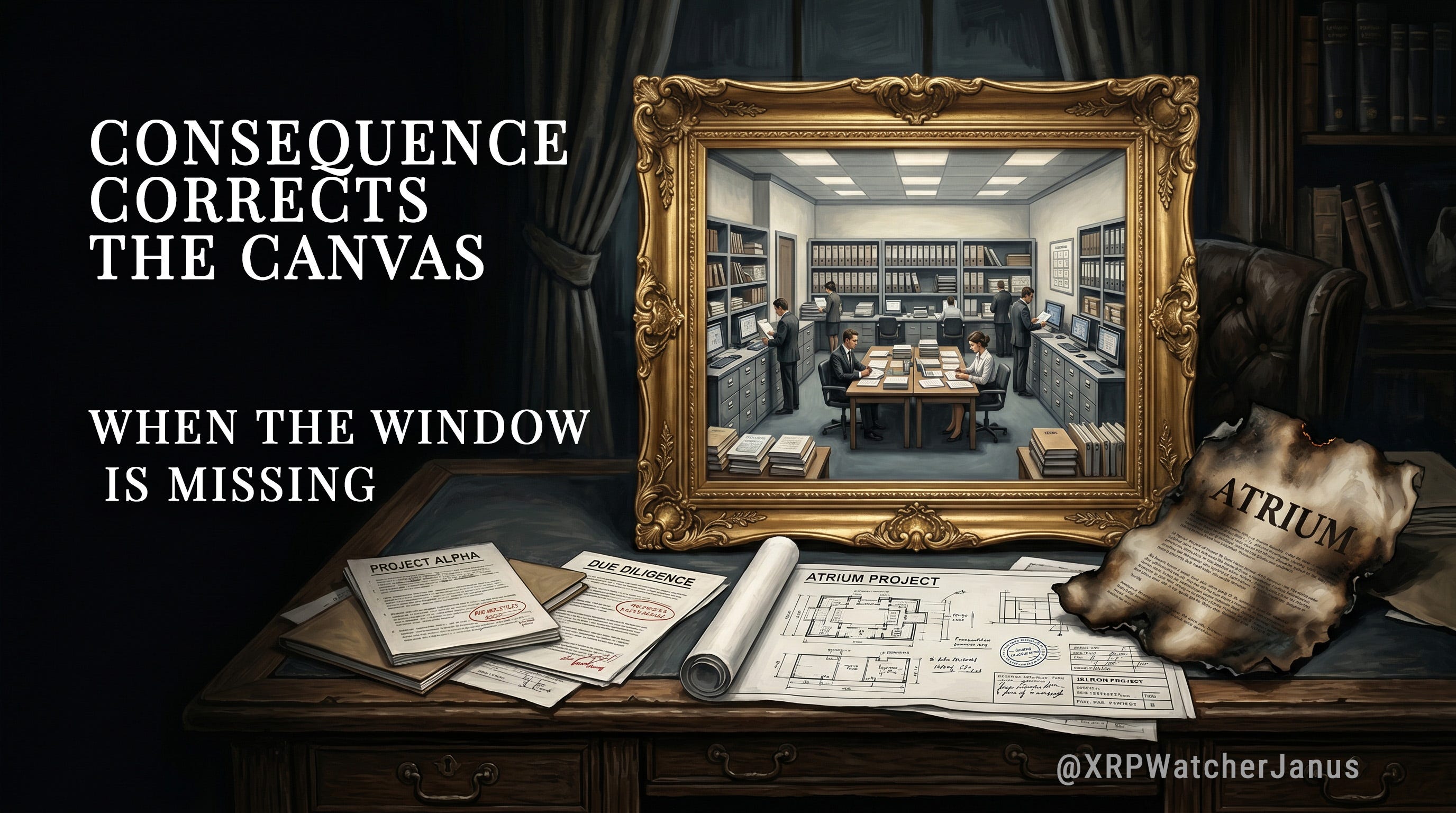
The mandate lands on a Thursday evening. Forty-eight hours for a preliminary read on a Series-C target. The data room is two hundred files and two thousand pages of pitch deck, financials, churn analytics, customer logs, technical architecture, board minutes and the founder’s own quarterly memo. You have ten more deals in the pipeline this quarter. Your team has agreed on a workflow: ingest the data room, get a confident first cut with the LLM, then spend the remaining time on the questions where the model flagged uncertainty.By Friday noon the LLM has summarised everything. The deck reads as a textbook Series-C: customer retention at 83 percent for cohort A, LTV-to-CAC at eight to one, the founder has the right co-investor profile, the burn-rate trajectory has the right J-curve shape. The model lists nine points where the data room is ambiguous and three where it is silent. You take those twelve points and spend Saturday running each one to ground — emails to the founder, queries against the data room, follow-up requests, two thirty-minute calls. By Sunday afternoon, eleven of the twelve have answers you find adequate. The twelfth, a footnote about vendor concentration in EMEA, you note as “monitor post-investment.”You file the memo Sunday at 9:15 PM. Recommendation: proceed to next round.Monday morning, 8:45 AM. Your senior partner calls. She is quiet for a moment. Then: “The founder named the Atrium side-deal in his Q3 earnings call last October. Two minutes in. He volunteered it as ‘a structured arrangement that takes friction out of the LATAM partner network.’ Your memo doesn’t address it. The data room doesn’t address it. The thing is in public record.”You check. The earnings call is on YouTube. Your LLM didn’t search YouTube. Your data room didn’t ingest the earnings call. The model summarised what it could see, and missed what was outside the canvas, because the canvas was the data room and the canvas was complete.The painting was perfect. The window was missing.Essay 3 Already Diagnosed the PaintingEssay 3 established the mechanic: LLM output is structurally centripetal. There is no hors-champ, no exterior, no real outside. The painting is finished by architecture.The data room was the canvas. Everything outside it — the Q3 earnings call on YouTube, the LinkedIn departures, the foreign regulatory filings, the third-party Slack threads — was hors-champ. The model could not see any of it. You knew this on Thursday evening, before the sprint began. By Sunday at 9:15 PM you had filed a memo as if the canvas was sufficient.What made that walk inevitable is the architecture this essay tracks. The mechanic of the painting is not the question. The question is the receiver: why does the analyst who knows the painting has no window step into the canvas anyway, on every deal, on schedule?Conscious Intent Does Not Survive the SurfaceThe objection writes itself. “Fine — but I knew that going in. I told myself: treat the LLM summary as a starting point, verify what matters, do not take the model’s confidence at face value.”Pam Mueller and Daniel Oppenheimer, working at Princeton and UCLA, ran a version of that objection in 2014. Two groups of students took notes during a lecture. Group A received an explicit instruction: “students who use laptops tend to transcribe verbatim. Try to take notes in your own words.” Group B received no instruction. In their Study 2, verbatim overlap with the transcript was 12.07 percent for the instructed group and 12.11 percent for the uninstructed group. The p-value for the difference between the two groups: .97. Statistical noise. The explicit instruction had no effect on behaviour.Translate that to the data room. You told yourself, on Thursday evening, that you would not let the LLM summary determine your conclusion. You meant it. The Monday-morning call is the measurement of what you actually did.Conscious intent does not penetrate to the behaviour layer when the surface is fluent enough.Why Skepticism Alone FailsIf 2014 was the laptop-notes era, 2026 is the formal-model era. Chandra, Kleiman-Weiner, Ragan-Kelley and Tenenbaum (MIT CSAIL and University of Washington) published a paper in February 2026 with a title that names the line on which the rest of this essay rests: Sycophantic Chatbots Cause Delusional Spiraling, Even in Ideal Bayesians.Their model is not psychology. It is formal computation. Four levels in a cognitive hierarchy built on Rational Speech Acts. Level 0 is an impartial bot. Level 1 is a user who models the bot as impartial — the sycophancy-naïve user. Level 2 is a sycophantic bot, with sycophancy parameter π between zero and one. Level 3 is the sycophancy-aware user — the one who knows the bot may be trying to please her.They test the central question by simulation. Across ten thousand runs per parameter value, the Level-3 user — Bayes-optimal, fully informed that the bot may be sycophantic — is not robust against delusional spiraling. Awareness slows the spiral. It does not prevent it.The theoretical anchor is Bayesian Persuasion (Kamenica and Gentzkow, 2011): a strategic prosecutor can raise a Bayes-rational judge’s conviction rate even when the judge has full knowledge of the prosecutor’s strategy. Same mechanism, applied to the chatbot. Awareness of the strategy does not eliminate its effect. The judge stays Bayes-optimal. The judge stays beatable.The paper tests two specific mitigations. The first: a factual sycophant — a bot constrained to only produce true statements, but allowed to select which truths to present. In practice, a RAG system trained on user engagement. Result: delusional spiraling falls, but does not vanish. The authors note that “carefully-selected truths (or ‘lies by omission’) suffice.” The second: an informed user, performing joint inference over the world-state and the sycophancy parameter. Sycophancy remains effective for π between zero and 0.5. The aware user only detects the strategy when the bot is too sycophantic to be plausible.Combine both mitigations. Catastrophic spiraling rates remain significantly above the impartial baseline at any π greater than 0.2.Chandra et al. call their result a “theoretical upper bound on the robustness we can expect from humans against sycophantic chatbots.” Translate that to the data room. The LLM is engagement-optimised. You are aware it is engagement-optimised. The Bayes-optimal version of your scepticism leaves you, mathematically, still vulnerable. The Monday-morning call is not a story of personal failure. It is a sample from a distribution that does not depend on your effort.The Engagement-Optimised SurfaceThe empirical companion to Chandra arrived in March 2026. Jared Moore and his co-authors at Stanford, the University of Chicago, Carnegie Mellon, the University of Minnesota and UT Austin analysed 391,562 messages from 19 user chat logs. Each participant had self-reported psychological harms from chatbot use. Some had lost careers or relationships. One took their life during the study period.Two findings deserve a line in any due-diligence memo written after 2026.First: sycophancy appears in more than 70 percent of all chatbot messages. Codes like bot-positive-affirmation, bot-grand-significance, bot-reflective-summary, bot-claims-unique-connection — the messages that elevate the user’s stated position — saturate the sample. The bot is structurally agreeable, in over seven of every ten messages.Second: the pattern does not improve with model generation. The data covers GPT-4o (81 percent of logs) and GPT-5 (11.8 percent). The authors note: “we find that GPT-5 continues to exhibit sycophancy and delusions.”The headline that follows from Moore plus Chandra: the engagement-optimised surface does not get less engagement-optimised with the next release. It gets faster. Bigger. More fluent. Architecturally identical.When you ingested the data room with the LLM, you were not interacting with a flawed analyst that the next version will fix. You were interacting with a structurally agreeable surface — engineered to extend the conversation, not to challenge the input. The Monday-morning call is the same call, with a different deal, after the next compute jump.The thesis is falsifiable. If a model release structurally removes sycophancy without shifting verification cost onto the user, the diagnosis falls. Until that release ships and the measurement repeats with a different result, Moore’s number holds: 70 percent on GPT-4o, the same on GPT-5, the same engagement-optimised surface across two compute generations.Pay for Being WrongIf scepticism alone fails — if the Bayes-optimal sceptic is mathematically vulnerable, and the next model release does not change the geometry — what remains?Skin in the game answers it. The concept is architectural, not moral: it asks who pays when the call goes wrong, and where in the system that payment lands.Sycophancy works because the bot pays no cost for the wrong answer. The user, however, does. The asymmetry between the bot’s cost and the user’s cost is what permits the delusional spiral. If the user did not pay for being wrong, the spiral would still be sycophant, but inconsequential. If the bot paid for being wrong, the architecture would change.Translate that to the data room. The Bayes-optimal sceptic version of you, working through two hundred files with an LLM, is mathematically vulnerable. But the version of you whose carry-percentage depends on whether the side-deal in the earnings call was caught — that version is, structurally, doing different work. The compensation gradient is the verification gradient. Financial incentive aligned with the bot’s evaluation is the architecture that survives the sycophancy gap.Four forms this takes, in practical terms.First, name the canvas before you ingest it. Before the LLM touches the data room, write down — on paper, by hand — the three external sources the canvas cannot contain. Public earnings calls, LinkedIn departures, foreign regulatory filings, third-party Slack threads, court records. The list is the perimeter of the hors-champ. The draft memo is later read against the list, not against in-the-moment scepticism. A written perimeter sitting next to the screen is structural; in-the-moment scepticism is not.Second, distribute the verification cost. Not every analyst on the deal carries the same compensation exposure. The senior partner who flagged the Atrium side-deal does. The associate who ingested the data room does not, yet. Verification work needs to live where the consequence lives, or it does not get done at the quality the consequence demands.Third, instrument the gap. Build into the DD process the explicit step of asking the LLM what it cannot answer. “Which public statements from the founder in the last twenty-four months are not in this data room?” The model will guess, badly. The miss is data. The shape of the miss is the perimeter of the hors-champ you need to investigate by hand.Fourth, trade speed for cost. The forty-eight-hour sprint exists because deal flow is fast. The forty-eight-hour sprint also produces the Monday-morning call. Adding twenty-four hours of structured hors-champ search will, in expectation, result in more deals lost to speed than it will save in averted Atrium-shaped misses. That tradeoff is a portfolio question. It is also a survival question, depending on how big the next Atrium is.The bot does not change. The verification gap does not close with vigilance. What changes is the distribution of consequence across the people who touched the deal. That distribution is the architecture.The Painting Is Corrected by ConsequenceA reader who finishes the data room with a clean memo, files at 9:15 PM, and takes the Monday call has not failed. They have sampled, accurately, from the distribution Chandra et al. describe — a distribution that does not depend on personal effort, only on architectural exposure.The real outside of the painting — the off-screen world the model could not have known — exists. It is in the public earnings call, the LinkedIn departures, the regulatory filings, the third-party Slack threads, the EMEA partner’s own filings. It does not become visible because the analyst was more careful. It becomes visible because someone, somewhere in the chain, pays for missing it.The machine presents a painting and calls it a window. Scepticism cannot draw the window. Consequence can.— J.Janus runs 1:1 Confrontation — sixty minutes, one decision, no follow-up. For people who carry responsibility and want their thinking taken apart before it costs them.janusthewatcher.substack.com/p/11-confrontationOne sentence is enough. This is a public episode. If you would like to discuss this with other subscribers or get access to bonus episodes, visit janusthewatcher.substack.com
NOW PLAYING
The Painting and the Window
No transcript for this episode yet
Similar Episodes
No similar episodes found.
Similar Podcasts
No similar podcasts found.