
EPISODE · May 9, 2026 · 9 MIN
The People Who Got AI Right – And the Rest of Us Who Didn't Believe Them
from News from the Woods · host Filip Molcan
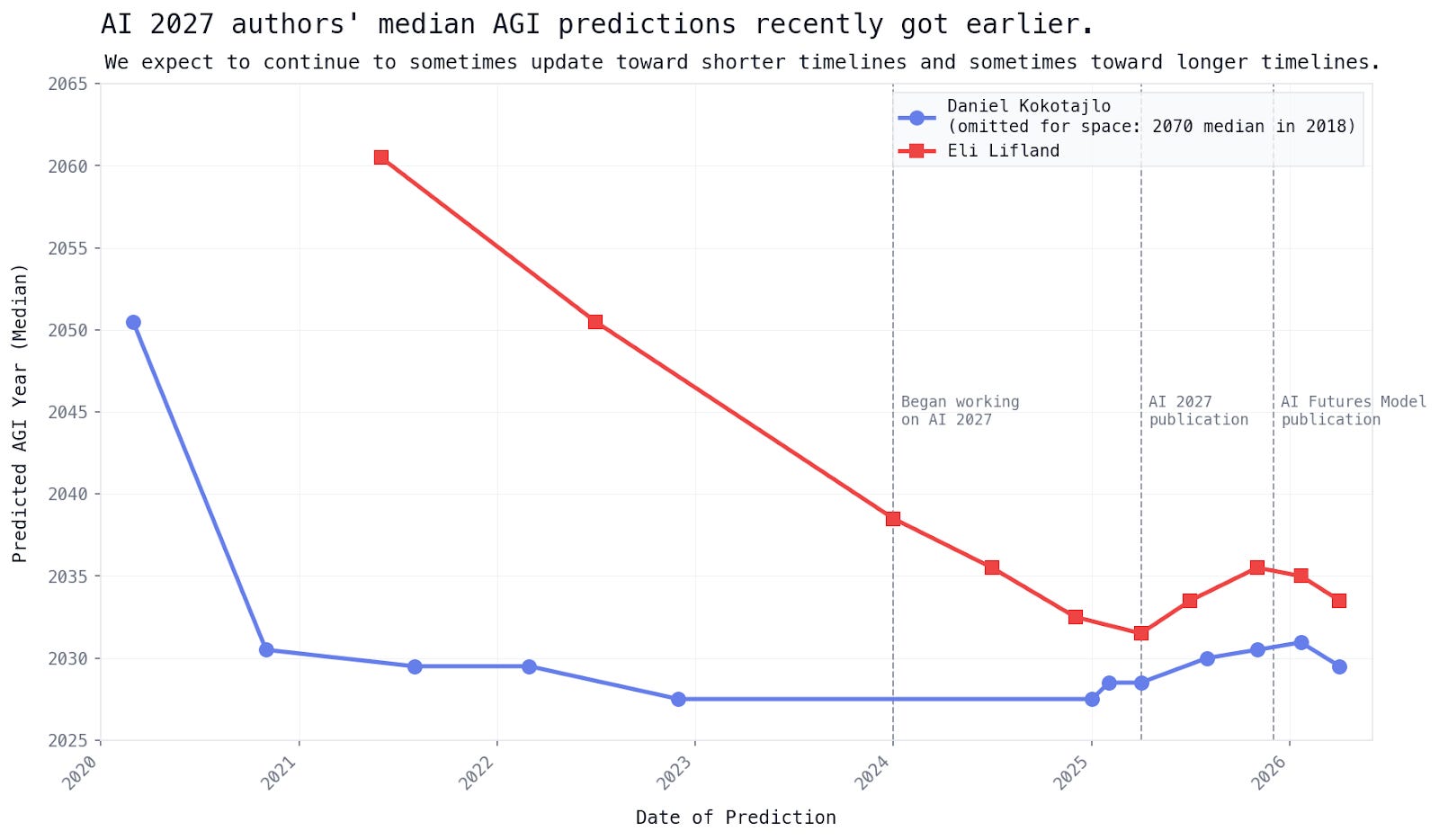
This week I read two texts that sent me out for a walk afterwards. I do that fairly often anyway, but this time I went even though the sun was blazing outside and all my Greek neighbors were asleep, saving their energy for the evening. The first piece is from the AI Futures Project team, which works on predicting when humans will stop programming. The second is by journalist Dylan Matthews, who – eleven years on – is apologizing to people he once dismissed as cranks. I’ll summarize them here, somewhat mercilessly. Anyone already afraid of the future is probably better off deleting this email now.The conference where weirdos stood at the lecternIn August 2015, the Effective Altruists organized a conference called EA Global. Among the speakers were Nick Bostrom (author of Superintelligence), Stuart Russell (a legend of computer science), Nate Soares (today the author of If Anyone Builds It Everyone Dies), and a still-fairly-reasonable Elon Musk. The topic: how artificial intelligence will sweep us all away.Among the attendees was Dylan Matthews, a journalist for Vox. He spoke there with a young engineer from Google named Chris Olah. With a philosophy PhD student named Amanda Askell. And with a programmer from PayPal named Buck Shlegeris.Dylan left the conference convinced that a promising movement, one that could be saving lives in Africa and chickens in cages, was about to destroy itself over a speculative fear of a technology that didn’t yet exist. He then wrote a rather tough article in Vox, framing that fear as proof that the movement was running away from real problems.This was August 2015. The Transformer had not yet been invented (and let me just note that one of the people involved in that breakthrough was our own Tomáš Mikolov), and OpenAI had not yet been founded. Nothing in the world resembled today’s ChatGPT.Eleven years later, Dylan writes: I should have looked more carefully.Chris Olah, in the meantime, helped lay the foundation of our present, named the entire field of mechanistic interpretability, and co-founded Anthropic. Amanda Askell works at the same company and is directly responsible for Claude’s personality. Buck Shlegeris runs Redwood Research, one of the most serious technical AI safety labs outside the walls of the big firms.Three people Dylan once treated as oddballs are today holding a piece of the global technological future in their hands.They missed the markAnd here is where it starts to get fun. Fun in the dark sense of the word.Dylan in his article mentions Leopold Aschenbrenner, a former OpenAI researcher who in 2024 wrote a series of essays under the title Situational Awareness. In them he predicted that by 2026, $520 billion would flow into AI infrastructure. Everyone tapped their head and called him crazy. Real-world investment is now estimated at $650 to $700 billion.We undershot it again. The reality is wilder than the wild prediction.Similarly, Ajeya Cotra and Peter Wildeford predicted at the end of 2024 what would happen to AI in 2025. Dylan writes: they were very accurate – and where they were wrong, they were wrong in underestimating the revenues of AI companies. Meaning, they didn’t err in expecting AI to grow more slowly. They erred in failing to dare to predict how fast it would actually grow.Anthropic? Annual revenue running at the $10 billion level. Tenfold growth every year. Claude Code, their programming tool, hit $2.5 billion in annualized revenue nine months after its launch. A product that isn’t even a year old.Revision to 2028The AI Futures Project team (Daniel Kokotajlo, Eli Lifland, Brendan Halstead) published a quarterly revision of its predictions. Daniel Kokotajlo is co-author of the famous AI 2027 scenario. Eli Lifland is a professional forecaster. These people predict the future for a living, not by crystal ball.What did they revise?They moved a moment they call the Automated Coder – AC. The point at which an AGI company would rather lay off all of its human software engineers than stop using AI for programming.Read that definition again. Slowly.It’s not about AI becoming better than programmers. It’s about companies preferring to fire all their people over giving the AI back. Faced with those two options, they choose the second.Daniel shifted the median of his estimate from late 2029 to mid-2028. Eli shifted his from early 2032 to mid-2030.Why? Because the new models are better than the team could have imagined. The doubling time of AI’s coding capabilities has shrunk from 5.5 months to four. METR (the organization measuring this) released a new methodology, and the curve climbs faster than predicted. Daniel even cut the requirement for 80% reliability from three years to one – meaning he believes it’s enough for AI to handle one-year-long tasks comfortably, and the layoffs begin.The people working with artificial intelligence inside the AI companies are telling us it will come sooner than we think. In private and in public, they’re doubling down on their predictions rather than walking them back.Which means that the people who sit closest to the technology, who know what is being readied in the labs we are only allowed to see six months later as filtered marketing material – they consider the pace that puts Daniel into 2028 to be conservative.When I connect this with what Dylan wrote: we ignored this group of people once already. In 2015 we told them to go play on their pseudo-intellectual Reddit. In the meantime, they invented and built a technology that today generates ten-billion-dollar annual revenues, and which their own creators admit they don’t fully understand.These same people are now saying something crazy again. They say AI will replace programmers within two years. That within three to four years it will match or surpass top experts in every field where the work is done with your head – lawyers, doctors, researchers, financial analysts, designers, journalists. That the world economy will no longer grow at today’s two or three percent a year, but at perhaps thirty, because machines work without stopping, without sick leave, without vacation, without notice. That somewhere in the desert there will stand factories run by artificial intelligence, where one robot builds another and a human just occasionally checks the fuses. And that the moment may soon arrive when AI begins improving itself. The point of no return, because every next step forward will be made faster than the previous one. Without us. Today this sounds like a wildly overdrawn scenario, but looking back, maybe the right move is not to dismiss such ideas but to talk about them more.What nowWhen someone asks me: should we be afraid?I answer: no. Fear makes no sense. Fear is the worst counselor you could ever choose.What to do?1. Listen. Not to everyone – to some. The people who said weird things in 2015 and whom we now see at Anthropic, at Redwood Research, and in labs around the world. The people who attach graphs and methodology to their predictions, not clickbait headlines. People who publish their recalculations every three months and adjust them in both directions, not only the comfortable one.2. Don’t expect institutions to explain it to you. Dylan in his article admits something graceful – his original skepticism was based on the fact that no major institution in 2015 was dealing with AI. He inferred from that that it couldn’t be serious. He was wrong. Large institutions are often worse at predicting the future than we think.3. Don’t give all your attention to artificial intelligence. It will take it anyway. Pick up a book, go outside, teach your kid to work with wood. Love the person who shares your kitchen. By the time those people from the previous paragraphs arrive with their predictions, it won’t matter how many productivity books you have on your hard drive. What will matter is what you’ve managed to build as a human being.What will actually have value in the future?✌️🙏 This is a public episode. If you would like to discuss this with other subscribers or get access to bonus episodes, visit newsfromthewoods.substack.com
NOW PLAYING
The People Who Got AI Right – And the Rest of Us Who Didn't Believe Them
No transcript for this episode yet
Similar Episodes
Mar 26, 2026 ·1m
Mar 19, 2026 ·34m
Feb 18, 2026 ·11m
Feb 11, 2026 ·45m