
EPISODE · Sep 18, 2024 · 57 MIN
The relationship of literacy and language skills and involvement with the justice system (with Dr. Shameka Stewart)
from De Facto Leaders · host Dr. Karen Dudek-Brannan
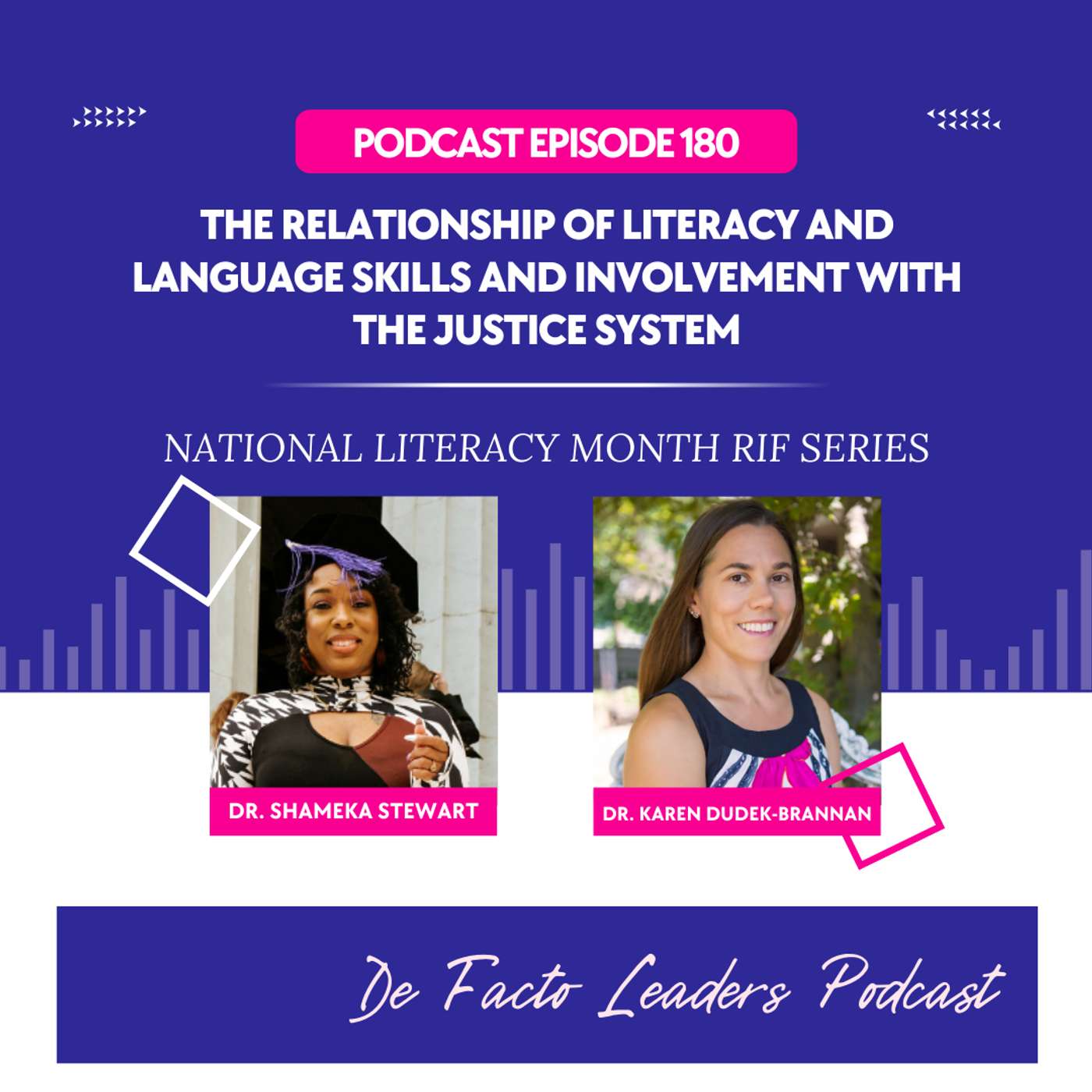
There is a disproportionate number of individuals with communication disorders and reading disabilities involved with the justice system for both children and adults.Past research suggests that more than 40% of incarcerated people have some type of nonpsychiatric disability (Berzofsky et al., 2015; Bixby et al., 2022; Thompson, 2022)Additionally, once youth are involved in the justice system, it becomes more difficult for them to access the education and therapeutic services they need. Both literacy and language skills will impact someone’s ability to comprehend employee or disciplinary handbooks, to read language in legal documents, fill out job applications, and or explain past events during job interviews, when interacting with school staff or with law enforcement. Many times things are written off as “behavior problems” when the real underlying issue could be tied to language, reading, or writing. That’s why I invited Dr. Shameka Stewart to episode 180 of the De Facto Leaders podcast). Dr. Shameka Stewart is an Associate Professor of Communication Sciences and Disorders and the Juvenile Forensic Speech-Language Pathologist(r). Dr. Stewart is also a special education advocate trained by the Wright's Law training center. Dr. Stewart’s clinical and scholarly work specializes in Juvenile Forensics, Law Enforcement Interaction with youth with CD, child language disorders, and augmentative and alternative communication (AAC). Her primary research focuses on the Confluence and Impact of cognitive and communication disorders on the school-to-confinement pipeline, status offenses, involvement with the criminal justice system, law enforcement interaction, and criminal recidivism in youth placed at-risk for delinquency and crime (especially Black and Brown youth from under-resourced areas). Dr. Stewart is also a clinically certified and licensed speech-language pathologist and is licensed to practice in Maryland, Washington, D.C., and multiple other states. Through her work, Dr. Stewart has created cutting edge social justice and juvenile justice specialty courses for graduate CSD students, nationally known training programs for law enforcement and legal counsel, and national and international CE workshops and training for licensed SLP clinicians, students, and families of children with special needs.This episode is part of the National Literacy Month series of podcasts, presented in partnership between the Be Podcast Network and Reading Is Fundamental (RIF).In this conversation, we discuss:✅The relationship between reading challenges and the school-to-confinement pipeline.✅Why “behavior problems” could be related to language processing, reading, or writing challenges.✅When youth become involved with the justice system, how do they get access to special education services (including language therapy)? ✅“They should know better”: Why we can’t assume kids comprehend language in the school discipline handbook. ✅A case for continuing direct language therapy in high school (and why therapists need support from school leaders in making this happen).You can connect with Dr. Stewart on her website here: www.juvforensicslp.comConnect with her on Instagram @drjuvenile_forensicslpJoin her Facebook group SLPs 4 Juvenile Justice here. References for this episode’s show notes:Berzofsky, M., Bronson, J., & Maruschak, L. L. (2015). Disabilities among prison and jail inmates, 2011–12. Washington, DC: U.S. Department of Justice, Office of Justice Programs, Bureau of Justice Statistics.Bixby, L., Bevan, S., & Boen, C. (2022). The link between disability, incarceration, and social exclusion. Heath Affairs, 41,10. doi: https://.doi.org/10.1377.hlthaff.2022.00495Thompson, E. (2022). Reading through the lines; The correlation between literacy and incarceration. Retrieved from: https://www.northcarolinahealthnews.org/2022/03/21/reading-through-the-lines-the-correlation-between-literacy-and-incarceration/In this episode, I mention the School of Clinical Leadership, my program that helps related service providers develop a strategic plan for putting executive functioning support in place in collaboration with their school teams. You can learn more about that program here. In this episode, I mention Language Therapy Advance Foundations, my program that helps SLPs create a system for language therapy. You can learn more about Language Therapy Advance Foundations here. You can get 25% off either program when you join between September 15-October 15. Just enter coupon code RIF25 on the checkout page to get this special rate. *If you’re already a member of either program and you refer a friend, tell them to email me at [email protected] if they join and let me know you referred them and I’ll send you a $100 referral bonus. Here’s what you can do right now to support this campaign and ensure you don’t miss any of these amazing interviews/commentary. Go to Apple, Spotify, or any other directory you use for podcasts and subscribe to the De Facto Leaders podcast.Once you listen to an episode or two, leave me a rating and review. This helps get my show into the hands of people who need the information.Do you have a colleague or friend who needs to learn more about the research surrounding language and literacy? Do you want to spread the word about practices and ideas you’d like to see in your school, community, or state? If so, tell them about the De Facto Leaders podcast so they can listen to all the episodes in this special campaign. Reading Is Fundamental is a nonprofit that focuses on connecting educators and families with materials and training aligned with evidence-based literacy instruction. Not only is their model aligned with the science of reading; they also offer unique book ownership solutions for professionals and families to address book equity issues. You can learn more about Reading Is Fundamental here.&n...
What this episode covers
There is a disproportionate number of individuals with communication disorders and reading disabilities involved with the justice system for both children and adults.Past research suggests that more than 40% of incarcerated people have some type of nonpsychiatric disability (Berzofsky et al., 2015; Bixby et al., 2022; Thompson, 2022)Additionally, once youth are involved in the justice system, it becomes more difficult for them to access the education and therapeutic services they need. Both literacy and language skills will impact someone’s ability to comprehend employee or disciplinary handbooks, to read language in legal documents, fill out job applications, and or explain past events during job interviews, when interacting with school staff or with law enforcement. Many times things are written off as “behavior problems” when the real underlying issue could be tied to language, reading, or writing. That’s why I invited Dr. Shameka Stewart to episode 180 of the De Facto Leaders podcast). Dr. Shameka Stewart is an Associate Professor of Communication Sciences and Disorders and the Juvenile Forensic Speech-Language Pathologist(r). Dr. Stewart is also a special education advocate trained by the Wright's Law training center. Dr. Stewart’s clinical and scholarly work specializes in Juvenile Forensics, Law Enforcement Interaction with youth with CD, child language disorders, and augmentative and alternative communication (AAC). Her primary research focuses on the Confluence and Impact of cognitive and communication disorders on the school-to-confinement pipeline, status offenses, involvement with the criminal justice system, law enforcement interaction, and criminal recidivism in youth placed at-risk for delinquency and crime (especially Black and Brown youth from under-resourced areas). Dr. Stewart is also a clinically certified and licensed speech-language pathologist and is licensed to practice in Maryland, Washington, D.C., and multiple other states. Through her work, Dr. Stewart has created cutting edge social justice and juvenile justice specialty courses for graduate CSD students, nationally known training programs for law enforcement and legal counsel, and national and international CE workshops and training for licensed SLP clinicians, students, and families of children with special needs.This episode is part of the National Literacy Month series of podcasts, presented in partnership between the Be Podcast Network and Reading Is Fundamental (RIF).In this conversation, we discuss:✅The relationship between reading challenges and the school-to-confinement pipeline.✅Why “behavior problems” could be related to language processing, reading, or writing challenges.✅When youth become involved with the justice system, how do they get access to special education services (including language therapy)? ✅“They should know better”: Why we can’t assume kids comprehend language in the school discipline handbook. ✅A case for continuing direct language therapy in high school (and why therapists need support from school leaders in making this happen).You can connect with Dr. Stewart on her website here: www.juvforensicslp.comConnect with her on Instagram @drjuvenile_forensicslpJoin her Facebook group SLPs 4 Juvenile Justice here. References for this episode’s show notes:Berzofsky, M., Bronson, J., & Maruschak, L. L. (2015). Disabilities among prison and jail inmates, 2011–12. Washington, DC: U.S. Department of Justice, Office of Justice Programs, Bureau of Justice Statistics.Bixby, L., Bevan, S., & Boen, C. (2022). The link between disability, incarceration, and social exclusion. Heath Affairs, 41,10. doi: https://.doi.org/10.1377.hlthaff.2022.00495Thompson, E. (2022). Reading through the lines; The correlation between literacy and incarceration. Retrieved from: https://www.northcarolinahealthnews.org/2022/03/21/reading-through-the-lines-the-correlation-between-literacy-and-incarceration/In this episode, I mention the School of Clinical Leadership, my program that helps related service providers develop a strategic plan for putting executive functioning support in place in collaboration with their school teams. You can learn more about that program here. In this episode, I mention Language Therapy Advance Foundations, my program that helps SLPs create a system for language therapy. You can learn more about Language Therapy Advance Foundations here. You can get 25% off either program when you join between September 15-October 15. Just enter coupon code RIF25 on the checkout page to get this special rate. *If you’re already a member of either program and you refer a friend, tell them to email me at [email protected] if they join and let me know you referred them and I’ll send you a $100 referral bonus. Here’s what you can do right now to support this campaign and ensure you don’t miss any of these amazing interviews/commentary. Go to Apple, Spotify, or any other directory you use for podcasts and subscribe to the De Facto Leaders podcast.Once you listen to an episode or two, leave me a rating and review. This helps get my show into the hands of people who need the information.Do you have a colleague or friend who needs to learn more about the research surrounding language and literacy? Do you want to spread the word about practices and ideas you’d like to see in your school, community, or state? If so, tell them about the De Facto Leaders podcast so they can listen to all the episodes in this special campaign. Reading Is Fundamental is a nonprofit that focuses on connecting educators and families with materials and training aligned with evidence-based literacy instruction. Not only is their model aligned with the science of reading; they also offer unique book ownership solutions for professionals and families to address book equity issues. You can learn more about Reading Is Fundamental here.&n...
NOW PLAYING
The relationship of literacy and language skills and involvement with the justice system (with Dr. Shameka Stewart)
No transcript for this episode yet
Similar Episodes
No similar episodes found.