
EPISODE · Jan 5, 2026 · 10 MIN
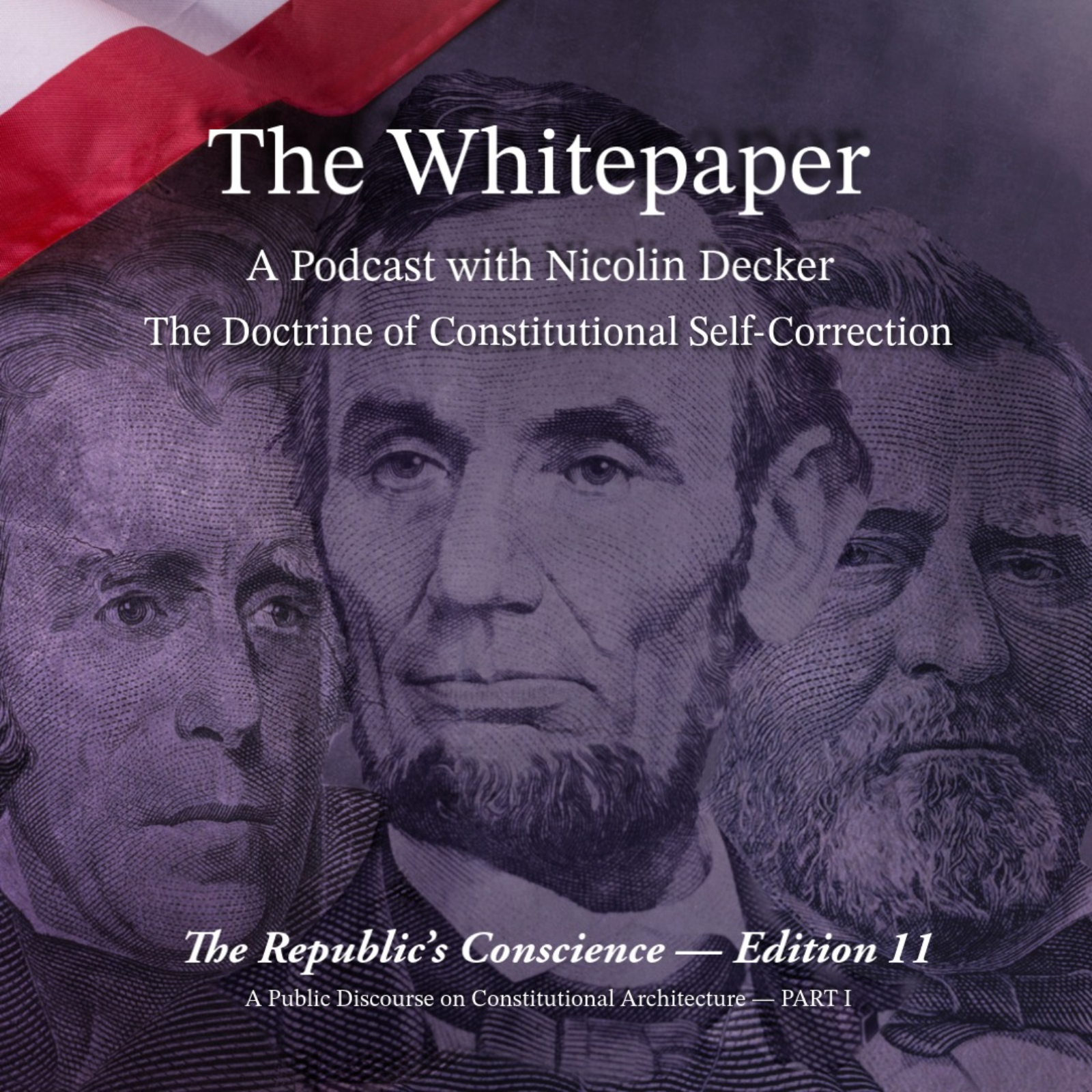
The Republic's Conscience — Edition 11. Part I.: The Doctrine of Constitutional Self-Correction
from The Whitepaper
In this opening episode of The Doctrine of Constitutional Self-Correction, Nicolin Decker begins a ten-day public series examining how the United States Constitution actually functions under pressure—and why it is so often misunderstood in modern political discourse.Day One introduces a central corrective insight: the American Republic is not failing because it cannot move quickly, agree easily, or resolve cleanly. It is being misjudged by expectations foreign to its design. The Constitution was not engineered as a machine for immediate preference fulfillment. It was architected as a durable system for carrying disagreement, restraining power, and preserving legitimacy across time.Rather than defending any policy, party, or institution, this episode reframes common public frustrations by explaining how delay, conflict, and visible disagreement are not signs of democratic decay, but core operating features of a self-correcting constitutional order. When evaluated through the wrong model—speed, efficiency, and outcome optimization—the system appears broken. When evaluated on its own terms, it reveals deliberate structure and resilience.🔹 Core PremiseDemocratic governance in the United States is not designed to aggregate preferences into instant outcomes. It is designed to process public signal through representation, deliberation, and time.🔹 Key Clarifications• Why modern political culture mistakes speed for health • Why disagreement often signals constitutional load-bearing, not failure • Why elections function as signals of public condition, not instruments of possession • Why restraint and delay preserve legitimacy rather than negate responsiveness🔹 Why This MattersWhen the Constitution is expected to behave like a machine, frustration becomes inevitable. When it is understood as an architecture designed for endurance, clarity replaces cynicism—and disagreement becomes intelligible rather than alarming.This episode sets the foundation for the series. Day Two will examine the Constitution as a living system: how fixed rules adapt to changing human conditions without rewriting themselves, and how endurance depends on architecture rather than speed.Closing ReflectionThe Constitution does not promise comfort. It promises continuity.And sometimes, the most responsible thing a system can do is slow down long enough to listen.Read Chapter §I. The Republic Misunderstood.📄 The Doctrine of Constitutional Self-Correction: The Republic as Signal [Click Here]This is The Republic's Conscience. And this is the Doctrine of Constitutional Self-Correction.
NOW PLAYING
The Republic's Conscience — Edition 11. Part I.: The Doctrine of Constitutional Self-Correction
No transcript for this episode yet
Similar Episodes
Mar 26, 2026 ·1m
Mar 19, 2026 ·34m
Feb 18, 2026 ·11m
Feb 11, 2026 ·45m