
EPISODE · Jan 11, 2026 · 8 MIN
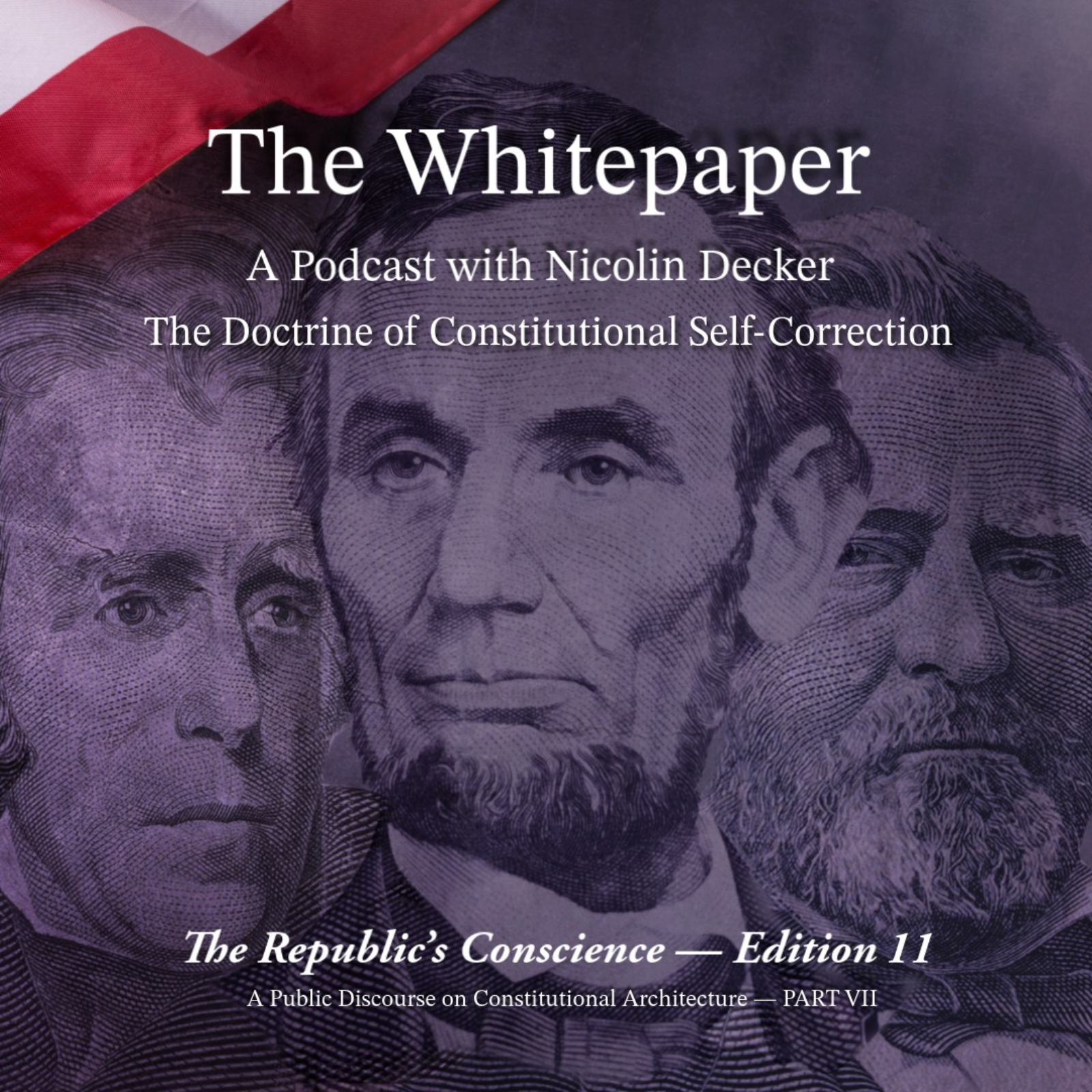
The Republic's Conscience — Edition 11. Part VII.: The Doctrine of Constitutional Self-Correction
from The Whitepaper
In this Republic’s Conscience edition of The Whitepaper, Nicolin Decker presents §VII. Formal Modeling of Constitutional Signaling—the central analytical framework of The Doctrine of Constitutional Self-Correction.This chapter moves the doctrine from descriptive theory to formal structure, modeling the U.S. Constitution not as a command hierarchy or episodic political reactor, but as a sequenced signaling and enforcement system operating across time, institutions, and legal thresholds.Rather than predicting outcomes or optimizing governance, §VII clarifies when constitutional authority is invited, how it is earned, and why it is sometimes withdrawn by rule.🔹 Core ThesisThe Constitution governs through ordered sequencing—not immediacy.Democratic stress is diagnostic, not dispositive. Authority arises only after signal has been detected, processed, tested, and lawfully authorized—or else withheld through compulsory restraint.🔹 What This Section Does• Distinguishes constitutional stress from constitutional compulsion • Introduces Constitutional Stress Indicators (CSI) and Constitutional Compulsion Indicators (CCI) as separate analytical layers • Models how civic pressure moves from detection to deliberation, alignment, restraint, or cessation • Clarifies why delay, division, and shutdowns are lawful outputs—not failures • Integrates voters, Congress, appropriations law, and compulsory cessation into a single coherent system🔹 Key Concepts IntroducedConstitutional Stress Indicators (CSI) Ambient diagnostic signals—elections, dissent, volatility, disagreement—that invite response but do not mandate action.Constitutional Compulsion Indicators (CCI) Rule-bound legal triggers—such as failed appropriations under Article I, Section 9—that withdraw discretion and mandate obedience regardless of political pressure.Together, CSI and CCI explain why the Constitution can tolerate immense stress without acting—yet insist on stopping entirely when authorization fails.🔹 Why This MattersModern constitutional conflict often collapses critical distinctions: • Stress is mistaken for mandate • Elections are misread as instructions • Delay is framed as dysfunction • Cessation is labeled failureFormal Modeling replaces accusation with diagnosis.By restoring proper sequencing—stress, signal, deliberation, authorization, compulsion—§VII provides courts, scholars, policymakers, and the public with a disciplined vocabulary for evaluating constitutional behavior without resorting to partisan motive analysis.🔻 What This Section Is Not• Not a reform proposal • Not a predictive algorithm • Not a justification for acceleration • Not a defense of paralysisIt is a structural map—showing how a free people govern themselves without surrendering legitimacy to urgency.🔻 Closing InsightThe Constitution does not fail when it delays. It fails only when it accelerates without legitimacy—or continues without authorization.Formal modeling does not mechanize the Republic. It reveals why restraint, sequencing, and obedience are the conditions of endurance.Read §VII. Formal Modeling of Constitutional Signaling in The Doctrine of Constitutional Self-Correction.📄 The Doctrine of Constitutional Self-Correction: The Republic as Signal [Click Here]This is The Republic's Conscience.And this is the Doctrine of Constitutional Self-Correction.
NOW PLAYING
The Republic's Conscience — Edition 11. Part VII.: The Doctrine of Constitutional Self-Correction
No transcript for this episode yet
Similar Episodes
Mar 26, 2026 ·1m
Mar 19, 2026 ·34m
Feb 18, 2026 ·11m
Feb 11, 2026 ·45m