
EPISODE · Jan 12, 2026 · 6 MIN
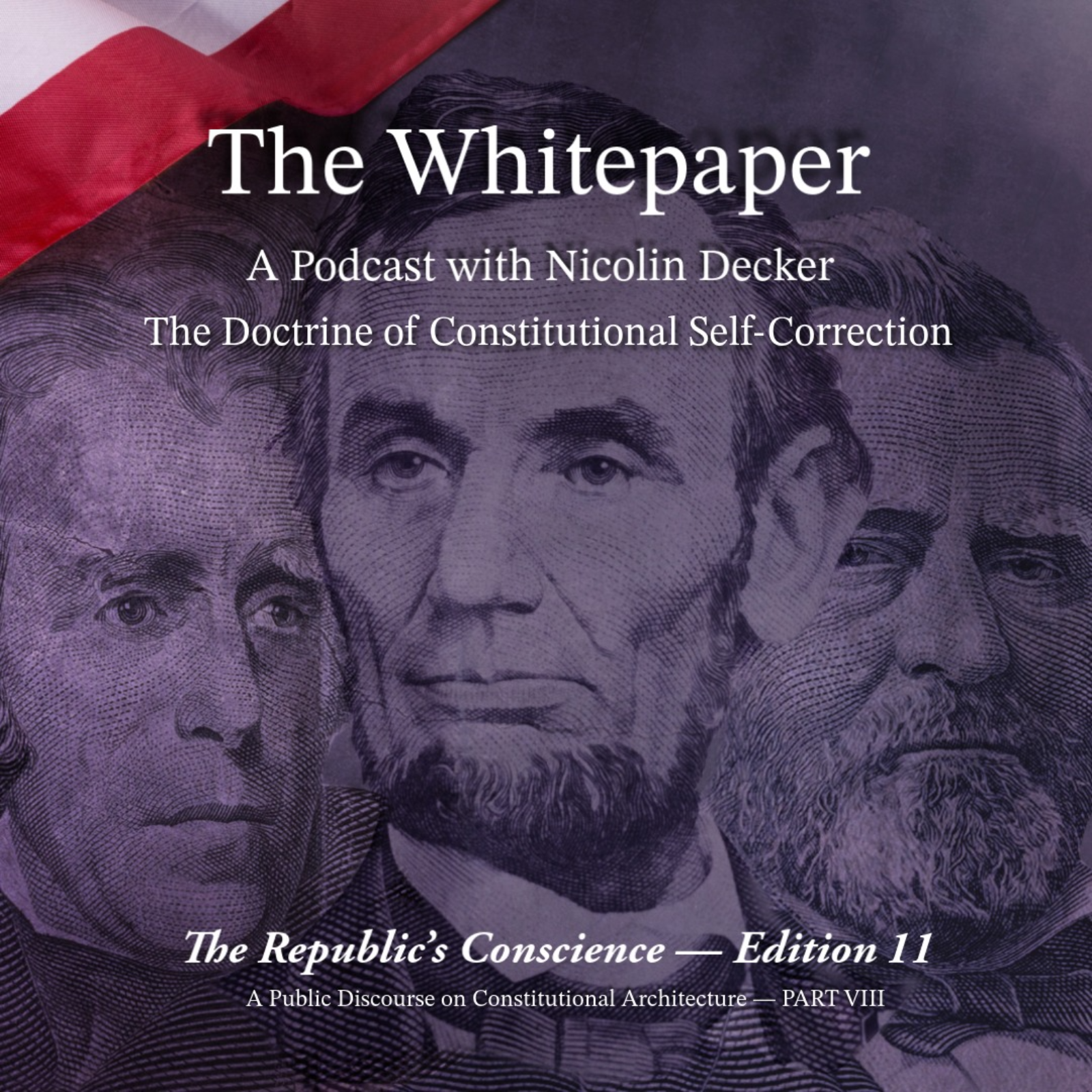
The Republic's Conscience — Edition 11. Part VIII.: The Doctrine of Constitutional Self-Correction
from The Whitepaper
In this Republic’s Conscience edition of The Whitepaper, Nicolin Decker presents §VIII. Fidelity vs. Performance, a critical examination of how modern governance has come to misjudge constitutional legitimacy.This chapter addresses a growing category error in democratic culture: the substitution of visible performance—speed, efficiency, and output—for constitutional fidelity. In an age that praises decisiveness and condemns delay, institutions are increasingly evaluated by whether they appear to be “doing something,” rather than by whether they are acting within lawful bounds. The Constitution, Decker argues, was never designed to perform. It was designed to endure.🔹 Core ThesisLegitimacy in a constitutional system does not arise from outcomes achieved, but from authority exercised within prescribed limits. Performance may feel responsible, but only fidelity confers lawful power.🔹 What This Section Examines• How “output legitimacy” distorts constitutional judgment • Why efficiency and coordination do not equal authorization • The danger of rewarding motion over process • Congress’s true dignity as a bearer of democratic pressure, not an outcome factory • How courts, media, and civic expectations misinterpret restraint as failure • Why endurance, not immediacy, preserves legitimacy across generations🔹 Key Insight IntroducedFidelity vs. Performance A structural distinction between governance that acts quickly and governance that acts lawfully. The Constitution privileges restraint, delay, and process over visible success—especially in moments of urgency.🔹 Why This MattersWhen performance becomes the measure of legitimacy: • Constitutional time collapses • Shortcuts normalize • Authority accelerates beyond consent • Trust erodes across administrationsFidelity resists this erosion by accepting inefficiency where efficiency would corrupt authorization.🔻 What This Section Is Not• Not a call for paralysis • Not an argument against action • Not a defense of inefficiency for its own sakeIt is a constitutional clarification: power is legitimate not because it works, but because it remains bounded, disciplined, and worthy of endurance.🔻 Closing InsightThe Constitution does not ask institutions to perform. It asks them to remain faithful—especially when performance would be easier.Read §VIII. Fidelity vs. Performance in The Doctrine of Constitutional Self-Correction.📄 The Doctrine of Constitutional Self-Correction: The Republic as Signal [Click Here]This is The Republic's Conscience.And this is the Doctrine of Constitutional Self-Correction.
NOW PLAYING
The Republic's Conscience — Edition 11. Part VIII.: The Doctrine of Constitutional Self-Correction
No transcript for this episode yet
Similar Episodes
Mar 26, 2026 ·1m
Mar 19, 2026 ·34m
Feb 18, 2026 ·11m
Feb 11, 2026 ·45m