
EPISODE · Feb 9, 2026 · 7 MIN
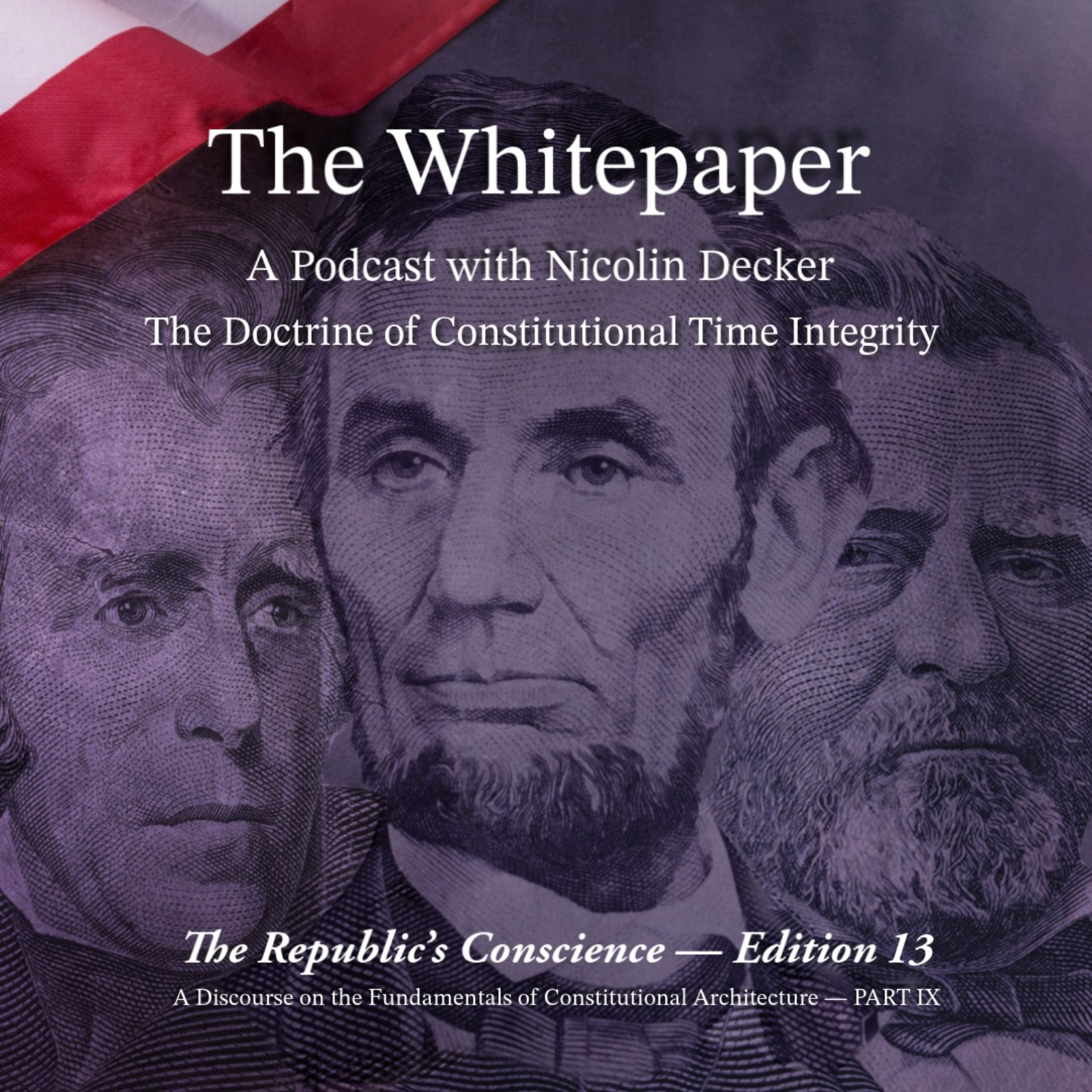
The Republic's Conscience — Edition 13. Part IX.: The Doctrine of Constitutional Time Integrity
from The Whitepaper
In Day Nine of The Doctrine of Constitutional Time Integrity, Nicolin Decker brings the doctrine to its interpretive conclusion by clarifying a central claim: the crisis facing modern democratic governance is not constitutional insufficiency, but constitutional misreading. The Constitution has not failed to keep pace with modern life. Rather, modern evaluation has abandoned the criteria by which the Constitution was designed to be judged.This episode reframes contemporary frustration with democratic institutions as a problem of interpretation, not architecture. Speed, simultaneity, amplification, and urgency have reshaped public expectation—but they have not rendered constitutional design obsolete. What appears as dysfunction is often the Constitution performing exactly as intended: transforming democratic pressure into lawful authority through time, not immediacy.Day Nine advances a doctrine of preservation rather than reform. It rejects the premise that constitutional durability requires amendment, redesign, or structural supplementation. Instead, it restores clarity around mechanisms already embedded in the Constitution—bicameralism, staggered elections, deliberative sequence, and judicial finality—each serving as a temporal safeguard against premature consolidation of power.🔹 Core Insight The Constitution does not need to be fixed. It needs to be understood.🔹 Key Themes• No Amendments Required Why delay, friction, and sequence are not gaps in constitutional design, but deliberate safeguards against haste—and why adding what already exists risks compounding misunderstanding.• Cultural Misalignment vs. Institutional Failure How modern impatience has replaced endurance as the metric of legitimacy, leading lawful restraint to be misdiagnosed as dysfunction.• Interpretive Recovery, Not Redesign Why constitutional confidence is restored by recalibrating how institutions are evaluated—measuring survivability rather than speed.• Time as a Democratic Safeguard How refusing to rush—without refusing to act—protects liberty, preserves correction capacity, and allows authority to endure.• Preservation as Constitutional Confidence Why this doctrine does not defend inertia or excuse inaction, but affirms that the Constitution remains sufficient because it still knows when not to move quickly.🔹 Why It Matters Day Nine resolves the doctrine’s central tension: democracy does not fail because it slows down; it fails when it confuses immediacy with legitimacy. By restoring the proper interpretive lens, this episode shows that constitutional endurance is not accidental—it is designed.🔻 What This Episode Is Not Not a call for constitutional amendment Not an argument for institutional stagnation Not a rejection of modern democratic urgencyIt is a reaffirmation that the Constitution governs modern democracy not by accelerating authority, but by insisting that authority earn the right to bind.🔻 Looking Ahead Day Ten concludes the series with a formal Congressional Briefing—synthesizing the entire doctrine into a structural orientation for lawmakers, jurists, and institutional stewards tasked with governing under conditions of acceleration without surrendering constitutional legitimacy.Read Chapter IX — A Doctrine of Preservation, Not Reform [Click Here]This is The Doctrine of Constitutional Time Integrity.And this is The Republic’s Conscience.
NOW PLAYING
The Republic's Conscience — Edition 13. Part IX.: The Doctrine of Constitutional Time Integrity
No transcript for this episode yet
Similar Episodes
Mar 26, 2026 ·1m
Mar 19, 2026 ·34m
Feb 18, 2026 ·11m
Feb 11, 2026 ·45m