
EPISODE · Apr 10, 2026 · 8 MIN
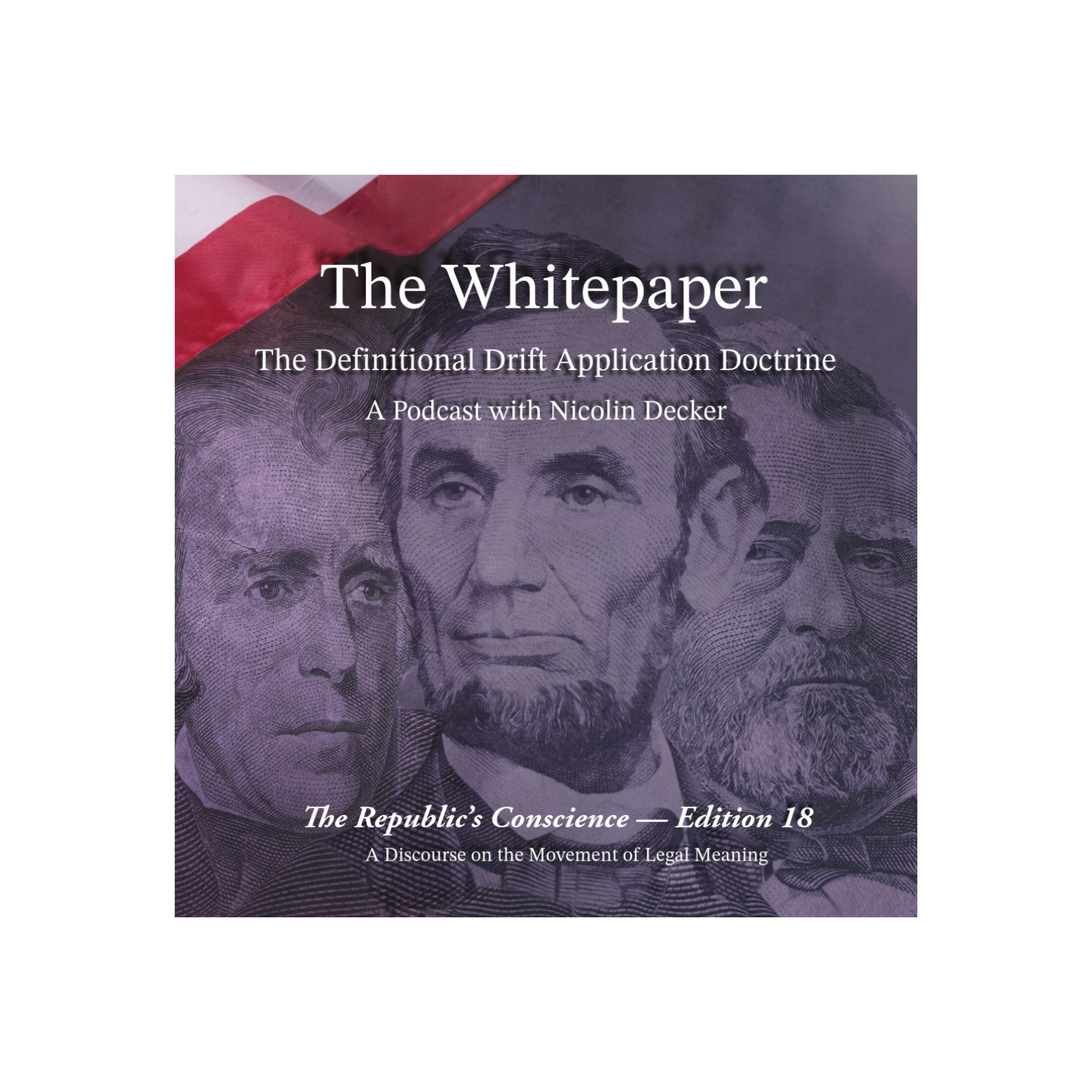
The Republic's Conscience — Edition 18: The Definitional Drift Application Doctrine — Part I.
from The Whitepaper
In this special edition of The Republic’s Conscience, Nicolin Decker presents The Definitional Drift Application Doctrine (DDAD)—a system-level framework explaining how legal meaning evolves through application even when constitutional and statutory text remains unchanged.This episode introduces the central premise of the doctrine: that stability in legal language does not guarantee stability in legal meaning. While the text of law endures, its operational meaning develops through repeated application across institutions operating within an evolving interpretive environment. This movement is not the result of institutional failure or deliberate reinterpretation, but emerges through lawful processes embedded within representative governance.From this foundation, the episode establishes the core problem addressed by DDAD: the absence of a unified framework capable of explaining how meaning shifts without textual amendment. In response, the doctrine introduces the concept of the application layer—the domain in which legal text is operationalized within a dynamic system shaped by public perception, electoral selection, institutional context, and time.🔹 Core Insight Legal meaning may evolve through application—even when the words themselves remain unchanged.🔹 Key Themes• Stability vs. Movement Why enduring legal text can coexist with changing legal outcomes.• The Doctrinal Gap The absence of a system-level framework explaining semantic evolution without formal amendment.• The Application Layer Where law becomes operational, and where meaning is formed through use rather than text alone.• Interpretive Environment How institutional, cultural, and temporal conditions shape the application of legal language.• Law as Written vs. Law as Applied The structural distinction between formal authority and lived legal experience.• Naming the System Why identifying definitional drift clarifies an existing structure rather than creating a new one.🔹 Why It Matters Modern legal systems are often evaluated through the assumption that stability in text ensures stability in meaning. DDAD challenges this assumption—not by questioning the legitimacy of law, but by revealing how meaning evolves within it. By providing a vocabulary for this process, the doctrine allows institutions and citizens alike to better understand how legal outcomes develop across time without formal change, preserving both continuity and clarity within constitutional governance.🔻 What This Episode Is NotNot a critique of the Constitution. Not a theory of judicial activism. Not a claim of institutional failure.It is a structural clarification of how legal meaning evolves within a system designed for continuity.🔻 Looking AheadIn Day 2, the doctrine moves from introduction to definition—establishing the core components of the system, including definitional drift, the application layer, the interpretive environment, and public perception. These elements form the foundation for understanding how meaning moves within law through structured, repeatable processes.Read: The Definitional Drift Application Doctrine (DDAD) [Click Here]This is The Definitional Drift Application Doctrine. And this is The Republic’s Conscience.
NOW PLAYING
The Republic's Conscience — Edition 18: The Definitional Drift Application Doctrine — Part I.
No transcript for this episode yet
Similar Episodes
Mar 26, 2026 ·1m
Mar 19, 2026 ·34m
Feb 18, 2026 ·11m
Feb 11, 2026 ·45m