
EPISODE · May 3, 2026 · 10 MIN
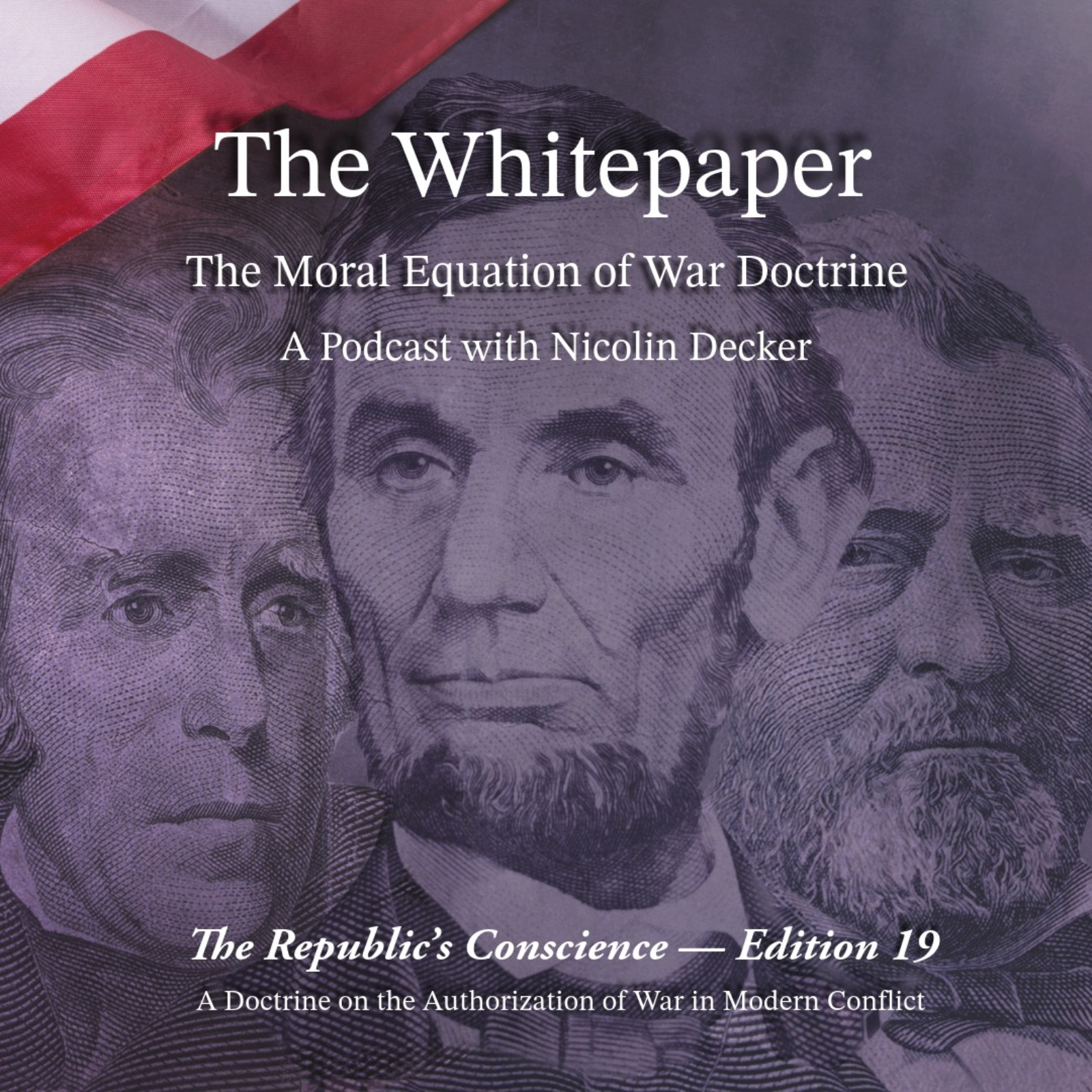
The Republic's Conscience — Edition 19: The Moral Equation of War Doctrine — Part IX.
from The Whitepaper
In this special edition of The Republic’s Conscience, Nicolin Decker advances The Moral Equation of War Doctrine by reframing national security—not as a measure of capability, but as a function of systemic coherence.This episode shifts focus from what a nation possesses—military strength, intelligence, and economic power—to how its constitutional system operates under pressure. National security is presented as an integrated architecture composed of constitutional authority, statutory authorization, fiscal structure, institutional coordination, and temporal sequencing.From this foundation, the doctrine introduces two critical conditions. The first, the Intelligence Bottleneck Condition (IBC), describes a state in which the velocity of information exceeds the capacity of institutions to interpret it. In this condition, the system does not fail—but slows. Decision cycles extend, coordination costs increase, and ambiguity rises, demonstrating that more intelligence does not necessarily produce better decisions.The second, the National Security Threshold (NS-T), defines a condition in which alignment requires increasing effort. The nation remains capable, but maneuverability declines as coordination becomes more complex. This threshold is not a moment, but an emergent state formed through sustained system interaction.The episode then examines the evolution of war authorization. What was once expressed through discrete declarations has transitioned into continuous frameworks. This shift—identified as Authorization Compression—increases responsiveness and flexibility, but reduces deliberative clarity and the visibility of national decision-making. Authorization becomes less an event and more a sustained condition.These dynamics converge into a unified pattern: continuous authorization, accelerated intelligence, compressed deliberation, fiscal coupling, and institutional coordination operating simultaneously. This is not failure, but structural transition—a lawful evolution of constitutional systems under modern complexity.🔹 Core Insight National security is not defined by strength alone—it is defined by the system’s ability to maintain coherence across time.🔹 Key Themes• National Security as a System Integrated constitutional architecture • Intelligence Bottleneck Condition (IBC) Information exceeds comprehension capacity • National Security Threshold (NS-T) Alignment requires increasing effort • Authorization Compression Shift to continuous authorization frameworks • Coherence vs Capability Strength without alignment reduces maneuverability • Structural Transition Modern security as evolving system condition🔹 Why It Matters Security depends not only on capability, but on whether institutions can sustain clarity, coordination, and alignment under complexity.🔻 What This Episode Is NotNot a critique of defense or intelligence institutions Not a claim of systemic failure Not a rejection of modern authorization frameworksIt is a structural analysis of national security under evolving conditions.🔻 Looking AheadIn Day 10, the doctrine moves from threshold to expression—examining how persistent power is interpreted when transitions are no longer discrete.Read: The Moral Equation of War Doctrine. [Click Here]This is The Moral Equation of War Doctrine. And this is The Republic’s Conscience.
NOW PLAYING
The Republic's Conscience — Edition 19: The Moral Equation of War Doctrine — Part IX.
No transcript for this episode yet
Similar Episodes
Mar 26, 2026 ·1m
Mar 19, 2026 ·34m
Feb 18, 2026 ·11m
Feb 11, 2026 ·45m