
EPISODE · Apr 20, 2026 · 13 MIN
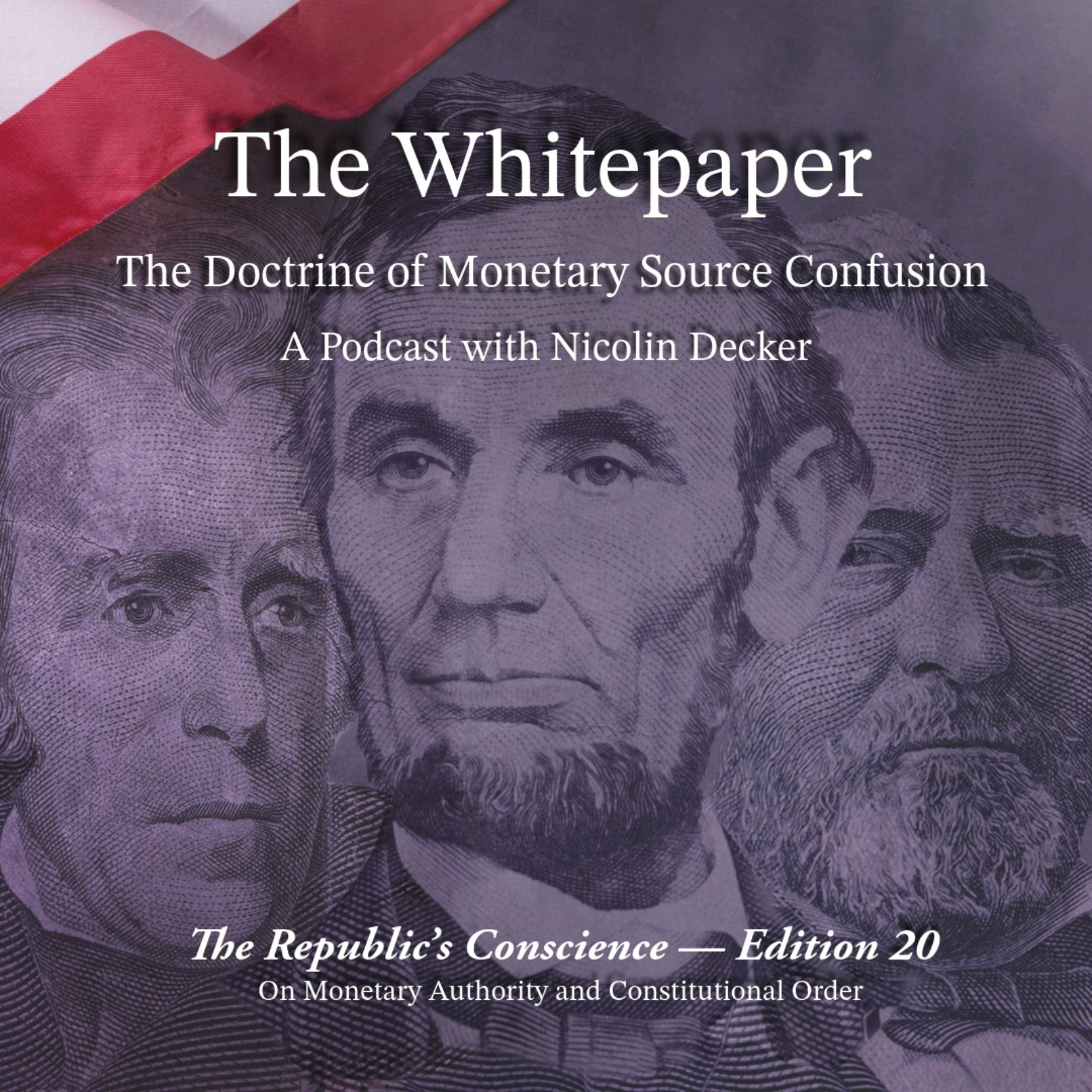
The Republic's Conscience — Edition 20 Preview: The Doctrine of Monetary Source Confusion (MSC)
from The Whitepaper
In this preview edition of The Republic’s Conscience, Nicolin Decker introduces The Doctrine of Monetary Source Confusion (MSC)—a constitutional framework examining the divergence between legal monetary authority and modern financial system experience.This episode establishes the conditions from which MSC emerges, beginning with the transformation of payment systems in the United States. As financial interaction has shifted from institution-centered processes to interface-driven environments, users increasingly engage with systems that are functionally indistinguishable at the point of use. Transactions appear uniform—regardless of whether they originate from sovereign monetary instruments, intermediary systems, or digital asset infrastructures.The episode clarifies that this convergence does not alter the legal structure of money. Within the constitutional framework, money remains defined by sovereign authority, anchored in Article I, and expressed through the legal tender doctrine as the mechanism by which obligations are conclusively discharged. Payment systems, by contrast, facilitate exchange but do not independently confer legal closure.From this foundation, the episode presents the central question: when does a payment system become indistinguishable from money? The answer lies not in legal transformation, but in perceptual convergence. As systems align in speed, reliability, and user experience, distinctions between payment and money become increasingly obscured—producing a condition in which systems are experienced as equivalent, despite remaining legally distinct.This condition is defined as Monetary Source Confusion (MSC): a likelihood-of-confusion threshold applied to monetary systems. It arises from the interaction between system design and user perception, where functional equivalence compresses distinctions that remain intact in law.🔹 Core Insight A system may function like money in practice—while remaining something entirely different in law.🔹 Key Themes • Payment vs. settlement • Interface convergence and perceptual compression • Money as sovereign authority • Functional equivalence vs. legal identity • Diagnostic—not prescriptive—framework🔹 Why It Matters As financial systems evolve toward seamless interfaces, the distinction between monetary authority and payment mechanisms becomes less visible. MSC provides a framework for identifying this divergence, preserving clarity in law and the integrity of obligation.🔻 What This Episode Is NotNot a critique of innovation Not a reclassification of monetary instruments Not a policy recommendationIt is a structural clarification of how financial systems are experienced within a constitutional framework.🔻 Looking AheadOn April 25, 2026, The Moral Equation of War Doctrine will be introduced.The full thirteen-day series on The Doctrine of Monetary Source Confusion begins May 8, 2026.Read: The Doctrine of Monetary Source Confusion (MSC) [Click Here]This is The Doctrine of Monetary Source Confusion.And this is The Republic’s Conscience.
NOW PLAYING
The Republic's Conscience — Edition 20 Preview: The Doctrine of Monetary Source Confusion (MSC)
No transcript for this episode yet
Similar Episodes
Mar 26, 2026 ·1m
Mar 19, 2026 ·34m
Feb 18, 2026 ·11m
Feb 11, 2026 ·45m