
EPISODE · May 8, 2026 · 17 MIN
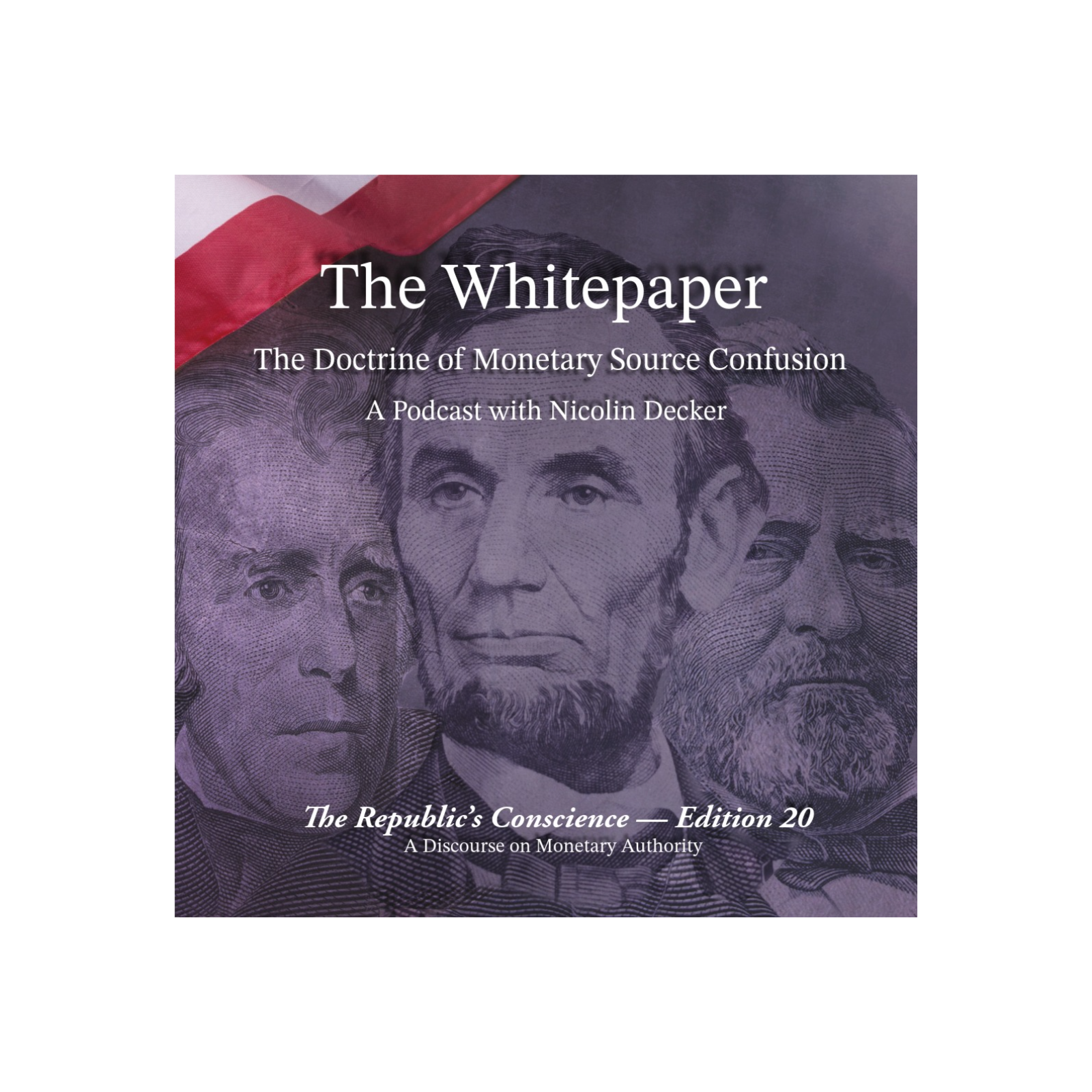
The Republic's Conscience — Edition 20: The Doctrine of Monetary Source Confusion — Part I.
from The Whitepaper
In this opening episode of The Republic’s Conscience — Edition 20: The Doctrine of Monetary Source Confusion (MSC), Nicolin Decker establishes a foundational condition within modern financial systems—one shaped not by changes in law, but by the evolution of structure.The episode demonstrates that while monetary systems in the United States remain legally distinct—defined by constitutional authority, statutory frameworks, and institutional structure—the way individuals encounter those systems has fundamentally shifted. Financial interaction has moved from institution-centered processes to interface-driven environments, where transactions occur through unified digital experiences.Across these systems—whether bank deposits, credit facilities, or digital asset platforms—the user experience has converged into a single pattern: select, confirm, complete. This convergence, driven by speed, accessibility, and abstraction, has created conditions in which distinct financial systems are no longer distinguishable at the point of use.From this observation, the doctrine introduces Monetary Source Confusion (MSC)—a threshold at which systems that remain distinct in law become indistinguishable in experience. This condition arises not from legal ambiguity, but from the evolution of system design, where improvements in efficiency obscure the underlying structure of monetary authority.The episode clarifies a critical distinction: money versus payment. In law, money represents authority—the capacity to discharge obligation—while payment systems function as mechanisms of transfer. Yet as modern systems converge in execution and interface, this distinction becomes less visible, producing perceptual equivalence across fundamentally different architectures.This introduces a structural tension. The legal definition of money remains stable, but the experiential understanding begins to diverge. Users increasingly rely on system performance—speed, reliability, and accessibility—as indicators of legitimacy, rather than the legal authority that defines it.From this divergence, the doctrine reframes the central question: when systems feel identical in use, what distinguishes them in law?The answer is not found in the interface—but in the structure beneath it.The episode does not resolve this tension—it defines it. By naming the condition of indistinguishability, the doctrine restores visibility to a boundary that remains legally intact but perceptually obscured.🔹 Core Insight Monetary systems remain distinct in law—but increasingly indistinguishable in experience.🔹 Key Themes• Interface Convergence — Standardized digital interaction • MSC Threshold — Legal distinction vs experiential equivalence • Money vs Payment — Authority vs transfer • Perceptual Compression — Efficiency obscures structure • Legal Stability vs Experiential Drift🔹 Why It MattersWhen perception replaces structure, risk emerges—not from failure, but from misalignment between legal reality and user interpretation.🔻 Series IntroductionWith Day 1, The Doctrine of Monetary Source Confusion begins—establishing the condition upon which the doctrine is built.Read: The Doctrine of Monetary Source Confusion (MSC) [Click Here]This is The Doctrine of Monetary Source Confusion.And this is The Republic’s Conscience.
NOW PLAYING
The Republic's Conscience — Edition 20: The Doctrine of Monetary Source Confusion — Part I.
No transcript for this episode yet
Similar Episodes
Mar 26, 2026 ·1m
Mar 19, 2026 ·34m
Feb 18, 2026 ·11m
Feb 11, 2026 ·45m