
EPISODE · May 18, 2026 · 14 MIN
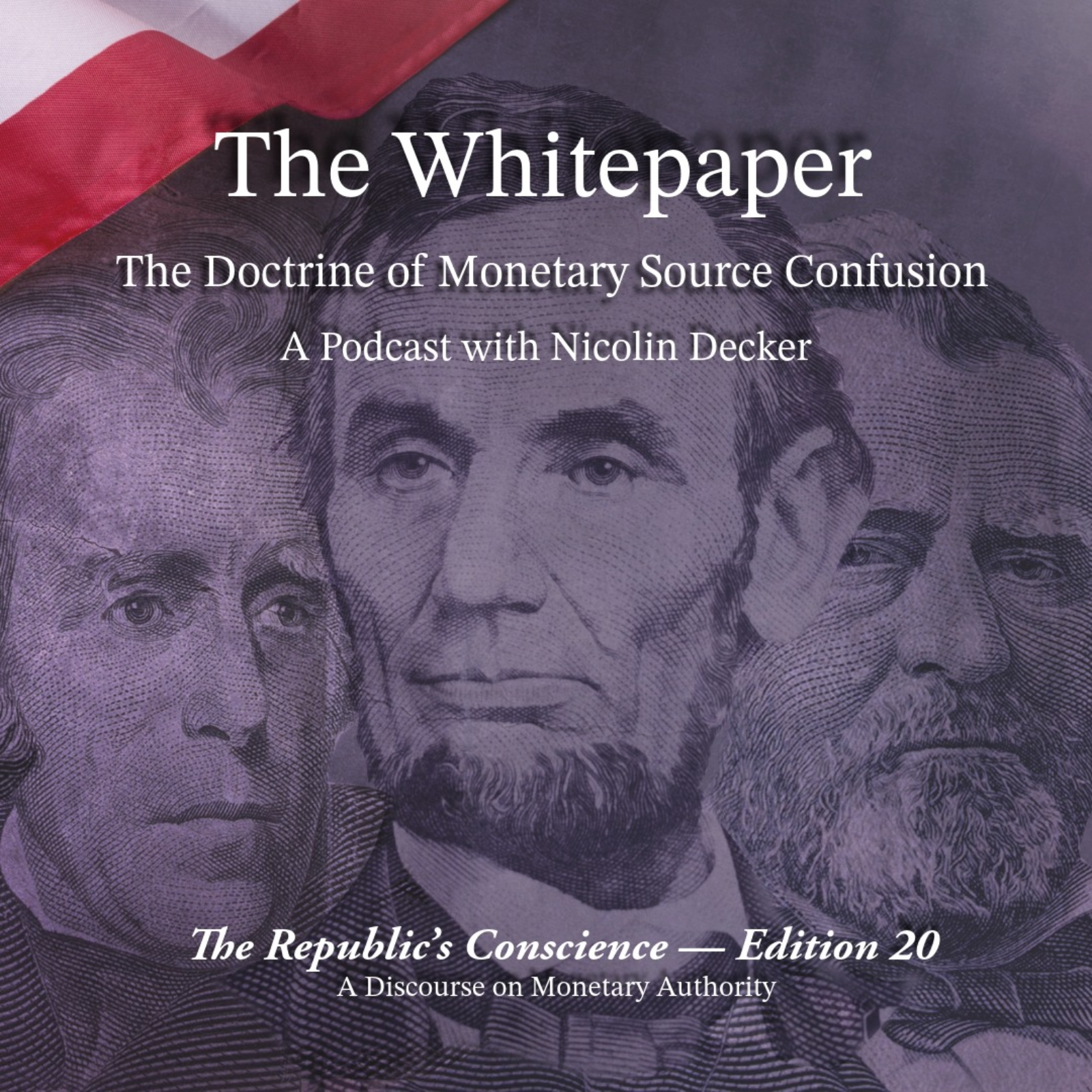
The Republic's Conscience — Edition 20: The Doctrine of Monetary Source Confusion — Part XI.
from The Whitepaper
In this eleventh edition of The Republic’s Conscience in The Doctrine of Monetary Source Confusion (MSC) series, Nicolin Decker advances the doctrine into governance—examining how financial systems are classified in law and why classification alone does not fully explain how those systems are experienced in practice.The episode establishes that the United States regulates financial systems through a classification-based framework. Assets are defined by legal identity—as securities, commodities, or payment instruments—and from those classifications jurisdiction and oversight are assigned. This structure prioritizes clarity, consistency, and enforceability.From this foundation, the episode identifies a central observation: the regulatory architecture determines what a system is in law, but not explicitly how it is experienced at the point of use. This reflects a boundary within the domain—classification determines identity, not perception.The episode then introduces Monetary Source Confusion as a supplemental analytical framework. MSC does not replace classification, alter jurisdiction, or prescribe outcomes. It operates as a diagnostic lens through which lawmakers, courts, and regulators may evaluate how systems are perceived and used in practice alongside their legal status.To support this analysis, the episode outlines a five-factor observational framework grounded in the reasonable economic actor standard: functional similarity, market substitution, consumer perception, settlement belief, and infrastructure integration. These factors do not create a legal test, but provide a structured method for recognizing when a system is treated as money in practice.From this, the episode clarifies a key distinction: classification, function, and perception are separate but interacting layers. Classification defines legal identity. Function defines operation. Perception defines user understanding. MSC emerges at the intersection of function and perception.The episode concludes with a governance insight: legal clarity at the level of classification does not eliminate convergence at the level of use. A system may be correctly classified and compliant in law, yet still be experienced as indistinguishable from money. In this way, MSC does not compete with legislative clarity—it complements it.🔹 Core Insight Monetary Source Confusion does not change what a system is in law—it reveals how that system is understood in practice.🔹 Key Themes• Classification-Based Governance — Legal identity and oversight • Perception Boundary — Experience beyond classification • MSC as Supplement — Diagnostic, not regulatory • Observational Framework — Recognition of monetary-like use • System Layers — Classification, function, perception • Legislative Relevance — Legal clarity does not eliminate convergence🔹 Why It MattersDay 11 shows that systems can be clearly defined in law while still being experienced as money in practice. This distinction matters because classification alone does not capture how systems are interpreted and relied upon by users.🔻 Series ContinuationWith Day 11, the doctrine completes its governance layer.Day 12 brings final synthesis—integrating classification, function, perception, authority, and closure into a single constitutional framework defining the boundary of money.Read: The Doctrine of Monetary Source Confusion [Read Here]This is The Doctrine of Monetary Source Confusion.And this is The Republic’s Conscience.
NOW PLAYING
The Republic's Conscience — Edition 20: The Doctrine of Monetary Source Confusion — Part XI.
No transcript for this episode yet
Similar Episodes
Mar 26, 2026 ·1m
Mar 19, 2026 ·34m
Feb 18, 2026 ·11m
Feb 11, 2026 ·45m