
EPISODE · Jun 13, 2026 · 16 MIN
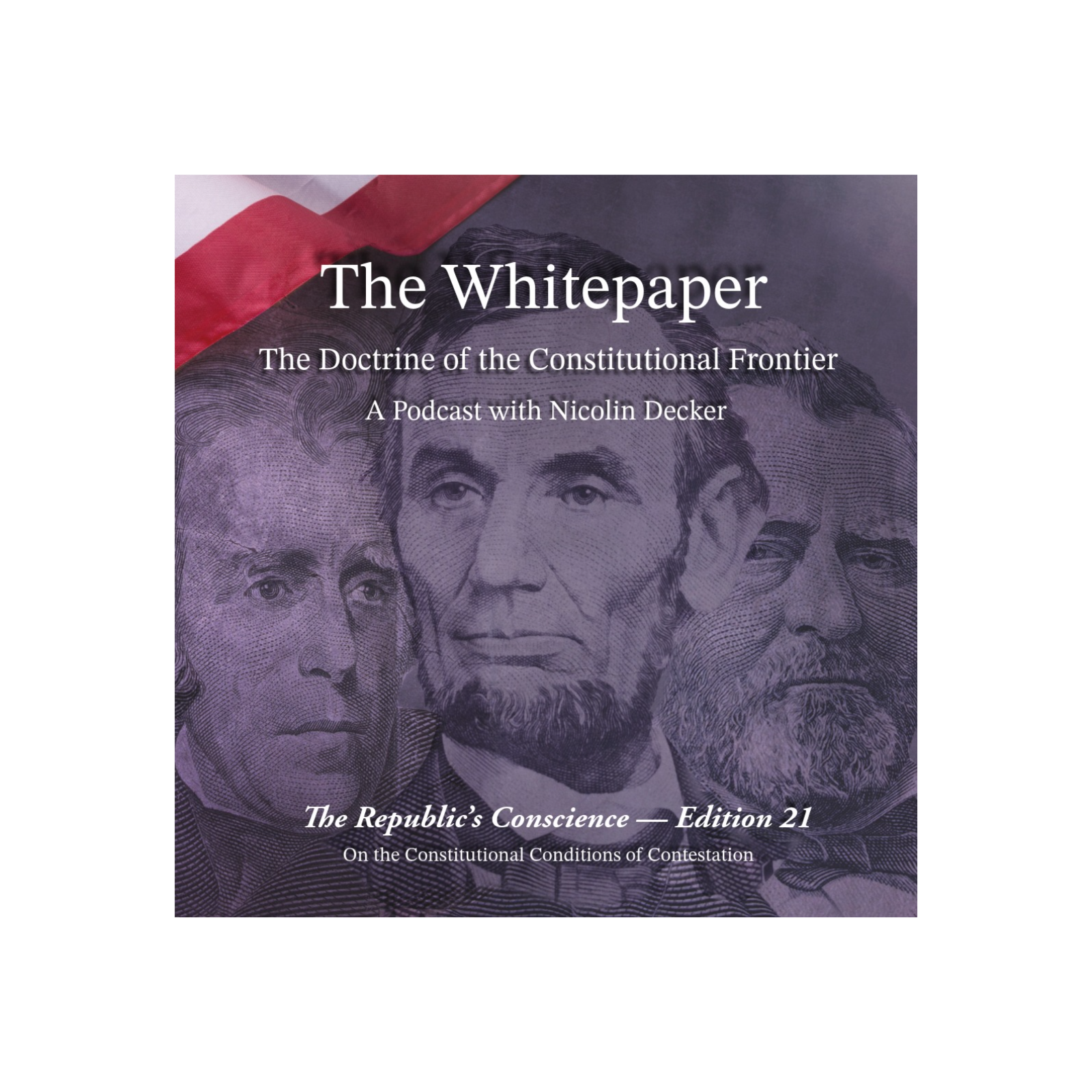
The Republic's Conscience — Edition 21: The Doctrine of the Constitutional Frontier — Part III.
from The Whitepaper
In this third edition of The Republic’s Conscience — Edition 21, within the 7-day The Constitutional Frontier series, Nicolin Decker advances the inquiry from empirical anomaly to structural explanation—introducing constitutional architecture as the governing variable underlying long-run system performance.Building on the divergence identified in Day 2, the episode shifts from observation to structure. It shows that differences in innovation, talent concentration, and adaptive capacity are not explained by material inputs alone, but by how systems organize the conditions under which ideas are generated, contested, and refined.Within this framework, constitutions are reconceptualized as condition-preserving systems rather than outcome-producing instruments. Their function is not to optimize performance, but to define the boundaries within which authority operates, information flows, and ideas are evaluated over time.A central distinction follows: constitutions do not guarantee correct outcomes—they preserve the capacity for correction. Through distributed authority, procedural constraint, and protected expression, they sustain continuous error detection and refinement.At the core of this structure is contestability—the sustained ability for ideas to be challenged, evaluated, and revised within institutional processes. Contestability maintains variation, enables error detection, and supports long-run adaptation.Innovation, in this context, is not a direct objective but an emergent consequence of preserved contestability. Systems that sustain these conditions generate continuous cycles of variation and refinement.The episode concludes by identifying constitutional architecture as the structural variable underlying the anomaly observed in Day 2: where contestability is preserved, systems retain adaptive capacity; where it is constrained, output may persist, but the capacity for correction gradually diminishes.🔹 Core Insight Constitutional systems do not produce innovation directly—they preserve the conditions under which ideas can be contested, corrected, and refined over time.🔹 Key Themes• Constitutional Variable — Structural conditions governing system performance • Architecture vs Outcomes — Conditions over outputs • Constraint Systems — Authority limitation and procedural structure • Contestability — Sustained capacity for challenge and revision • Error Correction — Continuous system refinement • Emergent Innovation — Output as consequence, not objective • Structural Differentiation — Why systems diverge under similar inputs🔹 Why It MattersDay 3 provides the structural explanation for the anomaly identified in Day 2, demonstrating that long-run system performance depends not on material advantage, but on the preservation of conditions that enable continuous correction and renewal.🔻 Series ContinuationThe Constitutional Frontier unfolds across seven days—progressing from reframed inquiry to empirical anomaly, then to constitutional mechanism, comparative validation, system-level diagnosis, and institutional synthesis—culminating in a framework for understanding how constitutional architecture governs long-run cognitive performance.Read: The Constitutional Frontier [Click Here]This is The Constitutional Frontier.And this is The Republic’s Conscience.
NOW PLAYING
The Republic's Conscience — Edition 21: The Doctrine of the Constitutional Frontier — Part III.
No transcript for this episode yet
Similar Episodes
Mar 26, 2026 ·1m
Mar 19, 2026 ·34m
Feb 18, 2026 ·11m
Feb 11, 2026 ·45m