
EPISODE · Jun 15, 2026 · 13 MIN
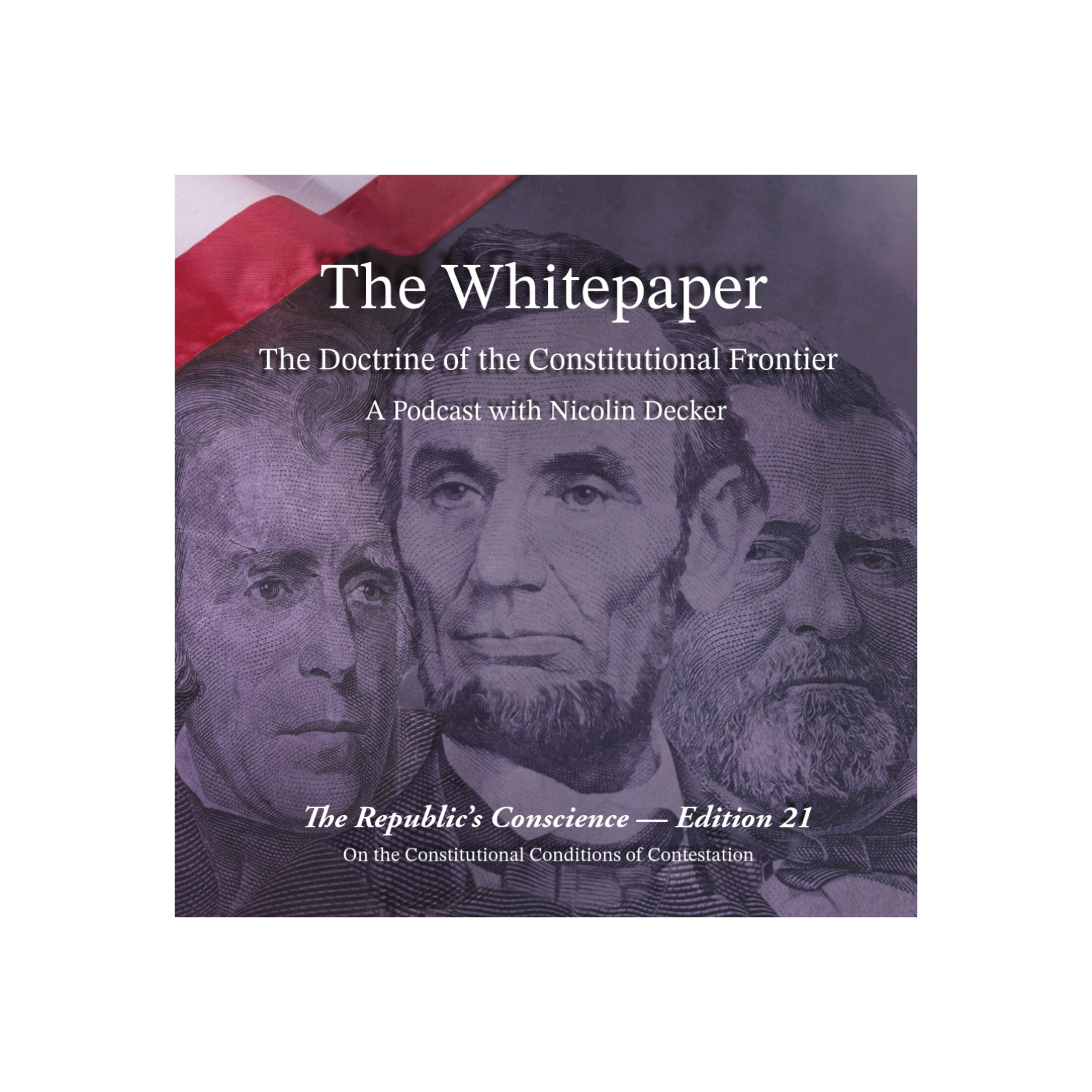
The Republic's Conscience — Edition 21: The Doctrine of the Constitutional Frontier — Part V.
from The Whitepaper
In this fifth edition of The Republic’s Conscience — Edition 21, within the 7-day The Constitutional Frontier series, Nicolin Decker advances the framework from comparative validation to system-level diagnosis—identifying the mechanisms through which institutional erosion occurs over time.Building on the validated constitutional variable established in Days 3 and 4, the episode introduces the concept of the “invisible frontier”—the internal boundary defined not by geography, but by the conditions under which systems preserve contestability and the capacity for correction.The analysis reframes decline not as a sudden event, but as a gradual process of misinterpretation. Observable outputs—such as stability, efficiency, and continued performance—may persist even as the underlying conditions that sustain adaptive capacity begin to weaken. This creates a temporal gap between structural degradation and visible consequence.The episode identifies informal erosion as the dominant mode of institutional degradation. Rather than occurring through formal constitutional change, erosion proceeds through the narrowing of permissible discourse, the substitution of consensus for contestation, and the distortion of incentives within bureaucratic and institutional structures.These dynamics reduce the range of survivable dissent, impair information aggregation, and constrain error detection. As contestability declines, systems may maintain output but lose the ability to identify and correct underlying error, increasing long-run fragility.The analysis further highlights the role of over-optimization and procedural compression, where speed, efficiency, and throughput are prioritized at the expense of deliberation and adversarial evaluation. While these conditions may improve short-term performance, they reduce the system’s capacity for renewal.The episode concludes by identifying the central risk: not the immediate loss of capacity, but the erosion of the conditions under which capacity can be exercised, challenged, and corrected. When contestability is constrained, systems do not fail instantly—they lose the ability to adapt.🔹 Core Insight Institutional decline occurs not through sudden failure, but through the gradual erosion of contestability and the system’s capacity for error correction.🔹 Key Themes• Invisible Frontier — Internal boundary of system performance • Informal Erosion — Gradual, non-formal degradation • Misinterpretation Risk — Outputs masking structural decline • Narrowing Discourse — Reduced survivability of dissent • Incentive Distortion — Bureaucratic and institutional effects • Over-Optimization — Speed vs deliberation tradeoff • Adaptive Fragility — Loss of correction capacity🔹 Why It MattersDay 5 identifies how structurally sound systems can begin to degrade without immediate visibility, demonstrating that long-run risk emerges when the conditions for contestability and correction are gradually constrained.🔻 Series ContinuationThe Constitutional Frontier unfolds across seven days—progressing from reframed inquiry to empirical anomaly, structural explanation, comparative validation, system diagnosis, and institutional synthesis—culminating in a framework for understanding how constitutional architecture governs long-run cognitive performance.Read: The Constitutional Frontier [Click Here]This is The Constitutional Frontier.And this is The Republic’s Conscience.
NOW PLAYING
The Republic's Conscience — Edition 21: The Doctrine of the Constitutional Frontier — Part V.
No transcript for this episode yet
Similar Episodes
Mar 26, 2026 ·1m
Mar 19, 2026 ·34m
Feb 18, 2026 ·11m
Feb 11, 2026 ·45m